

For decades, V8 muscle cars were built with one goal in mind: straight-line speed. Comfort, tech, and practicality usually came second. But times have changed.
Modern muscle cars now blend old-school power with everyday usability, think heated seats, adaptive suspension, Apple CarPlay, advanced safety systems, and surprisingly reasonable ride quality.
For U.S. drivers who want thunder under the hood and something livable Monday through Friday, today’s V8 offerings are better than ever.
Whether you’re commuting, running errands, or heading out on weekend road trips, these cars prove you don’t have to give up comfort just to enjoy eight cylinders of American (and international) performance.
Here are 10 V8 muscle cars that strike the rare balance between raw power and daily-drive comfort.
1. Dodge Challenger R/T
If comfort is your top priority, the Challenger R/T might be the most relaxed muscle car on this list.
Its wide body and long wheelbase translate into a smoother ride than most rivals, while the cabin feels genuinely spacious, especially in the back seat, which is rare in this segment.

The 5.7L HEMI V8 delivers strong performance without feeling overly aggressive, making it perfect for daily commuting.
You also get a large infotainment screen, supportive seats, and a trunk big enough for groceries or weekend luggage. For drivers who want classic muscle styling with modern livability, the Challenger R/T is a standout.
2. Ford Mustang GT
The Mustang GT has evolved far beyond its pony-car roots.
Powered by Ford’s 5.0L Coyote V8, it offers thrilling acceleration while remaining surprisingly refined. With available adaptive suspension, the ride can be softened for daily driving or stiffened for spirited back-road runs.
Inside, the Mustang feels modern and driver-focused, with digital gauges, smartphone integration, and optional heated and cooled seats. It’s also one of the easiest V8 muscle cars to maneuver in traffic thanks to its relatively compact size.
For drivers who want sharp handling without sacrificing comfort, the Mustang GT hits a sweet spot.
Do not underestimate it based solely on cylinder count, the standard turbocharged EcoBoost four-cylinder delivers performance capable of outclassing V-8 Mustangs from earlier eras.
The available High-Performance package further enhances the EcoBoost configuration, incorporating a more responsive and better-sounding variant of the engine derived from the discontinued Ford Focus RS.
GT models are powered by a 460-horsepower V-8, which can be paired with an optional active exhaust system that produces an assertive, amplified exhaust note. Both the EcoBoost and GT engines are offered with a standard six-speed manual transmission or an available 10-speed automatic, the latter contributing to improved acceleration compared to previous iterations.
For drivers seeking greater circuit capability, the V-8 model can be equipped with the Performance Pack Level 2 package. This upgrade incorporates track-focused components influenced by the Ford Mustang Shelby GT350. Similarly, the optional EcoBoost Handling package enhances the four-cylinder coupe’s readiness for track use.

This generation of the Ford Mustang also introduced a long-awaited independent rear suspension system, replacing the previous solid rear axle. The revised suspension architecture significantly improves handling precision while elevating ride comfort. Even in lower-output configurations, the Mustang’s updated chassis provides a composed and comfortable driving experience.
Additional sport-oriented enhancements are available through optional Performance packages for both EcoBoost and GT trims. The electrically assisted steering system is calibrated to remain light in Comfort mode while offering increased heft and feedback in the other selectable settings.
Brake pedal response is firm; while it can feel somewhat sensitive in congested, low-speed conditions, modulation becomes smoother and more predictable at higher speeds.
Also Read: Top 10 Cars That Sound Amazing With Stock Exhausts
3. Chevrolet Camaro SS
The Camaro SS is often praised for its performance credentials, but it’s also a capable daily driver.
Its magnetic ride control system (when equipped) adjusts instantly to road conditions, providing comfort on rough pavement and precision when pushing harder.
The 6.2L V8 delivers serious power, yet the car remains composed in city driving. Visibility isn’t perfect, but once you’re used to it, the Camaro rewards you with excellent steering feel, supportive seats, and a quiet cabin at highway speeds.
The standard configuration features a 335-horsepower V-6 paired with either a six-speed manual transmission or an available 10-speed automatic. The naturally aspirated six-cylinder produces a sharp, distinctive exhaust note, but the Camaro’s primary performance credentials are most evident with the optional small-block V-8.
That engine delivers 455 horsepower and 455 lb-ft of torque, offering substantial low-end pull, linear power progression, and forceful acceleration. The available dual-mode exhaust system amplifies the experience, emitting a pronounced bark at startup and an aggressive tone under wide-open throttle.
As with the V-6, the V-8 can be equipped with a six-speed manual transmission, preserving driver engagement, or an optional 10-speed automatic. For models not specified with the 1LE package, the six-speed manual remains the standard gearbox.

The Chevrolet Camaro distinguishes itself through a highly capable chassis that fosters an unusually direct connection between car and driver within the pony car segment.
Structural rigidity contributes to precise handling characteristics and a refined overall feel. Suspension tuning strikes a deliberate balance: firm enough to maintain agility on winding roads, yet compliant enough to manage imperfect pavement without excessive harshness.
When fitted with the 1LE package, the coupe’s dynamic capabilities advance further, enabling it to compete credibly with higher-priced performance vehicles from more premium segments.
The 1LE variants remain composed and focused on track surfaces while retaining everyday drivability. Electrically assisted power steering is calibrated for appropriate effort and delivers accurate, predictable responses.
Braking performance is equally strong, with a pedal that provides consistent, progressive feedback. Models equipped with the 1LE package benefit from upgraded, track-focused Brembo braking components that further enhance stopping capability.
4. Dodge Charger R/T
Need four doors but still want V8 muscle? The Charger R/T is your answer. It combines the same 5.7L HEMI V8 found in the Challenger with a full-size sedan layout.

That means real rear-seat space, easy access for passengers, and a large trunk, perfect for families or professionals who still crave performance.
Despite its size, the Charger feels planted on the highway and comfortable during long drives, making it one of the most practical V8 options available.
5. Chrysler 300C
The Chrysler 300C is muscle with a luxury twist. Sharing its platform with the Charger, the 300C leans more toward comfort and refinement. The V8 provides effortless highway passing power, while the interior emphasizes leather, soft-touch materials, and a quiet ride.
If you want V8 performance wrapped in a more upscale package, and don’t care about aggressive styling, the 300C is a comfortable daily cruiser.
The 1998 Chronos concept provided an early indication of Chrysler’s design direction, but a more production-oriented prototype wearing the 300C badge followed in 2003.
When the first-generation 300 reached dealerships in early 2004, Ralph Gilles’s design work resulted in a long, low sedan with substantial visual authority. Its proportions and upright stance led many observers to compare it to a scaled-down Bentley.
The model was built on Chrysler’s LX platform, which incorporated significant engineering influence from then-partner Mercedes-Benz. Entry-level versions were equipped with either a 2.7-liter or 3.5-liter V-6 engine.

The 300C variant introduced a 340-horsepower 5.7-liter V-8, while the SRT-8, added the following year, featured a 425-horsepower 6.1-liter Hemi.
The second generation debuted in 2011 with revised exterior styling that appeared more streamlined, though arguably less visually striking than the original.
A 3.6-liter V-6 became the standard six-cylinder offering, while upper trims retained access to the 5.7-liter V-8 and, beginning in 2012, a 6.4-liter V-8. For the 2015 model year, the lineup received a mid-cycle update that introduced enhanced safety systems, improved infotainment, and an eight-speed automatic transmission. During this refresh, the SRT variant was discontinued.
Production then continued with minimal changes until the reintroduction of the 6.4-liter engine in the 300C as part of a limited-production run. This iteration is restricted to 2,000 units in the United States and 200 units in Canada.
The 6.4-liter V-8, shared with other Mopar performance models, generates 485 horsepower and 475 lb-ft of torque, delivered exclusively to the rear wheels through an eight-speed automatic transmission.
Also Read: 10 Cars Where the Transmission Is Stronger Than the Engine
6. Genesis G80 5.0 Ultimate
Not every V8 daily driver has to scream “muscle car.”
The Genesis G80 5.0 Ultimate offers a naturally aspirated V8 paired with a luxury-focused driving experience. It’s quiet, smooth, and packed with advanced safety tech, making it ideal for long commutes or business travel.

While it doesn’t look like a traditional muscle car, it delivers strong acceleration with executive-level comfort perfect for drivers who prefer subtle performance.
Regardless of trim level, the G80 makes its size apparent from behind the wheel. This is not a compact sport sedan; its dynamics are more aligned with long-distance cruising than aggressive mountain-road driving.
The exception within the lineup is the 3.3T Sport trim, which is equipped with an adaptive suspension system. That setup broadens the car’s operating range, allowing it to remain composed and comfortable during highway travel while tightening body control when driven with greater intent.
The standard 3.8-liter V-6 provides adequate performance for everyday use, and the available 5.0-liter V-8 may appeal to buyers seeking maximum output.
However, the most balanced configuration in the range is the turbocharged 3.3-liter V-6. It delivers strong, responsive acceleration without imposing a significant penalty in fuel efficiency, making it the most cohesive choice within the G80 lineup.
7. Lexus RC F
The RC F brings Japanese reliability into the V8 performance world.
Its naturally aspirated 5.0L V8 is known for durability, while the interior offers Lexus-level comfort and build quality.
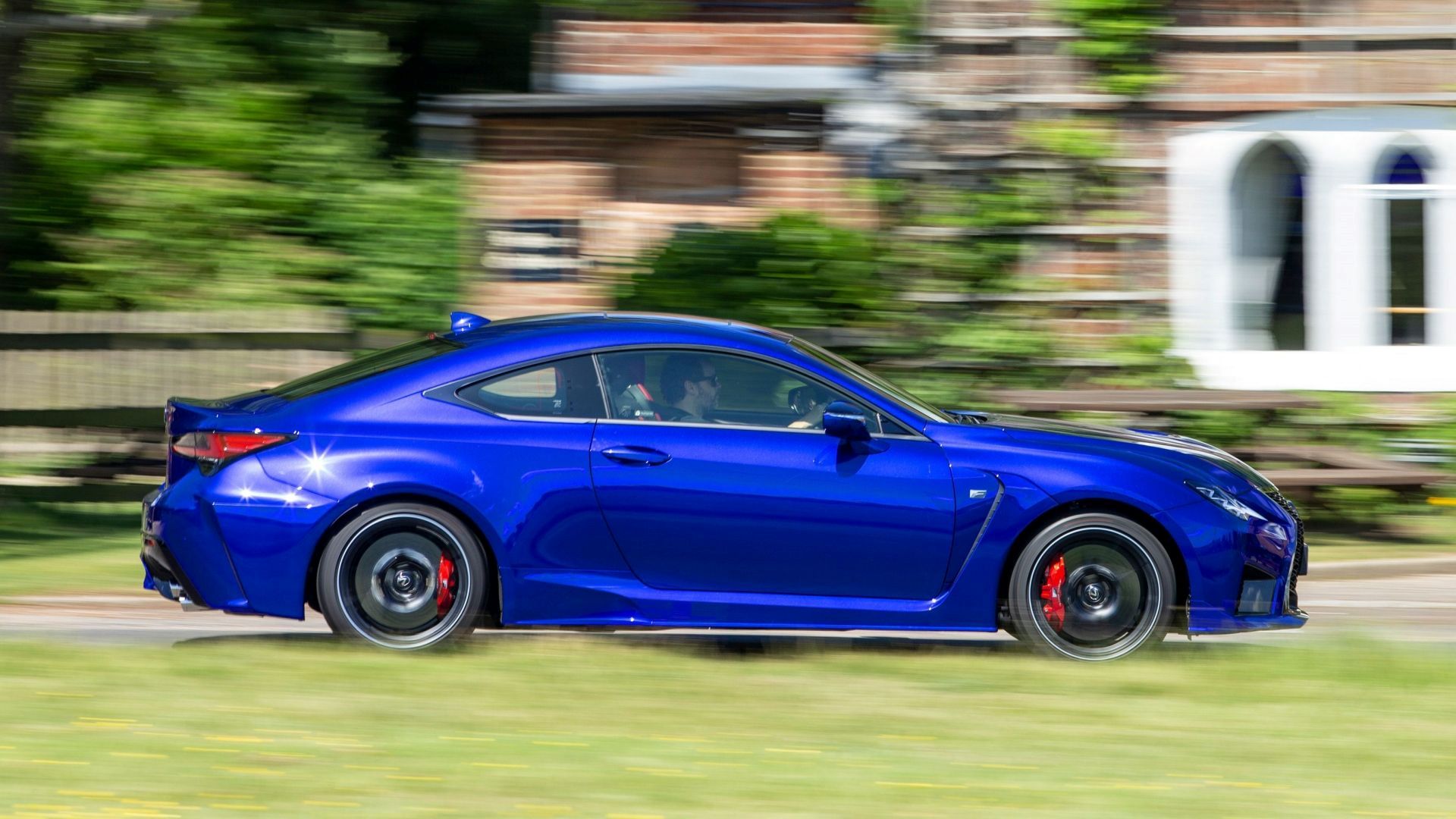
Adaptive dampers help smooth out rough roads, and the seats are supportive without being harsh. For U.S. buyers who want something different from Detroit muscle, with fewer maintenance worries, the RC F is a compelling option.
The RC 300 presents itself visually as a sharp, athletic coupe, particularly in F Sport specification, but its on-road character aligns more closely with that of a grand tourer. It remains composed when navigating corners, yet its strengths are more apparent during steady highway cruising than during aggressive back-road driving.
Two engine options are available, though neither delivers particularly exhilarating acceleration. Rear-wheel drive is standard, while all-wheel drive is offered for buyers who require additional traction.
For shoppers who value the RC 300’s distinctive styling, refined ride quality, and well-executed interior materials, it remains a viable option. However, competitors such as the Audi A5 and BMW 4 Series may warrant consideration.
Both European alternatives have undergone more recent redesigns and incorporate newer technology and contemporary features. The RC 300’s infotainment interface can be difficult to operate, and its overall performance metrics trail much of the segment, adding to its list of compromises.
In dynamic terms, the RC 300 delivers acceptable performance. It lags behind most rival luxury coupes in acceleration, recording a 0–60 mph time of 7.3 seconds. Steering response, however, provides satisfying feedback from both the road surface and the front tires. At highway speeds, the car tracks straight and remains stable, requiring minimal correction when entering corners.
Testing included the RC 300 F Sport equipped with the turbocharged four-cylinder engine. Fitted with performance-oriented summer tires, the coupe is capable of maintaining relatively high cornering speeds.
Its stable chassis inspires confidence, often resulting in quicker progress along winding roads than anticipated. Even so, the overarching impression is that of a capable and comfortable cruiser rather than a sharply focused sport coupe.
8. Mercedes-AMG C63
The AMG C63 blends German engineering with thunderous V8 power.
It’s compact, luxurious, and brutally fast, yet still comfortable enough for everyday use.

The cabin features premium materials, advanced infotainment, and driver-assistance systems that make commuting easier.
It’s more expensive than traditional muscle cars, but it proves that daily-driving comfort and V8 performance can coexist beautifully.
For buyers seeking maximum aggression in a compact luxury coupe, the 2023 Mercedes-AMG C63 S stands out as one of the most extreme options in the brand’s portfolio. This twin-turbocharged two-door delivers 503 horsepower from a V-8 engine and pairs it with a chassis calibrated for sharp, highly precise handling.
The result is a vehicle that prioritizes outright performance. Ride quality, however, leans firmly toward the firm side rather than traditional luxury softness, even though the cabin is outfitted with premium materials and a comprehensive feature set.
It is important to note that the 2023 model rides on the prior-generation C-Class platform. Buyers focused on the newest architecture may prefer to wait for the 2024 iteration, which transitions exclusively to a sedan body style and adopts a significantly different 671-horsepower turbocharged four-cylinder hybrid powertrain.
The 2023 C63 S is equipped with a hand-assembled 4.0-liter twin-turbocharged V-8 producing 503 horsepower and 516 lb-ft of torque. A nine-speed automatic transmission sends power exclusively to the rear wheels; all-wheel drive is not available.
In instrumented testing, the C63 S coupe accelerated from 0 to 60 mph in 3.8 seconds and completed the quarter mile in 12.0 seconds at 121 mph. The convertible variant posted nearly identical figures, reaching 60 mph in 3.9 seconds and covering the quarter mile in 12.2 seconds at 119 mph.
During Lightning Lap 2019, a C63 S coupe recorded a 2:57.1 lap time, placing it just behind the now-discontinued Cadillac CTS-V on the all-time leaderboard. Standard performance hardware includes an electronically controlled limited-slip rear differential and AMG Ride Control suspension with adaptive dampers.
Dynamic capability is correspondingly high: fitted with summer tires, the C63 S generated 1.02 g of lateral grip on the skidpad and required only 157 feet to brake from 70 mph to a complete stop. This level of performance comes with a trade-off, as the suspension calibration transmits noticeable harshness over uneven pavement.
9. Chevrolet SS
A hidden gem in the U.S. market, the Chevrolet SS offers Corvette-derived V8 power in a discreet sedan body.

It provides excellent ride quality, roomy seating, and a driver-focused interior. Enthusiasts love it for its balance, while daily drivers appreciate its understated looks and practicality. If you can find a well-kept used example, it’s one of the most rewarding V8 sedans to live with.
Powered by a robust 415-horsepower V-8 and configured with rear-wheel drive, the Chevrolet SS revived the traditional formula of a full-size sedan paired with substantial output. Although its configuration reflected a classic performance template, the chassis tuning and standard equipment levels were thoroughly contemporary.
The exterior design remained understated, reinforcing its sleeper appeal. However, the pronounced exhaust note and a 0–60 mph time of 4.5 seconds confirmed its performance credentials.
Buyers could choose the standard six-speed automatic transmission or opt for a six-speed manual at no additional cost. Fuel efficiency was not a strength, and pricing approached the higher end of the segment, yet the SS established itself as an overlooked but highly capable sports sedan.
In its concluding year, the rear-wheel-drive SS exited production propelled by a traditional pushrod 6.2-liter small-block V-8. Unlike competitors such as the Dodge Charger equipped with Hemi power or the twin-turbocharged Kia Stinger, the Chevrolet offered an available six-speed manual transmission, enhancing driver involvement. The V-8 delivered strong, immediate acceleration accompanied by a distinctive exhaust character.
Dynamically, the SS demonstrated notable balance. Its chassis provided precise steering response and confident handling across varied surfaces. Suspension tuning blended firmness and control during cornering with sufficient compliance over uneven pavement. Adaptive dampers adjusted their calibration based on the selected drive mode, though overall character remained oriented toward sport-focused performance rather than luxury isolation.
10. Cadillac CTS-V
The CTS-V is what happens when luxury meets supercar-level power.
With a supercharged V8 and a refined interior, it delivers brutal acceleration while still offering heated seats, premium audio, and advanced safety tech. Magnetic ride control helps keep the ride comfortable in daily driving, even with its massive performance potential.
It’s a serious machine, but one you can still drive to work every day.

The idea that V8 muscle cars are only good for weekend blasts is outdated. The 2014 Cadillac CTS-V blends traditional American muscle with the form factor of a midsize luxury sedan.
It delivers high-output performance while maintaining the space and comfort expected of a four-door executive car. Its sharply creased exterior design signals intent, but the defining characteristic lies beneath the bodywork: performance figures that substantiate its aggressive appearance.
Acceleration is consistently forceful, driven by a 556-horsepower supercharged V-8. Despite its substantial output, the CTS-V retains composure during routine driving.
The engine note is pronounced and mechanical under load, yet sufficiently restrained to avoid overwhelming everyday use. The adaptive magnetic suspension system further enhances versatility, offering ride compliance suitable for urban environments while maintaining control and precision during spirited driving.
Primary competitors offer comparable combinations of power and refinement, though typically at higher price points. The Mercedes-Benz E63 AMG features a similarly potent V-8 paired with a more opulent interior presentation.
The BMW M5 also competes in this segment, though some observers note a reduction in the raw character that defined earlier versions. Alternatives such as the Jaguar XF Supercharged and Jaguar XFR provide strong acceleration and a distinctively British design approach.
Within Cadillac’s own lineup, the redesigned 2014 Cadillac CTS presents another consideration. While not as overtly performance-focused as the CTS-V, the 420-horsepower Vsport variant delivers substantial speed along with a more spacious cabin and a more refined ride-and-handling balance.
The 2014 CTS-V is equipped with a 6.2-liter supercharged V-8 generating 556 horsepower and 551 lb-ft of torque. A six-speed manual transmission and rear-wheel drive are standard, while a six-speed automatic is available at no additional cost. In instrumented testing conducted by Edmunds, an automatic-equipped CTS-V accelerated from 0 to 60 mph in 4.3 seconds.
Today’s models offer comfort, technology, and practicality that make them perfectly viable daily drivers especially for U.S. roads and driving habits.
Whether you prefer classic American styling, luxury performance sedans, or something in between, there’s a V8 on this list that can handle your commute just as confidently as your right foot.
