
Highway driving challenges a car’s stability, requiring more than just engine power. The eight vehicles featured here, from the track-focused Porsche 911 GT3 RS to the technologically advanced Mercedes-Benz EQS, demonstrate how aerodynamics can actively improve high-speed control.
Each car uses airflow management to enhance grip, reduce lift, and maintain composure on the road. Some generate significant downforce for increased traction, while others streamline their bodies to minimize turbulence and drag.
Features such as the Tesla Model S Plaid’s flat underbody, the Hyundai IONIQ 6’s adjustable air flaps and boat-tail rear, and the McLaren Speedtail’s long-tail design illustrate how engineers transform air into a functional tool for stability. These vehicles show that well-designed aerodynamics can provide precise steering, confident handling, and a secure driving experience at elevated speeds.
1. Porsche 911 GT3 RS: Aerodynamic Engineering for Extreme Stability and Performance
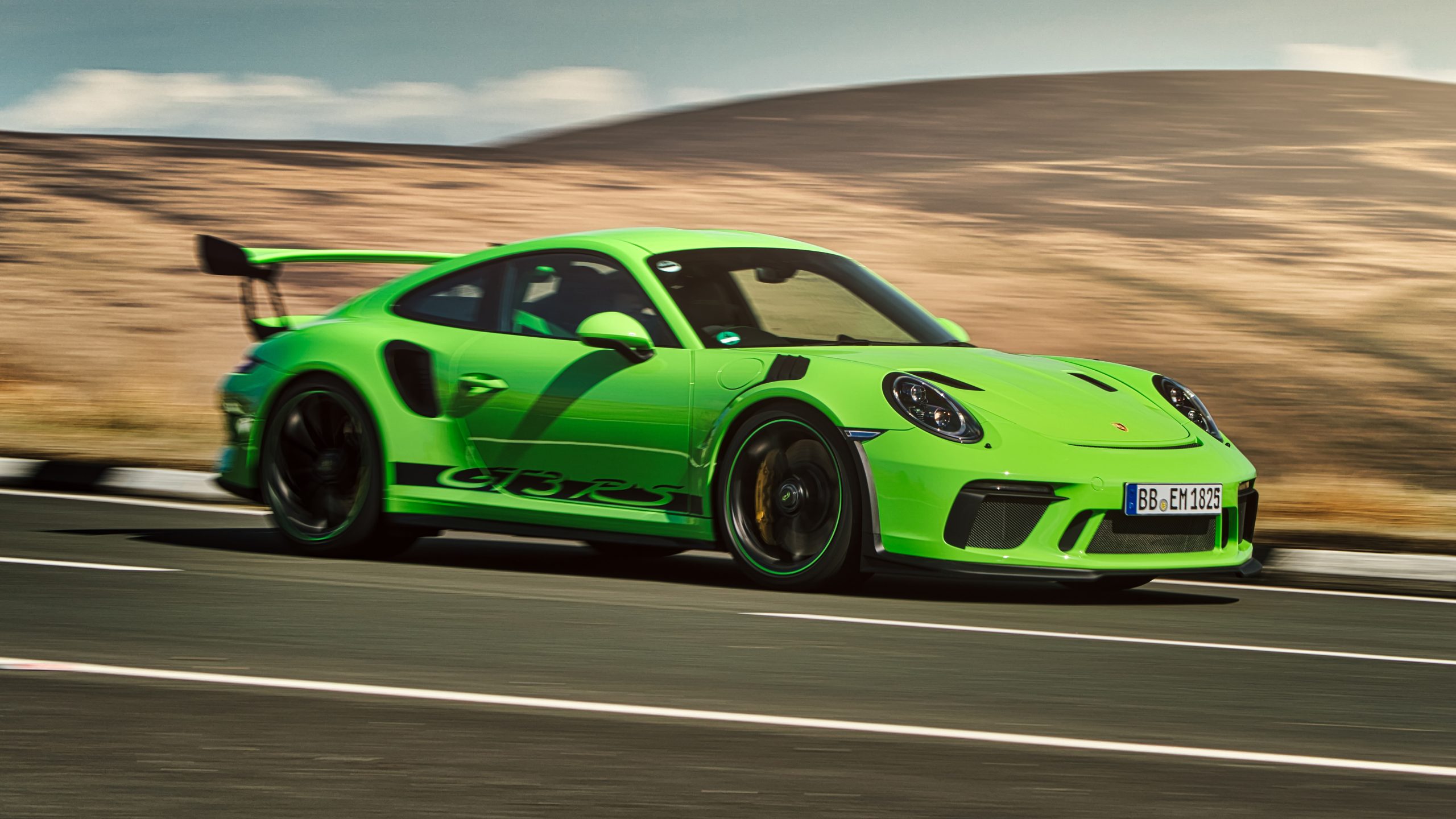
The Porsche 911 GT3 RS represents one of the most advanced examples of aerodynamic engineering applied to a road-legal performance car. Rather than prioritizing low drag like traditional sports cars, the GT3 RS focuses on generating massive downforce to maximize grip, stability, and driver confidence at high speeds.
Designed with heavy influence from motorsport, it functions almost like a race car adapted for public roads, combining cutting-edge aerodynamics, precise chassis engineering, and carefully balanced performance upgrades.
At the heart of the GT3 RS’s performance is its sophisticated airflow management system. The car produces an astonishing 860 kilograms of downforce at 285 km/h, more than double that of its predecessor. This downward pressure forces the tires firmly onto the road surface, significantly improving traction and stability during cornering, braking, and high-speed driving.
The most recognizable feature enabling this is the massive swan-neck rear wing, mounted high above the car and paired with active front aerodynamic elements. Together, they maintain an aerodynamic balance of roughly 30 percent at the front and 70 percent at the rear.
A standout innovation is Porsche Active Aerodynamics (PAA), which includes a Formula 1–inspired Drag Reduction System (DRS). The system automatically adjusts the angle of the rear wing and front flaps depending on driving conditions.
On straight sections, the wing flattens to reduce drag and increase speed. During braking or cornering, it quickly returns to a steep angle to generate maximum downforce, enhancing stability and making the car feel exceptionally planted even at highway speeds.
The GT3 RS also features a unique single central radiator layout inspired by Porsche’s racing cars. Replacing the traditional three-radiator setup frees space for adjustable underbody vanes that continuously fine-tune airflow.
Hot air exiting the radiator is redirected away from the engine intake using bonnet fins and roof elements, ensuring cooler intake temperatures and preserving engine performance. Additional vents around the wheel arches extract trapped air to reduce lift and further improve aerodynamic efficiency.
Interestingly, Porsche chose not to focus heavily on increasing engine power. The naturally aspirated 4.0-liter flat-six engine produces 518 horsepower and revs to 9,000 rpm, only a modest improvement over previous models. Instead, performance gains come from aerodynamic grip, suspension design, and drivetrain refinement.
A seven-speed PDK gearbox with shorter gearing, double-wishbone front suspension, rear-wheel steering, and wing-shaped suspension arms all contribute to improved handling and approximately 40 kilograms of extra downforce at top speed.
Despite extensive aerodynamic hardware, lightweight materials such as carbon fiber panels and optional magnesium wheels keep the kerb weight to about 1,450 kg. The result is a car capable of accelerating from 0–62 mph in 3.2 seconds while maintaining exceptional control and responsiveness.
The Porsche 911 GT3 RS stands as a masterclass in aerodynamic and chassis engineering. Rather than chasing raw horsepower, Porsche refined airflow, balance, and mechanical grip, creating a machine that delivers race-car levels of stability and precision both on track and on the road.
2. Tesla Model S Plaid: Aerodynamics as the Foundation of Electric High-Speed Stability
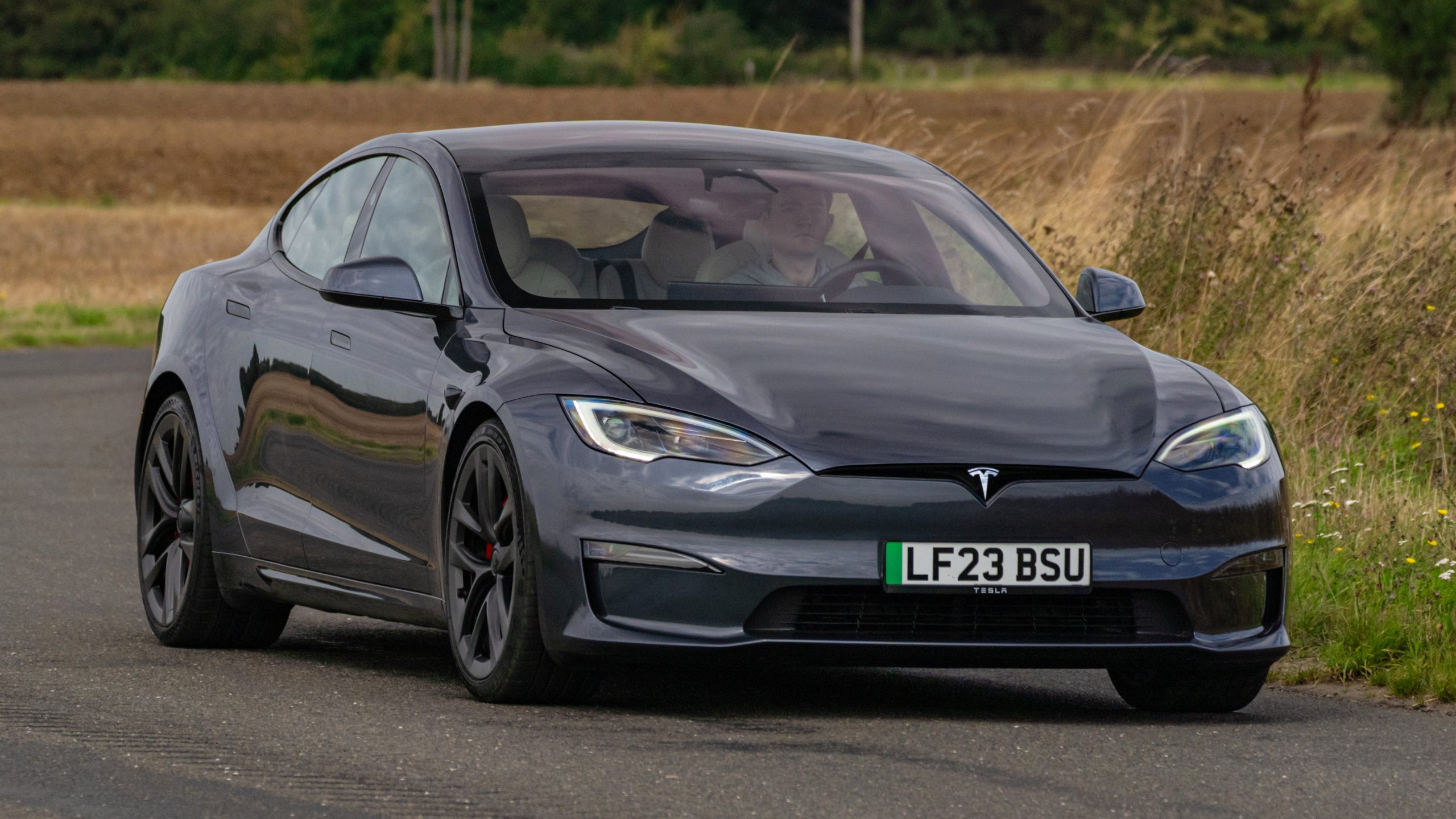
The Tesla Model S Plaid proves that aerodynamic engineering is just as important as electric power in delivering extreme performance and stability.
Although Tesla is often associated with advanced battery technology and rapid acceleration, the Plaid’s ability to remain stable at high speeds comes largely from careful airflow management and intelligent vehicle design. Its aerodynamic efficiency allows the car to handle intense acceleration and sustained highway driving while maintaining control, balance, and driver confidence.
One of the most important aspects of the Model S Plaid is its very low coefficient of drag. The smooth and streamlined body shape allows air to move cleanly around the vehicle, reducing turbulence that can cause instability at high speeds.
The sculpted front fascia directs airflow away from the front wheels, preventing the buildup of high-pressure air that leads to nose lift. By reducing lift at the front axle, the car maintains a stable steering response even during rapid acceleration or triple-digit driving speeds.
The flat underbody design further improves aerodynamic performance. Air traveling beneath the vehicle flows smoothly instead of becoming trapped or disrupted, which minimizes lift and enhances stability. At the rear, a functional carbon fiber spoiler plays a critical role in managing wake separation.
This component ensures that airflow leaves the vehicle in a controlled manner, preventing the floating sensation sometimes experienced in less aerodynamically refined electric vehicles. The result is a planted feel that keeps the chassis settled and predictable.
Another important feature contributing to stability is the adaptive air suspension system. At higher speeds, the suspension automatically lowers the ride height, reducing the amount of air passing underneath the car.
This lowered profile decreases lift forces and improves aerodynamic efficiency while helping the vehicle remain firmly connected to the road surface. The placement of the battery pack along the floor also creates a low center of gravity, which enhances cornering stability and reduces body roll during dynamic driving.
Performance figures demonstrate how these engineering choices support the car’s capabilities. The tri-motor electric powertrain produces 1,020 horsepower, allowing the Model S Plaid to accelerate from 0 to 60 mph in approximately 2.1 seconds and complete the quarter mile in about 9.4 seconds.
Despite these extreme numbers, the vehicle remains calm and comfortable during everyday driving and delivers strong real-world highway range performance close to 300 miles.
Some reviewers note that the suspension can feel soft at very high speeds, occasionally requiring careful steering input to maintain precision. Even so, aerodynamic refinements and chassis balance prevent instability and maintain confidence behind the wheel.
The Tesla Model S Plaid demonstrates how aerodynamic efficiency, adaptive suspension, and intelligent design work together to support electric hypercar performance while preserving stability, usability, and comfort in a high-performance sedan.
3. McLaren Speedtail: Aerodynamic Design for Ultimate Hyper-GT Stability
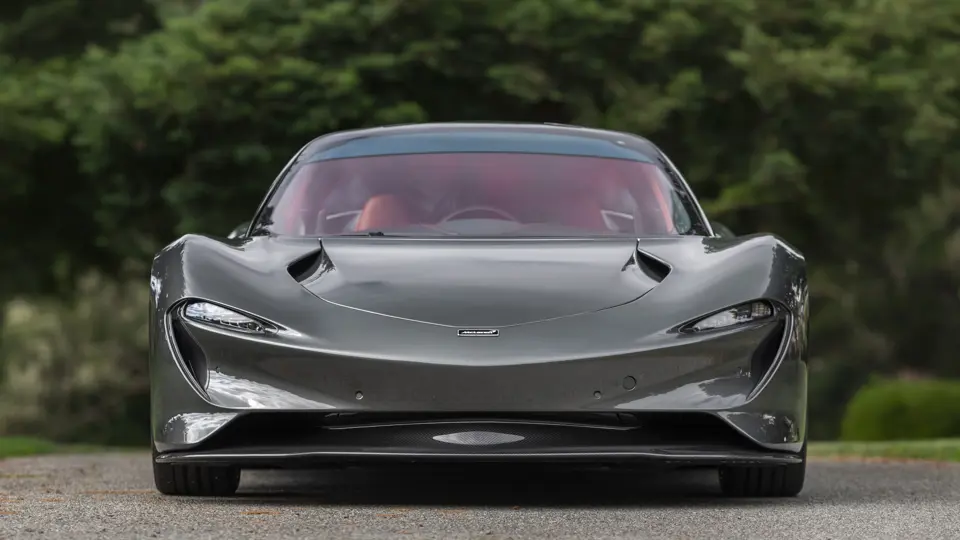
The McLaren Speedtail earns its “Hyper-GT” title through an extreme focus on aerodynamic efficiency and high-speed stability rather than traditional downforce-heavy design. Built to reach and sustain speeds approaching 250 mph, the Speedtail uses a teardrop-shaped body, the most aerodynamically efficient form found in nature, to minimize drag while maintaining remarkable composure.
Every surface of its elongated carbon fiber structure is engineered to keep airflow smoothly attached to the car for as long as possible, reducing turbulence and allowing it to travel through the air with exceptional efficiency.
A defining characteristic of the Speedtail is its long-tail design. The car is significantly longer than typical supercars, with much of the added length extending behind the rear wheels.
This stretched profile improves aerodynamic stability by smoothing airflow as it leaves the vehicle, reducing drag and preventing instability at extreme speeds. The extended wheelbase also contributes to balance and predictability, helping the car remain planted even when traveling far beyond normal highway velocities.
One of the most innovative features is the use of flexible rear ailerons integrated directly into the bodywork. Instead of a conventional wing mounted on hinges, the Speedtail’s carbon fiber body panels bend upward using hydraulic actuators.
These ailerons can rise nearly five inches to adjust airflow and act as an air brake when needed. Because they are seamlessly integrated into the body, they avoid the turbulence typically created by separate aerodynamic components, allowing the car to alter its aerodynamic profile without increasing drag.
Airflow management continues at the front of the vehicle through static carbon fiber wheel covers. These covers do not rotate with the wheels and help air remain attached along the sides of the car, reducing turbulence generated by spinning wheels.
The Speedtail also replaces traditional side mirrors with retractable digital cameras, eliminating another common source of aerodynamic resistance while improving efficiency and stability.
The cockpit and body structure further reinforce aerodynamic performance. The smooth, uninterrupted surfaces, curved windshield, and enclosed rear body panels guide air cleanly over the vehicle. When Velocity mode is activated, the suspension lowers the car closer to the ground, decreasing air resistance and preparing the Speedtail for maximum speed runs.
Power comes from a hybrid system combining a twin-turbocharged V8 engine with an electric motor, producing a total of 1,055 horsepower. This setup enables acceleration from 0 to 60 mph in about 2.9 seconds and allows the car to reach 186 mph in just 13 seconds.
Despite these extreme capabilities, the Speedtail maintains composure and refinement, delivering smooth acceleration and stable handling even at very high speeds.
Designed as a grand touring hypercar, the Speedtail balances performance with comfort, offering a three-seat central driving layout and a luxurious cabin. Its aerodynamic precision, hybrid powertrain, and carefully engineered stability systems create a machine capable of crossing continents at extraordinary speed while remaining controlled, efficient, and remarkably composed.
4. Audi TT (Modern Generations): Aerodynamic Refinement for Everyday High-Speed Stability
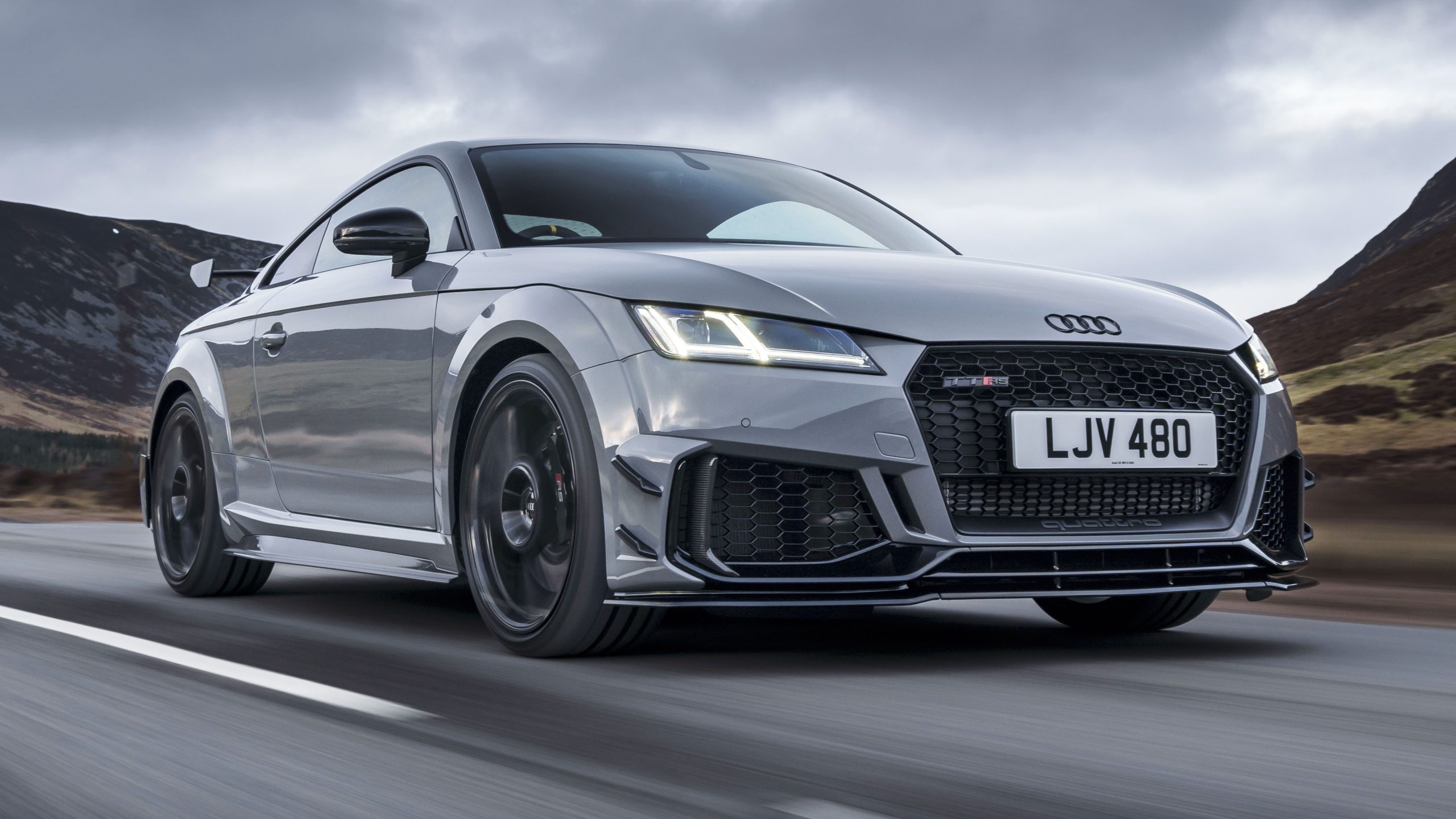
The modern Audi TT represents a significant evolution in aerodynamic engineering, shaped largely by lessons learned from the original first-generation model. While the early Audi TT became iconic for its rounded, symmetrical styling, that same design unintentionally created excessive aerodynamic lift at high speeds, leading to stability concerns.
Audi responded by reengineering the car’s aerodynamics in later generations, transforming the TT into a coupe known for predictable handling, improved highway stability, and balanced performance.
One of the most important improvements in the second- and third-generation Audi TT models is the introduction of an active rear spoiler. This component automatically deploys at higher speeds and retracts when traveling slowly. Its purpose is to disrupt airflow rolling off the roofline, creating a spoiling effect that reduces rear lift.
By limiting the amount of air pushing upward on the back of the car, the spoiler prevents the rear end from feeling light or unstable during lane changes, fast corners, or highway driving. The result is a planted and confidence-inspiring driving experience compared with the earlier model.
Modern TT generations also feature refined body shaping designed specifically to manage airflow more effectively. Designers moved away from the original bubble-like form toward a more functional aerodynamic profile that guides air smoothly over and under the vehicle.
Improved underbody airflow reduces turbulence and helps stabilize the car at speed. These refinements lowered the drag coefficient to approximately 0.30, an improvement over the first generation’s higher figure, allowing the TT to cut through the air more efficiently while maintaining stability.
Active airflow management works together with advanced chassis technology to enhance control. Audi’s Magnetic Ride suspension system continuously adjusts damping in real time based on driving conditions.
By adapting suspension firmness instantly, the system helps maintain tire contact with the road during high-speed cornering or uneven surfaces. This cooperation between aerodynamics and suspension engineering ensures the vehicle remains composed without sacrificing ride comfort.
Despite offering selectable drive modes such as Comfort, Eco, and Dynamic, the modern Audi TT is engineered to feel stable even in its default configuration. In Comfort mode, the car already delivers secure handling, accurate steering, and confident traction through Audi’s quattro all-wheel-drive system.
Switching to Dynamic mode sharpens responses and increases steering weight, yet the car’s underlying stability remains consistent because its aerodynamic balance has already been carefully optimized.
The Audi TT’s mission has always differed from track-focused sports cars. Rather than chasing extreme performance figures, it aims to combine design appeal, usability, and everyday drivability. Capable of accelerating from 0 to 62 mph in roughly five seconds, depending on the variant, it provides brisk performance while remaining approachable and comfortable for daily use.
Through improved aerodynamics, adaptive suspension, and thoughtful engineering updates, modern generations of the Audi TT successfully corrected earlier stability challenges. The result is a stylish coupe that blends iconic design with reliable high-speed composure and refined real-world performance.
Also read: 5 Cars With Simple Dash Layouts vs 5 With Confusing Ones
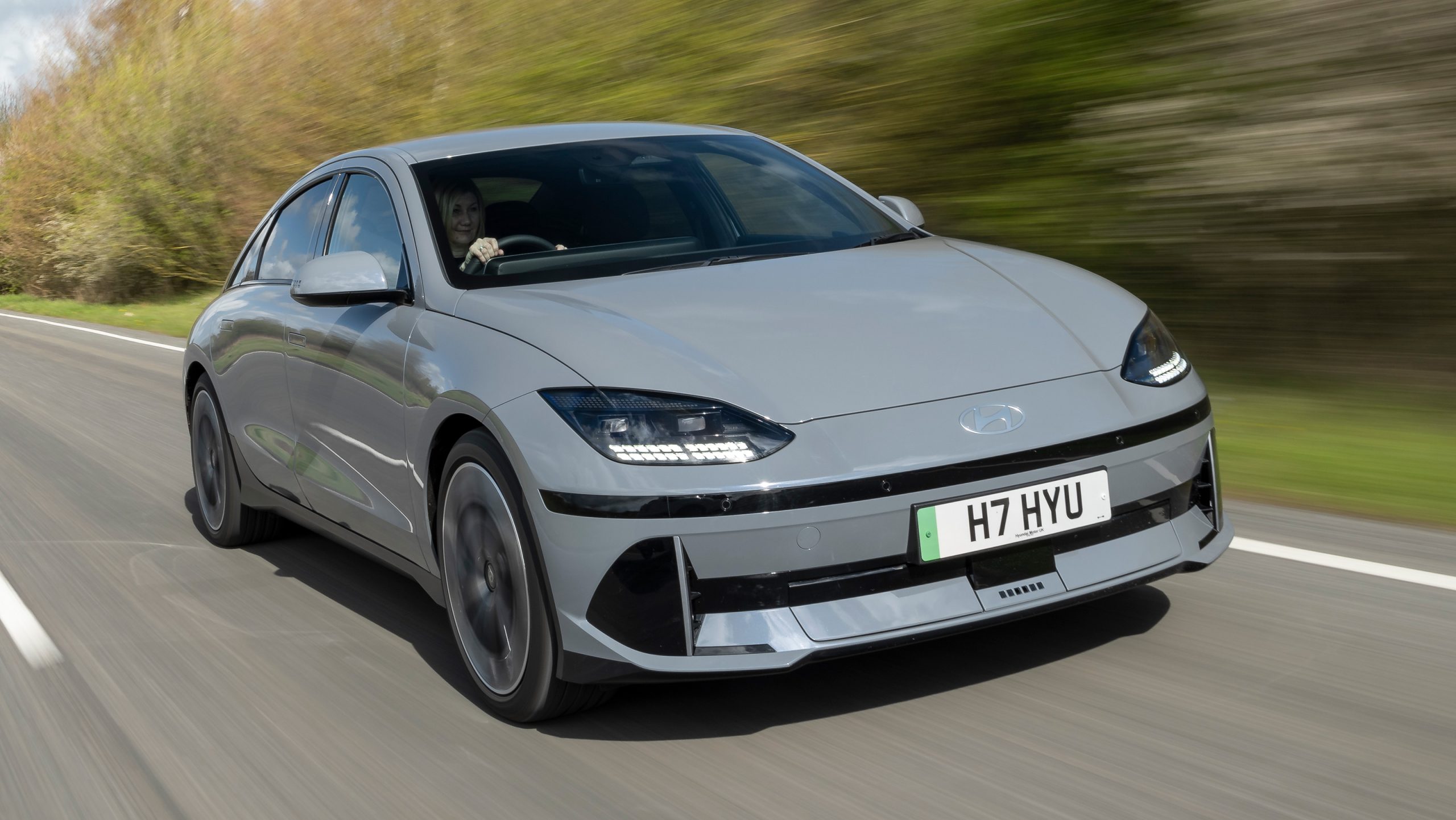
5. Hyundai IONIQ 6: Streamlined Aerodynamics for Efficient and Stable Long-Distance Driving
The Hyundai IONIQ 6, often called the “Electrified Streamliner,” demonstrates how aerodynamic efficiency can enhance not only driving range but also high-speed stability and comfort.
Designed primarily as a long-distance electric cruiser, the vehicle uses advanced airflow management and a carefully sculpted shape to reduce drag, minimize turbulence, and maintain composure during highway travel. Its exceptionally low drag coefficient of 0.21 places it among the most aerodynamically efficient production cars, directly contributing to both energy efficiency and driving stability.
Central to the IONIQ 6’s performance is its streamliner fastback silhouette, inspired by classic aerodynamic principles. The smooth, elongated body reduces frontal resistance while guiding air cleanly along the vehicle’s surface.
This shape limits airflow separation and reduces the low-pressure vacuum that typically forms behind cars at speed, a phenomenon known as base drag. By minimizing this effect through its boat-tail rear structure and elliptical rear spoiler, the car experiences less aerodynamic disturbance, making it notably calm and resistant to crosswinds during long highway journeys.
Active aerodynamic components further refine airflow control. Adjustable air flaps positioned in the front bumper regulate how much air enters the cooling system versus how much is redirected around the vehicle.
At higher speeds, these flaps close to reduce drag, while at lower speeds they open to ensure adequate cooling. This precise airflow management improves efficiency and helps maintain balanced aerodynamic forces acting on the car.
The rear spoiler plays a key role in stability by generating mild downforce that counters lift at highway speeds. Small winglets integrated into the spoiler reduce vortices and eddy currents, smoothing airflow as it exits the vehicle.
Complementing this system are wheel air curtains and deflectors that guide air around the wheel arches, an area typically responsible for significant turbulence. By reducing chaotic airflow around rotating wheels, the IONIQ 6 achieves improved directional stability and quieter operation.
A fully covered underbody and rear diffuser further enhance aerodynamic performance. Smooth airflow beneath the vehicle reduces turbulence and lift, helping the car remain planted while also lowering wind noise. These features contribute to a refined driving experience characterized by minimal cabin disturbance and impressive efficiency during steady cruising.
Built on Hyundai’s E-GMP electric platform, the IONIQ 6 balances aerodynamic design with practical performance. The rear-wheel-drive version produces 226 horsepower and can accelerate from 0 to 62 mph in about 5.1 seconds while delivering a driving range of roughly 338 miles. Its low-drag design allows strong efficiency without requiring an excessively large battery, keeping weight manageable at around two tons.
Rather than focusing on aggressive performance, the IONIQ 6 prioritizes smoothness, quietness, and ease of use. Gentle ride quality, reduced wind noise, and stable highway behavior align with its purpose as an efficient electric grand tourer. Through advanced aerodynamics and thoughtful engineering, the IONIQ 6 achieves a balance of efficiency, comfort, and confident long-distance stability.
6. Nissan GT-R (R35): Aerodynamics Engineered for Grip and High-Speed Control
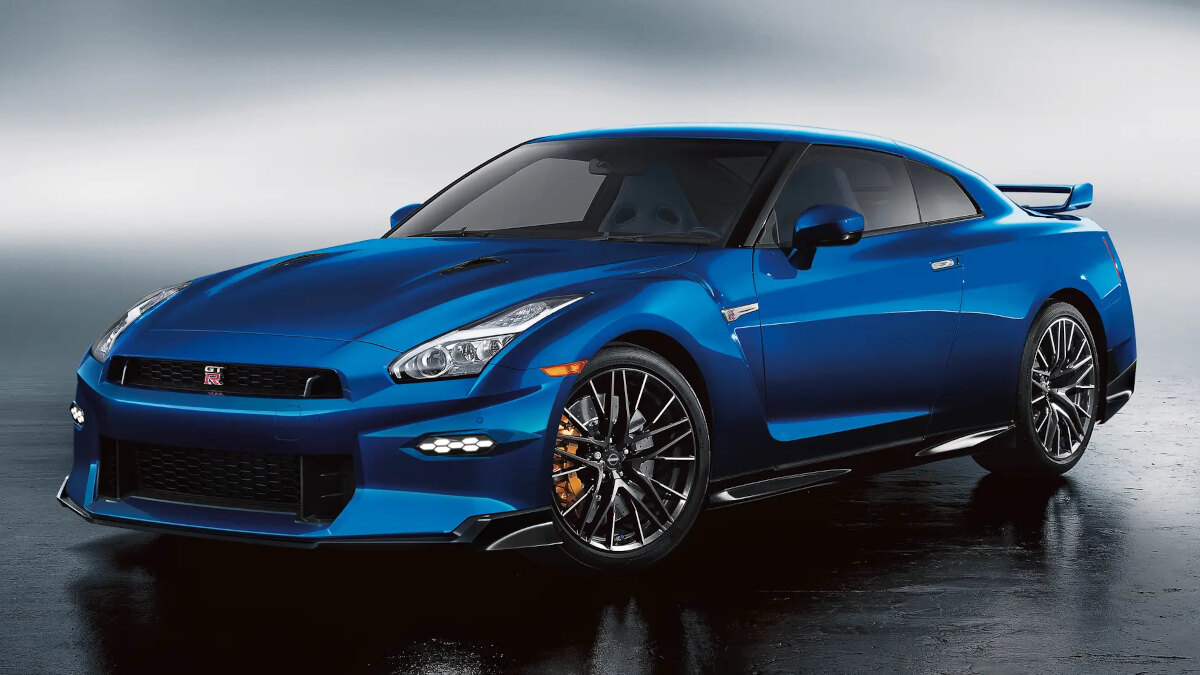
The Nissan GT-R (R35), widely known as “Godzilla,” uses aerodynamics not merely to reduce drag but to actively generate grip and stability. Since its debut in 2007, the GT-R has combined advanced airflow management with mechanical engineering to create a performance car that becomes more stable as speed increases.
Despite weighing close to 1,800 kilograms, the R35 achieves remarkable composure at high speeds by using air as a functional tool to press the car onto the road surface.
A major contributor to the GT-R’s stability is its nearly flat underbody. Unlike conventional road cars with exposed mechanical components disrupting airflow, the R35 channels air smoothly beneath the chassis toward a large carbon fiber rear diffuser.
This design creates a venturi effect, accelerating airflow underneath the vehicle and generating low pressure that effectively pulls the car downward. The result is increased downforce without relying on oversized external wings, allowing the GT-R to maintain stability while preserving aerodynamic efficiency.
The car’s front bumper and splitter also play a crucial role in airflow management. These components guide air around and under the vehicle in a controlled manner, reducing lift at the front axle and improving directional control.
Side sills prevent air from spilling underneath the car, ensuring the low-pressure zone created by the underbody remains effective. As speed rises, this aerodynamic “suction” effect strengthens, helping the GT-R feel increasingly planted rather than unstable.
Another distinctive feature is the use of Aero-Blade fenders. These sculpted panels create controlled vortices that extract air from the wheel arches. By reducing pressure buildup inside the arches, the system minimizes lift and turbulence caused by rotating wheels. This contributes to sharper handling and improved stability during high-speed driving and rapid lane changes.
At the rear, sharp vertical and horizontal edges help airflow detach cleanly from the body, reducing turbulence and stabilizing the car’s wake. Redesigned C-pillars further limit unwanted vortex formation, lowering drag and enhancing straight-line composure.
Instead of focusing solely on minimizing resistance, the GT-R’s aerodynamic philosophy prioritizes balanced downforce that reduces the need for constant steering corrections at highway speeds.
Mechanical systems complement these aerodynamic advantages. The hand-assembled 3.8-liter twin-turbocharged VR38DETT V6 produces up to 565 horsepower in standard form, paired with the ATTESA E-TS all-wheel-drive system that continuously distributes torque for maximum traction.
Combined with communicative hydraulic steering and powerful Brembo brakes, the GT-R delivers precise control even under extreme acceleration.
Inside, the cabin emphasizes function over luxury, featuring performance-focused controls and a telemetry display developed with Polyphony Digital. While the interior shows its age compared with modern rivals, it reinforces the GT-R’s mechanical character.
Through integrated aerodynamics, advanced drivetrain technology, and purposeful engineering, the Nissan GT-R R35 achieves exceptional high-speed stability, proving that intelligent airflow management can overcome weight and deliver confidence-inspiring performance.
7. Porsche Taycan: Precision Aerodynamics Meets Electric Performance
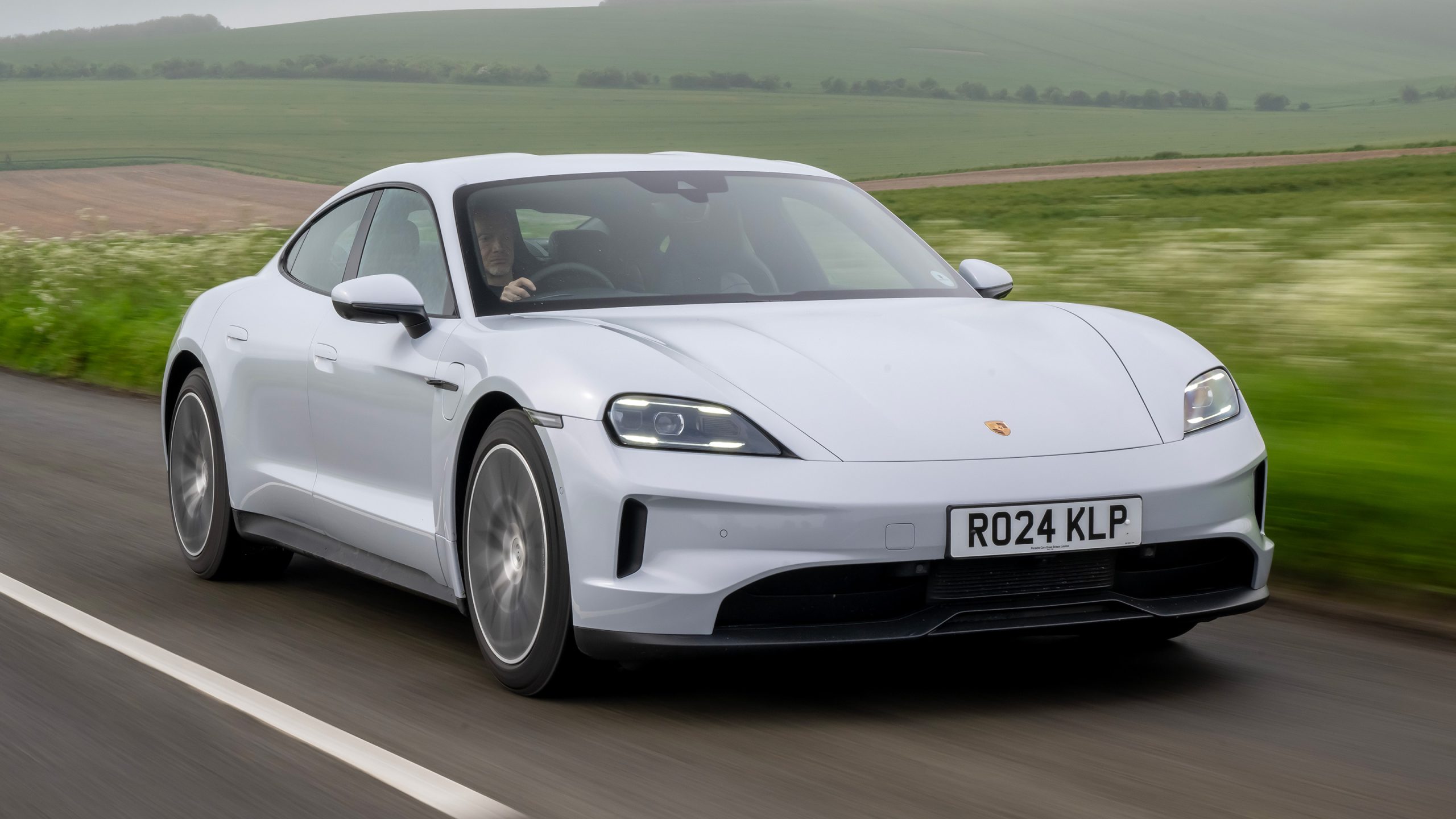
The Porsche Taycan represents a new interpretation of high-performance engineering, combining advanced electric power with carefully controlled aerodynamics to achieve exceptional highway stability. Rather than relying solely on raw power, the Taycan uses intelligent airflow management and active systems to remain composed, efficient, and stable at high speeds.
At the core of its stability is Porsche Active Aerodynamics (PAA), a system that continuously adjusts the car’s aerodynamic profile depending on speed and driving conditions. A three-stage active rear spoiler automatically changes position.
During highway cruising, it shifts into an Eco setting that reduces drag and improves efficiency. Under aggressive driving or higher speeds, it extends further to generate downforce, pressing the car firmly onto the road. This adaptive behavior allows the Taycan to balance efficiency with performance without compromising stability.
Additional aerodynamic elements work together to control airflow with precision. Active air intakes at the front open only when cooling is required, minimizing unnecessary drag while directing air toward brakes and radiators when performance demands increase. Air curtains positioned near the front guide airflow smoothly around the wheel arches, preventing turbulence that can disrupt stability.
Beneath the vehicle, a fully sealed underbody channels air toward a rear diffuser, accelerating airflow and creating a suction effect that reduces lift. The active air suspension also lowers the car at highway speeds, limiting airflow underneath and improving both aerodynamic efficiency and road grip.
Performance remains a defining characteristic of the Taycan lineup. Except for the base rear-wheel-drive version, most models feature dual electric motors powering all four wheels. Power outputs vary widely, ranging from just over 400 horsepower in entry models to more than 1,000 horsepower in the Turbo GT during launch control.
A unique two-speed transmission enhances acceleration while maintaining efficiency at higher speeds. Acceleration figures reflect this capability, with some variants reaching 60 mph in under two seconds, placing the Taycan among the quickest production cars available.
Despite its performance focus, the Taycan emphasizes driving precision and comfort. Its low driving position, responsive steering, and advanced suspension systems provide confident handling uncommon among electric vehicles. Optional active suspension technology further minimizes body roll and smooths road imperfections, allowing the car to remain composed during both spirited driving and long highway journeys.
Inside, the cabin blends luxury with technology through multiple digital displays and customizable materials. Touchscreen interfaces manage most vehicle functions, while available premium audio systems and advanced connectivity features enhance daily usability. Seating comfort is strong for front passengers, though rear space and cargo capacity are more limited due to the car’s sleek design.
Charging performance also supports practicality, with rapid DC charging capable of replenishing the battery from low to high levels in minutes under ideal conditions. Combined with competitive driving range and comprehensive driver-assistance features, the Taycan delivers a modern electric driving experience defined by precision engineering, aerodynamic intelligence, and unmistakable Porsche performance.
8. Mercedes-Benz EQS: The Benchmark of Electric Luxury and Highway Stability
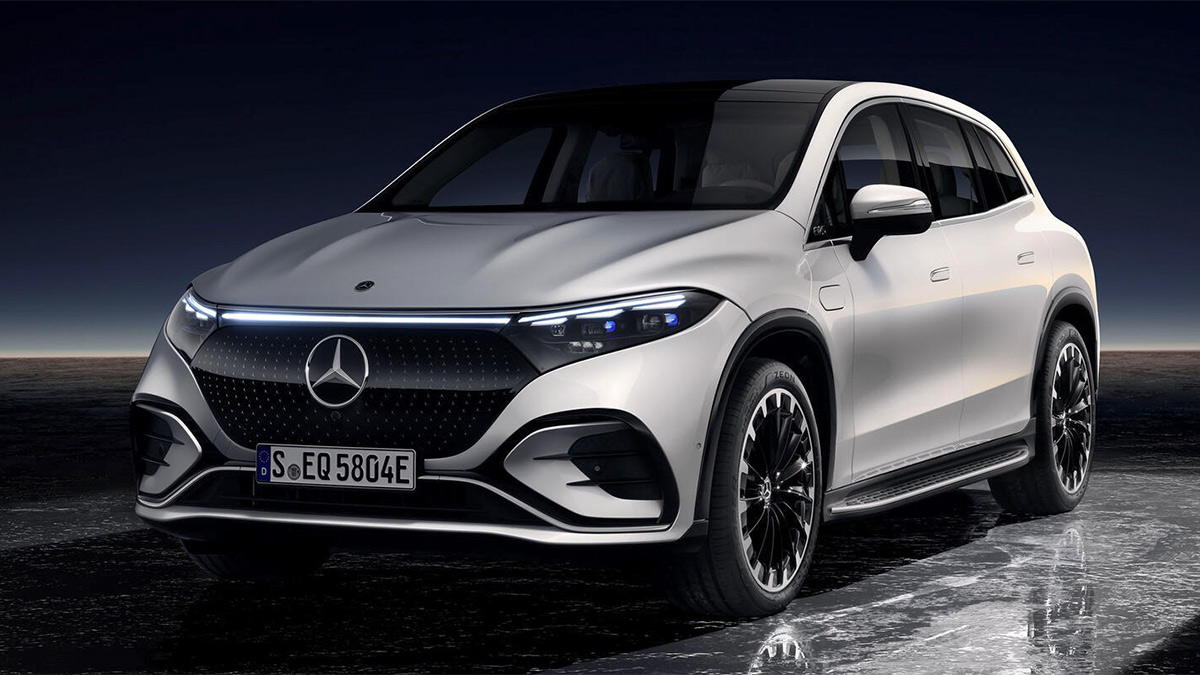
The Mercedes-Benz EQS sets a new standard for aerodynamic efficiency and high-speed composure in luxury electric vehicles. Its record-low drag coefficient comes from the “One-Bow” design, which directs air smoothly over the roof, while underbody cladding and saw-tooth window seals prevent pressure pockets that can create turbulence.
These refinements reduce vortex shedding, giving the EQS a highway experience that feels exceptionally stable, silent, and anchored, even at high speeds.
The car’s stability is enhanced by a variety of active systems. The air suspension automatically lowers the ride height at higher speeds, decreasing frontal area and center of gravity while reducing drag. A subtle integrated rear spoiler adds downforce to the rear wheels, and the tapered rear with fully enclosed underbody minimizes lift and turbulence.
Standard or optional rear-axle steering improves lane-change stability and high-speed agility, while low-drag wheels contribute to smoother airflow. The heavy battery is positioned low in the chassis, further improving road-holding and balance.
The EQS is a purpose-built EV, not a converted S-Class, and accommodates a 107.8 kWh battery in an extended wheelbase. Powertrain options include the EQS 450+ with a single 325-horsepower rear motor, and the EQS 580 4MATIC with dual motors and all-wheel drive, achieving 0-62 mph in under 4.2 seconds with top speeds up to 130 mph.
Future AMG variants are expected to exceed 700 horsepower, challenging the Porsche Panamera Turbo S and Tesla Model S Plaid. Rear-wheel steering allows up to 10 degrees of turn, providing the maneuverability of a smaller car while maintaining highway stability.
Inside, the EQS combines high technology with luxury. Leather, wood, and ambient lighting create a refined cabin, while the optional 55-inch Hyperscreen integrates three digital displays beneath a single glass surface.
The infotainment system includes voice control, smart-home integration, and MercedesMe Charge, allowing access to multiple charging networks with one card. Charging rates peak at 200 kW, replenishing the battery from 10 to 80 percent in roughly 30 minutes with a fast charger.
The EQS demonstrates that Mercedes can merge electric efficiency with luxury performance. Acceleration is effortless, cabin quietness is exceptional, and highway handling is secure and composed.
Features such as the Hyperscreen and touch-sensitive controls may require adaptation, but the car delivers a blend of technological sophistication and traditional Mercedes comfort. Starting around $102,000, the EQS proves that electric vehicles can offer both innovation and refinement while maintaining the hallmark poise of a high-end luxury sedan.
The eight cars presented demonstrate that aerodynamics play a crucial role in highway stability, improving safety, control, and comfort at high velocities. The Nissan GT-R R35 uses a venturi-effect underbody to enhance downforce, the Porsche Taycan adjusts its rear spoiler to balance drag and grip, and the Mercedes-Benz EQS employs a “One-Bow” design combined with active suspension to maintain composure.
By managing airflow and minimizing lift, these vehicles remain planted, predictable, and refined during highway driving. Aerodynamic engineering ensures that acceleration, cornering, and braking are delivered with precision, giving drivers confidence even in extreme conditions.
Each example confirms that intelligent design can transform high-speed performance into a controlled, stable, and enjoyable driving experience without compromising comfort, efficiency, or luxury.
Also Read: 10 Cars With Large Windows and Great Visibility for Older Drivers
