
For decades, the internal combustion engine has been the beating heart of the automotive world. It has powered everything from humble economy cars to roaring supercars, from rugged pickup trucks to sleek luxury sedans.
But in recent years, a relentless wave of electrification has swept across the industry, with automakers pledging to go fully electric and governments setting aggressive timelines to ban the sale of new combustion-powered vehicles.
Many analysts confidently declared that the internal combustion engine was living on borrowed time a relic of the fossil fuel age, destined for the history books alongside the steam engine and the carriage horse.
Yet the internal combustion engine has refused to die quietly. Engineers and researchers around the world have responded to the existential pressure of electrification not with surrender, but with a remarkable burst of innovation.
Through cutting-edge materials science, advanced computational modeling, and radical new thermodynamic approaches, the modern ICE has become cleaner, more efficient, and more powerful than ever before.
The result is a new generation of engine technologies that are not merely prolonging the life of combustion they are redefining what combustion can be. Here are five of the most exciting technologies keeping the internal combustion engine alive and relevant in the 21st century.
1. Homogeneous Charge Compression Ignition (HCCI) and Its Modern Derivatives
For engineers obsessed with efficiency, the internal combustion engine has always had a frustrating paradox at its core. Gasoline engines are clean but relatively inefficient. Diesel engines are efficient but notoriously dirty.
For decades, the holy grail of engine research was finding a way to combine the best of both worlds the low emissions of a gasoline engine with the thermodynamic efficiency of a diesel. That quest led to one of the most fascinating combustion technologies ever developed: Homogeneous Charge Compression Ignition, or HCCI.
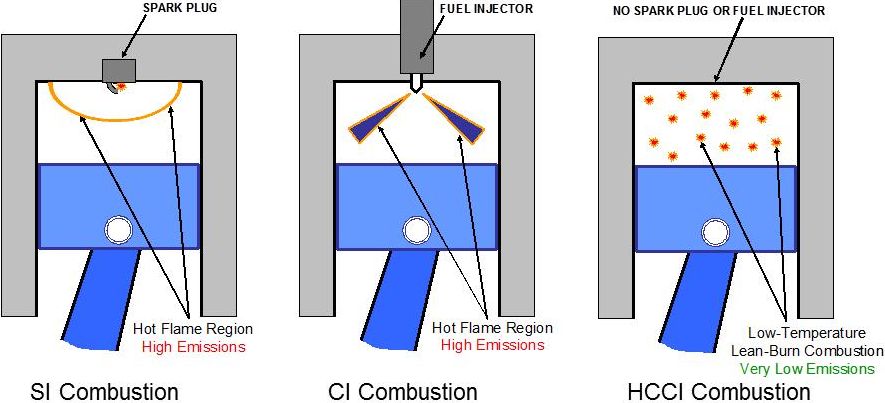
HCCI works on a deceptively simple principle. Instead of igniting a fuel-air mixture with a spark plug (as in a gasoline engine) or injecting fuel into highly compressed air to trigger ignition (as in a diesel), HCCI premixes fuel and air uniformly throughout the entire combustion chamber and then compresses the mixture until it auto-ignites simultaneously across the whole chamber.
This “whole-chamber” combustion is extraordinarily efficient because it burns fuel at lower temperatures and more evenly, dramatically reducing both the energy wasted as heat and the nitrogen oxide (NOx) emissions that are a hallmark of high-temperature diesel combustion.
The thermodynamic advantages are staggering. HCCI engines have demonstrated thermal efficiencies approaching 50% in laboratory conditions compared to roughly 35–40% for the best conventional gasoline engines and 45% for advanced diesels.
This means more of the fuel’s energy is converted into motion rather than heat, directly translating into better fuel economy and lower CO2 emissions.
However, HCCI has historically been plagued by a critical challenge: control. Because ignition is triggered by temperature and pressure rather than a spark, it is extremely sensitive to operating conditions.
At high loads, the mixture can ignite too violently, causing destructive engine knock. At low loads, it can fail to ignite at all. For years, this narrow operating window made HCCI impractical for production vehicles that need to perform reliably across a vast range of speeds, loads, and temperatures.
Modern engineering has tackled this problem head-on. Mazda’s Spark Controlled Compression Ignition (SPCCI), marketed as SKYACTIV-X, is the closest any automaker has come to bringing HCCI to production reality.
Mazda’s ingenious solution uses a stratified charge a richer fuel mixture near the spark plug surrounded by a leaner mixture so that a small spark-ignited flame front creates a localized pressure wave that triggers the surrounding lean mixture to compression-ignite in a controlled manner. This hybrid approach extends the operating range dramatically while preserving most of HCCI’s efficiency benefits.
Meanwhile, researchers at institutions like Oak Ridge National Laboratory and companies like Delphi Technologies (now part of BorgWarner) have been developing “Reactivity Controlled Compression Ignition” (RCCI), which uses two fuels of different reactivity typically gasoline and diesel injected simultaneously to give engineers precise control over when and how combustion unfolds.
Early RCCI prototypes have achieved thermal efficiencies exceeding 50% under real-world driving conditions, a figure that rivals even the most advanced electric powertrains when full well-to-wheel energy losses are accounted for.
The broader family of Low Temperature Combustion (LTC) strategies, of which HCCI is the most famous member, represents a paradigm shift in how engineers think about burning fuel. Rather than fighting the inherent messiness of combustion, these technologies work with the fundamental chemistry of ignition to produce cleaner, more controlled, and more efficient burn events.
As computational power continues to advance and real-time combustion sensing becomes more affordable, the practical operating range of these technologies will only expand making the dream of a gasoline engine with diesel-like efficiency an increasingly commercial reality.
2. Variable Compression Ratio (VCR) Technology
One of the fundamental limitations of the conventional internal combustion engine is that it is designed around a fixed compromise. The compression ratio the ratio between the volume of the cylinder when the piston is at the bottom of its stroke versus the top is set during manufacturing and never changes.
A high compression ratio delivers better thermodynamic efficiency and more power, but it also makes the engine prone to knocking when running on lower-octane fuel or under heavy load.
A low compression ratio is safer and more tolerant of varying conditions, but it wastes thermodynamic potential. For over a century, engineers have had to pick a number and live with it, designing for the worst case rather than the best.
Variable Compression Ratio technology shatters this compromise by allowing the engine to dynamically change its compression ratio on the fly, adapting to whatever the driver demands in real time.
Under light load at highway cruise exactly the conditions where a high compression ratio shines the engine can run at a high ratio for maximum efficiency.
Under hard acceleration, when knock is a risk and power is the priority, it can instantly drop to a lower ratio to prevent damage and maintain performance. The result is an engine that is simultaneously more powerful, more efficient, and more adaptable than any fixed-ratio design could ever be.
The engineering challenge of actually implementing VCR in a production engine is immense. The compression ratio is geometrically determined by the piston’s travel distance relative to the combustion chamber volume, which means changing it requires physically altering the geometry of the engine’s most stressed and precisely engineered components while the engine is running at thousands of revolutions per minute.
Infiniti (Nissan’s luxury brand) became the first automaker in history to bring a production VCR engine to market with its VC-Turbo engine, launched in 2018 in the QX50 SUV.
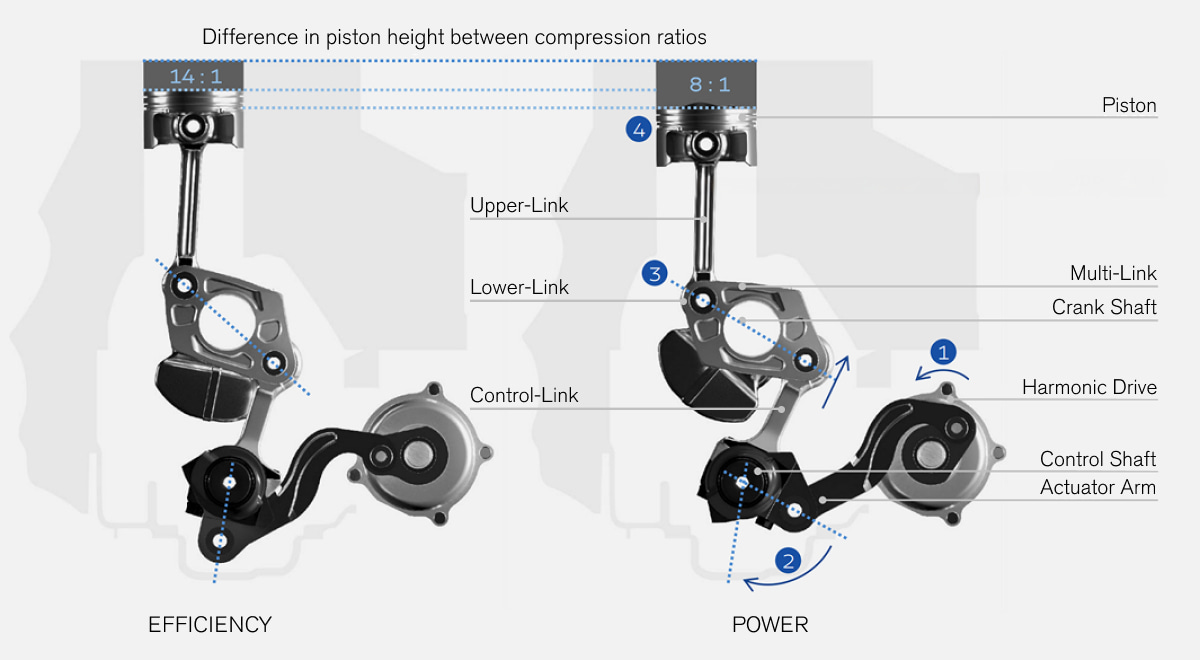
The VC-Turbo uses a patented multi-link mechanism that replaces the conventional connecting rod with a sophisticated linkage system controlled by an electric actuator.
By changing the geometry of this linkage, the engine smoothly varies its compression ratio between 8:1 (for maximum turbocharged performance) and 14:1 (for peak naturally-aspirated efficiency) a remarkable 75% variation in a matter of seconds. Nissan claims the engine is up to 27% more fuel-efficient than a comparable conventional V6, while producing more torque.
Beyond Infiniti, other manufacturers have explored VCR through different mechanisms. Some approaches involve variable combustion chamber volume (achieved by moving the cylinder head slightly), while others use hydraulic or electromechanical systems to alter piston stroke length.
Mercedes-AMG has researched variable-compression architectures for high-performance applications, recognizing that the technology’s ability to optimize for both power and efficiency aligns perfectly with the modern demand for cars that are fast yet frugal.
The technology also pairs exceptionally well with hybridization. In a hybrid powertrain, the combustion engine frequently operates at partial load, the exact conditions where VCR’s efficiency gains are most pronounced.
By maintaining an optimal compression ratio for each load condition, a VCR hybrid engine can operate near its thermodynamic optimum for a far greater proportion of driving time than a conventional engine ever could.
As hybridization becomes the dominant near-term strategy for automakers going through the transition away from pure combustion, VCR technology is poised to become an increasingly important tool in the efficiency arsenal.
Also Read: 5 Manual Transmission Cars That Are Easy to Learn on vs 5 With Finicky Clutches
3. Advanced Laser Ignition and Ultra-Lean Combustion
The humble spark plug has been doing its job with remarkable consistency for well over a century. A small electrical discharge jumps across a gap, ignites the compressed fuel-air mixture, and the piston is pushed down.
Simple, reliable, and thoroughly proven. But for all its virtues, the conventional spark plug has a fundamental limitation that has quietly constrained engine efficiency for generations: it can only reliably ignite fuel-air mixtures within a relatively narrow band of richness. Stray too far toward a very lean mixture one with much more air than fuel and the spark simply fails to ignite it consistently.
This matters enormously because lean combustion is one of the most powerful tools available for improving efficiency and reducing emissions. A lean mixture burns at a lower temperature, which means less heat loss to the cylinder walls and lower NOx formation.
It also produces more work per unit of fuel, improving thermal efficiency. The theoretical benefits of running an engine on extremely lean mixtures are well established the challenge has always been igniting those mixtures reliably enough for production use.
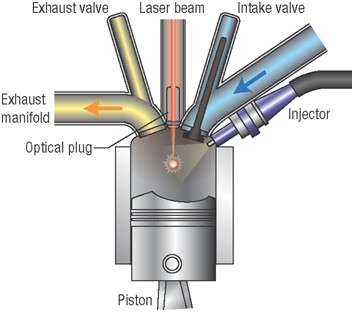
Laser ignition technology addresses this limitation with elegant precision. Instead of a spark jumping across a gap at the edge of the combustion chamber, a precisely focused laser pulse is fired directly into the center of the combustion chamber, creating a plasma kernel at exactly the point of maximum fuel-air concentration.
This central ignition point allows the flame front to propagate outward in all directions simultaneously, burning the mixture much more completely and rapidly than a peripheral spark ever could.
The result is more complete combustion, less unburned fuel in the exhaust, and the ability to ignite reliably at air-fuel ratios far leaner than conventional spark ignition allows.
Research institutions, including the Austrian Center for Competence in Mechatronics (ACCM) and various university laboratories have demonstrated laser-ignited engines running at lambda values (the ratio of actual air-fuel ratio to stoichiometric) of 1.4 to 1.6 meaning 40 to 60% more air than a conventional stoichiometric mixture.
At these lean conditions, NOx emissions fall dramatically and fuel consumption can improve by 10–15% compared to conventional stoichiometric operation.
The challenges for production implementation have historically centered on cost and durability. Laser systems capable of surviving the thermal and mechanical violence inside an engine cylinder firing reliably billions of times over the vehicle’s lifetime are expensive to manufacture and complex to maintain.
However, advances in solid-state laser technology, particularly in the fiber laser and diode-pumped laser fields driven by broader industrial and consumer electronics applications, have progressively reduced both cost and size.
Complementing laser ignition is a broader suite of advanced ignition technologies aimed at enabling lean combustion. Pre-chamber ignition systems, as used in Formula 1 engines and now trickling down to production vehicles through manufacturers like Porsche and Mercedes, use a small pre-chamber filled with a slightly richer mixture.
The spark ignites this pre-chamber mixture, which then jets multiple high-energy flame torches into the main combustion chamber through small holes, simultaneously igniting the lean main charge at multiple points.
This approach achieves similar benefits to laser ignition through a more mechanically conventional route, and it has already demonstrated efficiency improvements significant enough to justify the engineering complexity in production engines like Porsche’s new-generation naturally-aspirated units.
Together, these advanced ignition technologies are unlocking a new frontier of lean combustion that was simply inaccessible with conventional spark plugs, adding another dimension to the modern engine’s remarkable efficiency gains.
4. Electrified Turbocharging and Intelligent Forced Induction
Turbocharging is not a new technology. Engineers have been bolting turbos to engines since the early 20th century, and the combination of downsized, turbocharged engines became the dominant paradigm in mainstream automotive engineering during the 2010s, as automakers sought to extract more power and efficiency from smaller displacement engines.
A turbocharged 2.0-liter engine delivering the power of a naturally-aspirated 3.0-liter while consuming significantly less fuel became a familiar proposition from virtually every major manufacturer. But conventional turbocharging has always carried a fundamental flaw: turbo lag.
Because a conventional turbocharger is driven entirely by exhaust gases, it needs the engine to be producing a significant volume of exhaust flow before it can spool up and deliver boost pressure.
At low engine speeds and immediately after a throttle input, there is an inevitable delay the dreaded “turbo lag” during which the engine feels unresponsive and flat.
Engineers have spent decades trying to minimize this lag through smaller turbine wheels, twin-scroll housings, variable-geometry turbines, and twin-turbo configurations, but they have never fully eliminated it.
Electric turbocharging, specifically, 48-volt mild hybrid systems with electrically-assisted turbochargers, represents the most decisive solution to this problem yet devised. In an electric turbocharger (or “e-turbo”), an electric motor is integrated directly onto the turbocharger shaft.
This motor can instantly spin the compressor wheel to full speed regardless of exhaust flow, delivering full boost pressure from the moment the driver demands it. Turbo lag is effectively eliminated.
When the turbo is running normally under high load, the electric motor can switch to generator mode, recovering energy from the turbocharger shaft (which would otherwise be wasted through a wastegate) and feeding it back into the 48-volt battery system.
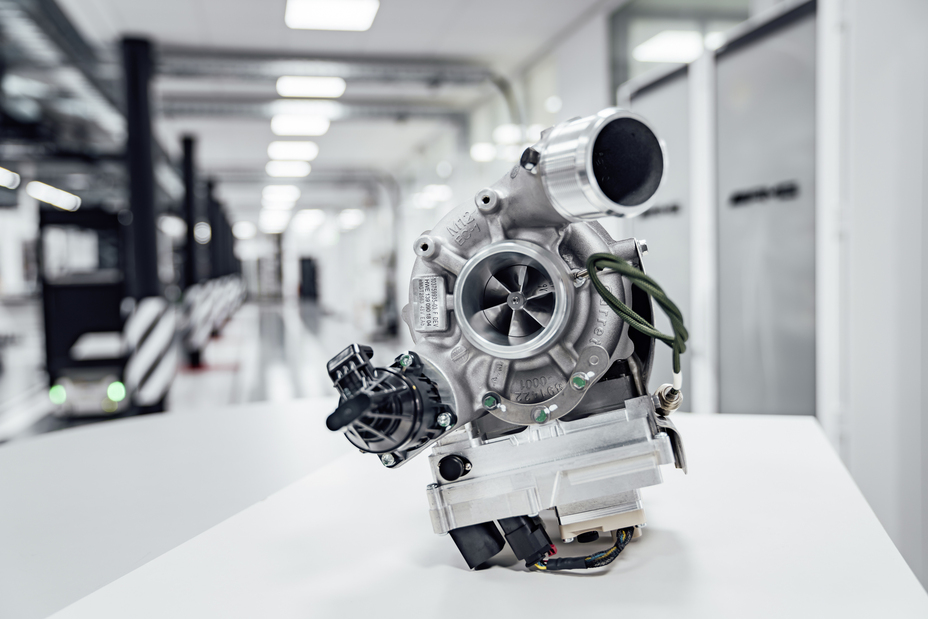
Mercedes-AMG’s EQ Boost system, as fitted to the straight-six engines in the AMG 53-series models, was an early production example of this principle in action.
The AMG system integrates a belt-driven starter-generator with a 48-volt system, effectively filling in torque during transients while allowing a smaller, more efficient turbo to handle steady-state boost delivery.
The latest evolution of this technology, as seen in the Mercedes-AMG C63 and its successors, uses a fully integrated e-turbo where the electric motor is housed directly within the turbocharger unit itself, enabling even faster response and greater energy recovery.
Garrett Motion, one of the world’s leading turbocharger manufacturers, has developed its own E-Turbo platform specifically designed for production vehicle integration.
Garrett’s system uses a high-speed electric motor operating at up to 170,000 RPM to provide a near-instantaneous boost while recovering energy during overrun.
The company claims a 10% improvement in fuel economy in hybrid applications, with a measurable reduction in CO2 emissions numbers that are significant in an era when every gram of CO2 per kilometer counts against regulatory targets.
Beyond individual e-turbo units, intelligent forced induction systems are now using sophisticated algorithms and predictive modeling to anticipate driver demand before it happens.
By reading throttle position, road gradient sensors, navigation data, and even the driver’s historical behavior patterns, modern engine management systems can pre-spool the turbocharger milliseconds before maximum boost is needed, further blurring the line between combustion and electric performance.
The combination of electrified turbocharging with advanced VCR technology and lean combustion strategies creates a synergy greater than the sum of its parts, an engine ecosystem that continuously optimizes itself for whatever the moment demands.
5. Synthetic and E-Fuel Combustion Optimization
Of all the technologies keeping the internal combustion engine alive, perhaps the most ambitious and philosophically interesting is not a mechanical innovation at all it is a chemical one
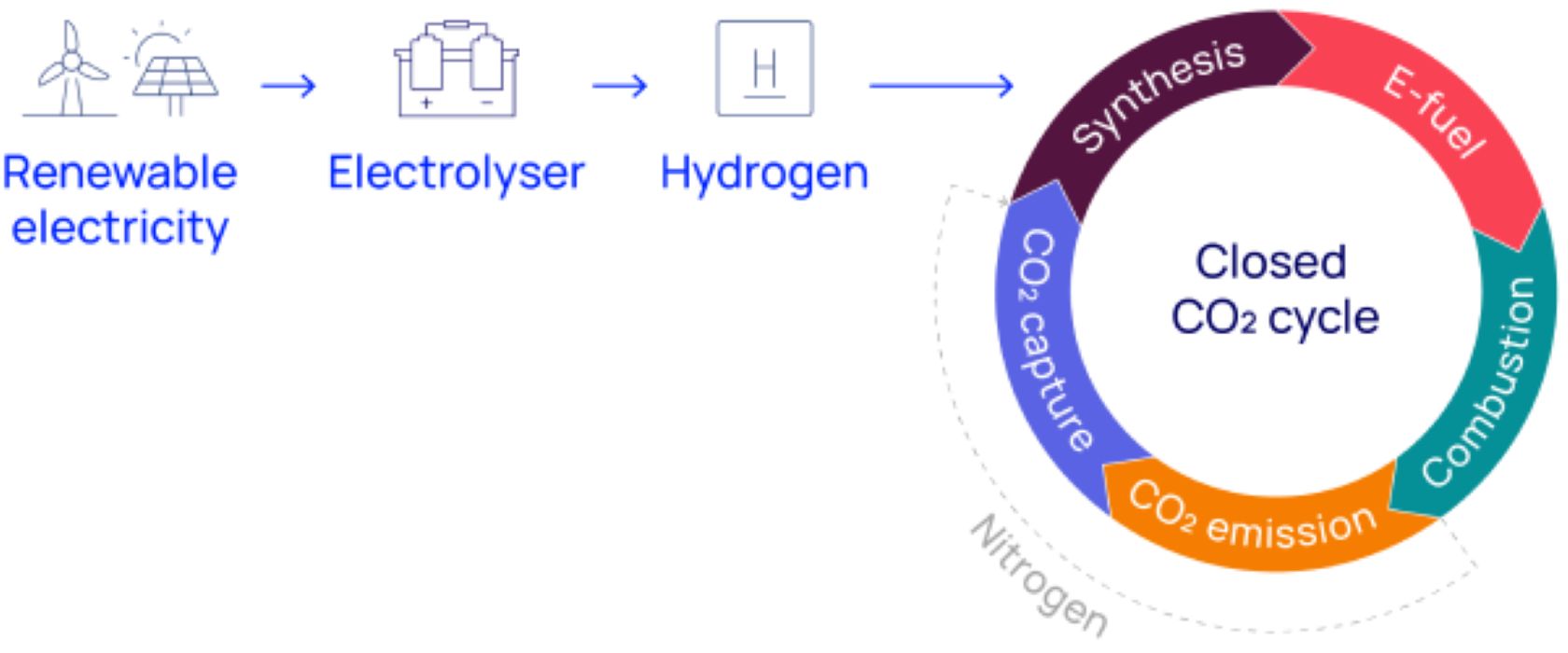
Synthetic fuels, also known as e-fuels or eFuels, are liquid hydrocarbon fuels manufactured using renewable electricity, captured carbon dioxide from the atmosphere, and green hydrogen.
Because the CO2 emitted when burning these fuels was originally captured from the atmosphere to make them, their carbon lifecycle can theoretically be carbon-neutral the engine keeps running, but the carbon cycle is closed.
This concept has electrified (no pun intended) the automotive world since Porsche and other manufacturers began lobbying the European Union to create an exemption for e-fuel-compatible vehicles from the bloc’s 2035 combustion engine ban.
After intense negotiation, the EU agreed in 2023 that vehicles certified to run exclusively on carbon-neutral e-fuels could continue to be sold after 2035 a watershed moment that gave the internal combustion engine a credible pathway to regulatory survival in its most important market.
Porsche has backed its lobbying with genuine industrial investment, becoming the lead investor in Haru Oni, a pioneering e-fuel production plant in Patagonia, Chile, chosen for its world-class wind resources.
The plant uses wind-generated electricity to produce green hydrogen via electrolysis, then combines that hydrogen with CO2 captured from the air to synthesize methanol, which is subsequently processed into high-octane synthetic gasoline.
The resulting fuel is chemically equivalent to premium fossil gasoline and can be used in existing engines with no modification, though engines specifically optimized for synthetic fuels can extract even greater efficiency from their superior anti-knock properties.
The anti-knock performance of synthetic fuels is one of their most important attributes for engine engineers. E-fuels can be formulated with very high octane ratings above 100 RON, which allows engines to run at higher compression ratios or with more aggressive ignition timing than is possible with standard pump gasoline.
This directly translates into higher thermal efficiency, enabling a well-designed e-fuel engine to achieve efficiency levels that would be impossible with conventional fuel. When this is combined with technologies like VCR and HCCI combustion, the potential gains compound dramatically.
Beyond Porsche, the Formula 1 championship has become an unexpected proving ground for e-fuel technology. From 2022, F1 mandated the use of 10% sustainable fuel content, rising to fully sustainable fuel by 2026.
The unique demands of F1, maximizing every fraction of a percent of efficiency at the absolute limit of thermodynamic performance, are driving rapid advances in fuel formulation and combustion optimization that will eventually find their way into road cars.
F1 teams and fuel suppliers like Shell, Petronas, and BP Castrol have invested heavily in understanding exactly how synthetic fuel molecules interact with combustion chamber surfaces, ignition timing, and exhaust chemistry at the molecular level.
The scalability of e-fuel production remains the most significant challenge. Current production costs are high estimates range from $2 to $10 per liter depending on the scale and source of renewable electricity and the total global capacity for e-fuel production is a tiny fraction of what would be needed to supply the world’s car fleet.
Critics rightly point out that the well-to-wheel energy efficiency of burning e-fuels is significantly lower than charging an electric vehicle directly from the same renewable electricity source, making e-fuels a thermodynamically inefficient use of green energy.
However, proponents argue that e-fuels offer something that electricity cannot: energy density, infrastructure compatibility, and the ability to decarbonize not just new vehicles but the hundreds of millions of existing combustion-powered cars, trucks, aircraft, and ships already in service.
For the vast populations of the world where EV infrastructure remains years or decades away, e-fuels offer a practical and scalable bridge. And for the enthusiasts and engineers who believe the internal combustion engine with its mechanical drama, its sensory richness, and its extraordinary versatility is worth preserving on its own terms, synthetic fuels represent the most compelling argument of all: that the engine’s future need not be defined by its past dependence on fossil fuels.
Also Read: 10 Features That Actually Increase Your Car Resale Value
