

The 1970s were a decade of reckoning for the global automobile industry. Squeezed between the twin pressures of the 1973 oil embargo and tightening emissions regulations, automakers were forced to rethink everything they thought they knew about building cars.
Gone were the days when a gas-guzzling V8 was the aspirational centerpiece of every showroom floor. In its place, something smaller, smarter, and surprisingly spirited began to take over the roads the hatchback.
For the everyday commuter going through the congested city streets, cramped parking decks, and ever-rising fuel prices, the hatchback wasn’t just practical it was a lifeline.
These compact, versatile machines offered folding rear seats, generous cargo flexibility, zippy four-cylinder engines, and a cheeky sense of style that felt perfectly suited to the era’s restless, reinventive spirit.
They weren’t built for the racetrack or the open highway. They were built for the school run, the grocery errand, the cross-town commute the rhythms of ordinary life.
Five cars, more than any others, captured this spirit and left an indelible mark on automotive history. From Stuttgart to Coventry, from Wolfsburg to Tokyo, these hatchbacks didn’t just sell in enormous numbers they changed what people expected from a car forever.
1. Volkswagen Golf Mk1 (1974)
When Volkswagen revealed the Golf in 1974, it wasn’t merely launching a new model it was staking a claim on the future of motoring itself. The Beetle had carried the company for three decades on the strength of its personality and its price, but by the early 1970s, it was a car running out of road.
The world had changed. Fuel was expensive, cities were dense, and drivers wanted something that felt modern rather than charmingly anachronistic. Volkswagen’s answer was the Golf: a front-wheel-drive, water-cooled, Giorgetto Giugiaro-designed hatchback that was rational, efficient, and quietly beautiful.
Giugiaro’s design for the Golf Mk1 remains one of the most elegant exercises in functional automotive styling ever committed to sheet metal. There was no excess here, no chrome excess or baroque ornamentation.
The Golf’s body was all clean, crisp creases a folded-paper geometry that felt utterly contemporary in 1974 and somehow still reads as modern today.
The proportions were near-perfect: a short nose, a long greenhouse, and that defining rear hatch that opened up a genuinely usable load area. It was a car designed by someone who understood that beauty and utility were not opposites.
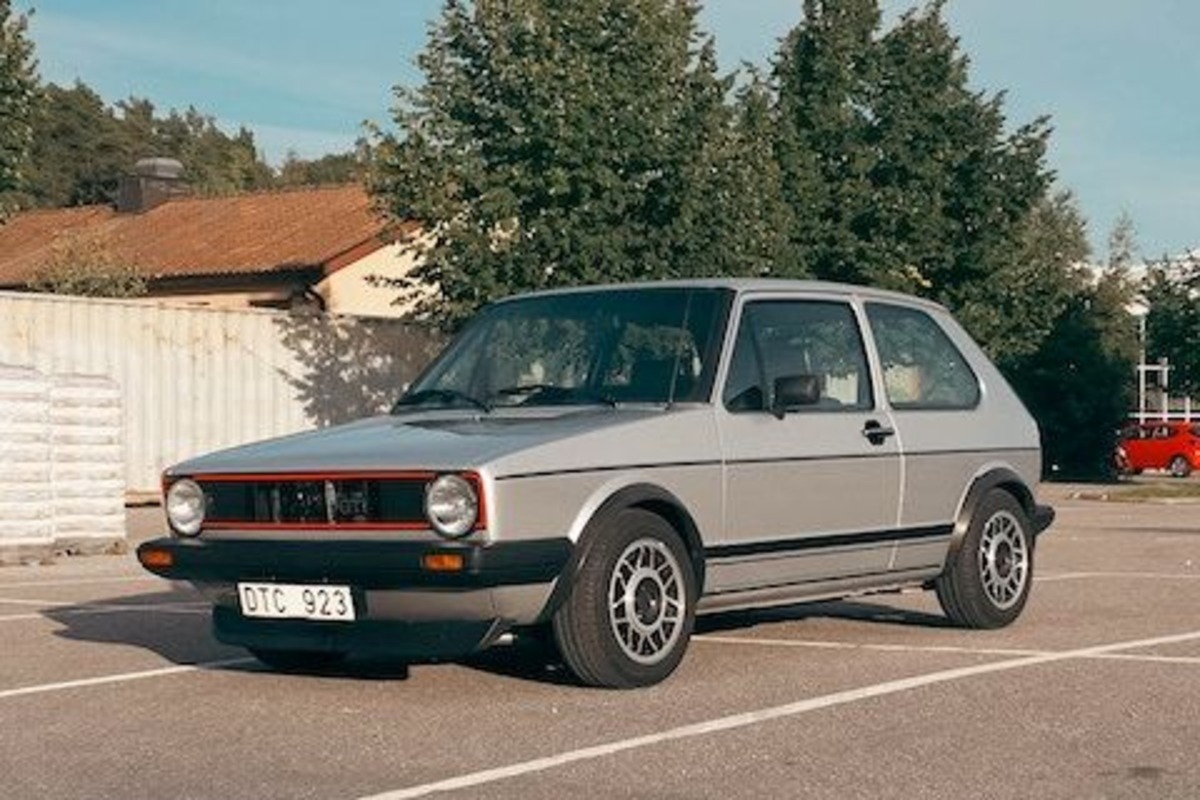
Under that clean skin lived a range of sensible, efficient four-cylinder engines. The base 1.1-litre unit offered modest performance but remarkable economy, while the 1.5-litre variant gave the Golf a pleasing turn of speed that made motorway cruising comfortable without demanding frequent visits to the petrol station.
The front-wheel-drive layout still something of a novelty in mass-market cars at the time gave the Golf a tidy, predictable handling character that rewarded confident driving without punishing the inexperienced.
Inside, the Golf was a revelation in the art of making a small space feel large. Volkswagen’s engineers had packaged the interior with extraordinary care. Rear passengers had real legroom.
The folding back seat transformed the car’s modest boot into something genuinely spacious. The dashboard was clean and logical, with instruments grouped sensibly and controls placed exactly where your hand naturally fell.
There was nothing superfluous, nothing confusing. It was functional design executed with the calm confidence of people who had thought carefully about how human beings actually use cars.
The Golf’s cultural impact was enormous. It didn’t just sell well it sold relentlessly, becoming the template against which every other small hatchback would be measured for the next half century.
The Golf defined what a family hatchback should be: honest, capable, refined without pretension, and rewarding to drive every single day. By the end of the 1970s, it was the best-selling car in Europe, a position it would defend with remarkable consistency for decades to come.
More than any other car of its era, the Golf Mk1 established the hatchback as the dominant vehicle type of modern motoring and it did so not by being flashy or revolutionary but by being, in every meaningful way, exactly right.
2. Ford Fiesta Mk1 (1976)
Ford’s decision to build the Fiesta was, by any measure, a corporate gamble of breathtaking scale. The American giant had never built a car this small before, and the investment required new factories in Spain and Germany, an entirely new platform, new engines, new everything was staggering. But Ford’s European executives had read the room correctly.
The oil crisis had scrambled consumer priorities across the continent, and the market was screaming for something small, cheap to run, and easy to park. When the Fiesta arrived in 1976, it answered that call with extraordinary completeness.
The Mk1 Fiesta was an immediately appealing car in a way that owed as much to its proportions as to its practicality. Ford’s stylists had given it a slightly rounded, friendly silhouette not quite as rigidly geometric as the Golf, but with a warmth to it that felt approachable.
The three-door hatchback body was compact enough to slot into gaps that would have defeated larger family cars, yet inside it was surprisingly accommodating for four adults on shorter journeys.
The fold-down rear seat opened up a cargo area that would have seemed impossible given the car’s exterior dimensions, a fact that delighted buyers who had expected to compromise and found they didn’t have to.
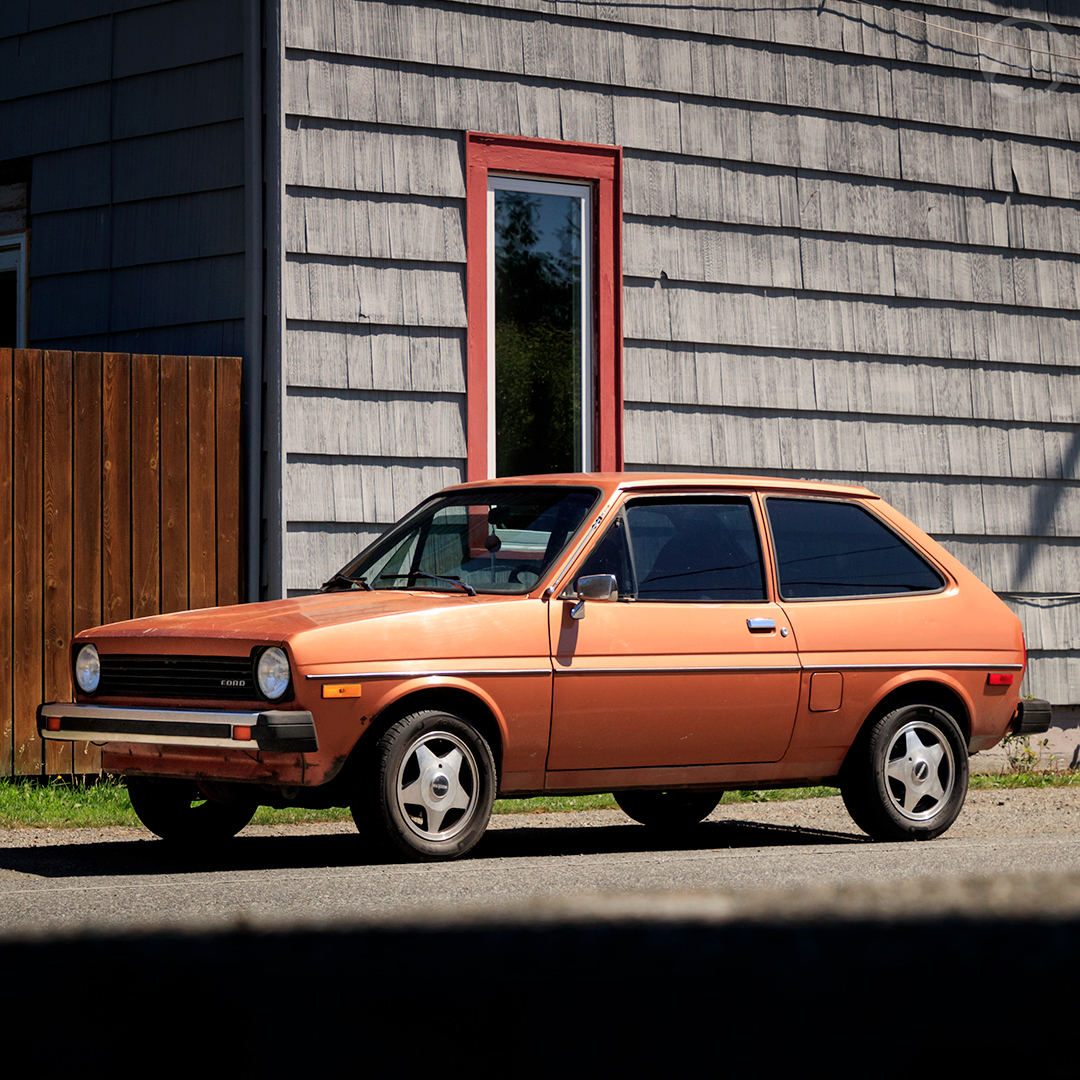
Mechanically, the Fiesta was straightforward and deliberately uncomplicated a quality that endeared it enormously to owners who had neither the time nor the inclination to spend weekends beneath the bonnet.
The Kent-series four-cylinder engines, offered initially in 957cc and 1117cc forms, were simple overhead-valve units of the old school a little rough and buzzy by later standards but enormously robust and easy to maintain.
Ford dealers across Britain and Europe could service them quickly and cheaply, and independent mechanics found them equally tractable. The Fiesta’s front-wheel-drive layout gave it a nimble, responsive feel in town that made threading through urban traffic genuinely enjoyable rather than merely tolerable.
The Fiesta’s success in Britain was particularly remarkable. At a time when domestic manufacturers were struggling to build cars that British buyers actually wanted, Ford an American company building Spanish-assembled cars in German factories managed to produce something that felt profoundly, instinctively right for the British commuter.
It was unpretentious, sensible, and honest. It didn’t claim to be more than it was, and what it was turned out to be exactly what millions of people needed.
By the end of the decade the Fiesta had become one of the best-selling cars in Britain, a position it would occupy with barely a pause for the next four decades.
The Mk1 established a template approachable styling, real-world packaging, reliable mechanicals, and a price that didn’t demand sacrifice that subsequent generations would refine but never fundamentally depart from.
For the 1970s commuter, the Ford Fiesta wasn’t simply a car. It was freedom measured out in miles per gallon, a small machine of genuinely large consequence.
3. Renault 5 (1972)
France has a long and honourable tradition of building small cars with outsized personalities, and the Renault 5 stands as perhaps the finest expression of that tradition. Launched in 1972 two years before the Golf and four before the Fiesta the Renault 5, known affectionately in Britain as the Le Car, arrived with a visual boldness that was entirely its own.
Where the Golf was geometric and precise, and the Fiesta was friendly and rounded, the Renault 5 was sculptural, almost architectural a car that looked as though it had been designed by someone who thought primarily in terms of form.
Michel Boué’s design for the Renault 5 was genuinely inspired, and it is a tragedy that he died young and never fully saw the scale of his creation’s success. The car’s most distinctive element was its integrated plastic bumpers a genuinely novel feature in 1972 that anticipated by years the direction the entire industry would eventually take.
These weren’t bolt-on afterthoughts but structural components that flowed organically from the car’s body, giving the Renault 5 a visual solidity that made it look purposeful and planted even when standing still. The profile was equally distinctive: a slightly rising beltline, a prominent rear hatch, and a greenhouse that felt expansive despite the car’s compact footprint.

For the urban commuter, the Renault 5 was a near-perfect machine. Its rear-engine layout inherited from Renault’s tradition of placing mechanical components where they were most useful for packaging gave it a flat front floor and a genuinely spacious interior relative to its external size.
The ride quality, too, was exceptional: Renault’s engineers had tuned the suspension for the realities of French urban roads, which meant potholes and cobblestones were absorbed with a suppleness that felt almost luxurious.
In a city like Paris, where roads could be rough and traffic perpetually aggressive, the Renault 5’s combination of agility, comfort, and compact dimensions made it the tool of choice for millions of commuters.
The range of engines offered throughout the 1970s was varied enough to suit almost every need: from the modest 782cc unit in the base model to the more spirited 1289cc engine that gave the Renault 5 TL a genuinely entertaining turn of speed.
Later in the decade, the 5 Alpine known in some markets as the Gordini would demonstrate that Renault’s little hatchback had genuine sporting potential, laying the groundwork for the later, turbocharged Renault 5 Turbo that would become a rally legend in the 1980s.
But it was as a commuter’s companion, not a performance machine, that the Renault 5 truly excelled. Economical, easy to park, comfortable over bad surfaces, and styled with a flair that made driving it feel like a small, daily act of aesthetic pleasure the Renault 5 was everything that a 1970s city-dweller could reasonably want from a car, wrapped in one of the decade’s most distinctive and enduring shapes.
4. Austin/Morris Mini (Hatchback Evolution, 1970s)
To include the Mini in any discussion of 1970s hatchbacks requires a small but important clarification. The Mini had, of course, been born in 1959 as Alec Issigonis’s revolutionary response to the 1956 Suez Crisis, and by the time the 1970s arrived it was already a genuine automotive legend.
But the decade brought significant evolution to the Mini’s specification and, crucially, confirmed its place in the lives of an entirely new generation of commuters who discovered in it everything they needed and almost nothing they didn’t.
The Mini of the 1970s was, in many respects, a more refined proposition than its original incarnation. British Leyland, whatever its many considerable failings as a corporation, had continued to develop the Mini’s mechanicals through the late 1960s and into the new decade.
The Hydrolastic suspension that had been fitted to earlier versions was replaced controversially for purists with a return to simpler rubber-cone suspension, which proved more durable and, in everyday use, arguably more effective.
The 998cc A-series engine, shared across a range of BL products, was a known quantity: modest in power but refined by long development, economical in fuel consumption, and virtually indestructible in everyday use provided it was maintained with reasonable conscientiousness.

What the Mini offered that its newer rivals could not quite replicate was a driving experience of singular character. The combination of its ultra-short wheelbase, front-wheel drive, and the concentration of all major mechanical components into the smallest possible space gave the Mini a handling agility that bordered on the extraordinary.
In urban traffic, this translated into a car that could be guided through gaps that no right-thinking driver would attempt in anything larger, parked in spaces that seemed mathematically insufficient, and turned around in streets that would have defeated even the Ford Fiesta. For the city commuter, this agility was not merely entertaining it was genuinely transformative.
The Mini’s interior, famously sparse in its original conception, had gained some small creature comforts by the 1970s improved seating, better instrumentation, additional sound insulation that, while still modest by any objective measure, represented real progress over the original’s industrial minimalism.
The car remained, at its core, a masterclass in spatial efficiency: four adults could be accommodated, however snugly, within an length of barely ten feet. The boot was modest but the rear seat folded, giving the Mini a practicality that belied its tiny footprint.
By the mid-1970s the Mini had outlasted most of the rivals that had been launched specifically to challenge it, and it continued to sell steadily throughout the decade as a second car, a commuter special, and a first car for young drivers who found in its simplicity and low running costs the perfect introduction to motoring.
It was not the most modern hatchback of the era, nor the most sophisticated, but it remained one of the most lovable a small car with a very large soul.
5. Toyota Corolla Liftback (1974)
If the Golf represented European rationalism and the Renault 5 embodied French flair, the Toyota Corolla Liftback of 1974 was something different again: a demonstration of Japanese industrial precision applied to the challenge of the everyday car, and a statement of intent from a manufacturer that was about to transform the global automotive world forever.
Toyota had been building Corollas since 1966, and by the time the third generation arrived in 1974 including, crucially, a new liftback bodystyle that gave the car genuine hatchback versatility the nameplate was already one of the world’s best-selling cars.
The liftback variant was particularly significant because it addressed one of the traditional criticisms of Japanese cars in European and American markets: that they were reliable and economical but somehow dull, anonymous, interchangeable.
The Corolla Liftback had a fastback roofline that gave it a genuine visual distinction, a sleek, almost sporty silhouette that suggested pace and modernity without sacrificing the practicality of its large, rear-opening hatch.
Mechanically, the Corolla of this era was a demonstration of everything Toyota had learned from two decades of increasingly sophisticated engineering.
The twin-cam engines the legendary 2T-C and, in more sporting variants, the 3T configuration were rev-happy, smooth, and responsive in a way that European economy cars of the period rarely managed.
These engines didn’t merely tolerate being worked hard; they seemed positively to relish it, delivering a driving experience that was notably more engaging than the car’s sensible, commuter-oriented positioning might have suggested.
Reliability was, of course, the Corolla’s headline virtue, and by the 1970s Toyota’s quality control processes were producing cars whose longevity simply exceeded anything that European manufacturers could routinely achieve.
This wasn’t merely an advantage in terms of ownership cost it was a philosophical statement about what a car could and should be. Where a British or Italian car might be understood to require regular mechanical attention as part of the relationship between driver and machine, the Toyota Corolla presented a different bargain: drive it, maintain it according to the schedule, and it will not give you trouble. For the time-poor commuter, this was an irresistible proposition.
The interior of the Corolla Liftback was a further demonstration of Japanese attention to detail. The materials were not exotic, but their fitting and finishing exceeded what was typically found in equivalent European cars.
Controls fell naturally to hand, instruments were clear and legible, and the ergonomic logic of the cabin suggested that someone had spent considerable time thinking about what it actually felt like to spend an hour in this car every day.
The Toyota Corolla Liftback was not a car that made headlines or inspired passion in the way that a Renault 5 Alpine or a Golf GTI might. But it was a car that changed minds particularly the minds of European and American buyers who discovered, often with some surprise, that Japanese engineering had arrived at a level of polish and dependability that their domestic manufacturers had not yet matched.
In doing so, the Corolla Liftback was not merely a successful car: it was the advance guard of a transformation that would reshape the global automotive industry entirely, and the 1970s commuter who chose it was, knowingly or not, making a choice that pointed toward the future.
Also Read: 6 Ways AI is Reducing Cost of Professional Car Repairs in 2026
