
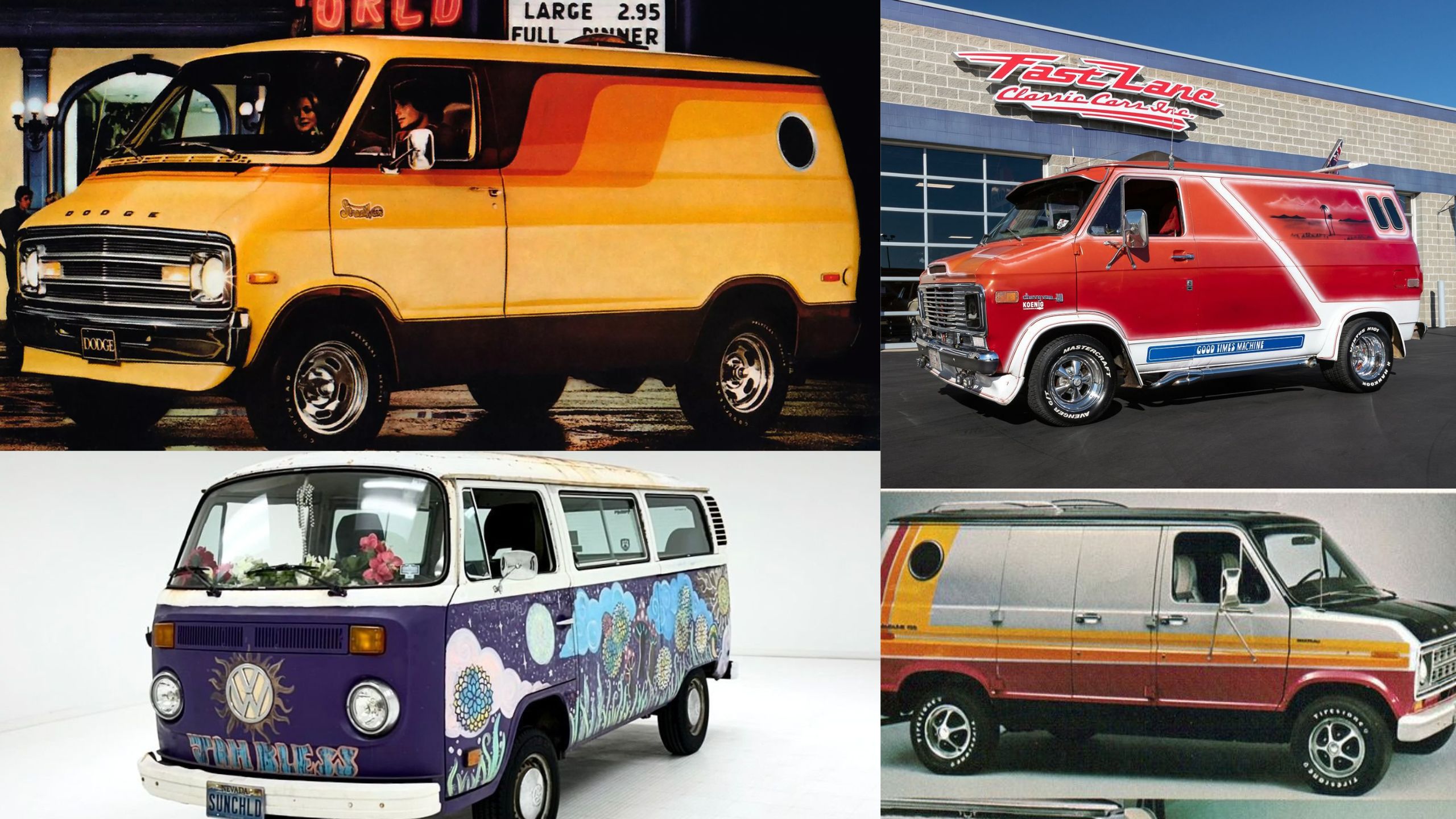
There was a moment in 1970s America when a plain steel box on wheels became the most personal statement a young person could make. It happened gradually, then all at once. The custom van craze was an offshoot of the muscle car phenomenon of the 1960s, when young rebels bought, tweaked, and drove muscle cars.
But as insurance premiums crept up and new low-emission standards were introduced, the next generation needed a new way to express themselves on the road. They found that way in the humble cargo van a blank rectangle of sheet metal just waiting to be transformed.
In the 1970s, the custom full-size vans built by Chevy, Ford and Dodge became the ultimate vehicles for self-expression. They represented an opportunity to escape at a moment’s notice in a tricked-out portable pad.
But beyond the shag carpet and bubble windows and 8-track stereos, it was the exterior murals that truly announced a van’s personality to the world. These weren’t mere paint jobs.
They were sprawling, airbrushed dreamscapes fire-breathing dragons, mythological warriors, cosmic goddesses, desert world, and fantasy scenes ripped from the imagination of an entire restless generation.
Talented painters were in high demand. Sharon Roberts of Etiboke, Ontario, was known as “Lady.” She was so highly regarded for her custom artwork she could charge $2,000 a mural in the Seventies.
By 1976, vanning had become a full-blown national phenomenon. Van clubs stretched all over North America. Vanfests and truck-ins were a thing. Magazines such as Custom Vans and Travvelin’ Van entered the market. In 1977, Time magazine reported on the van craze sweeping America.
What follows is the story of five classic vans real machines with real histories whose custom murals captured the spirit of a generation that refused to blend in.
1. The 1974 Dodge Tradesman
Of all the vans to emerge from the golden decade of American vanning, few carry as direct and documented a connection to the culture’s roots as the 1974 Dodge Tradesman known within vanning circles as the Chariots of the Gods van.
This specific machine didn’t just age gracefully it was preserved almost perfectly by a chain of owners who understood exactly what they had. And what they had was one of the clearest surviving examples of what it meant to grow up in 1970s America and pour your identity into a vehicle.
The showrunner of Chariots of the Gods, Nate Van Hofwegen, picked up this 1974 Dodge Tradesman from the original owner who received it from his parents as a high school graduation gift.
They had purchased it new in 1974 and had it modified before giving it to their son this may go down as one of the coolest graduation gifts of all time. The mural, by Bruce White, is quite well preserved for its age.
That single detail a van purchased new, customized, and gifted to a high school graduate captures everything true about what the vanning movement meant to American youth. It was not a fringe activity. It was a rite of passage.
Parents who had grown up driving practical cars understood that their children needed something different, something that spoke to a looser, more expressive post-Vietnam America. The Dodge Tradesman, particularly those from the 1971 through 1977 model years, was the platform of choice for exactly this kind of transformation.
Dodge Tradesman vans from the 1971–1977 model years were very popular as the basis for many custom vans during the custom van craze that occurred during the mid-to-late 1970s and early 1980s.
The Tradesman’s relatively affordable price tag and wide, flat body panels made it an ideal canvas. Unlike the muscle cars of the previous decade, the Tradesman wasn’t trying to be beautiful from the factory.
It was functional and intentionally plain which meant every ounce of visual drama it eventually carried came directly from its owner’s vision and the skill of the muralist hired to execute it.
Bruce White’s mural on this particular van followed the conventions of the best 1970s van art: bold lines, rich color gradients achieved through patient airbrushing, and subject matter drawn from the fantasy and mythology that saturated the decade’s pop culture.
The influence of artists like Frank Frazetta whose sword-and-sorcery paintings appeared on countless album covers and paperback novels, ran deep through the van mural world. Warriors, eagles, cosmic energy, and worlds that existed nowhere on earth were all fair game.
What makes the Chariots of the Gods van particularly significant is its survival. Most custom vans from the 1970s were driven hard, stripped for parts, or quietly retired to back lots as tastes changed.
The fact that this Tradesman endured, mural intact, through decades of shifting cultural attitudes is remarkable. It exists today as a rolling artifact of a moment when an entire generation decided that getting somewhere was less important than who you were when you arrived.
The van’s Dodge lineage gave it mechanical durability. The B-series engines, ranging from the reliable 225 cubic-inch Slant Six to optional V8 powerplants, were workhorses that could be driven coast to coast without drama.
This mattered enormously to the vanning culture, which prized freedom of movement above all else. You needed a van that could carry you from a truck-in in Colorado to a show-and-shine in Ohio without stranding you on an interstate. The Tradesman delivered that reliability, and the custom community responded by turning it into the decade’s defining rolling canvas.
2. The 1976 Ford Econoline “Cruising Van”
Few moments in 1970s automotive history are as telling as the day Ford Motor Company officially acknowledged the van craze by building a youth-targeted custom van straight off the factory floor.
That moment arrived in 1976 with the introduction of the Ford Econoline Cruising Van an acknowledgment from one of America’s largest corporations that young people had turned the humble cargo hauler into a full-blown cultural movement, and that there was real money in meeting them where they already were.
1976 was the first year that Ford manufactured a complete factory-produced and warranted youth van known as the Cruising Van. The significance of that cannot be overstated. Ford wasn’t responding to a niche request it was ratifying a phenomenon that had already swept across the country.
The Cruising Van came equipped with the kind of appointments that young vanners were building themselves: captain’s chairs, shag carpeting, tinted glass, and graphics packages that included two-tone paint and stripe treatments designed to evoke the handcrafted murals showing up on vans in every parking lot and truck-in across America.
On February 28, 1975, Ford Motor Company made truck history by introducing the first all-new family of Ford Econoline vans, along with the popular Club Wagons. Some historians said that the vans were the industry’s first vehicles of their type to feature a body-frame rather than unitized construction.
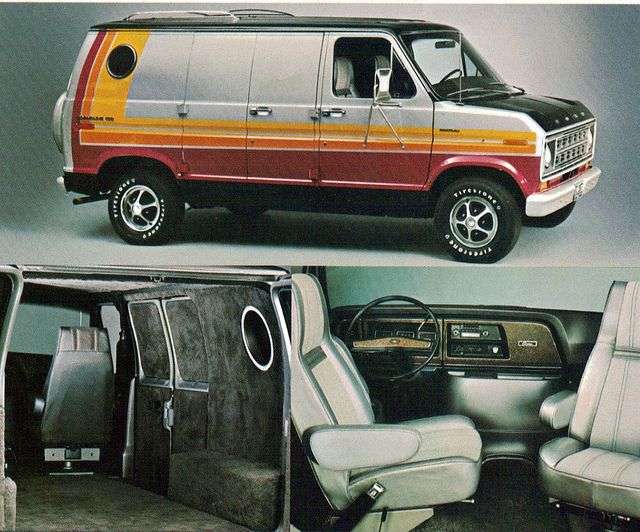
This structural foundation gave the Econoline a robustness that made it ideal for long road trips, van runs, and the general hard living that defined the culture.
Powered by engines ranging from a sturdy inline six to the optional 351 and 460 cubic-inch V8s, the Econoline could be loaded down with shag carpet, a waterbed, a refrigerator, and a sound system and still muscle its way across the country.
What the factory Cruising Van couldn’t provide was the hand-painted mural, and that’s where the real artistry lived. Vanners took these portable living rooms a step further, scooping up Ford Econoline and Dodge Tradesman vans, then renovating their interiors and exteriors with shag carpeting, refrigerators, and elaborate stereo systems.
Owners who started with a Cruising Van often took its factory graphics as a starting point and worked with local airbrush artists to expand them into full-panel fantasy compositions. A factory stripe might grow into a mountain scene. Factory two-tone paint might become the background for a swooping eagle or a Viking longship sailing through a cosmic fog.
Florida-based Skip Gage, who was once dubbed the “van Gogh of vans,” was one of the most celebrated figures in this world. After studying commercial art briefly in college, Gage went on to open a mural art shop in Naples, Florida.
Customers paid $175 and got a Gage original though nothing could quite outdone his own van, which featured a cobra on the sides with the head at the front. With the flip of a switch, a fire extinguisher would spray water from the cobra’s mouth.
The Econoline Cruising Van sat at the intersection of commerce and counterculture in a way that was uniquely American. Ford understood that the fantasy wasn’t just about the vehicle it was about what the vehicle meant.
Having a set of wheels that you had shaped to your own vision meant freedom, individuality, and rebellion from a society that increasingly felt corporate, homogenized, and bland.
The Cruising Van gave young buyers a head start on that vision while generating profitable sales for Dearborn. It was a partnership that both sides found entirely acceptable, which says something important about how thoroughly vanning had moved from fringe subculture to mainstream aspiration by the middle of the decade.
Also Read: Top 10 Brands Offering the Most Reliable Hands Free Driving Tech
3. The 1976 Dodge Street Van
If the Ford Cruising Van was a company acknowledging youth culture with a nod and a wink, the 1976 Dodge Street Van was Chrysler walking up to the counter and asking for everything on the menu.
No factory-produced van in the decade came closer to fully embracing the spirit of the custom van movement than the Street Van, a machine that Chrysler marketed with a candor that would be unimaginable from a major automaker today.
In 1976, Chrysler was taking part in a product line few people are aware of today dubbed “Adult Toys.” The toys were a series of factory-issued utility vehicles that rolled off the assembly line outlandishly customized in what would become a staple of late 1970s automotive culture.
In 1976, the inevitable happened and Dodge birthed from its shag-carpeted doors the Street Van. The name said everything. This wasn’t a work vehicle. It wasn’t a family hauler. It was a machine built for the street, for the truck-in, for the parking lot cruise and for whatever happened in the back.
The Street Van package consisted of a “Street Van” logo on the passenger and driver’s side door, chrome trim on the grille and windshield, simulated wood grain inlays in the steering wheel, five-slot chrome wheels or white spoked off-road type wheels, chrome front and rear bumpers, chrome trim on the gauges, and membership in the “Dodge Van Clan.”
That last item membership in the Dodge Van Clan reveals how deeply Chrysler had studied the culture it was entering. Vanning was a community activity.
People didn’t just buy vans; they joined clubs, attended shows, exchanged ideas at truck-ins, and formed lifelong friendships organized around their machines. Chrysler wasn’t just selling a vehicle. It was selling a social identity.
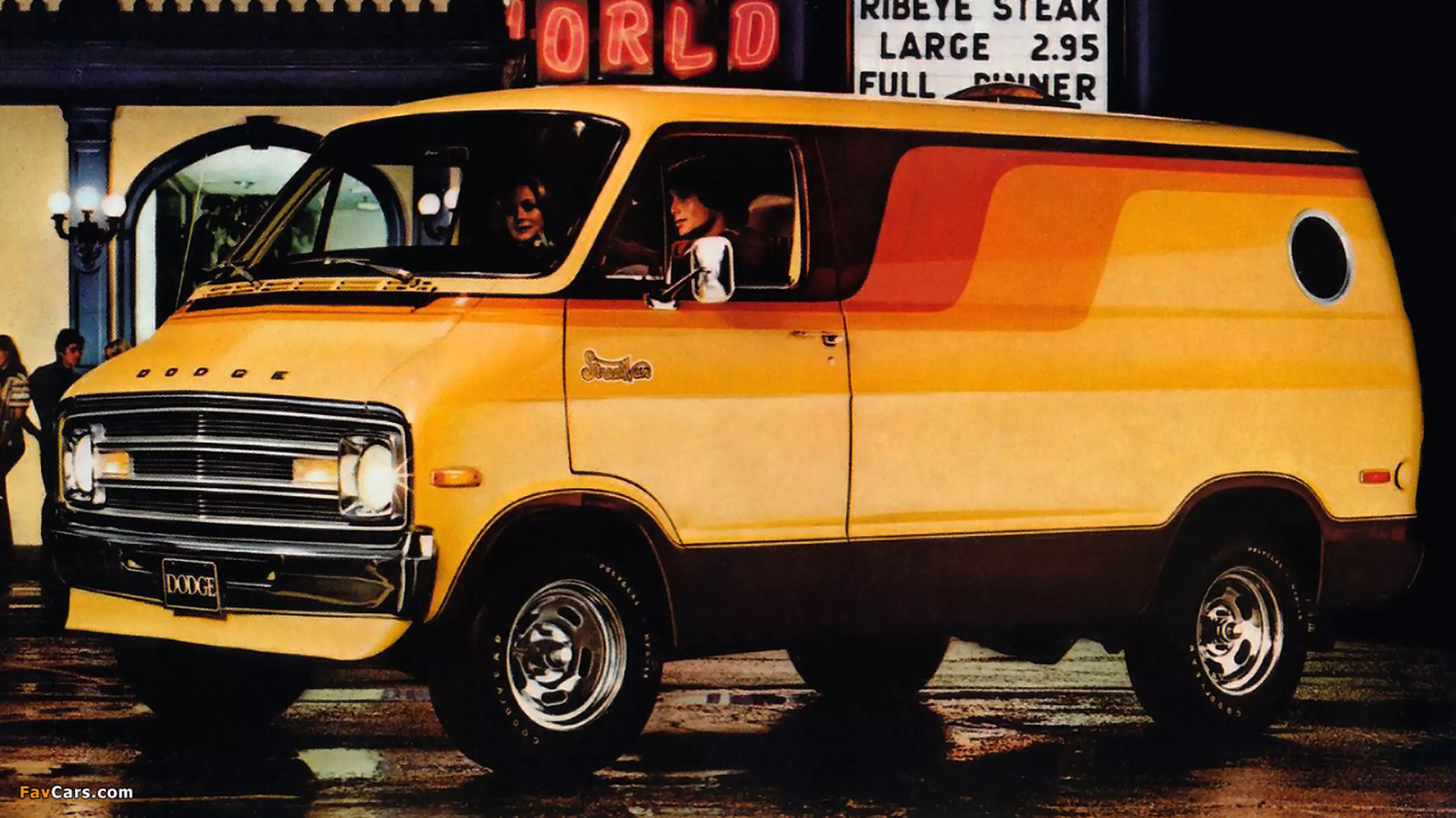
What truly raised the Street Van’s place in the mural culture was the Customizing Idea Kit provided to buyers. Street Van buyers received this kit, which included suggestions for paint schemes and interior choices, as well as a listing of aftermarket suppliers that could outfit their van with spoilers, fender flares, sunroofs, vents, and portholes of nearly every shape.
The kit included template designs and paint codes that gave owners a blueprint for transforming their Street Van into something entirely personal. Some owners followed the factory suggestions.
Many used them as a jumping-off point for far more ambitious projects, commissioning local airbrush artists to paint wizards, wolves, desert sunsets, and mythological battle scenes across the van’s wide steel flanks.
Many of these custom vans featured elaborate and beautiful airbrushed murals adorning the outside of the van, and some of the artistry was magnificent and admired by people of all ages.
The Street Van was offered in long-wheelbase configurations with the option of powerful big-block engines, including the 400 and 440 cubic-inch V8s, which gave buyers not just a canvas but a genuine performance machine beneath all that art.
A Street Van with a built 440 was no different from a muscle car in its essential character it simply expressed that character through a different vocabulary. The Street Van package was available from the 1976 model year until it was discontinued in the early 1980s.
By the time it was gone, the Street Van had earned its place as one of the most honest expressions of what American automotive culture looked like during a decade defined by contradictions economic uncertainty and hedonism, fuel shortages and gas-guzzling big blocks, corporate manufacturing and radical individualism. The Street Van somehow contained all of it.
4. The 1976 Chevrolet G20 “Good Times Machine”
Not every legendary van from the 1970s came from a factory customization package. Some of the most celebrated examples were produced by independent conversion shops that operated as full-scale mural and custom interior studios, turning out finished vans at a pace that would astonish anyone who thinks of custom work as slow or precious.
Of these shops, one of the most storied was Good Times of Arlington, Texas and the vans that carried its name became touchstones of what the decade’s custom van scene could achieve at its commercial peak.
Good Times was a custom shop in Arlington, Texas, employing upwards of 70 people and turning out a reported 10 vans per day at its peak. It was one of the larger players in the custom van game, and they did their thing throughout the 1970s and 1980s.
Ten vans a day. That figure reveals how enormous the appetite for custom vans had become by the middle of the decade. This was not a cottage industry. This was manufacturing art at scale, airbrushed dreams produced on a schedule, each van representing someone’s investment in an identity they couldn’t find anywhere else.
The Chevrolet G20 was the platform of choice for many conversion operations, Good Times included. Chevy vans from the 1970s offered wild, colorful side illustrations that appealed to younger drivers and inspired many to showcase their new vans. The G20’s wide body panels gave muralists more room to work than almost any other vehicle on the road.
A skilled airbrush artist working on a G20 had a canvas nearly as large as a bedroom wall enough space to tell a complete visual story, with foreground and background, primary subject and supporting detail, all blending together through the gradations that only skilled airbrush technique could produce.
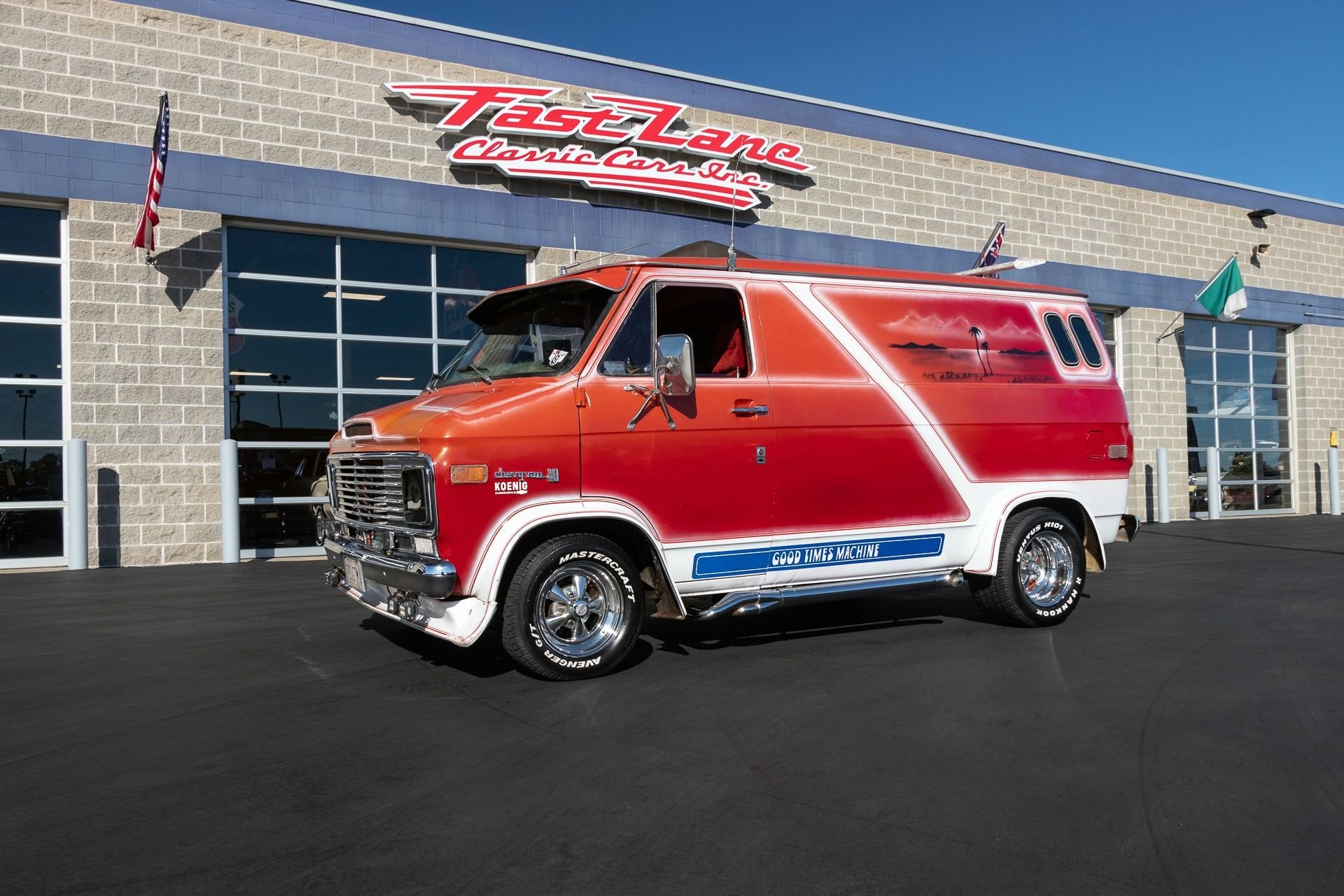
The Good Times Machine finish was recognizable: bold color palettes dominated by reds, oranges, and deep blues, interiors finished in coordinated shag carpet and crushed velvet, side pipes chromed to a mirror finish, and exterior murals that announced the van’s presence long before you could read its name.
At their wildest, vans were rolling canvases for elaborate murals, complete with flame-spitting dragons, graceful goddesses, wild wolves, whimsical wizards and open-range western scenes.
Good Times vans drew from this entire vocabulary, often combining elements a wolf beneath a full moon beside a cosmic energy burst beside a mountain range into compositions that somehow hung together through the sheer confidence of the execution.
People even named their rides. Stop at a light and you might see a van adorned with a “Ripped Van Winkle” insignia or a “Vanatomy” slogan. The Good Times Machine name that appeared on many Arlington-built vans served a similar function it was an identity statement, a declaration of purpose, a signal to everyone on the road that the vehicle’s occupants had made a deliberate choice to live differently.
Surviving Good Times Machines are rare today, which makes documented examples particularly valuable to collectors. A 1976 G20 built by Good Times represents not just one owner’s expression but the output of an entire industrial operation devoted to turning American youth culture into something you could park in a driveway and watch your neighbors walk over to admire.
5. The Volkswagen Type 2 (T2)
Any honest account of the van mural culture that defined 1970s youth must begin and end with the Volkswagen Type 2. The Type 2, known variously as the Microbus, the Kombi, the Transporter, and simply the Bus, was not a 1970s vehicle by origin.
Back in 1950, the Type 2 Volkswagen was introduced. Designed by Dutch businessman Ben Pon as a functional and inexpensive box to move goods from place to place, it came to be called the “Transporter” or “Microbus.” Envisioned as a practical vehicle, its creators never anticipated the cultural revolution that turned it into the iconic painted bus by the end of the 1960s.
What the Type 2’s designers created, and what two generations of young Americans transformed through paint, was the original rolling canvas. The second-generation T2, produced from 1967 onward, carried that tradition deep into the 1970s with its broader body, improved driveability, and large flat panels that seemed almost designed to receive a mural.
By the time the American vanning craze reached its full roar in the mid-1970s, the painted VW Bus was the ancestral image against which every custom Econoline, Tradesman, and G20 defined itself.
It was Ken Kesey and the Merry Pranksters who first showed the country what a painted vehicle could mean when they used an old school bus to travel America in the early 1960s, setting up what were known as “acid tests.”
Riding around in a bus they named Furthur, the Pranksters had an eye for artistic flair. They decorated Furthur with vibrant colors and patterns, like a rainbow put through a kaleidoscope.
That precedent the painted vehicle as a philosophical statement, as evidence that you had chosen a different path was the foundation everything else was built on. The VW Bus community absorbed it, expanded it, and by the early 1970s had turned it into a complete aesthetic language.
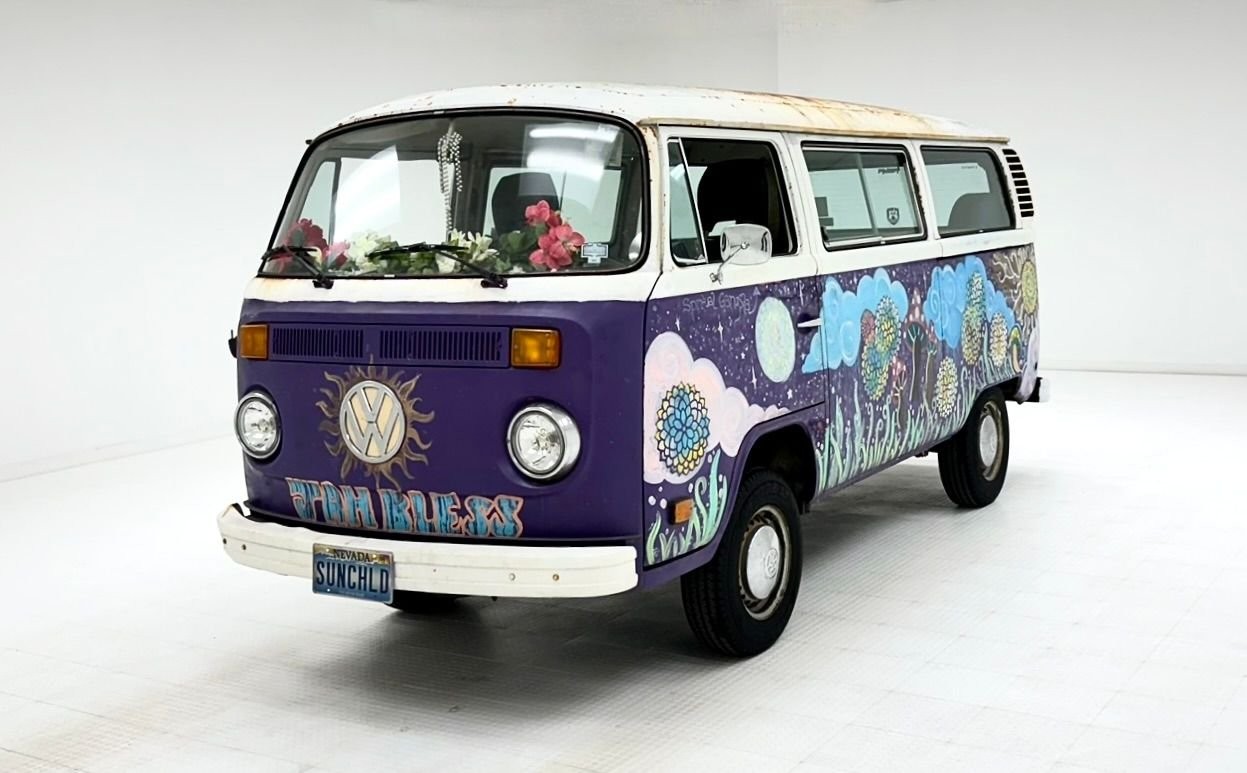
The VW Microbus became the choice mode of transport for young people heading to concerts or protest marches due to its ability to fit lots of gear, people, and supplies.
Decorating your vehicle was a political statement as well as an artistic one it meant you wanted to be seen, you had something to say, and weren’t afraid for everyone to know it.
This dimension the mural as manifesto gave the painted VW Bus a meaning that the later American custom vans largely set aside in favor of pure aesthetic pleasure. The Dodge Tradesman with a dragon on its flank was an expression of personality. The painted VW Bus was often an argument.
The VW Bus became more than just a vehicle; it transformed into a mobile home for many, providing a space where friendships were forged, philosophies were shared, and creativity flourished.
The colorful murals and peace symbols often splashed across these buses were manifestos of a generation. By the mid-1970s, the iconography had shifted somewhat fewer protest signs, more cosmic imagery, more fantasy but the underlying impulse remained the same.
Whether you were painting a peace sign on a split-window Bus in 1967 or commissioning an airbrushed Norse warrior on a T2 in 1975, you were doing the same essential thing: declaring that the vehicle you drove was an extension of who you believed yourself to be.
In Brazil, the Volkswagen Type 2 stayed in production until 2013 a longevity that reflects the depth of the attachment that formed between this vehicle and the cultures it served. No American van could claim a legacy that stretched across continents and decades the way the Type 2 did. It was the original, the ancestor, the patron saint of every mural that ever dried on a van’s steel skin.
When the great American custom van era finally wound down in the early 1980s its supporters older and out of fashion, rising fuel costs making it prohibitively expensive to attend van events the painted VW Bus carried the flame forward, its murals fading but never quite disappearing, waiting for the moment when the world would be ready to look at them again.
Also Read: 8 Reasons Hydrogen Is Becoming a Real Alternative to Diesel Trucks
