
In an automotive world increasingly dominated by forced induction, turbochargers, and hybrid systems, naturally aspirated engines represent a pure, unadulterated connection between driver and machine.
These mechanical marvels rely solely on atmospheric pressure to draw air into their combustion chambers, creating power through engineering excellence rather than artificial boost.
The result is an intoxicating, linear power delivery that builds predictably and rewards skilled driving, accompanied by some of the most glorious soundtracks ever produced by internal combustion engines.
The fastest naturally aspirated sports cars stand as testaments to what’s possible when brilliant engineers push the boundaries of physics, metallurgy, and aerodynamics.
These machines achieve their blistering velocities through high-revving engines, lightweight construction, and meticulous attention to every detail that affects performance.
From screaming V12s that approach 9,000 RPM to highly-tuned V10s and sophisticated V8s, these engines represent the pinnacle of naturally aspirated technology.
What makes these cars truly special isn’t just their top speeds, but how they achieve them. The throttle response is immediate, the engine note rises and falls with perfect correlation to the driver’s inputs, and there’s a raw, organic quality to the acceleration that turbocharged alternatives struggle to replicate.
As emission regulations and efficiency demands push manufacturers toward downsized, boosted engines, these naturally aspirated legends become increasingly precious, representing an era of engineering purity that may never return. These are the ten greatest expressions of naturally aspirated performance ever created.
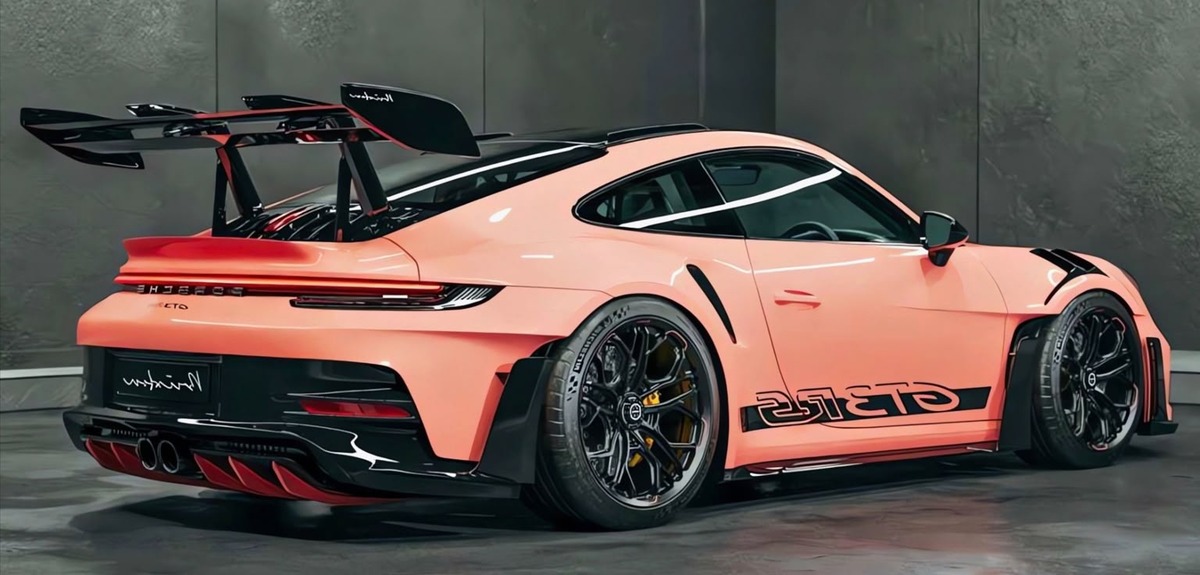
1. Porsche 911 GT3 RS (992)
The Porsche 911 GT3 RS represents the absolute zenith of naturally aspirated flat-six engineering, combining decades of motorsport heritage with cutting-edge technology to create one of the most focused road-legal track weapons ever conceived.
At the heart of this German masterpiece lies a 4.0-liter flat-six engine that produces 518 horsepower at a screaming 8,500 RPM, with a 9,000 RPM redline that delivers one of the most spine-tingling soundtracks in modern motoring.
What separates the GT3 RS from ordinary sports cars is Porsche’s unwavering commitment to weight reduction and aerodynamic efficiency. Every component has been scrutinized, optimized, and refined to enhance track performance.
The extensive use of carbon fiber, lightweight glass, and titanium components helps keep weight to a minimum, while the aggressive aerodynamic package generates massive downforce without creating excessive drag.
The iconic rear wing, which automatically adjusts based on speed and driving mode, works in concert with the front splitter and underbody diffusers to plant the car firmly to the tarmac at high speeds.
The engine itself is a masterclass in naturally aspirated performance. Derived directly from Porsche’s motorsport programs, it features individual throttle bodies for each cylinder, ensuring instantaneous throttle response and perfectly linear power delivery.
The seven-speed PDK dual-clutch transmission shifts with lightning speed, allowing drivers to keep the engine in its optimal power band during aggressive driving.
Unlike turbocharged alternatives, there’s no lag, no waiting for boost to build just immediate, visceral acceleration that builds relentlessly toward the stratospheric redline.
The GT3 RS achieves a top speed of 184 mph, but numbers alone don’t capture the experience. The steering communicates every detail of the road surface, the chassis remains perfectly balanced even at the limit, and the brakes provide seemingly endless stopping power.
The sound of that flat-six engine at full cry, echoing off canyon walls or reverberating through a tunnel, is an automotive symphony that stirs the soul in ways that synthesized engine notes and turbocharged whooshes simply cannot match.
Porsche has proven that in an age of electric assistance and forced induction, there’s still magic to be found in pure, naturally aspirated performance.
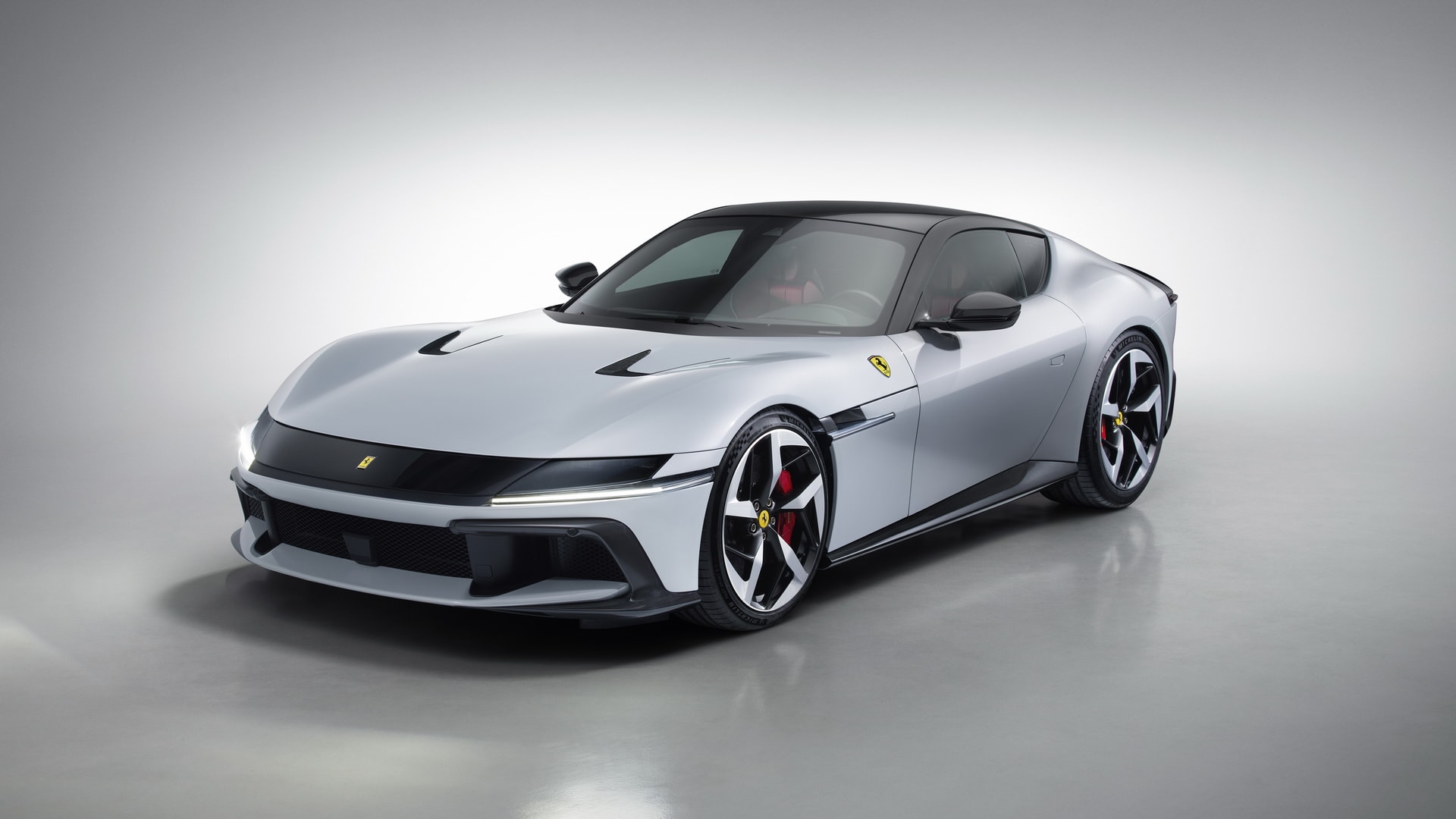
2. Ferrari 812 Superfast
The Ferrari 812 Superfast lives up to its audacious name, representing the Italian manufacturer’s final hurrah for front-engine, naturally aspirated V12 grand tourers.
This automotive masterpiece houses a 6.5-liter V12 that produces an astonishing 789 horsepower at 8,500 RPM, making it the most powerful naturally aspirated production car Ferrari has ever created.
The engine’s specific output of 121 horsepower per liter stands as a testament to Ferrari’s unmatched expertise in extracting maximum performance from atmospheric induction.
The 812 Superfast achieves a top speed of 211 mph, placing it among the fastest naturally aspirated cars ever built. But the velocity is only part of the story.
The real magic lies in how this V12 delivers its power a smooth, relentless surge that builds from 3,500 RPM all the way to its 8,900 RPM redline.
There’s no turbocharged punch or sudden boost; instead, the acceleration feels endless, organic, and completely addictive. The seven-speed dual-clutch transmission responds to paddle inputs in just 30 milliseconds, ensuring the engine remains in its optimal operating range during spirited driving.
Beyond straight-line speed, the 812 Superfast demonstrates remarkable agility for a front-engine GT car. The rear-wheel steering system enhances both low-speed maneuverability and high-speed stability, while the advanced magnetic dampers adapt within milliseconds to changing road conditions.
The carbon-ceramic brakes provide fade-free stopping power, essential for taming the V12’s prodigious performance. Despite its 3,570-pound curb weight, the car feels nimble and responsive, rotating willingly into corners while maintaining the grand touring comfort that makes it suitable for transcontinental journeys.
The 812 Superfast represents a bridge between Ferrari’s glorious past and its electrified future, a final reminder of what naturally aspirated engines can achieve when crafted by passionate Italian engineers who refuse to compromise on performance or emotion.
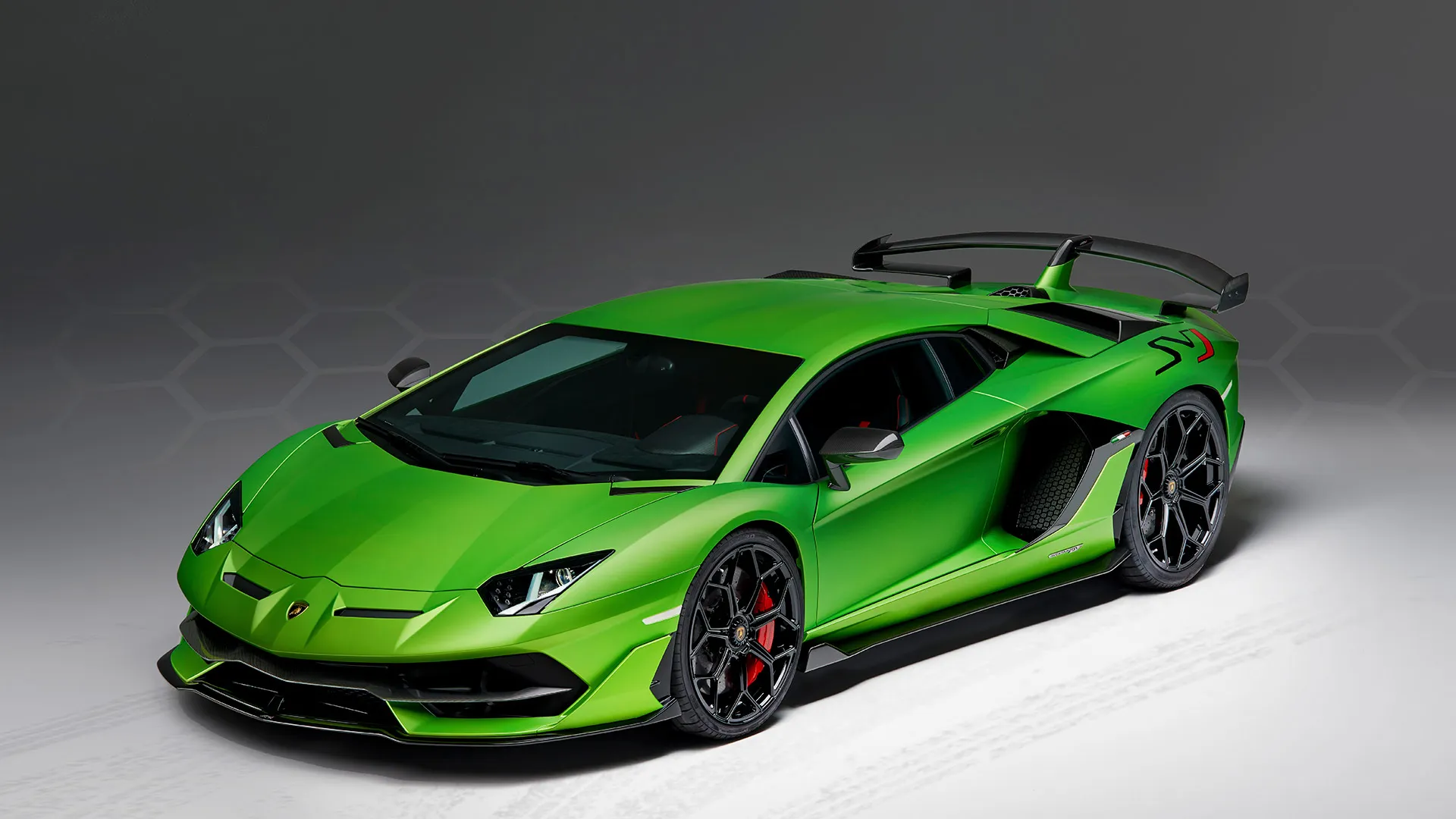
3. Lamborghini Aventador SVJ
The Lamborghini Aventador SVJ (Superveloce Jota) stands as the ultimate expression of Lamborghini’s naturally aspirated V12 philosophy, a raging bull that combines brutal power with aerodynamic sophistication.
At its heart lies a 6.5-liter V12 producing 759 horsepower at 8,500 RPM, delivering power through a seven-speed automated manual transmission to all four wheels. This Italian exotic achieves a top speed of 217 mph, making it one of the fastest naturally aspirated production cars ever created.
What makes the SVJ truly extraordinary is its ALA 2.0 (Aerodinamica Lamborghini Attiva) system, which actively manages aerodynamics in real-time.
Front flaps and rear wing elements open and close within 500 milliseconds, optimizing downforce for corners or reducing drag for straight-line speed. In maximum downforce configuration, the SVJ generates 40 percent more downforce than the standard Aventador, allowing it to corner at speeds that seem to defy physics.
The extensive use of carbon fiber throughout the chassis and body panels keeps weight to just 3,362 pounds, ensuring the massive V12’s power isn’t wasted moving unnecessary mass.
The driving experience in an SVJ is visceral and unfiltered. The engine sits just inches behind the occupants, its mechanical cacophony filling the cabin with a soundtrack that ranges from a menacing idle rumble to an apocalyptic scream at full throttle.
The all-wheel-drive system has been calibrated to feel rear-biased, allowing controlled slides on corner exits while maintaining the traction necessary to deploy all 759 horses effectively.
The rear-wheel steering system enhances both low-speed agility and high-speed stability, making this supercar surprisingly manageable despite its extreme performance capabilities.
The SVJ held the Nürburgring production car lap record upon its release, proving that naturally aspirated performance can still compete with and beat forced induction alternatives when executed with Lamborghini’s signature passion and precision.
4. Aston Martin Valkyrie
The Aston Martin Valkyrie represents Formula 1 technology translated to road legality, a collaboration between Aston Martin and Red Bull Racing’s Adrian Newey that has produced one of the most extreme naturally aspirated hypercars ever conceived.
Its Cosworth-developed 6.5-liter V12 produces 1,000 horsepower at an astronomical 10,500 RPM, with an 11,100 RPM redline that makes it the highest-revving production car engine ever built.
Combined with a hybrid system, total output reaches 1,160 horsepower, but even considering just the internal combustion component, this naturally aspirated V12 stands alone in its achievements.
The Valkyrie’s top speed exceeds 220 mph, but reducing this car to simple numbers fails to capture its revolutionary nature. Adrian Newey approached the Valkyrie as he would a Formula 1 car, obsessing over aerodynamic efficiency to the point where the entire vehicle functions as a ground-effect system.
The sculpted underbody and dramatic bodywork work together to generate massive downforce without relying on large wings that create drag.
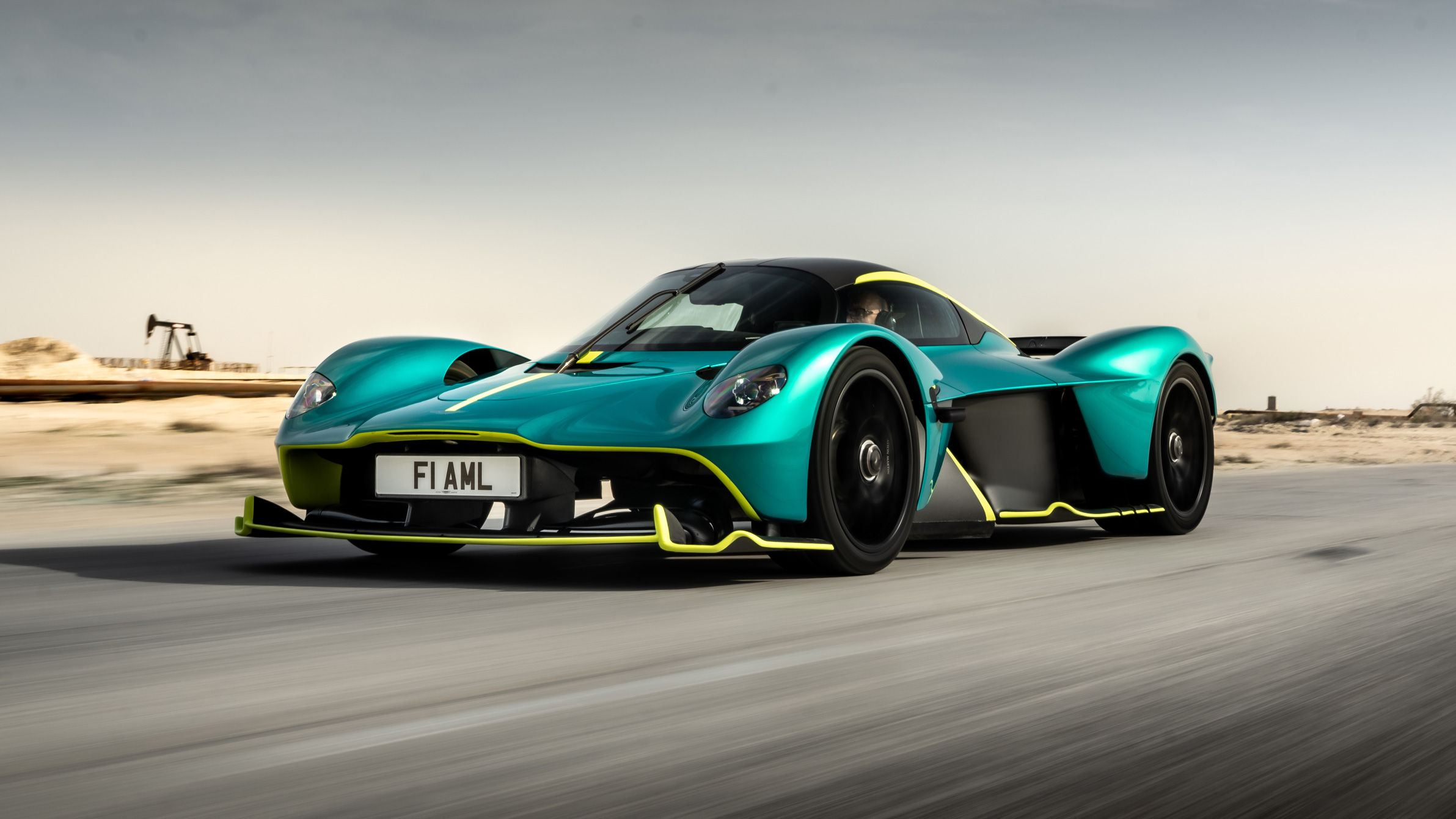
The result is a car that can theoretically generate more downforce than its own weight at speed, allowing it to drive upside down in a tunnel at least in theory.
Only 150 Valkyries will be produced, each one hand-assembled and personalized to its owner’s specifications. The driving position places occupants in a reclined, Le Mans-style seating position, while the steering wheel houses most controls, including the gear shift buttons.
The experience of piloting a Valkyrie reportedly comes closer to driving a Formula 1 car than any other road-legal vehicle, with response times, cornering forces, and sensory input that exceed what most drivers have ever experienced.
The Valkyrie represents not just the pinnacle of naturally aspirated performance, but potentially the final expression of pure internal combustion engineering before electrification becomes universal in the hypercar segment.
Also Read: 8 Most Expensive American Muscle Cars Ever Sold, Ranked by Auction Records
5. Lexus LFA
The Lexus LFA occupies a unique position in automotive history as Toyota’s $375,000 halo car that prioritized perfection over profitability.
At its heart lies a 4.8-liter V10 developed specifically for this application, producing 552 horsepower at 8,700 RPM with a 9,000 RPM redline.
This Japanese exotic achieves a top speed of 202 mph, but the LFA’s legacy extends far beyond simple performance metrics it’s widely considered to produce the greatest engine sound of any production car ever built.
Toyota’s engineers spent a decade developing the LFA, and their obsessive attention to detail shows in every aspect. The V10 engine features titanium valves and connecting rods to reduce reciprocating mass, allowing it to rev so quickly that a traditional analog tachometer couldn’t keep pace necessitating the digital display that became one of the car’s signature features.
The engine can rev from idle to redline in just 0.6 seconds, faster than most drivers can react. Yamaha’s expertise in musical instruments influenced the exhaust system’s design, with engineers tuning the header lengths and muffler configurations to create a sound that’s both emotionally stirring and acoustically perfect.
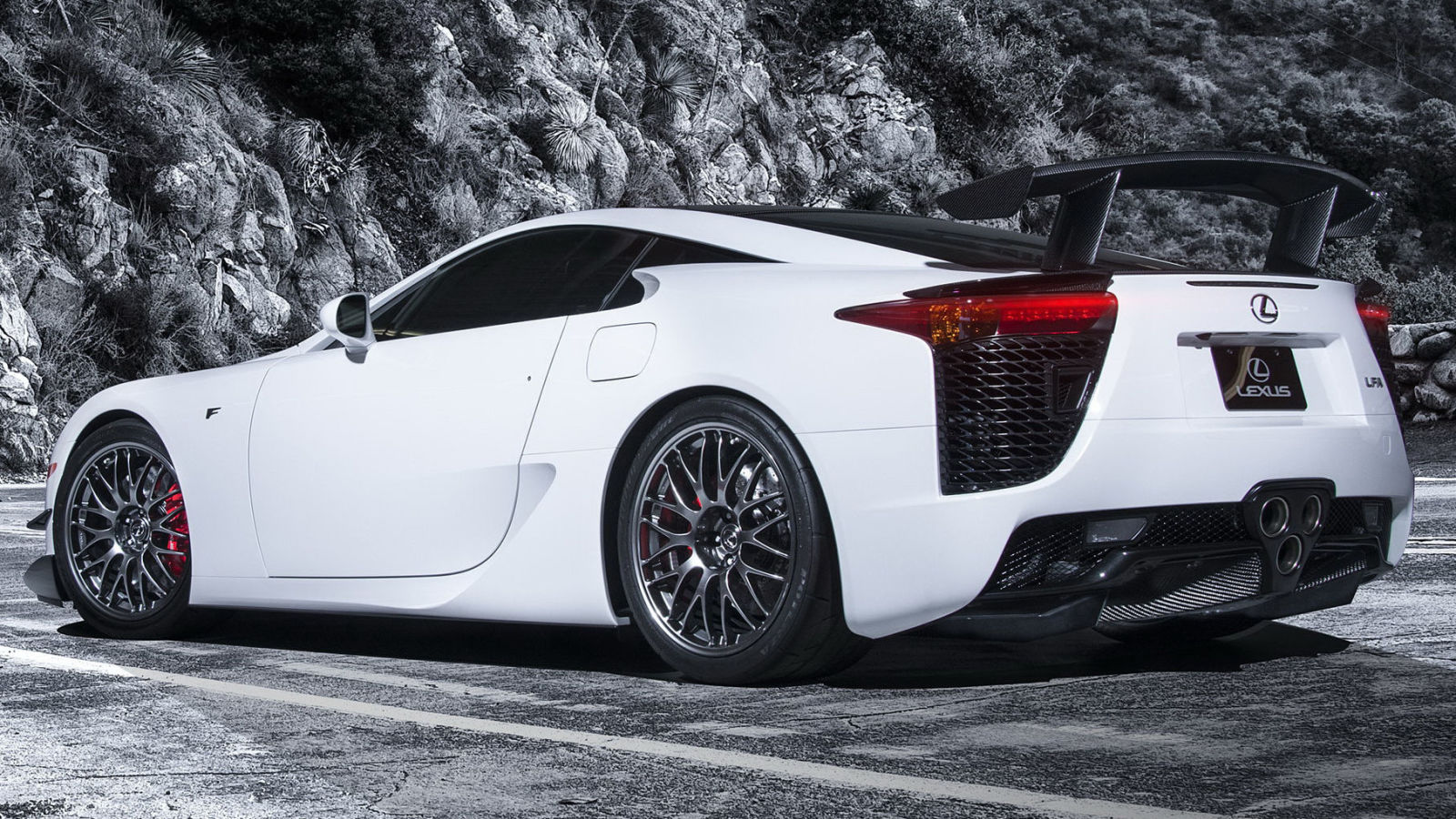
The LFA’s carbon fiber reinforced polymer monocoque chassis weighs just 143 pounds, contributing to a total curb weight of 3,263 pounds remarkable for a car with such presence and refinement.
The body panels are also carbon fiber, hand-laid by master craftsmen in a dedicated facility. Each LFA required six months to build, with only 500 examples produced between 2010 and 2012.
The six-speed automated sequential transmission was chosen over a dual-clutch system specifically because it provided superior sound transmission to the cabin, demonstrating how prioritizing emotion and engagement sometimes means rejecting the technically superior solution.
Driving an LFA is an experience unlike any other naturally aspirated sports car. The V10 pulls cleanly from low RPM but truly comes alive above 6,000 RPM, where the intake roar and exhaust note combine into an automotive opera that makes every journey feel like a special occasion.
The steering provides exceptional feedback, the chassis balance is neutral and predictable, and the carbon-ceramic brakes deliver tremendous stopping power. The LFA wasn’t just about achieving the highest top speed or quickest lap times it was about creating an emotionally perfect sports car that engaged all the senses.
Values have appreciated significantly since production ended, with pristine examples now commanding substantially more than their original sticker price, as collectors recognize the LFA as one of the last truly special naturally aspirated supercars.
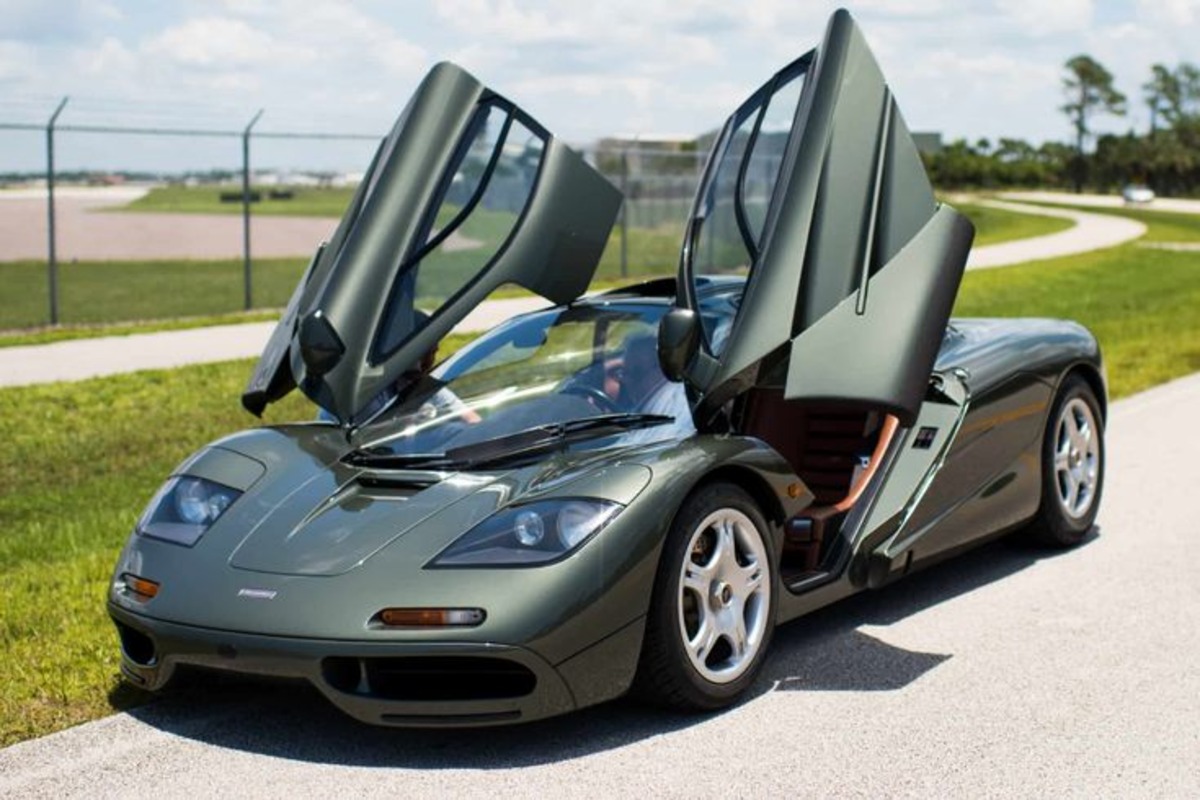
6. McLaren F1
The McLaren F1 remains the definitive naturally aspirated supercar, a machine that redefined what was possible when it debuted in 1992 and continues to command reverence three decades later.
Its BMW-developed 6.1-liter V12 produces 618 horsepower at 7,400 RPM, and the F1 achieved a top speed of 240.1 mph in 1998 a record it held for naturally aspirated production cars for over a decade.
Only 106 examples were produced, and they regularly sell for tens of millions of dollars today, testament to the F1’s legendary status.
Gordon Murray’s design philosophy centered on creating the purest possible driving experience. The central driving position places the pilot directly on the car’s centerline, with passenger seats flanking slightly back on either side.
This configuration provides perfect weight distribution and an uncompromised view of the road ahead. The entire vehicle was engineered without compromise if a component didn’t serve to reduce weight, increase performance, or enhance the driving experience, it was eliminated.
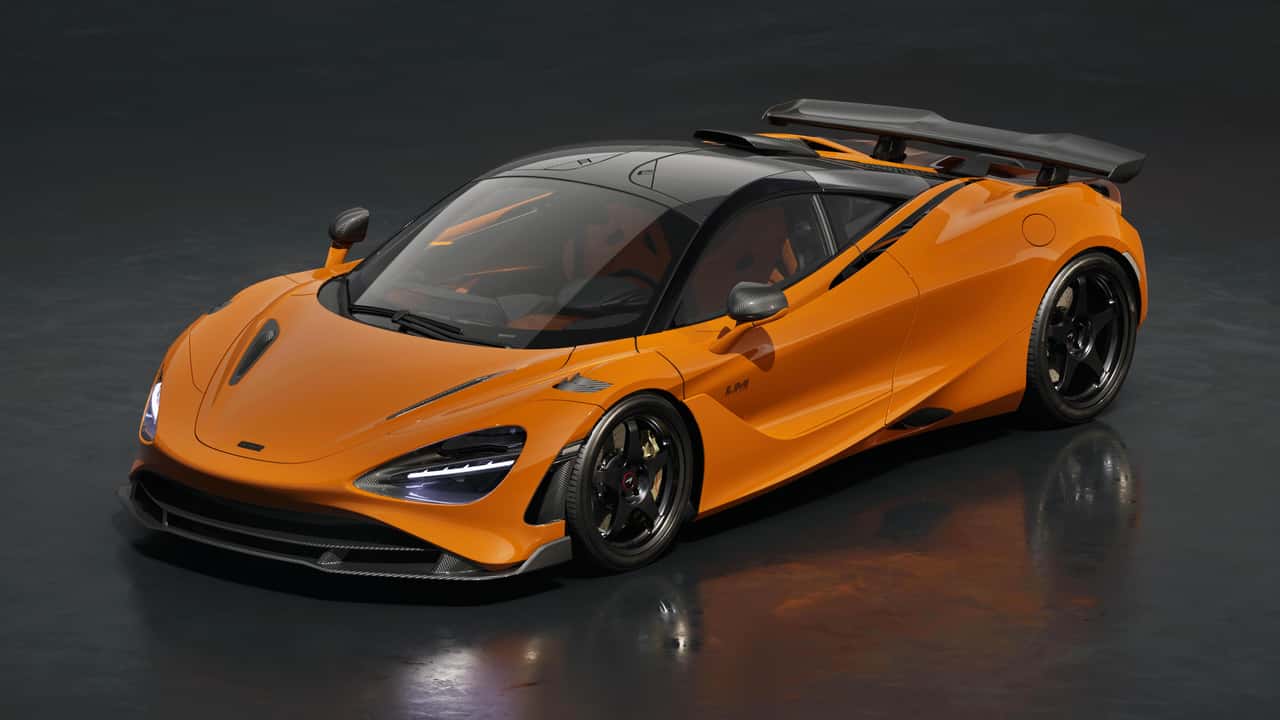
The result is a car weighing just 2,509 pounds, giving it a power-to-weight ratio that remains competitive with modern hypercars despite being developed before computer-aided design became standard.
The F1’s achievements extend beyond straight-line speed. It won the 24 Hours of Le Mans in 1995 on its first attempt, defeating purpose-built prototypes with a car derived directly from the road-going version.
The combination of aerodynamic efficiency, mechanical reliability, and balanced performance made it dominant in endurance racing despite competing against specialized machinery.
Today, the F1 represents the gold standard by which all other supercars are measured, a timeless design that proved naturally aspirated engines, manual transmissions, and driver-focused engineering could create automotive perfection.
Its influence echoes through every subsequent supercar, and many consider it the greatest road car ever built, naturally aspirated or otherwise.
7. Ferrari F12berlinetta
The Ferrari F12berlinetta arrived in 2012 as the successor to the 599, bringing with it a naturally aspirated 6.3-liter V12 producing 729 horsepower at 8,250 RPM the most powerful front-engine Ferrari at the time.
With a top speed of 211 mph and acceleration from 0-60 mph in just 3.1 seconds, the F12berlinetta demonstrated that front-engine grand tourers could compete with mid-engine supercars on performance while offering superior practicality and everyday usability.
Ferrari’s engineers achieved the F12berlinetta’s extraordinary performance through a combination of advanced materials and cutting-edge technologies.
The chassis features twelve different aluminum alloys, each selected for specific structural requirements, resulting in a body that’s 20 percent lighter than the 599 it replaced while being significantly stiffer.
The transaxle layout places the seven-speed dual-clutch transmission at the rear axle, improving weight distribution to an ideal 46/54 front-to-rear split.
Active aerodynamics include the Aero Bridge, which channels air from the hood through the fenders, reducing drag while generating downforce over the front axle.
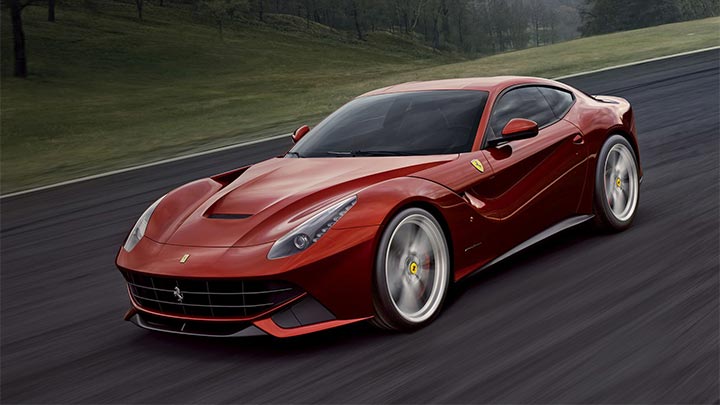
Driving the F12berlinetta reveals a character distinctly different from mid-engine alternatives. The front-engine configuration creates a more traditional sports car feel, with the weight of the V12 sitting just behind the front axle providing a sense of substance and stability.
The steering is direct and communicative, the chassis remains beautifully balanced even when pressing hard through corners, and the naturally aspirated V12 delivers a progressive, predictable power delivery that inspires confidence.
The magnetorheological dampers adapt continuously to road conditions, providing both comfort for grand touring and exceptional body control during spirited driving.
Ferrari sold over 5,000 F12berlinettas during its production run, making it one of the most successful V12-powered Ferraris and a final celebration of naturally aspirated front-engine performance before emissions regulations forced the adoption of turbocharged powertrains throughout Ferrari’s range.
8. Dodge Viper ACR (2016)
The 2016 Dodge Viper ACR (American Club Racer) represents American naturally aspirated performance at its most uncompromising, a track-focused monster that proved pushrod V10 engines could compete with sophisticated European exotics.
Its 8.4-liter V10 produces 645 horsepower at 6,150 RPM and a staggering 600 lb-ft of torque at 4,950 RPM, with a top speed of 177 mph.
While the Viper may not be the fastest naturally aspirated car in absolute terms, it held more production car track records than any other vehicle at the time of its retirement, demonstrating that outright top speed isn’t the only measure of performance.
The ACR’s extreme aerodynamic package generates an astonishing 1,465 pounds of downforce at 150 mph more than any other production car available when it debuted.
The massive carbon fiber rear wing, aggressive front splitter with dive planes, and carbon fiber side skirts work in concert to plant the Viper firmly to the track surface.
The suspension has been lowered and stiffened, with manually adjustable dampers allowing precise tuning for specific circuits. Lightweight forged wheels measuring 19 inches at all four corners are wrapped in Kumho Ecsta V720 tires specifically developed for the ACR, providing phenomenal mechanical grip.
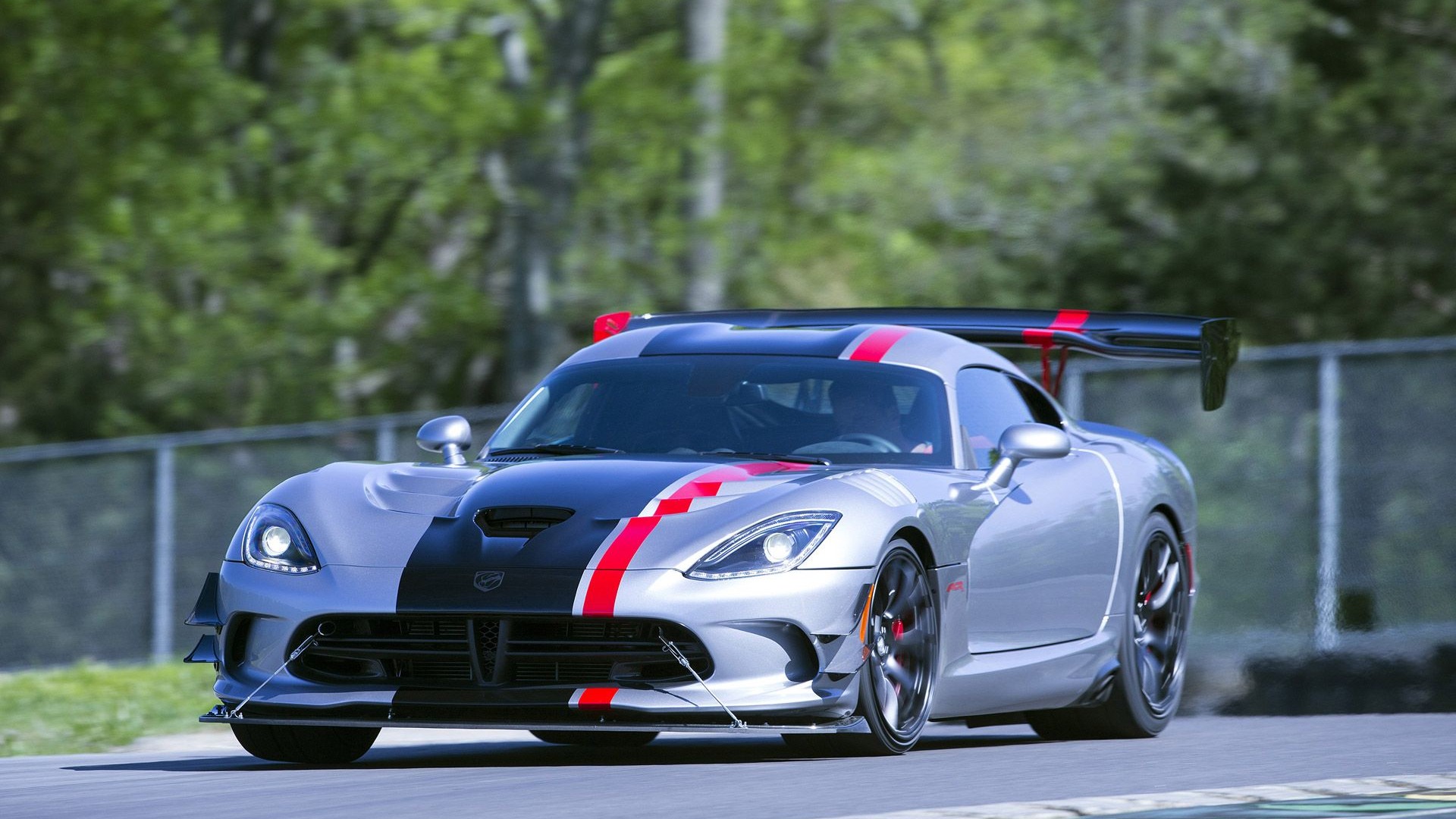
The 8.4-liter V10 retains its traditional pushrod architecture, an increasingly rare configuration that most manufacturers abandoned decades ago. Yet Dodge’s engineers extracted phenomenal performance from this seemingly antiquated design through careful optimization.
The lightweight aluminum block features cross-bolted main bearings for exceptional strength, while the composite intake manifold reduces weight and improves throttle response.
The side-mounted exhaust exits behind the doors rather than at the rear, reducing backpressure and creating an aggressive, purposeful note. Unlike exotic European engines that require stratospheric RPM to make power, the Viper’s V10 produces massive torque from low in the rev range, creating a very different but equally thrilling character.
The ACR’s cabin is sparse and focused, with lightweight racing seats, minimal sound deadening, and a prominent roll cage reminding occupants of the car’s purpose. The six-speed manual transmission requires commitment and skill, with a heavy clutch that won’t tolerate lazy inputs.
There’s no dual-clutch automatic option the ACR demands driver engagement. During its final production years, the Viper ACR set lap records at over a dozen tracks worldwide, outpacing cars costing two or three times as much.
The Viper represented the end of an era a naturally aspirated, manual transmission, front-engine, rear-wheel-drive American supercar with no electronic nannies to save drivers from their mistakes.
When production ended in 2017, it marked the end of a twenty-five year history that proved American manufacturers could build world-class naturally aspirated sports cars that competed with and often beat the European establishment.
9. Ferrari 458 Speciale
The Ferrari 458 Speciale represents the Italian manufacturer’s most extreme naturally aspirated mid-engine V8 sports car, a final hurrah before turbocharging arrived in Ferrari’s core model range.
Its 4.5-liter V8 produces 597 horsepower at 9,000 RPM with a stratospheric 9,000 RPM redline, achieving a specific output of 133 horsepower per liter the highest of any naturally aspirated production engine at the time.
With a top speed of 202 mph and acceleration from 0-60 mph in just 3.0 seconds, the Speciale demonstrated that displacement isn’t everything when engineering excellence is applied.
The Speciale’s development focused obsessively on weight reduction and aerodynamic efficiency. Active aerodynamics include a movable rear spoiler and front flaps that redirect airflow to optimize downforce or reduce drag depending on driving conditions.
The forged wheels are 25 pounds lighter than standard 458 wheels, while the interior features extensive use of Alcantara and carbon fiber to eliminate every unnecessary gram.
The result is a curb weight of just 2,844 pounds, giving the Speciale a power-to-weight ratio that allows it to accelerate and corner with intensity that belies its “only” 597 horsepower.

The Side Slip angle Control system represents Ferrari’s most sophisticated stability control yet, allowing controlled drifts while preventing dangerous losses of grip.
Rather than simply cutting power when the rear steps out, it subtly modulates individual brakes and power delivery to maintain the driver’s intended trajectory while allowing showmanship.
The magnetorheological dampers react within milliseconds to changing conditions, keeping the chassis perfectly controlled even over rough surfaces. The Speciale feels sharper, more immediate, and more responsive than the already-excellent standard 458, amplifying every positive characteristic while eliminating any trace of softness.
When Ferrari replaced the 458 with the turbocharged 488, many enthusiasts mourned the loss of the naturally aspirated V8’s character that instant throttle response, that linear power delivery, that glorious sound.
The 458 Speciale represents the absolute pinnacle of naturally aspirated V8 Ferrari development, a machine that future generations will recognize as one of the greatest driver’s cars ever created.
10. Honda/Acura NSX Type R (NA2)
The second-generation Honda NSX Type R (NA2) represents Japanese naturally aspirated engineering at its absolute finest, a lightweight interpretation of Honda’s exotic sports car philosophy that prioritized driver engagement over outright power figures.
Its 3.2-liter V6 produces 290 horsepower at 7,300 RPM with an 8,000 RPM redline modest compared to other entries on this list, yet the Type R’s 2,712-pound curb weight gives it a power-to-weight ratio that makes it genuinely fast by any measure.
The top speed of 168 mph demonstrates that naturally aspirated performance isn’t solely about maximum displacement and cylinder count.
What makes the NSX Type R truly special is Honda’s obsessive weight reduction program. The engineers removed sound deadening, air conditioning, audio system, spare tire, and traction control everything non-essential to the driving experience.
The Type R received thinner glass, a titanium shift knob, lightweight forged wheels, and single-pane rear window, with every component scrutinized for potential weight savings.
The stripped interior features carbon-kevlar racing seats and minimal carpeting, creating an environment that immediately communicates serious intent. This wasn’t a comfortable grand tourer it was a precision instrument designed for the driver who prioritized feedback and engagement over convenience.
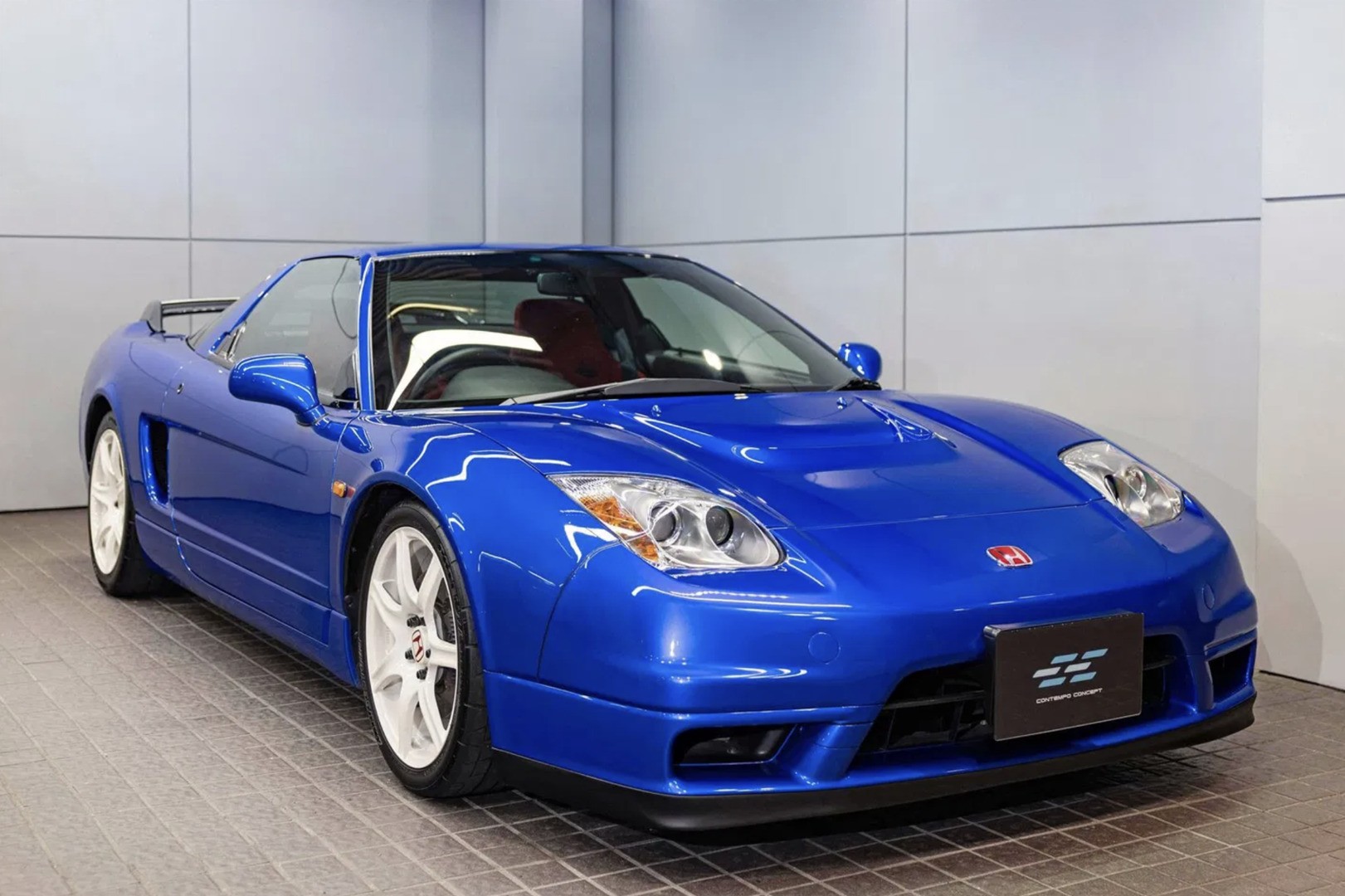
The 3.2-liter V6 features Honda’s VTEC (Variable Valve Timing and Lift Electronic Control) system, which transforms the engine’s character at 5,800 RPM. Below this threshold, the engine operates with relatively mild cam profiles for smooth operation and reasonable fuel economy.
Above 5,800 RPM, the system engages aggressive cam profiles that allow the engine to breathe freely and rev enthusiastically toward redline. The transition is accompanied by a distinct mechanical howl as the intake note intensifies and the engine pulls with renewed vigor.
The six-speed manual transmission features short, precise throws, while the aluminum shift linkage provides mechanical feedback that modern cables and electronically-assisted systems cannot match.
The NSX’s chassis benefits from decades of Formula 1 development, with double-wishbone suspension at all four corners and geometry optimized for neutral handling characteristics.
The electric power steering provides excellent feedback despite its assistance, while the brake system offers tremendous stopping power with exceptional pedal feel. Driving an NSX Type R reveals Honda’s engineering philosophy rather than overwhelming with power, they refined every element of the chassis, suspension, and controls to create a complete experience greater than the sum of its parts.
The naturally aspirated V6 may produce less power than exotic V12s, but the immediacy of its response and the precision of its controls create driving satisfaction that transcends simple performance metrics.
Only a handful of NA2 Type Rs were produced, making them highly sought after by collectors who appreciate naturally aspirated excellence in its purest form.
The NSX Type R proved that naturally aspirated performance cars didn’t need excessive displacement or cylinder counts to be genuinely special; they needed careful engineering, obsessive attention to detail, and a clear vision of what makes driving truly exciting.
Also Read: 10 Most Reliable American SUVs Released Within the Last Five Years
