

A growing number of automakers are sitting on aging 2024 inventory as U.S. vehicle stock climbs past 3 million units, yet meaningful price cuts remain elusive.
Determining the ideal time to purchase a new vehicle is rarely simple, as timing often depends on manufacturer incentives, dealer-specific deals, or even the lifecycle of a particular model. That said, for buyers with stable finances, shopping near the end of a model year, or just before a changeover, can sometimes work to their advantage.
Dealers are typically eager to move aging inventory, which can result in substantial discounts. At the moment, however, the number of unsold 2024 and 2025 vehicles across the United States remains unusually high.
As we noted in early December, dealerships nationwide are grappling with excess inventory, with 2024 and 2025 models piling up on lots and showroom floors. While December may have represented the strongest opportunity to land a bargain, there’s still reason for shoppers to keep looking as the new year begins.
According to the latest market figures, U.S. dealerships held 3,010,839 vehicles in inventory at the end of November. Although 60.3 percent of that total consisted of 2026 models, there remains a significant supply of 2024 and 2025 model-year vehicles waiting to be sold.
Inventory levels haven’t been this high since November 2024, when total stock reached 3,206,209 vehicles. Throughout the first ten months of 2025, inventory stayed below the 3 million mark, bottoming out in May at 2,503,529 units.
Despite the surplus, pricing has shown little movement. The average vehicle listing price in November stood at $49,422, slightly exceeding the previous high of $48,843 recorded in December 2024. For most of 2025, prices fluctuated between $47,000 and $49,000, creating a challenging environment for shoppers focused on value.
No automaker is facing excess inventory issues quite like Stellantis. As of early December, Dodge dealers were still holding 82.1 percent of all 2024 Dodge Hornet plug-in hybrid inventory. That figure is especially striking when compared to the industry-wide average of just 0.4 percent remaining for 2024 models.
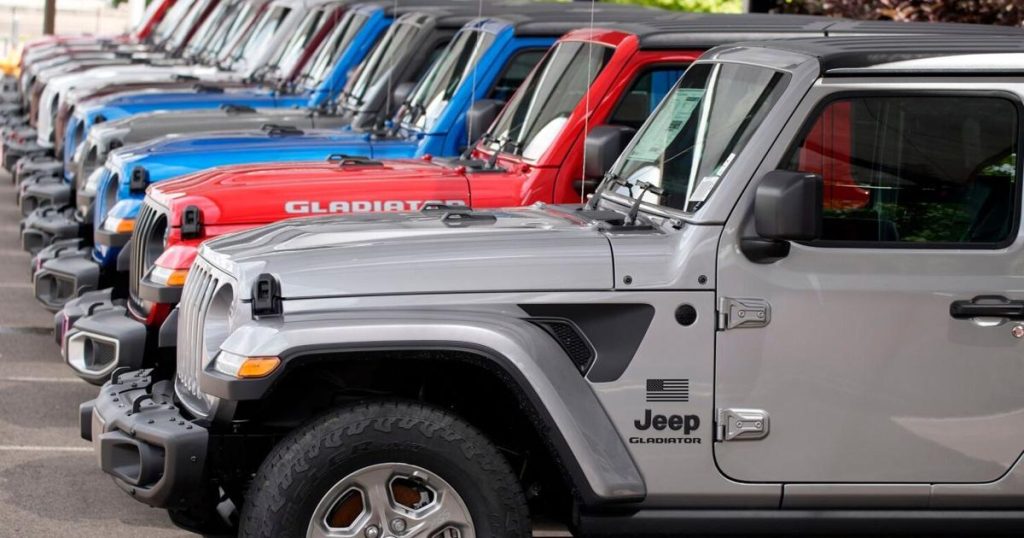
Jeep and Alfa Romeo are experiencing similar challenges. Approximately 70.8 percent of the 2024 Jeep Grand Cherokee inventory remained unsold, while 46.8 percent of the Alfa Romeo Tonale Hybrid was still available. Together, these numbers highlight how uneven sales performance has been across different brands and nameplates.
Elsewhere, the discontinued Chevrolet Malibu stands out as well, ranking fourth among 2024 models with 31 percent of its inventory still sitting on dealer lots.
That’s a surprisingly high figure for a mid-size sedan priced below $27,000. Even more puzzling, as we’ve previously reported, Consumer Reports data shows that the Malibu is somehow still selling above MSRP.
The outlook for 2025 models isn’t much better. BMW’s i4 tops the list, with 89 percent of its inventory unsold and an average transaction price of $67,745.
Lexus follows closely behind, with 88 percent of GX 550 inventory and 84 percent of LX 600 models still sitting on dealer lots. The Subaru BRZ also shows slow movement, with 87 percent of its inventory unsold at an average price of $38,516.
Even highly anticipated vehicles are seeing slower-than-expected turnover. The Toyota GR Corolla has 83 percent of its inventory unsold, while the Ford Maverick, across both gas and hybrid variants, stands at 79 percent.
Toyota, typically known for strong demand, appears four times, including the 4Runner Hybrid and Tacoma Hybrid. The brand’s repeated presence underscores that even strong reputations aren’t enough to guarantee rapid sales in today’s market.
