
Toyota recently made a bold claim that grabbed the attention of both the auto industry and the energy sector: the electric vehicles currently on American roads could collectively send enough electricity back to the grid to match the output of 40 nuclear reactors.
According to the automaker’s estimates, roughly four million EVs in the U.S. could provide about 40,000 megawatts of power if they were equipped with vehicle-to-grid (V2G) capability. In theory, that kind of distributed energy resource could help stabilize the nation’s power grid, reduce outages during peak demand, and even lower electricity costs for consumers.
It’s an ambitious vision, and one that aligns with broader conversations about grid resilience, renewable energy integration, and the role electric vehicles could play beyond transportation. There’s just one problem: Toyota doesn’t currently sell a single vehicle in North America that can actually do this.
That contradiction sits at the heart of Toyota’s announcement. The company is now publicly advocating for bidirectional charging, technology that allows EVs to send electricity back to homes, buildings, or the grid, while American buyers are still waiting for Toyota to offer it in a production model.
For a brand long known for cautious electrification strategies, the statement marks a notable shift in tone, if not yet in product reality.
Toyota’s argument is rooted in a simple but powerful idea: most cars sit parked for the majority of the day, and electric vehicles carry large batteries that usually go unused once they’re fully charged. If even a fraction of those batteries could be tapped during periods of high demand, the grid could become more flexible and resilient.
In Toyota’s framing, EVs could help smooth out spikes in electricity use caused by heat waves, cold snaps, or unexpected outages. Instead of utilities firing up expensive and carbon-intensive peaker plants, they could draw power from thousands, or even millions, of vehicles acting as mobile energy storage units. The cumulative effect, Toyota says, is comparable to dozens of nuclear reactors’ worth of generation capacity.
From a systems perspective, the idea isn’t far-fetched. The average EV battery today is between 60 and 100 kilowatt-hours, and many homes consume only a few dozen kilowatt-hours per day.
Multiplied across millions of vehicles, the numbers add up quickly. For utilities struggling to integrate intermittent renewable energy sources like wind and solar, bidirectional charging could offer a valuable buffer.
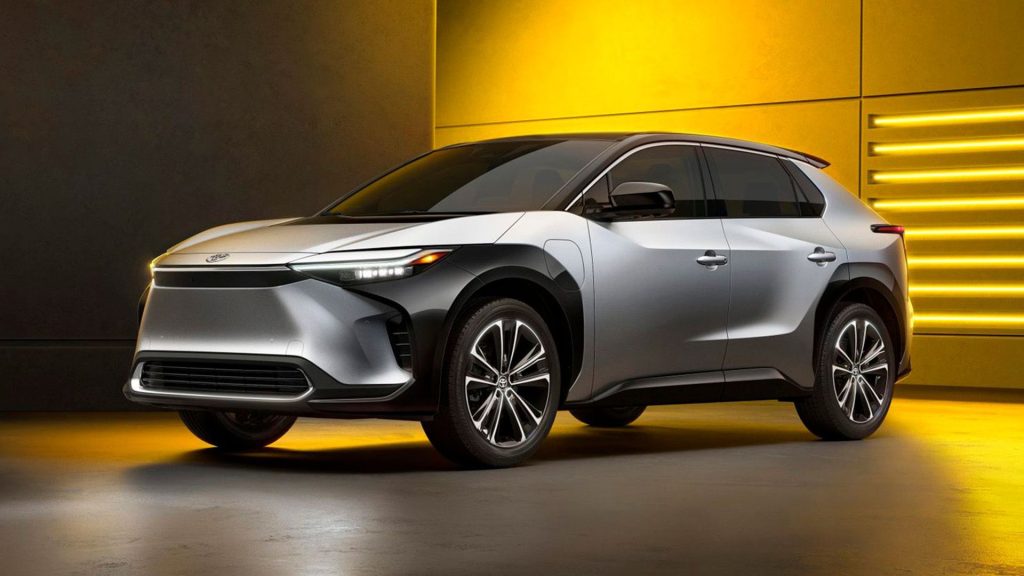
Despite the scale of Toyota’s projection, the company’s current North American lineup doesn’t support it. None of Toyota’s U.S.-market EVs, including the bZ4X, offer bidirectional charging or vehicle-to-grid functionality. The only Toyota vehicle shown with V2G capability has been a Japanese-market bZ4X prototype used for pilot programs overseas.
That disconnect hasn’t gone unnoticed. Toyota is effectively promoting a future where EVs play a central role in energy infrastructure, while American consumers who buy Toyota EVs today can’t participate in that future at all. It’s a particularly striking contrast given that several competitors already offer some form of bidirectional charging in the U.S.
To be fair, Toyota isn’t alone in talking about V2G long before it becomes widespread. Automakers often float long-term visions to influence regulators, utilities, and infrastructure planning.
Still, coming from a company that has historically emphasized hybrids and hydrogen over full battery-electric adoption, the announcement feels like a philosophical pivot, even if the hardware hasn’t caught up yet.
At its core, bidirectional charging allows electricity to flow both ways between an EV and an external power source. Instead of acting solely as a load on the grid, the vehicle becomes a power supply when needed.
There are several variations of this concept. Vehicle-to-grid (V2G) allows energy to be fed back into the broader electrical grid, often in coordination with a utility.
Vehicle-to-home (V2H) enables an EV to power a house during an outage or peak pricing periods. Vehicle-to-load (V2L) is the simplest form, allowing owners to power appliances, tools, or devices directly from the vehicle.
EV owners could charge their vehicles overnight when electricity is cheap and abundant, then discharge some of that stored energy during peak hours when electricity is more expensive. Utilities benefit from reduced strain on the grid, while consumers could see lower energy bills or even compensation for providing power.
However, making this work requires specialized hardware, advanced software, utility cooperation, and regulatory approval, all of which vary significantly across the United States.
While Toyota talks about potential, several automakers have already delivered real-world solutions. Ford’s F-150 Lightning offers up to 9.6 kW of vehicle-to-home power, enough to run an average household for several days during an outage. In disaster-prone areas, that capability has become a major selling point.
Nissan was one of the earliest pioneers, introducing V2G capability with the Leaf in Japan more than a decade ago. Although adoption has been limited in the U.S., the technology itself is well-proven.
General Motors has committed to standardizing vehicle-to-home charging across its modern EV lineup, starting with models like the Chevrolet Silverado EV and Cadillac Lyriq.
Hyundai and Kia have embraced vehicle-to-load and are running bidirectional charging pilots in Europe using models such as the Ioniq 5. Tesla, long resistant to V2G, has moved closer with the Cybertruck, which can provide up to 11.5 kW of home backup power when paired with Tesla’s Powerwall system.
Against that backdrop, Toyota’s absence in this space is increasingly noticeable.
Even for automakers that support bidirectional charging, widespread adoption faces significant hurdles. One of the biggest is cost. Bidirectional home charging equipment can cost several thousand dollars before installation, making it a tough sell for consumers who may never experience a major outage or utility incentive.
Grid readiness is another major issue. Many local grids weren’t designed to handle electricity flowing from homes back into the system. Utilities often require upgrades, approvals, and additional safety equipment before allowing V2G connections, and the rules vary widely from state to state.
Battery degradation is also a concern. Cycling a battery more frequently, especially discharging it for grid use, can accelerate wear over time. While automakers insist modern batteries are robust enough to handle this, consumers may worry about long-term impacts on range and resale value.
Then there’s regulation. In some states, selling electricity back to the grid is tightly regulated, and compensation structures differ dramatically. Without clear financial incentives, many EV owners have little reason to invest in bidirectional charging hardware.
Toyota’s sudden enthusiasm for vehicle-to-grid technology likely reflects shifting realities rather than an overnight change of heart. EV adoption in the U.S. continues to grow, renewable energy penetration is increasing, and grid resilience has become a national concern after years of high-profile outages caused by extreme weather.
By framing EVs as part of the energy solution, Toyota positions itself as a forward-thinking player in a space that extends beyond cars. The message appeals to policymakers, utilities, and regulators who are thinking in terms of systems, not just vehicles.
It also gives Toyota room to maneuver. By highlighting the potential benefits now, the company can shape expectations and discussions ahead of actually delivering the technology in North America.
Toyota’s claim that America’s EVs could rival the output of 40 nuclear reactors may sound dramatic, but it underscores a real shift in how electric vehicles are being perceived. They’re no longer just transportation devices, they’re potential energy assets.
For now, Toyota’s vision remains just that: a vision. Until bidirectional charging becomes standard across its U.S. lineup, American buyers can’t participate in the future Toyota is describing. Still, the fact that one of the world’s largest automakers is publicly embracing the idea suggests that V2G is moving from fringe concept to mainstream expectation.
The economics don’t quite work yet for most consumers, and the infrastructure isn’t fully ready. But as equipment costs fall, regulations evolve, and grids modernize, the case for bidirectional charging will strengthen. When that happens, Toyota’s projection may look less like marketing hype and more like an early glimpse of an inevitable transition.
In that sense, Toyota may be late to the hardware, but it’s clearly staking a claim in the conversation about what EVs will eventually become.
