Ford has disclosed additional details about its “Universal Electric Vehicle” initiative, the internal program responsible for developing a new $30,000 electric midsize pickup scheduled for launch in 2027.
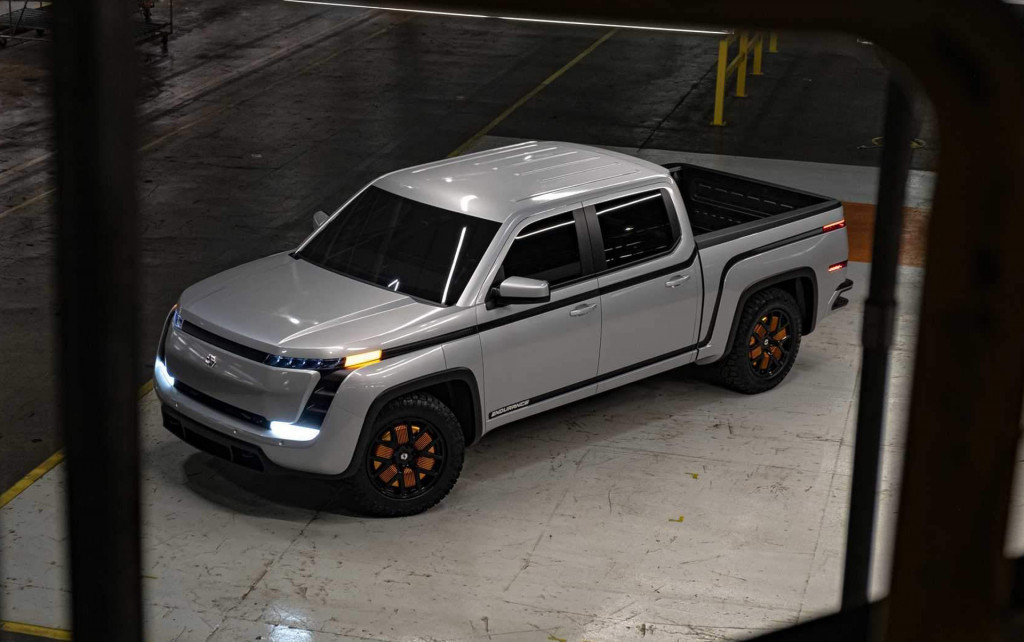
While the 14-minute technical presentation covered engineering fundamentals, the design sketches were the most revealing element, offering the clearest indication yet of the truck’s exterior form.
The early renderings, consistent with previously released teaser silhouettes, suggest a streamlined and forward-looking design.
The proportions indicate a softer and more cohesive alternative to the Tesla Cybertruck, avoiding sharp, angular surfaces while targeting a substantially lower entry price.
The front fascia appears to incorporate slim vertical LED lighting elements, an illuminated Ford emblem, and horizontal air inlets integrated into the bumper.
The windshield extends deeply into the hood area and transitions toward an integrated rear roof spoiler.
Despite the emphasis on aerodynamic sculpting, the truck is expected to retain a conventional dual-cab configuration roughly comparable in size to a Ranger. Functionality remains central to the concept rather than being sacrificed for styling.
Aerodynamic optimization has been a core development priority. Ford enlisted specialists, including former Formula 1 engineers, to minimize drag sufficiently to allow the use of smaller battery packs while maintaining competitive driving range.
Reducing drag directly lowers energy consumption, which in turn helps control manufacturing costs.
According to Ford, the curved roof profile mitigates turbulence typically generated by the open cargo bed of a pickup.
Side mirrors are approximately 20 percent smaller than standard designs, contributing an estimated 1.5 miles (2.4 km) of additional range.
Custom underbody panels add a further 4.5 miles (7.2 km). Collectively, these measures are projected to deliver roughly 50 miles (80 km) of added range compared with a similarly sized truck using more conventional aerodynamic solutions.
Beyond airflow efficiency, Ford has concentrated on simplifying production. The company plans to adopt large aluminum unicastings, conceptually similar to Tesla’s gigacasting approach.
Structural elements that currently consist of 146 components in the Ford Maverick will be consolidated into just two major pieces in the new EV platform. The vehicle weight is reportedly 27 percent lower than comparable competitors.
Reducing the number of parts and connection points decreases assembly complexity and the number of robots required on the production line.
Ford maintains that this approach yields measurable improvements in both build consistency and manufacturing efficiency.
Engineering efforts have also focused on electrical architecture. Lessons drawn from analyzing Chinese EV manufacturers and Tesla have influenced the redesign.
The new pickup’s wiring harness is approximately 4,000 feet (1.2 km) shorter than that of the Mustang Mach-E, cutting 22 pounds (10 kg) from total weight.
The truck will utilize prismatic lithium iron phosphate (LFP) battery cells and incorporate a separate 48-volt subsystem for auxiliary functions.
The advanced EV development team is led by former Tesla executive Alan Clarke, who brings over a decade of experience from the competing automaker.
Ford has not confirmed the vehicle’s official name. A recent patent filing suggests the potential revival of the Ranchero badge, though no announcement has been made.
The $30,000 electric pickup is targeted for 2027, with additional affordable EVs planned thereafter, including a sedan currently under consideration.