
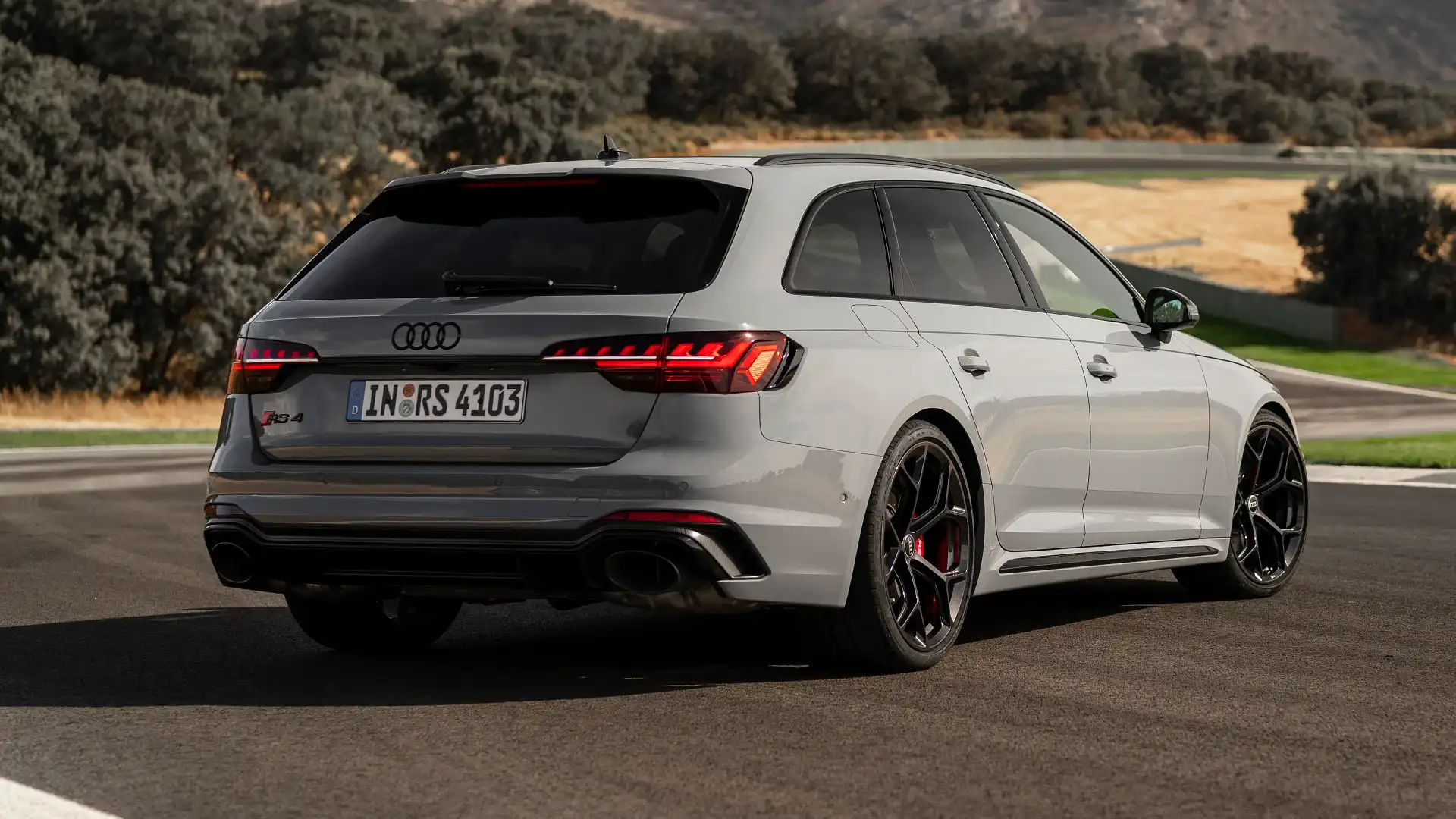
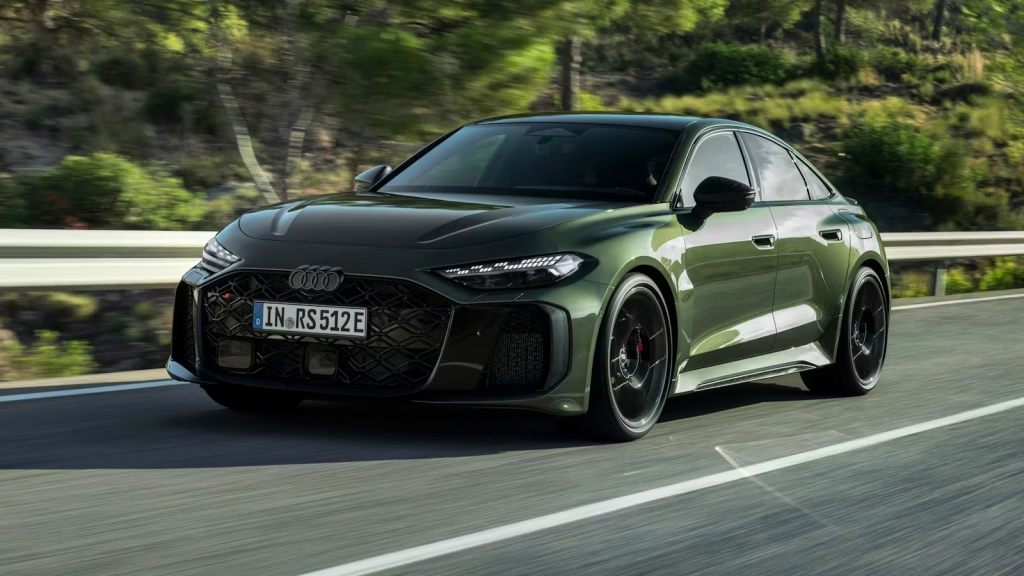
The all-new RS5, offered in both sedan and Avant wagon form, replaces the previous-generation Audi RS5 Sportback and Audi RS4 Avant. It also marks the first high-performance plug-in hybrid developed by Audi Sport.
As seen with the current BMW M5, electrification at this level comes with a measurable trade-off: mass. The RS5 follows the same trajectory. Its powertrain combines a 2.9-liter twin-turbocharged V6 engine, an electric motor, a high-voltage battery pack and a hybridized 8-speed Tiptronic transmission. The result is substantial weight gain.
The 2027 RS5 sedan has a stated curb weight of 5,192 pounds (2,355 kg), an increase of 1,376 pounds (624 kg) over the outgoing RS5 Sportback. The RS5 Avant is heavier still at 5,225 pounds (2,370 kg), compared to 4,012 pounds (1,820 kg) for the previous RS4 Avant.
That figure makes the new RS5 the heaviest production car ever to wear the Audi Sport badge, with only the Audi RS Q8 exceeding it at 5,434 pounds. The RS5 now outweighs several larger performance vehicles.
For example, the base Porsche Taycan weighs 4,630 pounds despite carrying a significantly larger battery pack, while the V8-powered Audi RS6 Avant comes in at 5,016 pounds.
Even certain configurations of the Ford F-150 undercut the RS5’s curb weight. A SuperCrew 4×4 equipped with the 3.5-liter EcoBoost V6 weighs approximately 4,500 pounds, and numerous lighter variants exist.
The RS5 does remain lighter than the BMW M5 at 5,532 pounds, though the M5 is a larger vehicle with greater output.
Despite the added mass, the RS5’s power-to-weight ratio remains unchanged at 0.121 hp per pound. That stability is attributable to a significant output increase. The plug-in hybrid system generates a combined 630 hp and 608 lb-ft of torque, up from 444 hp and 442 lb-ft in the previous generation.
Performance improves marginally on paper. The sprint from 0 to 62 mph is reduced to 3.6 seconds, compared to 3.8 seconds for the outgoing RS5 Sportback. More notably, the new model introduces an all-electric driving capability of up to 52 miles, allowing for silent urban commuting when desired.
Fuel economy is heavily dependent on battery charge. With electrical assistance, Audi cites a non-EPA estimate of up to 61.9 mpg. Once the battery is depleted, however, efficiency declines sharply to a claimed minimum of 23.1 mpg, reflecting the impact of the additional hybrid hardware and curb weight.
