Renault Group is attempting to solve one of the most persistent problems in electric mobility: fragmentation. With the launch of its new “Plug Inn” ecosystem, the company is moving to unify charging infrastructure, services, and user experience under a single, coherent platform across Europe.
At its core, Plug Inn is not just a rebrand. It represents a structural shift in how Renault approaches EV charging. Previously, the company’s charging solutions were spread across different services under its Mobilize division. Now, everything from public charging access to home energy systems is being consolidated into one integrated ecosystem designed to simplify the ownership experience.
The system is built around three primary components. First is “Plug Inn Fast Charge,” Renault’s high-speed public charging network. Second is “Plug Inn Powerbox,” a bidirectional home charging solution that enables vehicle-to-grid functionality.
Third is “Plug Inn Charge Pass,” a unified payment system that provides access to charging stations across Europe. Together, these elements create a closed-loop ecosystem that connects the car, the grid, and the user in a seamless way.
One of the most compelling aspects of this initiative is the performance of its charging network. Plug Inn fast chargers deliver up to 320 kW, allowing compatible vehicles to recover as much as 400 kilometers of range in roughly 15 minutes.
That places the network among the fastest currently available in Europe and positions Renault competitively in a market where charging speed is becoming a key differentiator.
However, Renault’s strategy is not purely about speed or expansion. In fact, the company is deliberately shifting focus away from aggressive network growth toward reliability and user experience.
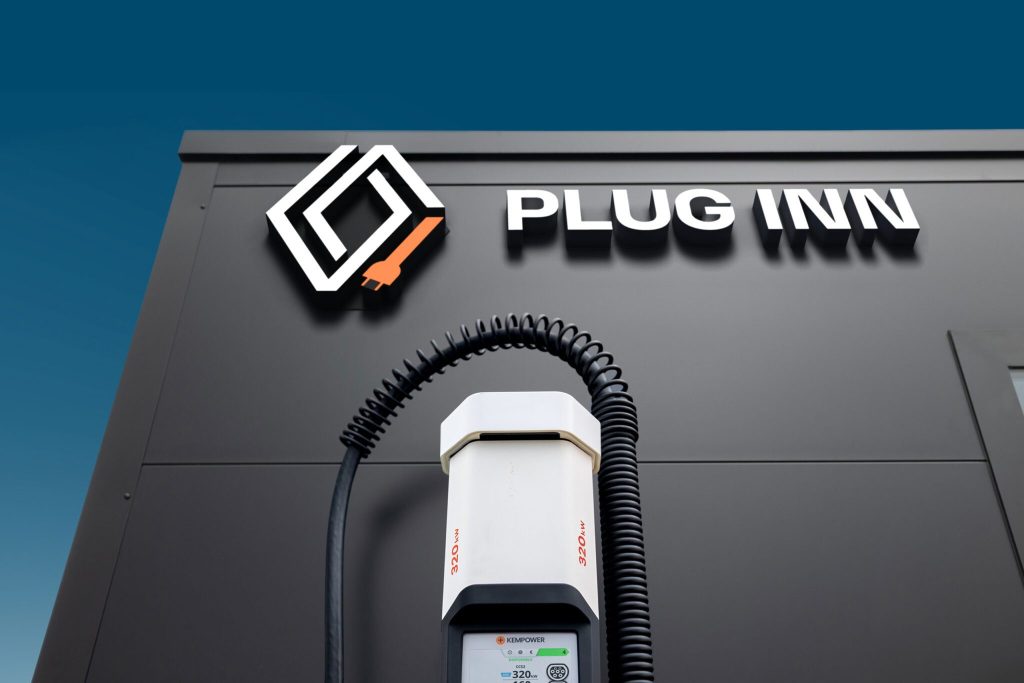
The target is 93 charging stations by the end of 2026, strategically located along major travel corridors and at dealership sites. These locations are designed for accessibility and consistency rather than sheer volume.
The emphasis on experience is also evident in the design of Plug Inn stations. Selected locations include premium lounges with Wi-Fi, workspaces, rest areas, and 24/7 access, aiming to transform charging from a functional necessity into a more comfortable, service-oriented interaction. This reflects a broader industry shift where convenience and environment are becoming as important as charging speed itself.
Another critical dimension of Plug Inn is its bidirectional charging capability. Through the Powerbox system, Renault vehicles can not only draw electricity but also feed it back into the grid. This vehicle-to-grid functionality allows EVs to act as mobile energy storage units, helping balance electricity demand while potentially reducing costs for owners.
Strategically, Plug Inn signals Renault’s intent to control more of the EV value chain. By integrating infrastructure, software, and energy services into one ecosystem, the company reduces reliance on third-party networks while improving customer retention and data integration.
In a market where charging inconsistency remains a major barrier to EV adoption, Renault’s approach is pragmatic. Rather than expanding indiscriminately, it is standardizing the experience. Plug Inn is less about building the largest network and more about building one that works reliably, intuitively, and across borders.
That distinction may ultimately prove more valuable as Europe’s electric transition accelerates.