Most drivers never think much about their spare tire until the day they actually need it. In many vehicles, finding the spare is simple. Lift the cargo floor, open a compartment in the trunk, or access a mount attached to the rear of the vehicle.
The process is straightforward because manufacturers generally place spare tires where they are easy to store without compromising passenger comfort or cargo space.
Automotive history, however, is filled with exceptions. Engineers have often been forced to think creatively when packaging a vehicle.
Sports cars with mid-mounted engines, compact city cars with limited storage, luxury sedans focused on maximizing trunk space, and off-road vehicles designed for rugged environments have all presented unique challenges.
The result is a surprising collection of automobiles that hide their spare tires in places few owners would think to check.
Some of these unusual locations were chosen to improve weight distribution. Others were designed to preserve cargo capacity or accommodate unconventional body shapes.
A few were simply the product of engineering compromises that prioritized other vehicle characteristics over convenience. Regardless of the reason, these designs have created memorable solutions that continue to fascinate automotive enthusiasts.
The placement of a spare tire might seem like a minor detail, but it reveals a great deal about a vehicle’s priorities.
A manufacturer willing to mount a spare beneath the engine bay, inside a front trunk, or underneath the vehicle is often responding to packaging constraints that shaped the entire design. In many cases, the location tells a story about the engineering challenges behind the vehicle.
The following cars feature some of the most unusual spare-tire locations ever seen in production automobiles. Some solutions are clever, others are inconvenient, and a few are downright strange.
Yet each one demonstrates the creativity that automotive engineers have displayed when trying to fit a spare wheel into a vehicle that wasn’t designed around conventional expectations.
Also Read: 10 Best Cars for San Francisco’s Steep Hills
1. Porsche 911 (Spare Tire in the Front Trunk)
The Porsche 911 has always been an unconventional sports car. While most performance vehicles place their engines in the front or center of the chassis, the 911 famously carries its flat-six engine behind the rear axle.
This unusual layout has shaped nearly every aspect of the car’s design, including where Porsche chose to store the spare tire.
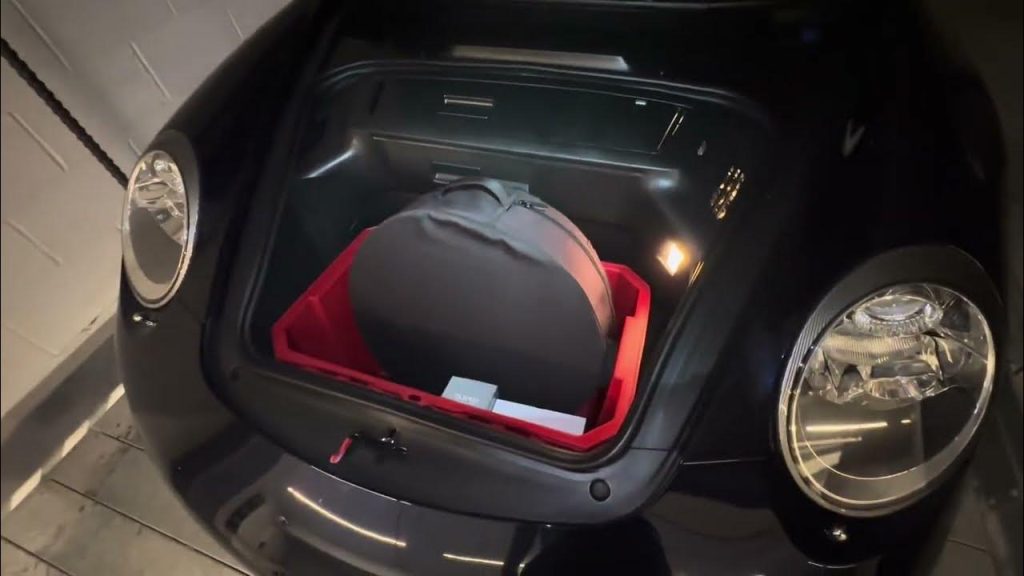
Drivers encountering a classic or modern 911 for the first time often expect to find luggage space behind the seats or perhaps beneath a rear hatch. Instead, opening the front hood reveals what Porsche owners affectionately call the “frunk,” a storage compartment located where an engine would normally sit in a conventional automobile.
Within this front cargo area sits the spare tire. The arrangement feels strange because most vehicles place their spare near the rear of the car. In the 911, the spare occupies valuable luggage space in a compartment that already serves as the vehicle’s primary cargo area.
The decision was not arbitrary. Porsche engineers recognized that placing the spare in the front helped balance some of the weight concentrated at the rear.
Since the engine sits behind the driver, adding weight toward the front improved handling characteristics and stability. The spare tire, therefore, performed a dual role, serving as emergency equipment while contributing to vehicle balance.
Accessing the spare is relatively simple, but the location surprises many people because it is hidden beneath the front hood rather than beneath the trunk floor. Owners unfamiliar with the design often spend time searching the rear of the vehicle before realizing the tire is located at the opposite end.
Over the decades, Porsche refined the concept, and some modern versions replaced full-size spares with compact emergency units or tire-repair systems. Nevertheless, the front-mounted spare remains one of the defining packaging features associated with classic 911 models.
The arrangement perfectly illustrates how an unconventional engine layout can create unconventional solutions elsewhere in the vehicle. What initially appears odd becomes logical when viewed through the lens of weight distribution and packaging efficiency.
Specifications
- Engine: 3.0-liter twin-turbocharged flat-six
- Torque: 331 lb-ft
- Horsepower: 388 hp
- Length/Width: 177.9 in / 72.9 in
2. Chevrolet Corvette C8
The eighth-generation Chevrolet Corvette represented one of the most significant transformations in American automotive history. After decades of front-engine production, Chevrolet moved the Corvette’s engine behind the passenger compartment, creating the first production mid-engine Corvette.
This dramatic change delivered major performance benefits, but it also created an interesting challenge regarding storage and spare-tire placement.
Traditional Corvettes provided a rear cargo area where owners could store luggage and other items. Once the engine occupied that space, engineers had to rethink nearly every aspect of the vehicle’s packaging. The result was a car featuring both a front trunk and a rear storage compartment, each serving specific purposes.
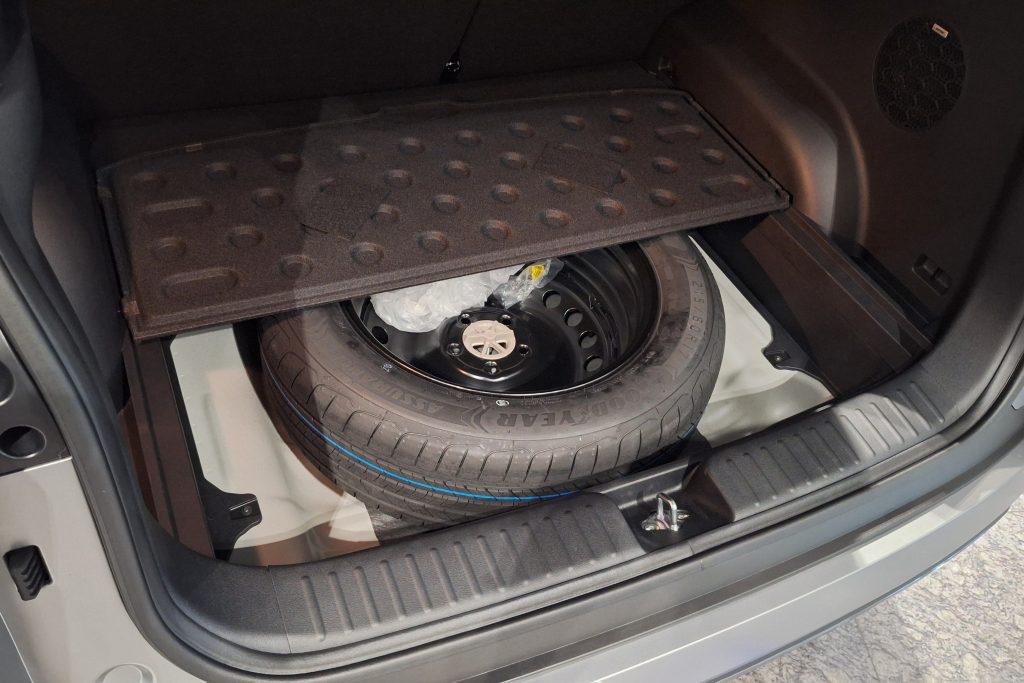
Unlike older sports cars that carried conventional spare tires, the C8 abandoned the idea entirely. However, the unusual aspect lies in how Chevrolet designed the front compartment. Early development plans considered packaging constraints associated with emergency tire equipment, but the mid-engine layout left very limited room for a traditional spare.
The front trunk became the location where many owners initially expect to find a spare. Instead, they discover storage space and tire-repair equipment. This highlights a broader trend among modern performance cars where engineering priorities make conventional spare-tire placement nearly impossible.
The C8’s design reveals how drastically vehicle architecture can influence practical details. A front-mounted spare would consume valuable cargo volume, while a rear-mounted spare would compete with engine and cooling-system components. Underbody mounting would interfere with aerodynamic requirements and ground clearance targets.
Because the Corvette was designed to achieve world-class handling and performance, every inch of available space had a purpose. Engineers prioritized cooling ducts, suspension geometry, luggage capacity, and structural rigidity over creating a dedicated spare-tire compartment.
What makes the Corvette noteworthy in this discussion is not merely the absence of a spare but the engineering challenge that forced Chevrolet to abandon traditional solutions.
Owners accustomed to conventional vehicles often find it surprising that a sports car of this caliber has no hidden spare at all, despite having two separate storage areas.
The Corvette C8 demonstrates how modern performance demands can completely alter long-standing automotive conventions. Its packaging strategy reflects the realities of a mid-engine layout, creating one of the most unusual spare-tire situations found in a contemporary production vehicle.
Specifications
- Engine: 6.2-liter naturally aspirated V8
- Torque: 470 lb-ft
- Horsepower: 490 hp
- Length/Width: 182.3 in / 76.1 in
3. Toyota Previa
Among all the vehicles ever sold in North America, few are as mechanically unusual as the Toyota Previa. Introduced during the 1990s, the Previa was a minivan that seemed determined to challenge every convention of automotive design.
While competitors relied on front-mounted engines and straightforward packaging, Toyota created a van with an engine mounted beneath the front seats. That decision had a dramatic impact on where the spare tire ended up.
At first glance, the Previa appeared relatively normal. Its rounded shape, spacious cabin, and family-friendly layout gave little indication of the engineering complexity hidden underneath. The surprise emerged when owners needed access to the spare tire.
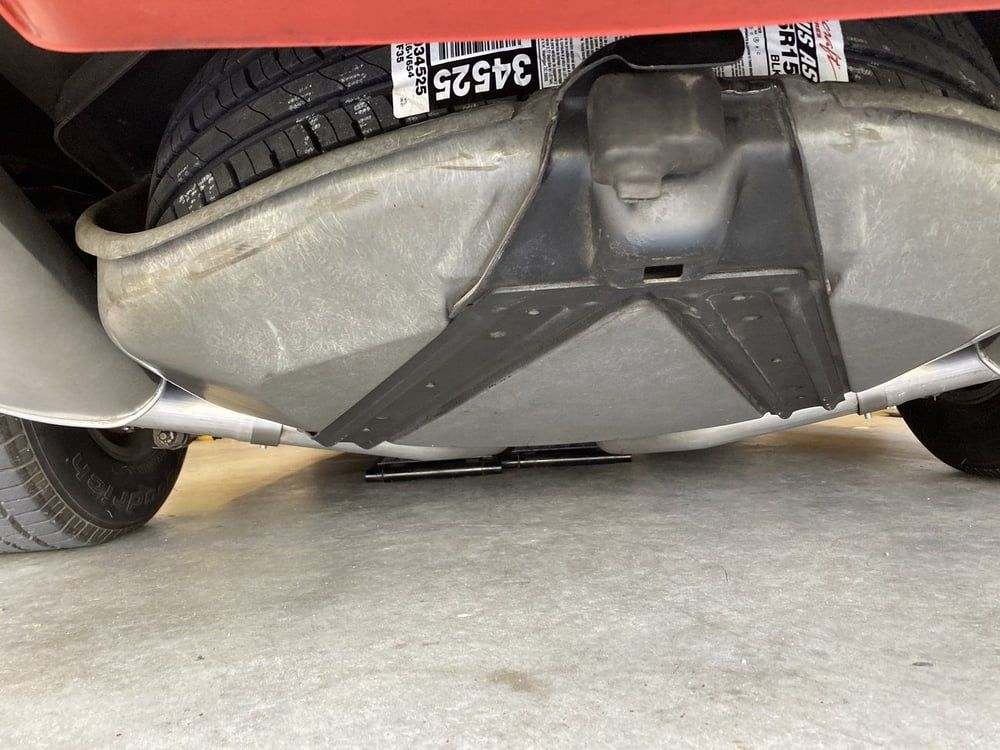
Rather than placing the tire beneath the cargo floor or inside a rear compartment, Toyota mounted it underneath the vehicle near the center of the chassis. The location was dictated largely by the unusual engine placement.
With mechanical components occupying space where a spare might normally reside, engineers had to search for alternatives that preserved interior room.
Accessing the tire required reaching beneath the vehicle and operating a lowering mechanism designed to release the wheel.
While underbody-mounted spares are not unheard of, the Previa’s configuration stood out because it was closely tied to one of the most unconventional engine layouts ever used in a mass-market minivan.
The arrangement offered several advantages. Most importantly, it allowed Toyota to maximize interior volume. Families purchasing minivans value passenger and cargo space, and the Previa delivered plenty of both. By moving the spare outside the cabin, Toyota avoided sacrificing valuable storage areas.
There were disadvantages as well. Road grime, moisture, and winter conditions could make access more difficult. Owners living in snowy climates occasionally discovered that the spare tire mechanism required extra effort after years of exposure to harsh conditions.
Yet the design reflected the Previa’s broader philosophy. Toyota was willing to embrace unconventional engineering if it created practical benefits elsewhere. The underbody spare was not merely a storage solution; it was a direct consequence of a vehicle that prioritized cabin space and innovative packaging above traditional layouts.
Today, the Previa remains a fascinating example of how creative engineering can influence even the smallest details of vehicle design. Its spare tire location may seem odd at first, but it becomes easier to understand once the rest of the vehicle’s unusual architecture is taken into account.
Specifications
- Engine: 2.4-liter supercharged inline-four
- Torque: 210 lb-ft
- Horsepower: 158 hp
- Length/Width: 187.0 in / 70.9 in
4. Volkswagen Beetle (Classic)
The classic Volkswagen Beetle earned its place in automotive history through simplicity, durability, and unmistakable styling. It also happened to feature one of the most recognizable spare-tire locations ever devised.
Thanks to the Beetle’s rear-mounted engine, the spare wheel found a home in a place that still surprises people unfamiliar with the car’s design.
Opening the front hood of a classic Beetle does not reveal an engine. Instead, owners find a compact luggage compartment containing the fuel tank, wiring components, and a prominently displayed spare tire. The wheel often sits upright, occupying a significant portion of the available storage space.
For drivers accustomed to modern vehicles, the arrangement appears unusual. The spare is not hidden beneath a floor panel or tucked behind trim pieces. It is immediately visible and forms one of the defining features of the Beetle’s front trunk.
The reason was straightforward. Volkswagen needed to use the rear of the vehicle for the air-cooled flat-four engine. With the powertrain positioned behind the passengers, the front became the logical location for luggage and emergency equipment. The spare tire also provided a useful counterbalance to the weight concentrated at the rear.
The wheel’s placement became part of the Beetle’s identity. Owners frequently packed luggage around it, treating the tire as a permanent fixture of the cargo area. The compromise reduced available storage capacity, but buyers generally accepted the limitation because the car offered affordability and practicality in other areas.
From an engineering perspective, the design solved multiple challenges simultaneously. It improved weight distribution, simplified packaging, and ensured that the spare remained easily accessible. Few vehicles have integrated a spare tire so visibly into their everyday layout.
The Beetle’s popularity meant millions of people became familiar with the concept, yet it remains unusual by modern standards. Contemporary vehicles tend to conceal spare tires whenever possible, while the Beetle displayed its spare proudly whenever the hood was raised.
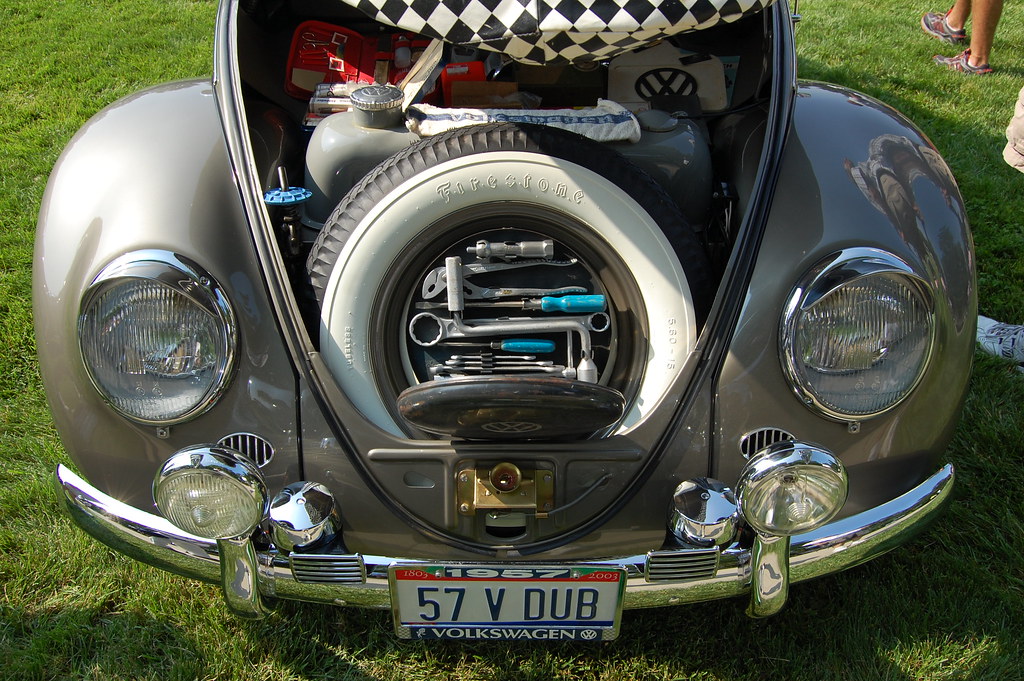
Decades after production ended, the classic Beetle continues to serve as one of the most famous examples of unconventional spare-tire placement. The wheel’s position inside the front trunk reflects a design philosophy built around practicality and efficient use of limited space.
Specifications
- Engine: 1.6-liter air-cooled flat-four
- Torque: 78 lb-ft
- Horsepower: 60 hp
- Length/Width: 160.6 in / 61.0 in
5. Land Rover Defender (Classic)
Few vehicles wear their spare tire as proudly as the classic Land Rover Defender. While most manufacturers attempt to hide emergency equipment beneath cargo floors, behind trim panels, or under the vehicle itself, Land Rover took the opposite approach.
The spare wheel became a visible part of the Defender’s character, mounted directly on the rear door where everyone could see it.
The placement was not merely a styling choice. The Defender was engineered for serious off-road work, often operating in environments where practicality mattered far more than appearance.
Large all-terrain tires consumed considerable space, making traditional storage solutions difficult to implement. Mounting the spare externally solved the problem while preserving cargo capacity inside the vehicle.
Owners appreciated another advantage as well. Accessing the spare was remarkably simple compared with underbody-mounted designs. There was no need to crawl beneath a muddy vehicle or lower a cable mechanism after a tire failure.
The wheel remained at a convenient height and could be removed relatively quickly, an important benefit when operating in challenging terrain.
Yet the arrangement introduced its own quirks. Because the spare was attached directly to the rear door, opening and closing that door required moving the additional weight every time.
Over years of use, hinges and mounting hardware experienced considerable stress. Land Rover reinforced the structure accordingly, but the design still demanded attention and maintenance.
The Defender’s rear-mounted spare also affected visibility. Looking through the rear window meant looking around a large tire.
Drivers eventually adapted, but newcomers often found the obstruction unusual. In return, they gained a storage solution that left the interior completely free for passengers, equipment, and supplies.
Another interesting aspect of the design was its contribution to the Defender’s visual identity. The exposed wheel became one of the vehicle’s most recognizable features. Even from a distance, the silhouette instantly communicated rugged capability and adventure-focused engineering.
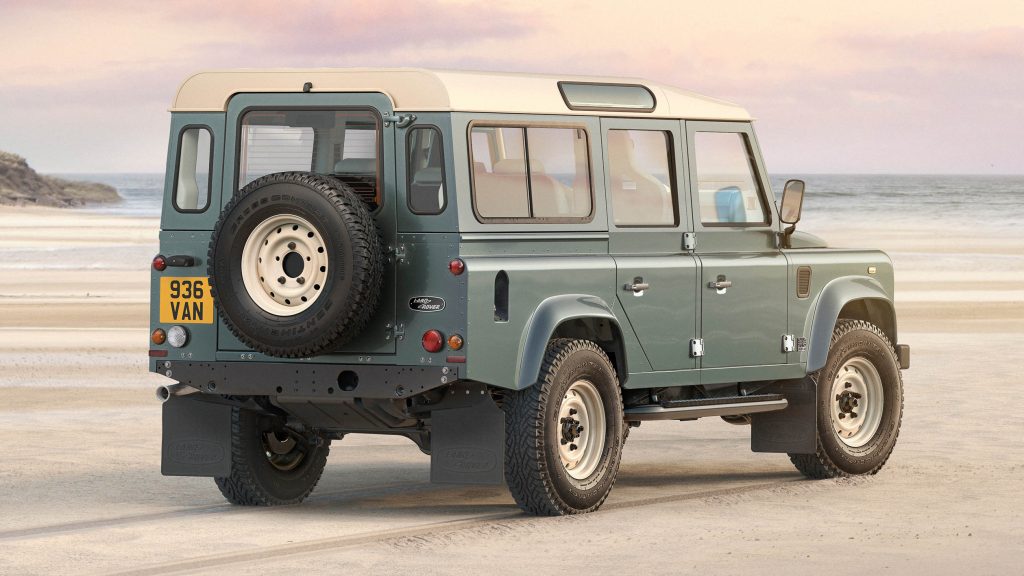
The Defender’s spare tire placement reflected the priorities of a vehicle built for remote locations where self-sufficiency mattered.
Off-road travelers frequently carry full-size spare tires because compact emergency spares are often inadequate in rough terrain. By mounting the wheel externally, Land Rover ensured owners had quick access to a tire matching the others on the vehicle.
Decades later, the design remains a classic example of function influencing form. What began as a practical packaging solution became one of the most iconic visual elements in automotive history.
Specifications
- Engine: 2.5-liter turbo-diesel inline-four
- Torque: 195 lb-ft
- Horsepower: 111 hp
- Length/Width: 181.0 in / 70.5 in
6. BMW Isetta
The BMW Isetta is one of the strangest production vehicles ever created, so it should come as no surprise that its spare tire arrangement was equally unusual. Developed during the postwar era when efficiency and affordability were paramount concerns, the tiny microcar challenged conventional automotive thinking in almost every area.
Most people remember the Isetta for its front-opening door. Instead of entering from the side, occupants stepped through a large door that swung outward from the front of the vehicle. This distinctive design immediately created packaging challenges because traditional layouts simply did not apply.
Space inside the Isetta was extremely limited. Engineers had to maximize every available inch while still accommodating passengers, mechanical components, and essential equipment. Finding a location for a spare tire required creative thinking.
Rather than placing the wheel in a trunk that barely existed, BMW integrated the spare into the vehicle’s side area behind interior panels. The arrangement helped preserve cabin space while keeping the tire accessible when needed.
Given the car’s tiny dimensions, virtually any spare-tire location would have appeared unusual, but the Isetta’s solution stood out even among microcars.
The design highlighted the compromises required when building a vehicle of such modest proportions. Every component competed for space, forcing engineers to evaluate priorities carefully.
Passenger comfort, structural integrity, and mechanical packaging all demanded attention, leaving little room for traditional storage solutions.
The Isetta’s spare tire placement reflected the broader philosophy behind the car. Rather than scaling down a conventional automobile, BMW approached the project with a clean sheet of paper. The resulting vehicle adopted unconventional solutions wherever they made sense, whether in door design, wheel layout, or storage arrangements.
Owners often viewed the spare tire as just another part of the car’s quirky personality. The Isetta was never intended to compete with larger automobiles on practicality. Instead, it offered economical transportation packaged in a way that maximized efficiency.
Looking back, the vehicle serves as a reminder that automotive design often becomes most creative when engineers face severe constraints. The Isetta’s unusual spare tire location was not the result of a desire to be different. It emerged because conventional solutions simply would not fit within the car’s tiny footprint.
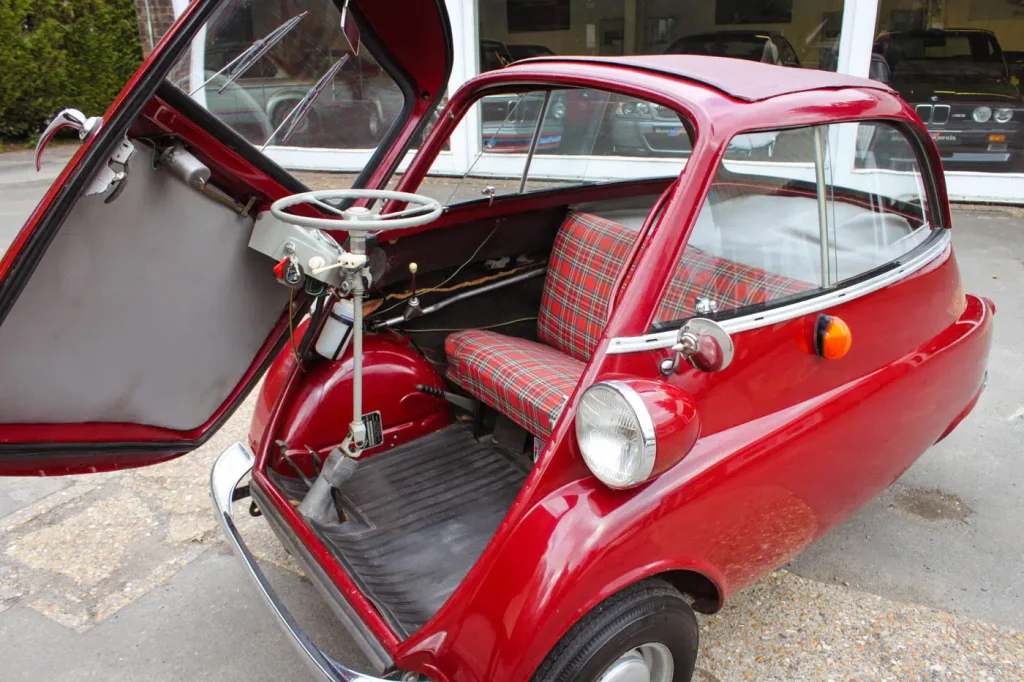
Among the many oddities associated with this famous microcar, the hidden spare remains one of the most intriguing examples of unconventional packaging.
Specifications
- Engine: 298 cc single-cylinder
- Torque: 13 lb-ft
- Horsepower: 13 hp
- Length/Width: 89.0 in / 54.0 in
7. Jeep Wrangler
The Jeep Wrangler is a vehicle whose design philosophy has remained remarkably consistent for decades. It prioritizes capability, durability, and simplicity over trends.
Like the classic Defender, the Wrangler places its spare tire in a location that immediately stands out, yet the reasons behind the decision are deeply rooted in off-road practicality rather than styling alone.
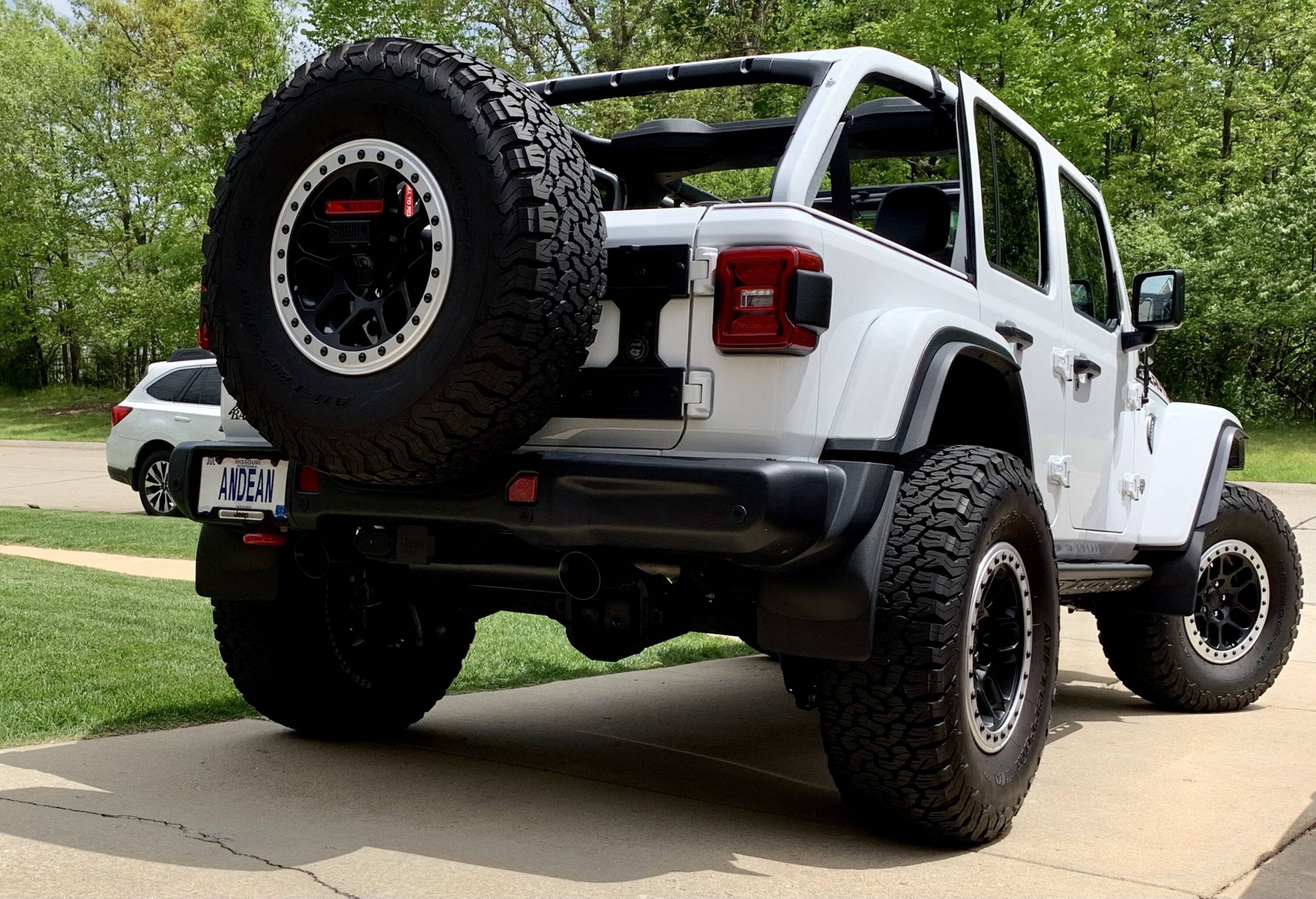
Walk behind a Wrangler, and the first thing that often catches the eye is the large spare tire mounted directly on the tailgate. In modern automotive design, where manufacturers work hard to conceal emergency equipment, the Wrangler proudly displays it as part of the vehicle’s identity.
The location serves several important purposes. Off-road driving can damage tires far more easily than ordinary pavement travel. Sharp rocks, deep ruts, and rugged trails increase the likelihood of punctures or sidewall damage.
A compact temporary spare would be nearly useless in such situations, so Jeep equips the Wrangler with a full-size spare matching the other wheels.
Finding room for a tire of that size inside the vehicle would require sacrificing cargo space or rear passenger comfort.
Underbody mounting presents another challenge because the Wrangler’s suspension articulation and ground-clearance requirements leave limited room beneath the chassis. The rear-mounted solution addresses both concerns while ensuring easy access.
There is another advantage that becomes apparent during trail use. When a tire change is required in mud, sand, or rocky terrain, owners do not need to crawl beneath the vehicle. The wheel is positioned at a convenient height and can be removed without dealing with underbody hardware.
The arrangement is not without drawbacks. The extra weight attached to the tailgate increases stress on hinges and mounting points. Larger aftermarket tires can amplify this issue, leading many enthusiasts to install reinforced carriers. Rear visibility is also affected because the spare occupies a portion of the rear window area.
Despite these compromises, the design has become inseparable from the Wrangler’s character. The exposed spare communicates purpose. It signals that the vehicle was engineered with adventure in mind rather than purely urban transportation.
The rear-mounted spare has survived multiple redesigns while countless other automotive traditions have disappeared. Jeep recognized that the placement continues to provide practical benefits for the Wrangler’s intended mission.
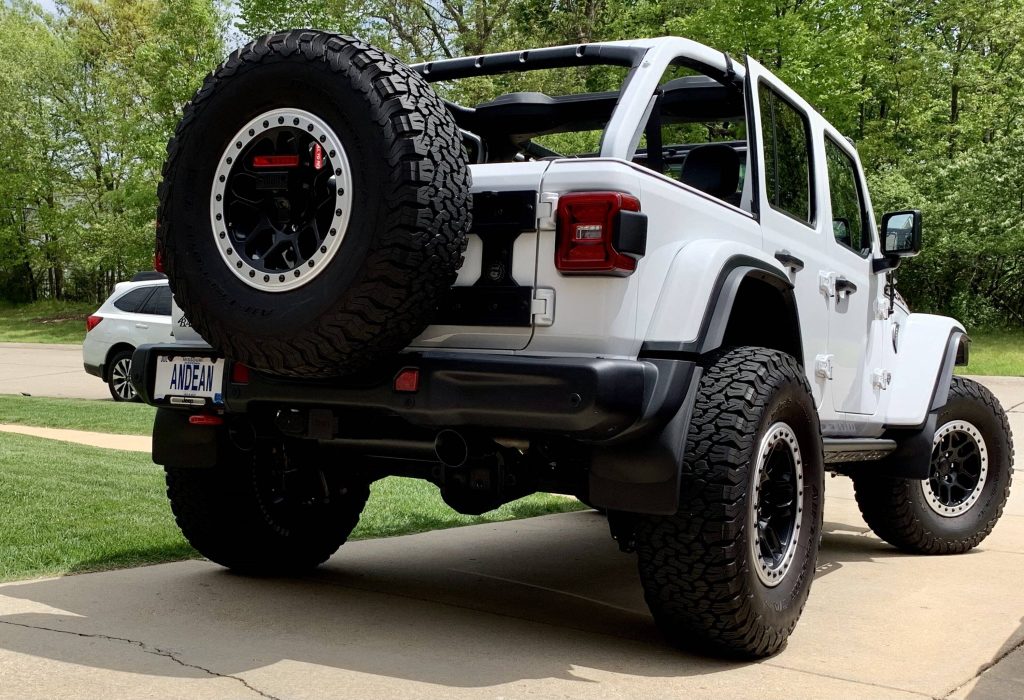
The result is a solution that may appear unusual compared with mainstream SUVs but makes perfect sense once the vehicle’s capabilities and intended use are considered. In the off-road vehicle world, the Wrangler’s spare tire location remains one of the most recognizable and functional designs ever created.
Specifications
- Engine: 3.6-liter naturally aspirated V6
- Torque: 260 lb-ft
- Horsepower: 285 hp
- Length/Width: 188.4 in / 73.9 in
8. Ferrari Testarossa
Few supercars are as visually distinctive as the Ferrari Testarossa. With its dramatic side strakes, wide stance, and mid-mounted flat-12 engine, the car became an icon of 1980s automotive design. Yet hidden beneath the striking bodywork was one of the most unusual spare-tire arrangements ever fitted to a production Ferrari.
The Testarossa’s mid-engine layout created severe packaging challenges. Engineers needed space for the engine, transmission, cooling systems, luggage compartments, suspension components, and aerodynamic structures. Every available inch was carefully allocated.
Rather than carrying a conventional full-size spare, Ferrari equipped the Testarossa with a compact space-saver spare tire located in the front luggage compartment.
At first glance, that may not sound particularly strange. The unusual part was how little room remained around it and how the entire storage arrangement reflected the compromises imposed by the car’s exotic architecture.
Owners opening the front compartment often found themselves surprised by the tire’s prominent position. Unlike a traditional sedan, where a spare might hide beneath a trunk floor, the Testarossa’s emergency wheel occupied valuable luggage space in an area already limited by supercar standards.
The decision reflected Ferrari’s priorities. Engineers focused primarily on performance, handling balance, and weight distribution. Cargo practicality ranked much lower on the list. The compact spare allowed Ferrari to provide emergency capability without adding the weight and packaging burden associated with a full-size wheel.
Weight distribution played a role as well. With the engine mounted behind the passenger compartment, placing the spare near the front helped offset some of the rearward weight bias. Even relatively small components could influence vehicle balance in a high-performance machine.
Using the spare was also an unusual experience. Owners were expected to treat it strictly as a temporary solution until a proper repair could be completed. The wheel was not intended for extended driving and served primarily as a way to avoid being stranded after a puncture.
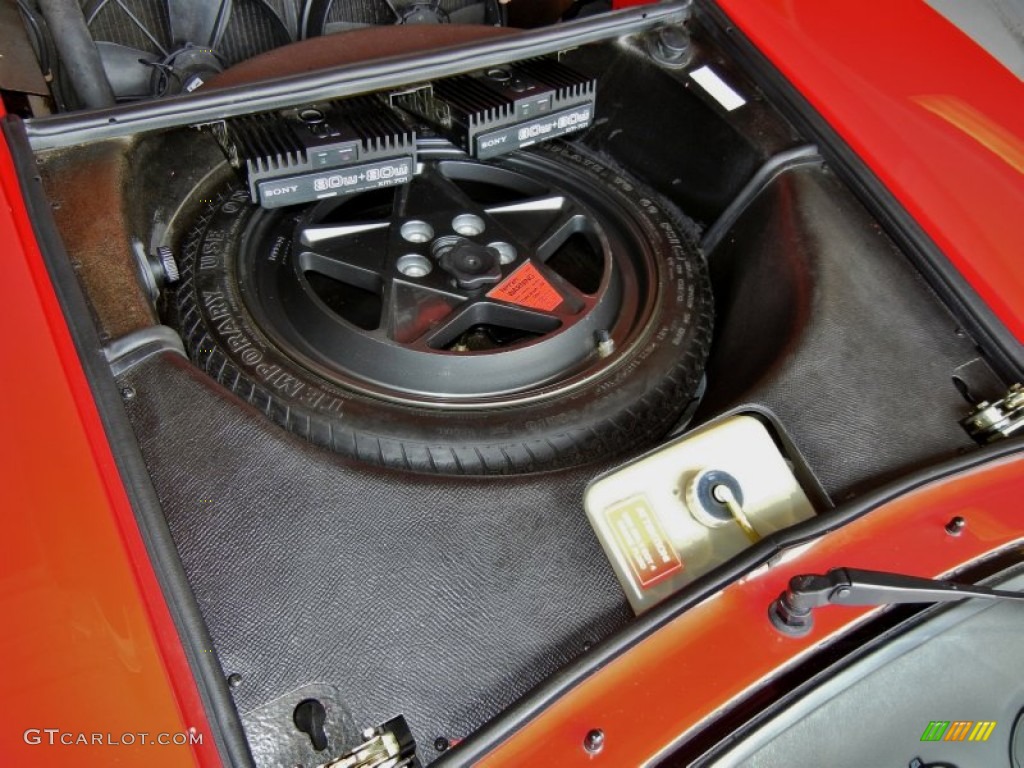
The Testarossa demonstrates how exotic-car engineering often produces unconventional solutions to seemingly simple problems. While most family vehicles can dedicate significant space to a spare tire, supercars must fight for every cubic inch of storage.
Today, the Testarossa’s spare tire arrangement remains a fascinating reminder of the compromises required when designing one of the most famous performance cars of its era.
It may not be the strangest location in automotive history, but it perfectly illustrates how packaging priorities can transform a routine component into an unusual engineering solution.
Specifications
- Engine: 4.9-liter naturally aspirated flat-12
- Torque: 362 lb-ft
- Horsepower: 390 hp
- Length/Width: 176.6 in / 77.8 in
Also Read: 10 Strangest Concept Cars – Ranked