
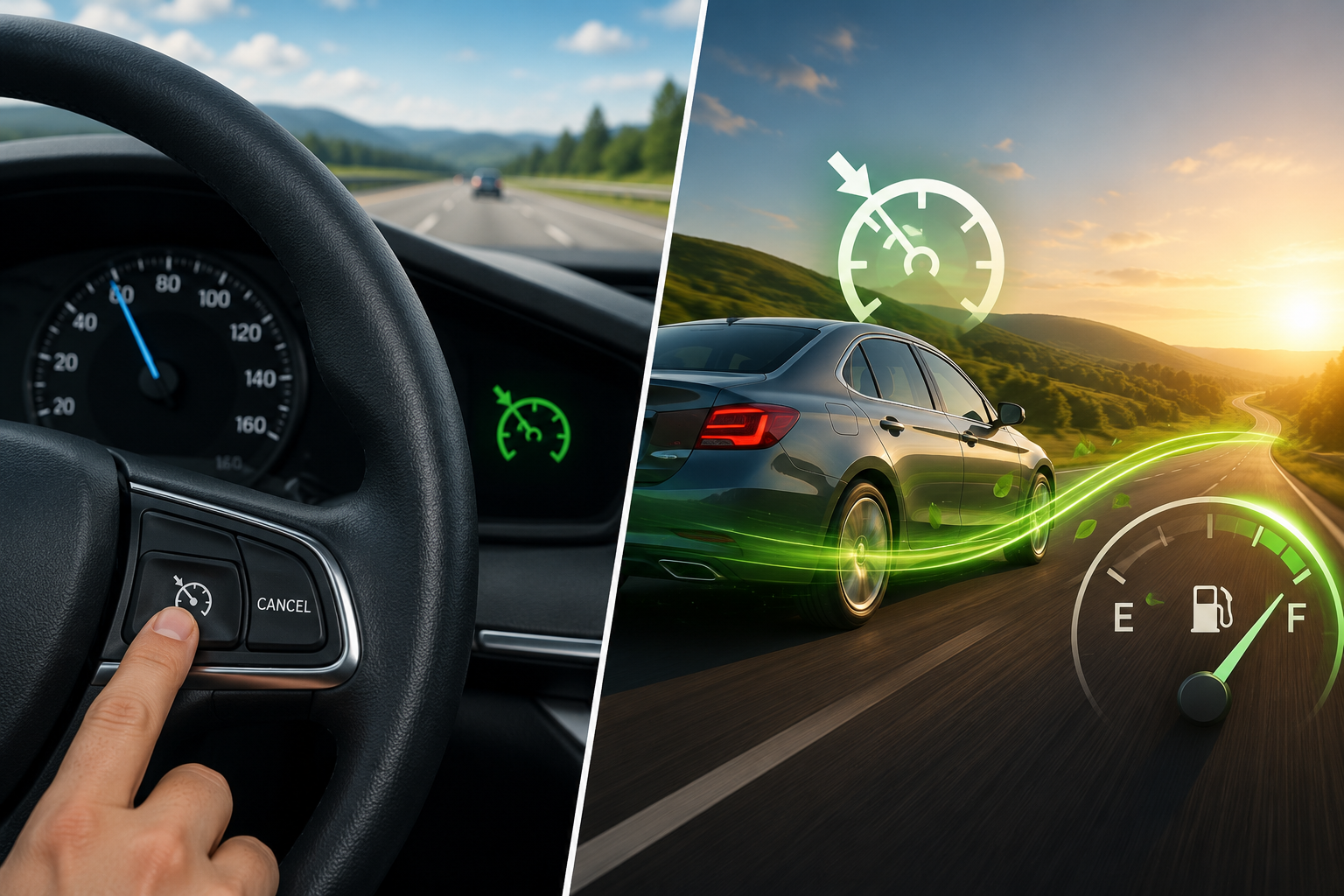
Rising fuel prices have encouraged many drivers to look for simple ways to improve fuel economy. One of the most common questions is whether cruise control can actually help reduce fuel consumption during long highway drives or if it simply makes traveling more comfortable by reducing driver fatigue. Some motorists believe it leads to noticeable fuel savings, while others argue that the impact is too small to make a meaningful difference.
The truth is a little more complicated. Cruise control has the potential to improve fuel economy, but the results depend on where, when, and how it is used. A smooth, consistent speed allows an engine to work more efficiently than one that is constantly responding to small changes in throttle input. At the same time, road conditions, traffic, weather, and terrain all influence whether the feature helps or hurts efficiency.
This guide explains how cruise control works, why maintaining a steady pace matters, and what research says about its effect on fuel use. You’ll also learn the situations where it delivers measurable savings, the conditions where those gains disappear, and the driving habits that can reduce its effectiveness, helping you make smarter choices every time you hit the road.
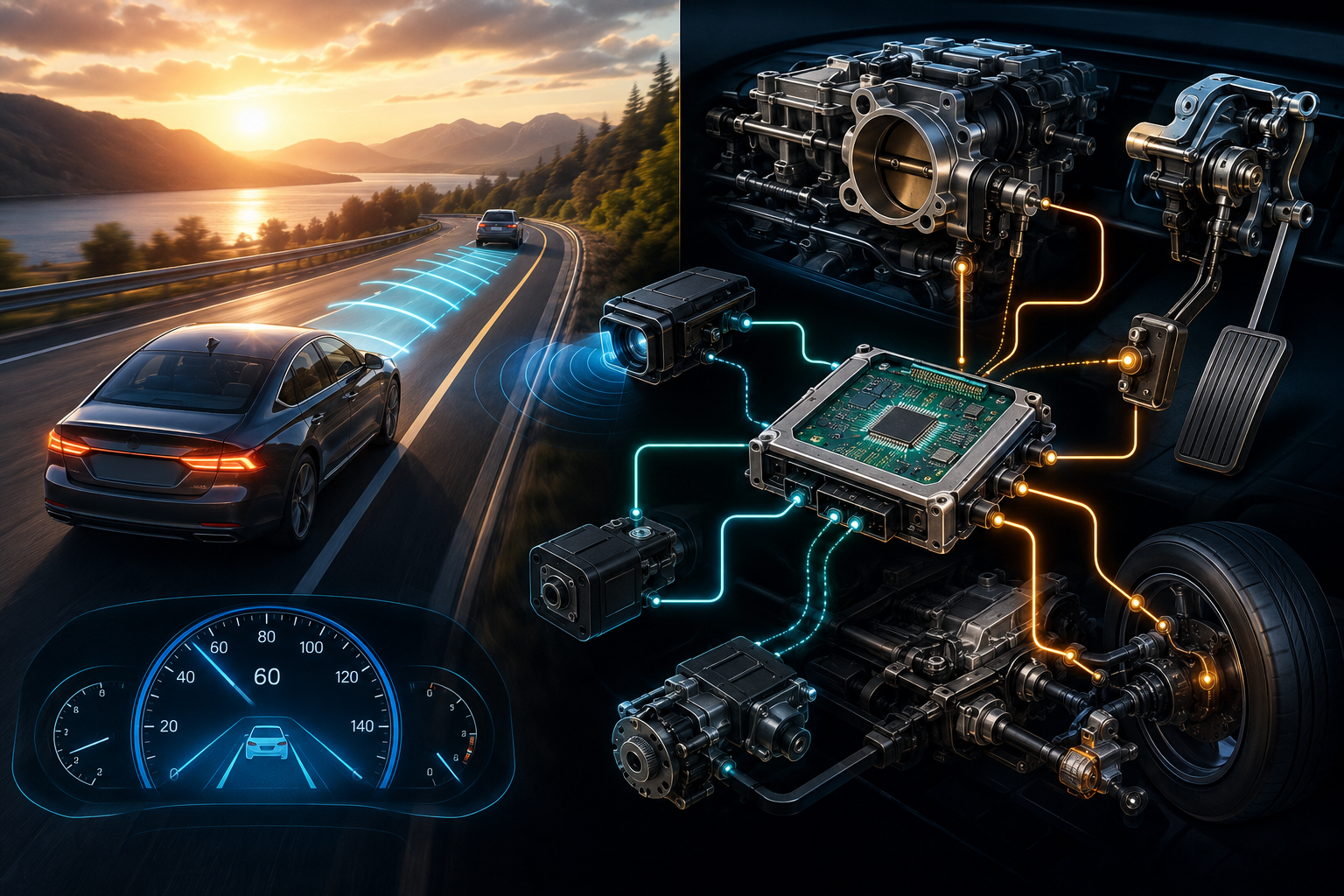
What Cruise Control Is Actually Doing Under the Hood
Cruise control sounds simple on the surface. Press a button, and your car holds a steady speed without you touching the gas pedal. But what’s happening mechanically is worth understanding before we get into the fuel savings question. When you drive manually, your foot naturally makes small corrections.
You speed up a little going downhill, ease off before a curve, press harder to pass someone, then let up again. Each of these adjustments changes how much fuel your engine burns, and most drivers don’t even notice they’re doing it. Cruise control removes that human inconsistency by locking your speed to one number and letting the throttle make tiny, precise adjustments instead.
Standard cruise control simply holds your set speed until you brake or turn it off. Adaptive cruise control goes a step further, using sensors to track the car ahead of you and adjusting your speed to keep a safe following distance automatically. Both versions rely on smoother, more predictable throttle inputs than a human foot typically provides.
That smoothness is the entire reason cruise control gets tied to fuel economy. Gas mileage suffers most when a car repeatedly speeds up and slows down, since acceleration demands extra fuel every single time. A steady speed means a steady fuel draw, which is generally more efficient than a stop-start rhythm. It is not a dramatic transformation of how your engine works. It is a quiet correction of driver habits that most people don’t realize are costing them fuel.
The Science Behind Steady Speeds and Fuel Burn
Physics does most of the explaining here. Every time a car accelerates, the engine has to overcome inertia, and that takes a burst of extra fuel. Slow down again, and that energy is largely wasted as heat through the brakes. Repeat this pattern enough times on a drive, and it adds up to noticeably worse mileage than a steady pace would produce.
Highway driving research has shown that speed fluctuations, even small ones, can reduce fuel efficiency more than people expect. A driver who constantly nudges the pedal up and down in response to traffic, hills, or simple distraction is essentially asking the engine to work harder than it needs to. Cruise control’s biggest gift is preventing those unnecessary bursts of acceleration.
There’s a reason this effect shows up most clearly on flat, open highways. On that kind of road, there’s little reason to change speed at all, so cruise control can hold a near-perfect line with minimal throttle adjustment. The engine settles into a rhythm and stays there for miles.
City driving tells a different story entirely. Stop signs, traffic lights, pedestrians, and sudden lane changes make holding one speed nearly impossible, which is why most drivers don’t even bother engaging cruise control in town. The system isn’t built for that kind of stop-and-go environment, and trying to force it rarely helps.
So the honest takeaway from the science is this: cruise control supports fuel efficiency by removing the small, repeated accelerations that a human foot introduces without thinking. It works with physics, not against it, and the effect is strongest wherever a steady speed is realistically possible to maintain for an extended stretch.
Also Read: 10 Cars Faster Than A Ferrari With Less than $40,000
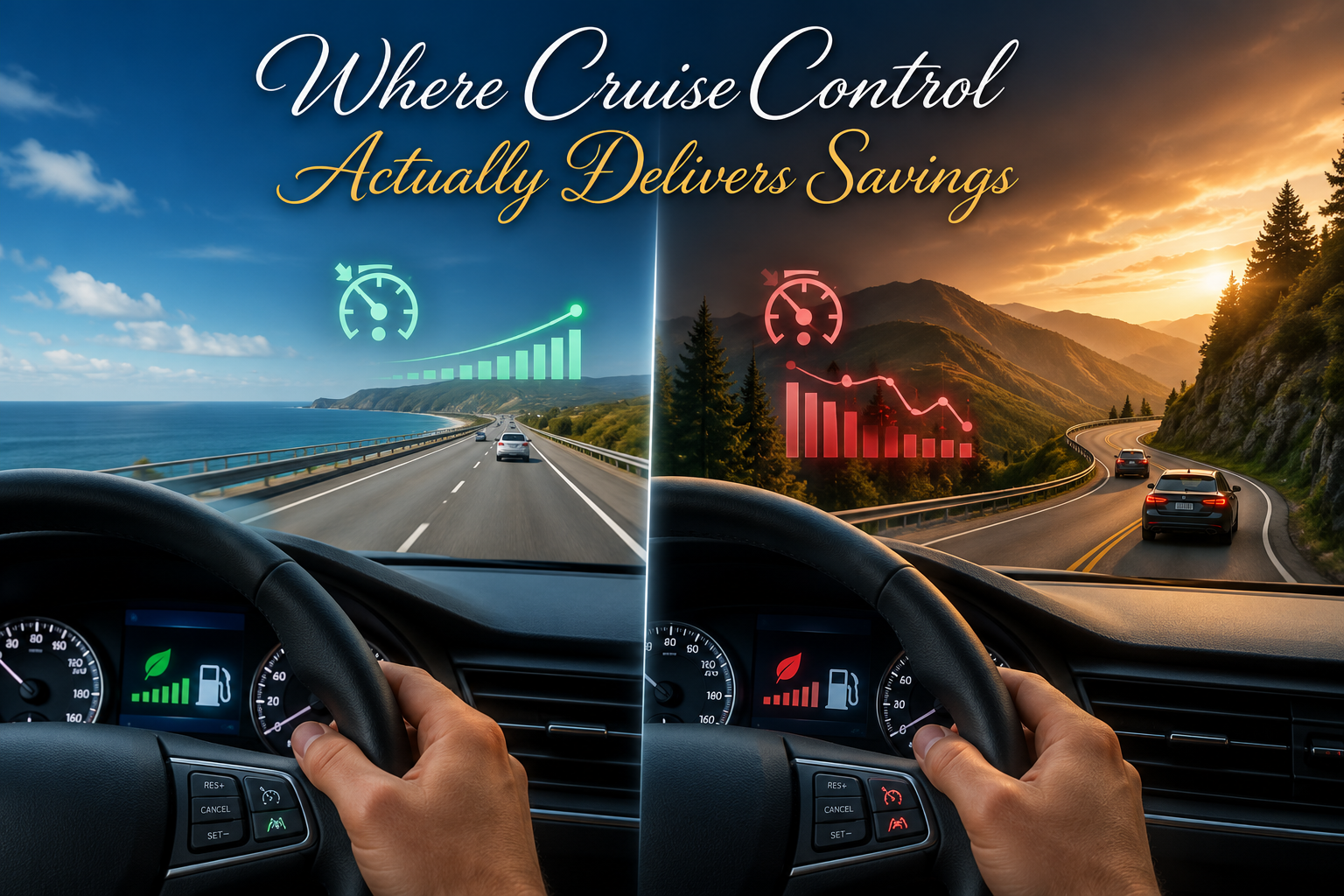
Where Cruise Control Actually Delivers Savings
Long highway drives are where cruise control shines brightest. Picture a five-hour road trip on a mostly flat interstate. Without cruise control, your speed probably drifts up and down by five or ten miles per hour depending on traffic, mood, and how much attention you’re paying. With cruise control engaged, that drift disappears, and your engine settles into one efficient pace for hours at a time.
Fuel economy testing organizations have repeatedly found that steady-speed highway driving produces better mileage than speed that bounces around, even on the same road under similar conditions. That single fact explains most of the savings people report after switching cruise control on for road trips.
There’s also a psychological angle worth mentioning. Drivers using cruise control tend to relax their pace and stop unconsciously creeping toward higher speeds, which happens surprisingly often when driving manually for long periods. Since fuel consumption rises sharply above certain speed thresholds, simply avoiding that gradual speed creep can save gas all on its own, separate from the smoothness benefit.
Flat, rural roads are another strong candidate for savings. Minimal elevation change means the system barely has to adjust the throttle at all once it locks onto your chosen speed. Compare that to stop-and-go commuting, where cruise control gets switched on and off every few minutes, and the difference in benefit becomes obvious.
Drivers hauling light loads or driving solo also tend to see slightly better results, since less weight means less demand on the engine to maintain speed. Add all of this together, and the picture becomes clear. Cruise control works best precisely where you’d expect: predictable roads, consistent conditions, and longer stretches of driving time.
Where the Fuel Savings Start to Disappear
Hills change everything. When cruise control tries to maintain one speed on rolling or mountainous roads, it often has to work harder than a human driver would to keep pace, downshifting and adding throttle aggressively on inclines. That extra effort can actually burn more fuel than driving manually and letting your speed drop slightly on the way up a hill.
Bad weather presents a separate problem entirely. Rain, snow, and ice reduce traction, and cruise control isn’t designed to sense slippery surfaces the way a cautious driver instinctively would. Beyond the fuel question, using cruise control in poor conditions raises real safety concerns, since the system won’t automatically slow down for a patch of ice the way your gut reaction might.
Heavy traffic is another situation where the benefits fall apart quickly. Constant merging, braking, and speed changes mean cruise control gets disengaged almost as often as it’s turned on, offering little real advantage over manual driving. Some drivers try to force it in stop-and-go conditions anyway, which usually leads to frustration rather than fuel savings.
Towing or carrying heavy cargo also works against the system. Extra weight demands more engine power to maintain speed, and cruise control’s automatic adjustments can end up less fuel-conscious than a driver manually easing off the accelerator based on feel.
The honest picture here is that cruise control isn’t universally good for mileage. Road type, weather, traffic density, and vehicle load all determine whether the feature helps or quietly works against you. Blindly flipping it on everywhere isn’t the smart move. Knowing when to skip it matters just as much as knowing when to use it.
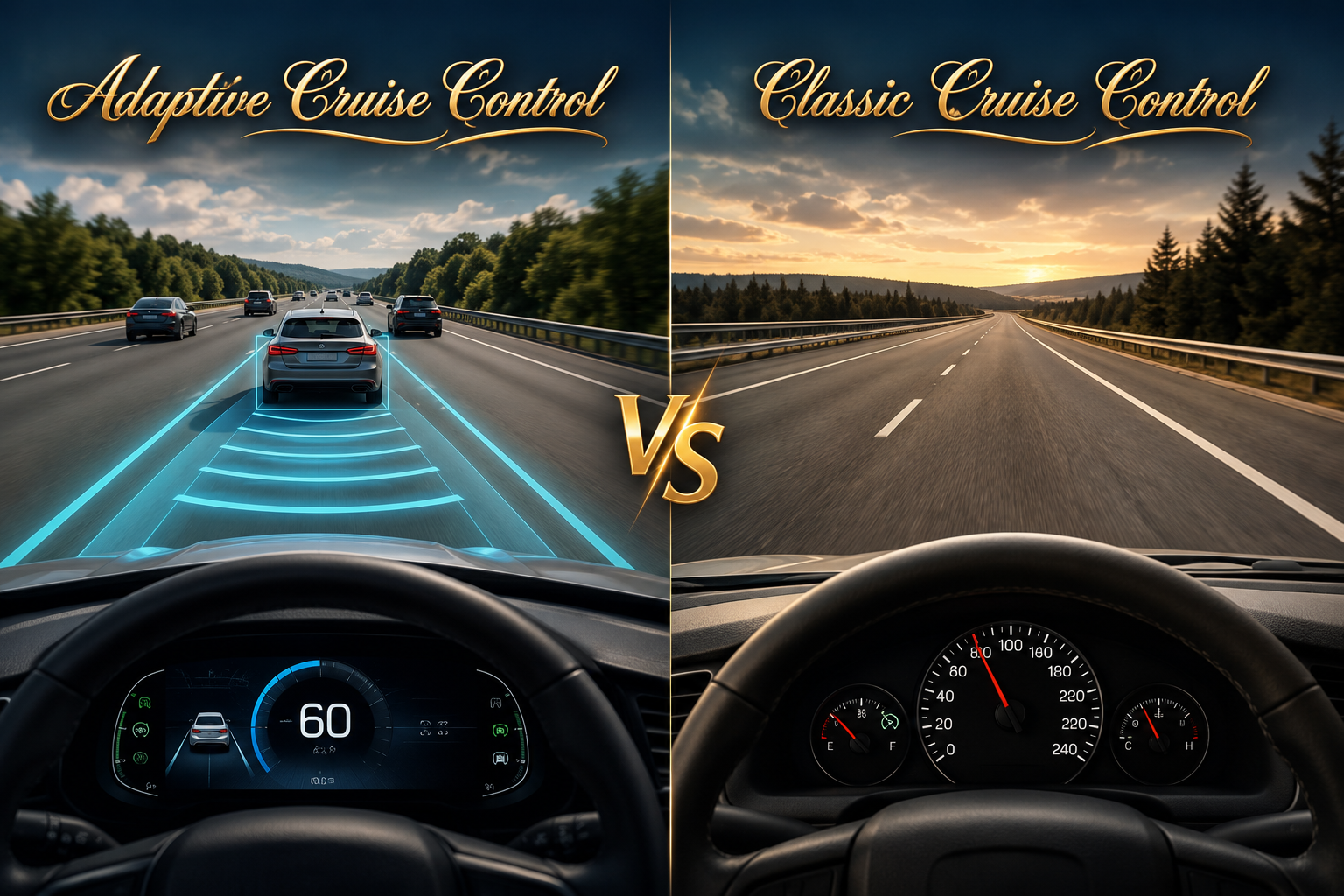
Adaptive Cruise Control Versus the Classic Version
Selecting between standard and adaptive cruise control is about more than choosing a newer feature. Although both systems help reduce the need to keep your foot on the accelerator, they perform their tasks differently. Standard cruise control maintains the speed you choose until you press the brake pedal or switch the system off.
Adaptive cruise control goes a step further by using sensors to monitor vehicles ahead and adjusting your speed automatically to maintain a comfortable and safe following distance. Fuel economy can also change depending on the type of cruise control installed in your vehicle.
When properly calibrated, adaptive cruise control responds to changing traffic with gentle acceleration and controlled braking. This smoother driving style reduces unnecessary fuel use because the vehicle avoids sudden speed changes whenever traffic conditions permit. The result is a more relaxed drive and better efficiency during many highway journeys.
Even with these advantages, adaptive cruise control is not always the right option for every driving situation. Some manufacturers program their systems to respond very quickly, leading to extra throttle inputs that may use more fuel than a careful driver would. The way each vehicle is designed has a direct effect on how efficiently the system performs, so results can differ from one model to another.
Modern vehicles now combine adaptive cruise control with fuel-saving technology such as automatic engine stop-start systems and GPS-based throttle management. These features work together to improve efficiency during daily driving. Standard cruise control remains a suitable choice for long, open roads with light traffic, while adaptive cruise control is better suited to roads where traffic moves steadily but requires occasional speed adjustments.
No matter which system your vehicle has, careful driving and proper judgment remain the best way to achieve better fuel economy and enjoy a safer driving experience on every trip throughout the year.
Also Read: 10 Vintage Cars Worth More Than A Ferrari
Common Habits That Undercut Cruise Control’s Benefits
Many motorists fail to get the best out of cruise control because they use it the wrong way without knowing it. One of the biggest mistakes is choosing a speed that is higher than necessary just to reach a destination faster. Once a vehicle goes beyond a certain speed, fuel consumption rises quickly. Cruise control can maintain a steady pace, but it cannot reduce the extra fuel required when you decide to drive faster than necessary.
A different habit that affects fuel economy is pressing the accelerator repeatedly while cruise control is active. Some drivers do this whenever they want to pass slower vehicles before allowing the system to take over again. Those repeated bursts of acceleration remove the steady driving pattern that helps reduce fuel use.
Road conditions also make a difference. Using cruise control on roads filled with hills, bends, or unfamiliar routes without lowering the selected speed can force the engine to work harder than needed. In such situations, manual driving may produce better fuel economy because the driver can ease off the accelerator when climbing.
Regular vehicle maintenance deserves equal attention. Poorly inflated tyres, clogged air filters, or neglected servicing can reduce fuel efficiency even if cruise control is used correctly. When these issues are ignored, many people blame the system instead of fixing the actual problem affecting the vehicle.
Long stretches of open highway remain the ideal places to use cruise control, yet many drivers forget to activate it when those conditions appear. Instead, they use it where traffic, poor weather, or changing road conditions make it less effective. The best results come from using the feature only when conditions suit it.
Research shows cruise control can reduce fuel consumption, but only when used wisely. It performs best during steady highway driving and delivers fewer benefits where traffic is heavy, roads are steep, or weather conditions are poor. Using good judgment always produces better results.
