
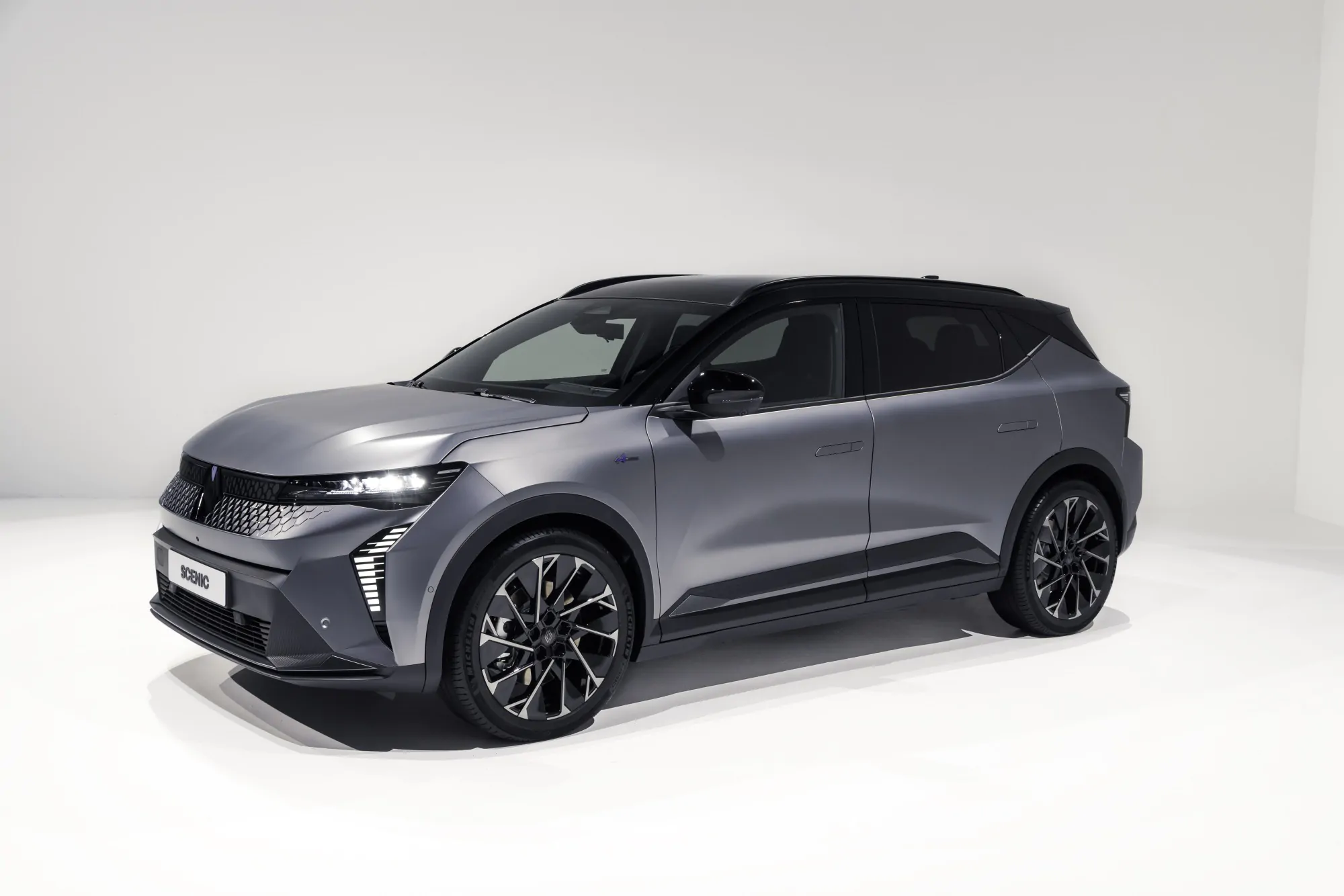
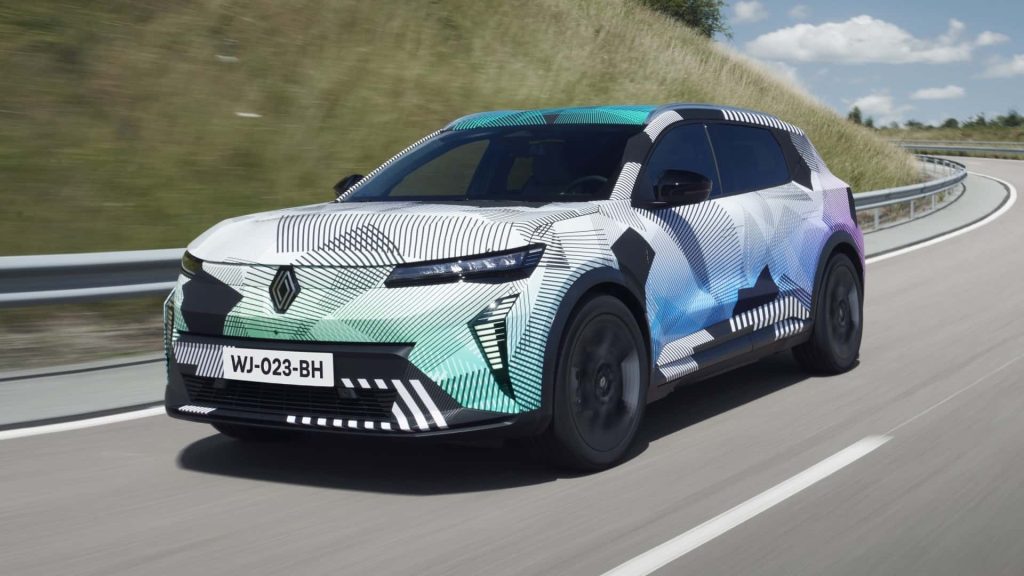
Renault is preparing the next chapter for the Scenic E-Tech electric, and early development prototypes have now been spotted testing on public roads.
The camouflaged vehicle appears to signal a mid-cycle update for Renault’s family-focused electric SUV, rather than a full replacement. It is expected to reach the market as a 2027 model, following closely behind the newly refreshed Megane E-Tech Electric.
The timing is notable. Renault has just revealed a substantially updated Megane E-Tech, bringing a new battery, revised exterior details, upgraded connected technology, and a simpler range structure to one of the company’s most important electric models.
The Scenic shares much of its architecture with the Megane, so a related update was always likely. Recent spy photographs suggest Renault is now moving the larger Scenic through the same development process.
The Scenic E-Tech has only been on sale since 2024, but electric vehicles are being updated faster than traditional combustion-powered models. Battery chemistry, charging performance, software, and digital services are becoming key reasons for manufacturers to revise a vehicle early in its life cycle.
Renault’s approach with the Scenic appears designed to keep the SUV current while strengthening its position in a rapidly changing European EV market.
Also Read: 10 Cars Worth More Used Today Than Their Original MSRP
A Familiar Shape With Carefully Hidden Changes
The test vehicle photographed in Europe retains the recognizable proportions of the current Scenic E-Tech. Its upright crossover body, sharply angled windscreen, long wheelbase, and high roofline are all visible beneath the camouflage.
That strongly indicates Renault is not preparing an all-new generation. Instead, the company appears to be developing a facelift that will modernize the exterior while preserving the vehicle’s existing body shell and interior packaging.
Spy shots published by Carscoops in April showed camouflage concentrated around the front bumper, headlights, and rear light clusters. That placement usually points to styling changes rather than major mechanical alterations.
The current Scenic already has a distinctive front end, with narrow headlamps, a prominent Renault diamond, and a geometric daytime-running-light signature. The facelifted model is expected to adopt a more recent interpretation of Renault’s design language, potentially borrowing elements from the updated Megane E-Tech.
The front bumper could receive a cleaner and more aerodynamic treatment, while the grille area may be reshaped to better match Renault’s newer electric models.
Since EVs do not need the same cooling openings as combustion-powered vehicles, manufacturers often use facelift programs to refine the front fascia for visual impact and airflow efficiency.
Changes at the rear may be more restrained. The prototype appears to wear coverings over the tail lamps and lower bumper, suggesting Renault is testing revised light graphics and possibly a redesigned diffuser-style lower section.
A new wheel design and additional paint choices are also likely, although those details tend to be finalized later in the development cycle.
Autoevolution reported that the Scenic prototype looked closely related to the Megane E-Tech development cars seen earlier, reinforcing the idea that Renault is updating both vehicles as part of one coordinated product program.
The two models are built on the same AmpR Medium electric architecture, previously known as CMF-EV, and share key components, including their electric drivetrain layout, electronics, and software foundation.
The Megane E-Tech Update Provides Important Clues
The recently revised Megane E-Tech offers the clearest indication of what Renault could bring to the Scenic. The Megane has received a new 67 kWh lithium-iron-phosphate battery, replacing the earlier 60 kWh nickel-manganese-cobalt unit in the updated range.
The change is significant because LFP chemistry is generally less expensive than NMC chemistry, while also offering strong durability and improved thermal stability.
A report published by Welt on June 22 stated that Renault has increased the Megane’s battery capacity to 67 kWh through cell-to-pack technology. The publication reported a claimed driving range of up to 500 kilometers under the WLTP test cycle, along with faster charging from 15 to 80 percent in 24 minutes.
Renault has also retained the Megane’s 160 kW, or 218-horsepower, electric motor and simplified the lineup to Techno and Esprit Alpine trims.
Those changes matter for the Scenic because Renault may apply the same strategy to its larger electric SUV. The current Scenic E-Tech is offered with 60 kWh and 87 kWh battery options in several European markets.
Renault’s UK product information lists a maximum claimed range of up to 381 miles, depending on version and test conditions, while also emphasizing the model’s family-oriented interior space and large cargo capacity.
The 87 kWh battery is expected to remain central to the Scenic lineup because long-distance capability is one of the SUV’s strongest selling points.
However, Renault could replace or supplement the entry-level 60 kWh pack with an LFP-based battery similar to the Megane’s new unit. That would allow Renault to reduce the entry price of the Scenic while keeping the higher-capacity version available for buyers who prioritize range.
Nothing has been officially confirmed regarding the Scenic’s battery lineup, power output, or charging speed. Still, the Megane update makes it reasonable to expect more than cosmetic changes.
Renault is likely to use the facelift to improve affordability, software capability, and charging performance, three areas that have become increasingly important as European buyers compare established brands with lower-priced Chinese EV competitors.
Software Could Become a Major Part of the Refresh
The Scenic E-Tech already uses Renault’s OpenR Link infotainment system, which is built around Google services such as Google Maps, Google Assistant, and the Google Play app store.
That system has been one of Renault’s stronger points in the electric-car segment because it offers a more integrated experience than many manufacturer-developed infotainment systems.
The revised Megane E-Tech introduces further software improvements, including the planned use of Google Gemini as a voice assistant. Welt reported that the updated Megane will offer access to more than 100 applications through Google Play, while its existing screen hardware remains in place.
Renault could bring similar updates to the Scenic. A more capable voice assistant would allow drivers to manage navigation, charging stops, cabin functions, and media more naturally. For an EV aimed at families and long-distance users, smarter route planning could be especially useful.
The system can calculate charging stops based on battery level, route conditions, and charger availability, making long journeys less complicated.
The facelift may also introduce new driver-monitoring functions, connected safety features, and expanded over-the-air update capability.
Auto Express reported that the refreshed Megane is expected to receive an A-pillar-mounted driver-recognition camera that can identify the person behind the wheel, load individual settings, and help monitor driver attention.
The same technology could be suitable for the Scenic because the two vehicles use closely related electrical systems.
Interior styling changes may be modest. Renault has invested heavily in the Scenic’s cabin design, which includes a high seating position, a flat floor, rear-seat space, and practical storage.
The company is unlikely to make expensive structural revisions during a facelift. Instead, buyers may see new upholstery choices, updated trim finishes, fresh ambient lighting options, and revised equipment packages.
Renault Needs the Scenic to Remain Competitive
The Scenic E-Tech occupies an important role in Renault’s electric lineup. It sits above the Megane E-Tech and below larger future electric models, offering a practical alternative for families who want more room than a compact hatchback can provide.
The name “Scenic” also carries history. Earlier generations were known as compact MPVs, but the modern model has transformed into an electric crossover SUV to match current buyer demand.
The latest Scenic won the 2024 European Car of the Year award, giving Renault a major endorsement at the start of the model’s life. The vehicle was recognized for its combination of range, interior practicality, technology, and electric-only packaging.
However, the market has become tougher since then. The Scenic competes with models such as the Volkswagen ID.4, Peugeot E-3008, Skoda Enyaq, Kia EV3, Hyundai Kona Electric, and Tesla Model Y.
Some rivals have newer battery technology, higher charging speeds, or aggressive pricing. Chinese manufacturers are also increasing pressure in Europe with products that often offer substantial equipment for the money.
Renault’s response appears to be based on continuous improvement rather than a complete redesign. Updating the Scenic with new battery technology, sharper styling, and stronger digital features could help the company extend the SUV’s life cycle without the cost of developing a replacement so soon after launch.
Production location will also remain relevant. The Scenic is built at Renault’s Douai plant in northern France, part of the company’s ElectriCity industrial network. The updated Megane and its LFP battery are also tied to Renault’s northern French manufacturing operations, according to Welt.
Keeping production and major component sourcing closer to Renault’s European customer base may help the company reduce supply-chain complexity while supporting its local-manufacturing strategy.
What to Expect Before the 2027 Launch
Renault has not announced a debut date for the revised Scenic E-Tech, and the company has not released official specifications. The current testing phase suggests development is still underway, with engineers likely evaluating styling parts, software calibration, and powertrain updates in real-world conditions.
More prototypes should appear in the coming months, possibly with less camouflage as the production design approaches approval.
Renault may reveal the facelifted Scenic in late 2026, with sales beginning in 2027. That schedule would align with the expected arrival of the updated Megane E-Tech and would allow Renault to present a more unified electric lineup.
The facelift is unlikely to change the Scenic’s core identity. It should remain a practical, front-wheel-drive electric family SUV with a spacious cabin, long-range options, and a technology-focused dashboard.
The important changes are expected to happen beneath the skin, where new battery chemistry, charging improvements, and software upgrades could make a bigger difference to daily ownership than a redesigned bumper alone.
For Renault, the next Scenic E-Tech will be a test of how effectively a young EV can be improved without losing the strengths that made it successful. The early prototype indicates the company is taking that task seriously.
If the Megane’s recent update is any guide, the 2027 Scenic E-Tech could arrive with sharper looks, more advanced connected features, and a stronger case for buyers looking for a European-built electric family vehicle.
Also Read: 10 Most Popular Trucks of Every Decade Since the 1960s
