
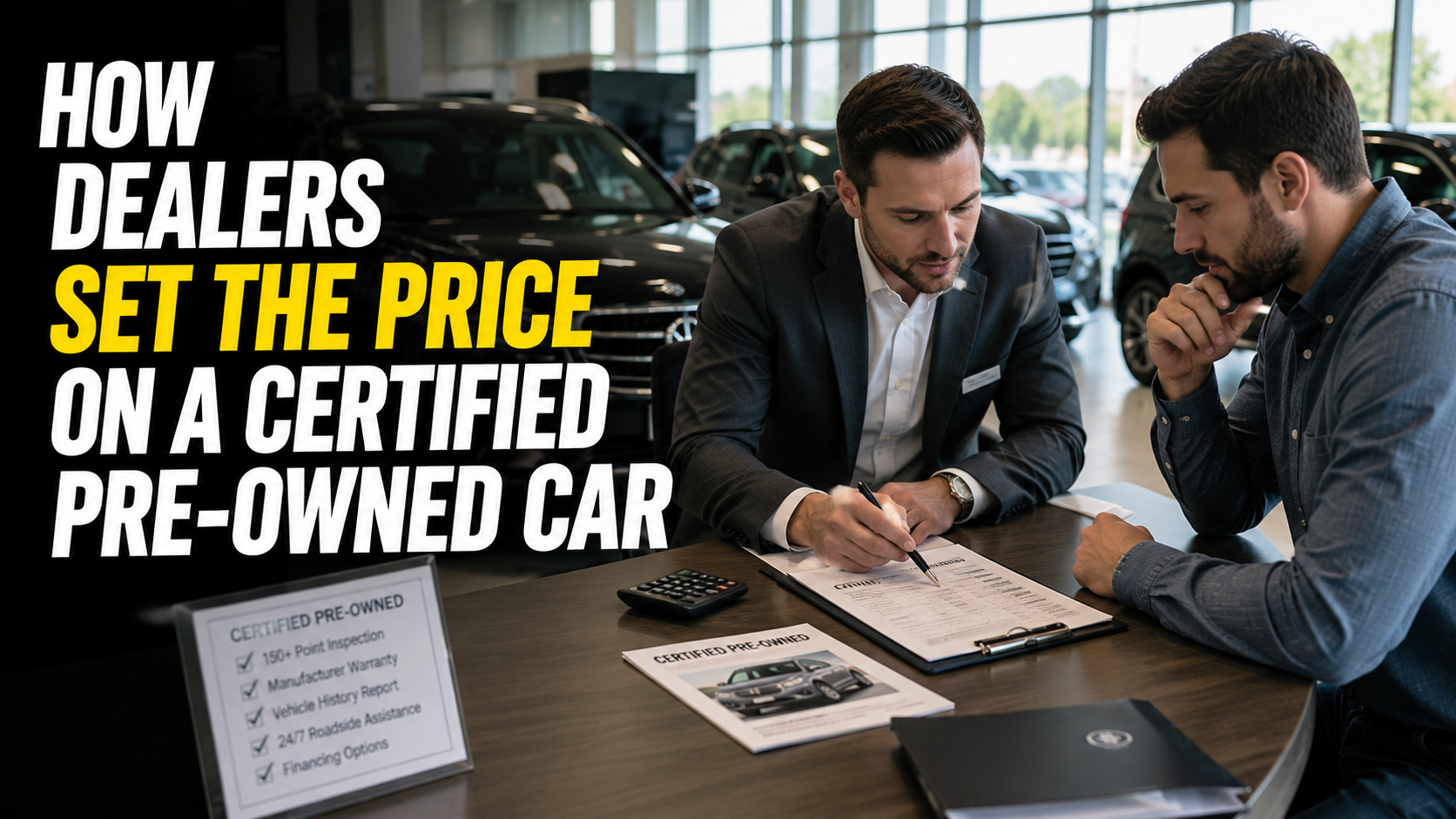
Certified Pre-Owned (CPO) vehicles have become one of the fastest-growing segments of the automotive market, offering buyers a middle ground between purchasing a brand-new vehicle and taking a chance on a standard used car.
These vehicles are typically newer, have lower mileage, undergo extensive inspections, and include manufacturer-backed warranties that provide added peace of mind. As a result, they almost always cost more than comparable non-certified used vehicles.
Many buyers assume dealerships simply add a few thousand dollars to the price after certifying a car, but the pricing process is much more detailed. Dealers consider dozens of factors before determining a certified pre-owned vehicle’s final asking price.
Market demand, reconditioning costs, warranty expenses, mileage, vehicle history, local competition, and expected profit margins all play important roles.
Understanding how these prices are determined helps buyers recognize what they are paying for and whether a certified pre-owned vehicle offers good value compared with a traditional used car.
Also Read: 10 Hidden Features in the Chevrolet Traverse
It Starts With the Vehicle’s Market Value
Before certification is even considered, the dealership determines the vehicle’s current market value.
Rather than relying solely on the original sticker price, dealers analyze what similar vehicles are currently selling for in their region. They monitor auction results, wholesale pricing, online listings, local inventory levels, and recent retail sales to establish a realistic market value.
This process gives the dealership a baseline price before any inspection or repairs begin. If the vehicle’s expected retail value cannot justify the cost of certification, it may be sold as a regular used car instead.
The Trade-In Price Is Only the Beginning
One of the biggest misconceptions among buyers is that dealerships make enormous profits simply because they paid less for a trade-in.
In reality, the trade-in value represents only the dealer’s initial investment. Once ownership changes hands, additional costs begin to accumulate almost immediately.
Transportation, administrative paperwork, inspections, photography, advertising, lot preparation, financing costs, and reconditioning all increase the dealership’s total investment before the vehicle is offered for sale.
By the time a certified pre-owned vehicle reaches the showroom, the dealership may have invested several thousand dollars beyond the original trade-in allowance.
Reconditioning Is One of the Largest Expenses
Every certified pre-owned vehicle must meet strict manufacturer standards. Technicians inspect the vehicle thoroughly, replacing worn components and correcting mechanical or cosmetic issues before certification is approved.
Common repairs include replacing worn tires, servicing brakes, performing scheduled maintenance, repairing scratches or dents, updating software, installing new wiper blades, correcting warning lights, and addressing any mechanical concerns discovered during inspection.
Depending on the vehicle’s condition, reconditioning alone often costs between $1,000 and $3,000, although luxury models can require considerably more. These expenses become part of the vehicle’s final selling price.
Certification Itself Has a Cost
Manufacturer certification is not free for the dealership. Automakers typically charge participating dealers certification fees that help cover the additional warranty and customer benefits included with the program.
Those benefits often include:
Factory-backed warranty coverage, roadside assistance, emergency towing, rental car reimbursement in certain situations, and complimentary maintenance on some brands.
Although customers rarely see these costs itemized, they are included in the dealership’s pricing calculations.
The certification fee is one of the reasons a CPO vehicle commands a higher price than an otherwise identical used model without certification.
Warranty Coverage Adds Real Value
Perhaps the biggest advantage of buying a certified pre-owned vehicle is the warranty. Unlike many traditional used cars, CPO vehicles usually include manufacturer-backed protection extending beyond the original factory warranty.
If a covered mechanical failure occurs, repairs are typically performed by factory-trained technicians using genuine replacement parts.
Providing this protection creates financial risk for both the manufacturer and the dealership. Warranty costs must therefore be built into the selling price.
While buyers pay more upfront, many consider the additional security worthwhile, particularly for vehicles equipped with advanced electronics or expensive drivetrains.
Mileage Has a Significant Impact
Mileage remains one of the strongest influences on Certified Pre-Owned pricing. Lower-mileage vehicles generally command higher prices because buyers associate fewer miles with reduced wear and longer remaining service life.
For example, two otherwise identical vehicles may differ substantially in value simply because one has traveled 25,000 miles while the other has 55,000 miles.
Even though both qualify for certification, the lower-mileage example will almost always carry a higher asking price.
Dealerships know that many shoppers search online using mileage filters, making lower-mileage inventory especially valuable.
Vehicle History Matters
Not every vehicle qualifies for certification. Manufacturers typically reject vehicles with major accident histories, flood damage, salvage titles, or significant structural repairs.
Even among eligible vehicles, a cleaner ownership history usually increases value. Cars that have had one owner, consistent maintenance records, and no reported accidents are generally easier to sell than vehicles with multiple owners or inconsistent service histories.
A clean history allows dealerships to price the vehicle more confidently because it increases buyer trust.
Local Market Conditions Influence Pricing
Certified Pre-Owned pricing also depends heavily on local supply and demand. If a particular SUV or pickup truck is selling quickly in one region, dealerships may price similar vehicles more aggressively.
Conversely, slow-selling models often receive price reductions regardless of certification status. Seasonality can also play a role.
Four-wheel-drive trucks often command stronger prices before winter, while convertibles generally sell for more during warmer months.
Dealerships constantly monitor competitors’ inventories and adjust prices to remain competitive without sacrificing profitability.
Popular Features Increase Value
Not every Certified Pre-Owned vehicle is equipped the same way. Optional equipment can significantly affect pricing.
Features that commonly increase resale value include leather upholstery, panoramic sunroofs, premium audio systems, heated and ventilated seats, advanced driver-assistance technology, all-wheel drive, and larger infotainment displays.
These features make the vehicle more desirable to buyers and often justify higher asking prices.
However, dealerships also recognize that some expensive factory options depreciate faster than others, so not every luxury feature adds its full original value to the resale price.
Certification Doesn’t Eliminate Depreciation
Although certified pre-owned vehicles sell for more than regular used cars, they still follow normal depreciation patterns. Age remains an important pricing factor.
A two-year-old certified vehicle generally commands a much stronger price than an otherwise similar five-year-old example, even if both qualify for certification.
Manufacturers usually impose age and mileage limits on CPO eligibility for this reason. Newer vehicles present lower warranty risk while remaining more attractive to buyers seeking near-new ownership experiences.
Dealer Profit Is Part of the Equation
Like every retail business, dealerships must earn a profit. The final asking price includes enough margin to cover operating expenses such as employee salaries, facility costs, insurance, financing, utilities, marketing, and future inventory purchases.

Certified pre-owned vehicles often require larger investments than standard used cars because of inspection, warranty, and reconditioning costs.
Consequently, dealerships carefully calculate pricing to recover those expenses while remaining competitive within the local market.
Profit margins vary widely depending on the vehicle, demand, and how long it remains in inventory.
Why Certified Vehicles Often Sell Faster
Although certified pre-owned vehicles cost more, buyers frequently choose them over comparable used vehicles because they reduce uncertainty.
Knowing the vehicle has passed a manufacturer-approved inspection, includes warranty protection, and meets strict eligibility requirements gives many shoppers greater confidence.
That confidence allows dealerships to maintain stronger pricing than they could for uncertified inventory.
In many cases, customers willingly pay the premium because they believe the additional inspection and warranty reduce the risk of unexpected repair costs after purchase.
Is the Higher Price Worth Paying?
The answer depends on the buyer’s priorities. Someone seeking the lowest possible purchase price may find a standard used vehicle more attractive.
However, buyers planning long-term ownership often appreciate the added security provided by certification.
A certified pre-owned vehicle can also retain stronger resale value because future buyers recognize the reputation associated with manufacturer-backed programs.
For many shoppers, the difference in price represents not just a cleaner vehicle but also a lower level of ownership risk.
Dealers do far more than simply increase the price of a used vehicle after adding a Certified Pre-Owned label. Pricing reflects the dealership’s total investment, including acquisition costs, extensive inspections, mechanical repairs, cosmetic reconditioning, certification fees, warranty coverage, market demand, and ongoing operating expenses.
By the time a vehicle reaches the showroom, thousands of dollars may have been invested to ensure it meets the manufacturer’s certification standards.
While certified pre-owned vehicles almost always cost more than comparable non-certified models, buyers receive more than just a cleaner car. The added inspection, factory-backed warranty, and higher preparation standards provide additional confidence that many shoppers consider well worth the premium.
Understanding how dealerships arrive at those prices makes it easier to decide whether a certified pre-owned vehicle offers the right balance of cost, protection, and long-term value.
Also Read: How Much an EV Battery Loses in Capacity After 100,000 Miles
