
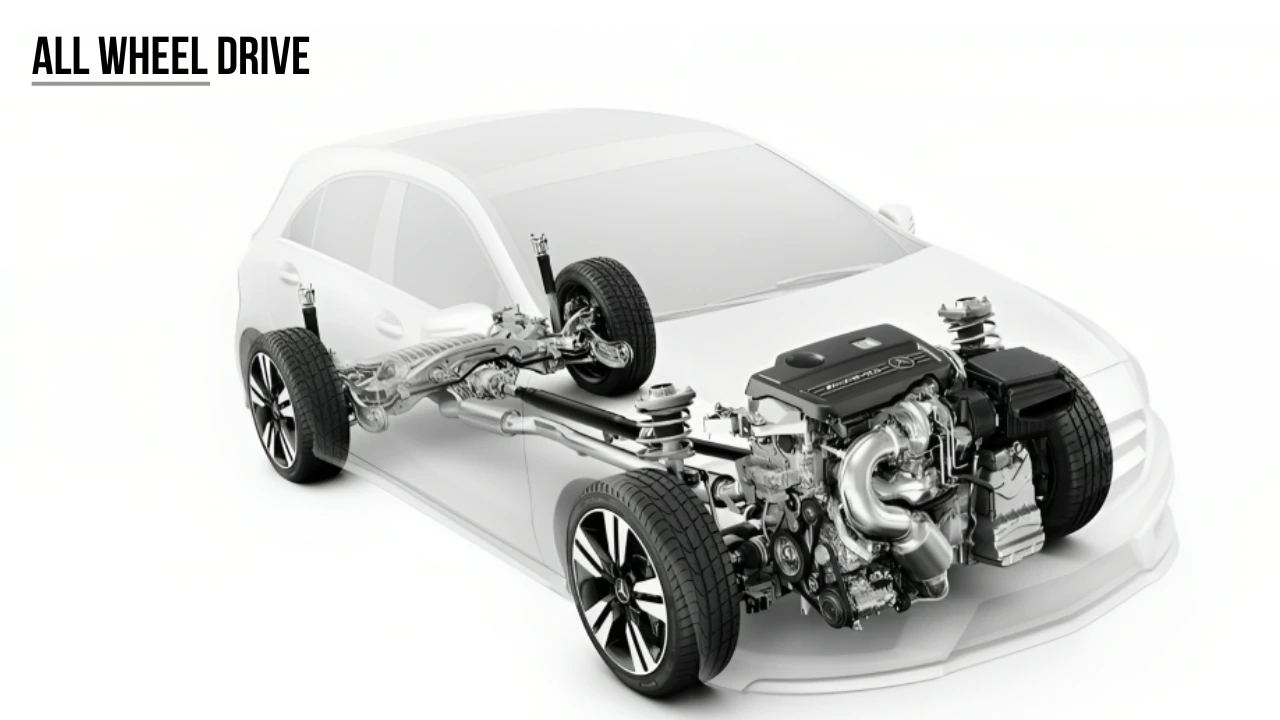
All-wheel drive has become one of the most desirable features in the American automotive market. Once reserved for off-road SUVs and luxury vehicles, it is now available on everything from compact sedans and family crossovers to minivans and high-performance sports cars.
For consumers, adding all-wheel drive (AWD) to a new vehicle often increases the sticker price by anywhere from $1,500 to $3,500, depending on the model. That naturally raises an interesting question: How much does it actually cost an automaker to engineer and build an AWD version of a vehicle?
The answer is much more complicated than simply adding a rear differential and two extra axle shafts. Developing an AWD model requires years of engineering work, extensive durability testing, manufacturing changes, supplier investments, software calibration, regulatory certification, and new production tooling.
Even when an automaker already has an AWD system in its parts catalog, adapting it to a different vehicle platform requires substantial investment before the first production vehicle reaches a dealership.
Automakers rarely disclose the exact cost of adding AWD to a specific model because those figures are considered highly competitive business information.
However, industry analyses, supplier reports, and manufacturing experts indicate that while the manufacturing cost of AWD hardware may add roughly $800 to $1,800 per vehicle, the total program investment required to develop an AWD variant often reaches tens or even hundreds of millions of dollars, depending on the scope of the project.
Those development costs are eventually spread across every vehicle produced during the model’s life cycle.
Understanding where that money goes explains why AWD remains an optional feature on many vehicles despite its growing popularity.
Also Read: 8 Trucks That Hold Their Value Past 15 Years
AWD Requires Far More Than Extra Drivetrain Parts
Many buyers assume that adding AWD simply means installing components that send power to all four wheels. In reality, the drivetrain is only one part of the equation.
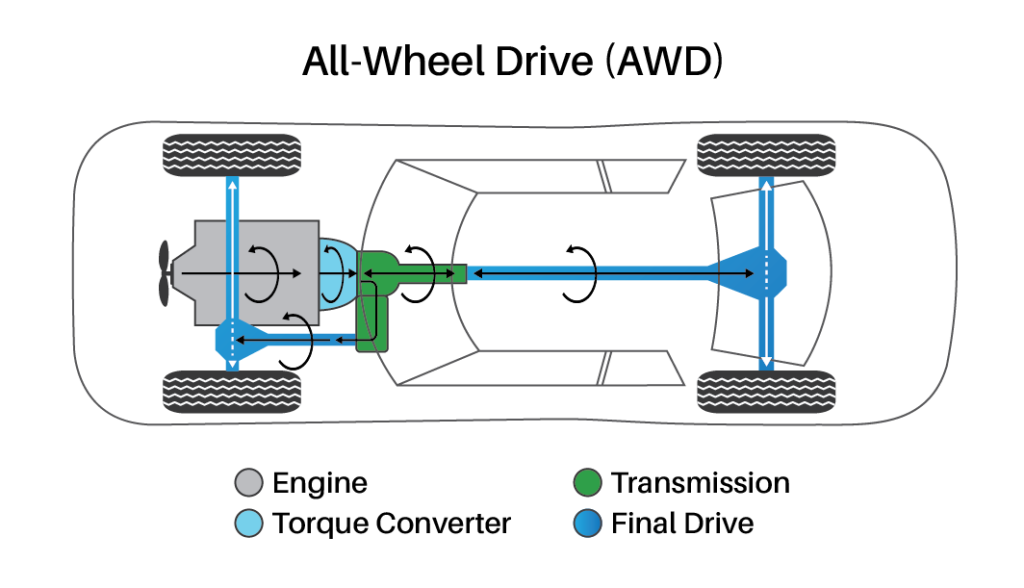
A typical AWD system includes:
- Transfer case or power transfer unit
- Rear differential
- Driveshaft
- Rear axle shafts
- Additional electronic controls
- Wheel-speed sensors
- Revised suspension components
- Software integration
Depending on the platform, engineers may also need to redesign the fuel tank, exhaust routing, rear subframe, and underbody structure to create space for the additional hardware.
For vehicles originally designed only with front-wheel drive, packaging these components can become a major engineering challenge.
Engineering Development Is One of the Biggest Expenses
Before a single production part is built, engineers spend years developing the AWD system.
This work includes:
- Computer simulations
- Structural analysis
- Cooling validation
- Noise and vibration testing
- Winter testing
- High-temperature durability testing
- Off-road evaluations
- Towing validation where applicable
According to the Society of Automotive Engineers (SAE), drivetrain development requires extensive validation to ensure durability, performance, efficiency, and compatibility with electronic stability and traction control systems. Engineers must verify that every component functions reliably under thousands of different operating conditions.
Even if the AWD hardware already exists in another vehicle, integrating it into a different platform requires significant calibration and testing.
Manufacturing Costs Increase on Every Vehicle
Once development is complete, each AWD vehicle costs more to manufacture than its two-wheel-drive counterpart.
Additional production costs include:
- Extra drivetrain components
- Larger wiring harnesses
- Additional fasteners
- More assembly time
- Higher logistics costs
- Increased quality inspections
Industry supplier estimates suggest that the hardware required for a conventional AWD system often adds approximately $800 to $1,800 to manufacturing costs, although luxury performance systems and advanced torque-vectoring designs can cost considerably more.
Automakers recover these costs through the higher purchase price charged for AWD models.
Factory Tooling Represents a Major Investment
Adding AWD frequently requires changes inside the assembly plant.
Production facilities may need the following:
- New assembly fixtures
- Updated robotic programming
- Revised conveyor systems
- Additional quality-control equipment
- Modified drivetrain installation stations
These investments allow both two-wheel-drive and AWD versions to be assembled efficiently on the same production line.
According to industry manufacturing practices, flexible assembly lines have reduced the cost of offering multiple drivetrain configurations, but significant tooling investments are still necessary whenever major underbody or drivetrain changes are introduced.
Software Has Become Just as Important as Hardware
Modern AWD systems rely heavily on electronic control. The software continuously analyzes information from dozens of sensors, including:
- Wheel speed
- Steering angle
- Throttle position
- Brake pressure
- Yaw rate
- Lateral acceleration
Based on this information, the control system determines how much torque should be delivered to each axle.
Engineers spend thousands of development hours calibrating these systems to achieve the desired balance between the following:
- Fuel economy
- Traction
- Stability
- Ride quality
- Handling
- Component durability
According to Bosch, one of the world’s largest automotive technology suppliers, electronically controlled AWD systems work in close coordination with anti-lock braking systems, electronic stability control, and traction control to maximize grip while maintaining predictable vehicle behavior.
Fuel Economy and Emissions Must Be Certified Again
Adding AWD changes more than traction. The additional drivetrain components increase:
- Vehicle weight
- Rotational mass
- Mechanical friction
These changes affect fuel economy and emissions performance. As a result, AWD variants generally require separate certification with the U.S. Environmental Protection Agency (EPA) and, where applicable, the California Air Resources Board before they can be sold.
Manufacturers also perform extensive fuel economy testing to establish official EPA ratings, which are typically slightly lower than those of equivalent front-wheel-drive models because of the added weight and drivetrain losses.
Warranty Costs Also Increase
Every new component added to a vehicle introduces another potential warranty expense.
Automakers must account for the long-term reliability of components such as
- Rear differentials
- Transfer cases
- Driveshafts
- Electronic couplings
- Bearings
- Axle seals
Before launching production, manufacturers conduct accelerated durability testing that simulates years of customer use.
Even so, companies build expected warranty expenses into the financial planning for every new vehicle program.
Reducing warranty claims is one reason manufacturers spend millions of dollars validating AWD systems before they reach customers.
Why Consumers Pay More Than the Manufacturing Cost
Many shoppers wonder why AWD typically increases a vehicle’s MSRP by several thousand dollars if the hardware itself costs considerably less. The answer lies in the difference between manufacturing cost and total program cost.
The retail price helps recover investments in:
- Engineering
- Product development
- Prototype construction
- Crash testing
- Certification
- Factory tooling
- Supplier development
- Warranty reserves
- Marketing
- Dealer support
These fixed costs are spread across every AWD vehicle sold during the model’s production run.
If an automaker expects to sell hundreds of thousands of AWD vehicles, the investment is distributed across a large production volume. Lower-volume models must recover similar engineering expenses from far fewer sales, often resulting in higher option prices.
Does AWD Increase Profit Margins?
Despite the significant development investment, AWD options are often profitable for manufacturers.
Market research consistently shows that buyers are willing to pay a premium for improved traction and all-weather capability, particularly in northern states where snow and ice are common.
Because much of the engineering investment is recovered over several years of production, the profit margin on AWD-equipped vehicles often improves as production volumes increase.
This is one reason manufacturers continue expanding AWD availability across their vehicle lineups, including segments that historically offered only front-wheel drive.
Adding all-wheel drive to a vehicle involves far more than installing a few additional mechanical components.
While the hardware itself may increase manufacturing costs by roughly $800 to $1,800 per vehicle, the total investment required to develop an AWD variant often reaches tens or even hundreds of millions of dollars once engineering, software development, testing, certification, factory tooling, and warranty planning are included.
Those costs explain why AWD models typically carry a higher MSRP than their two-wheel-drive counterparts, even though the visible hardware represents only part of the investment.
Automakers must recover years of research and development while ensuring the system delivers reliable performance in everything from dry highways to snow-covered mountain roads.
For consumers, the additional purchase price buys more than improved traction. It reflects the extensive engineering, validation, manufacturing changes, and long-term durability testing required to integrate AWD into a modern vehicle safely and reliably.
When viewed from that perspective, the cost of adding all-wheel drive is as much about engineering and development as it is about the extra mechanical parts hidden beneath the vehicle.
Also Read: 8 One-Generation Car Models That Were Never Renewed
