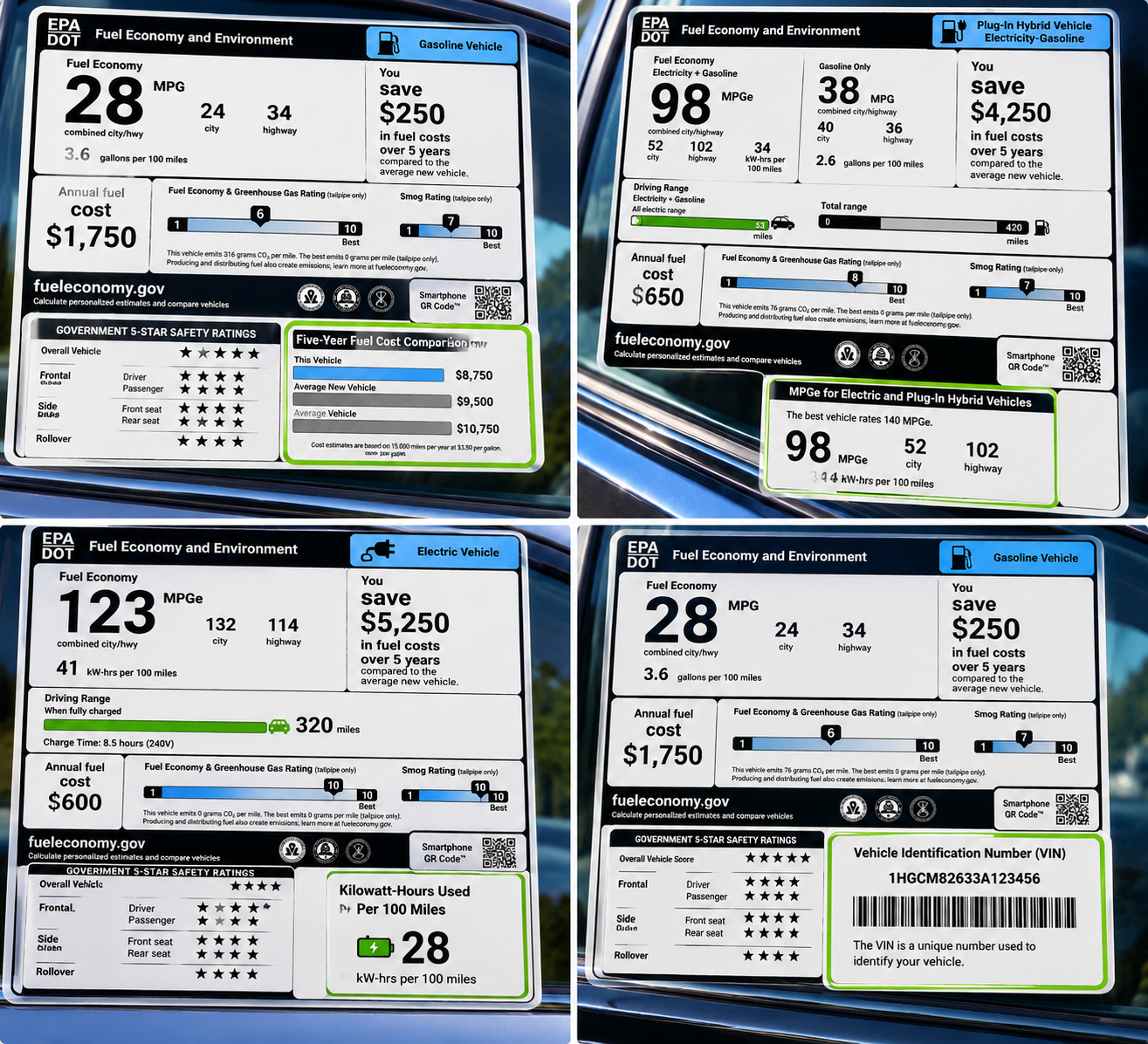
A new car’s window sticker contains far more than a suggested price and a list of equipment. In the United States, the Monroney label gives shoppers standardized information that can help compare vehicle pricing, factory options, destination charges, fuel economy, estimated fuel costs, and environmental performance.
The EPA’s Fuel Economy and Environment section adds another group of figures that can directly affect long-term ownership expenses.
The problem is that several numbers are easy to misunderstand. MSRP is not automatically the dealer’s final selling price. Combined MPG is a standardized comparison figure, not a promise that every owner will achieve the same result.
Annual fuel cost depends on assumptions printed directly on the label, while an electric vehicle’s MPGe rating measures energy efficiency rather than literal miles traveled on one gallon of gasoline.
EPA guidance explains how fuel-economy labels are designed to help consumers compare new vehicles, while federal window-sticker requirements standardize key pricing and equipment disclosures.
Reading these figures correctly can reveal much more about a car before a test drive begins. The following 10 numbers deserve particular attention because each answers a different question about what the vehicle costs, how efficiently it uses energy, or exactly which car is sitting on the dealer’s lot.
Also Read: The 10 Cars Owners Hold For 15 Years or More Are All Japanese
1. Manufacturer’s Suggested Retail Price
The MSRP is usually one of the first large dollar figures a shopper notices, but its meaning is narrower than many buyers assume. MSRP stands for Manufacturer’s Suggested Retail Price. The most important word is “suggested.”
It represents the manufacturer’s suggested retail price for the vehicle rather than a federally fixed amount that the dealer must accept as the final transaction price.
This number gives shoppers a standardized starting point. If two dealers have vehicles with the same trim and similar factory equipment, the sticker pricing provides a useful reference for comparing them.
The Automobile Information Disclosure Act requires pricing and equipment information to be disclosed on new-car window stickers in the United States.
Do not automatically treat the first MSRP figure as the final sticker total. A vehicle may have factory-installed optional equipment carrying separate prices. The destination charge is also disclosed separately. Those figures can increase the total manufacturer’s suggested retail price shown elsewhere on the label.
The number is equally important because it helps separate manufacturer pricing from dealership pricing. A dealer may negotiate below MSRP or ask more than MSRP depending on inventory, demand, and other market conditions.
Dealer-installed accessories and other dealer charges may also appear separately from the original manufacturer’s window sticker. That distinction is why buyers should read the original Monroney label rather than relying only on a large number written on a windshield.
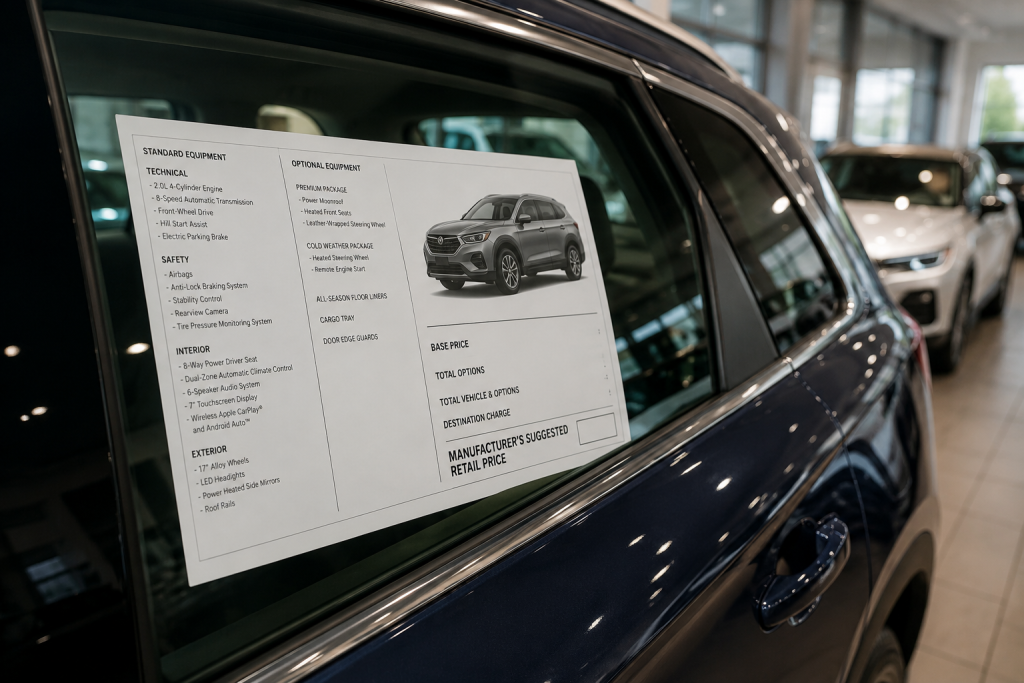
Think of MSRP as a pricing reference, not a complete purchase contract. It tells you what the manufacturer suggests for that vehicle and its disclosed factory configuration. It does not automatically include sales tax, registration costs, financing interest, or every possible dealer charge.
Before discussing a monthly payment, identify the MSRP and the complete sticker total. Keeping those figures separate from financing can make it easier to understand what the car itself is priced at before loan terms change the conversation.
2. EPA Combined MPG
A figure such as 32 MPG combined looks simple, but the word “combined” has a specific standardized meaning on the EPA Fuel Economy and Environment label. It is intended to represent a blend of city and highway driving rather than the arithmetic average of the two large MPG figures printed beside it.
EPA explains that the combined estimate is weighted 55 percent city driving and 45 percent highway driving. That means a vehicle rated at 30 MPG city and 40 MPG highway should not automatically be described as a 35-MPG car. The standardized weighting and EPA procedures determine the combined label value.
This number is especially useful when comparing vehicles. A buyer looking at several gasoline-powered cars can use combined MPG as a quick efficiency reference because the ratings are produced under a standardized federal program. EPA has required fuel-economy labels on new light-duty cars and trucks since the mid-1970s.
The figure is not a guarantee of what will appear on your trip computer. The EPA states that actual fuel economy varies for many reasons. Driving behavior, speed, temperature, road conditions, vehicle loading, and other factors can influence real-world fuel use. Two owners driving identical cars may therefore report different MPG results.
There is another reason to look beyond the largest number. A commuter who spends most of the week in slow urban traffic may care more about the city rating. A driver covering long interstate distances may find the highway estimate more relevant. Combined MPG remains valuable because it gives buyers one standardized figure for broad comparison.
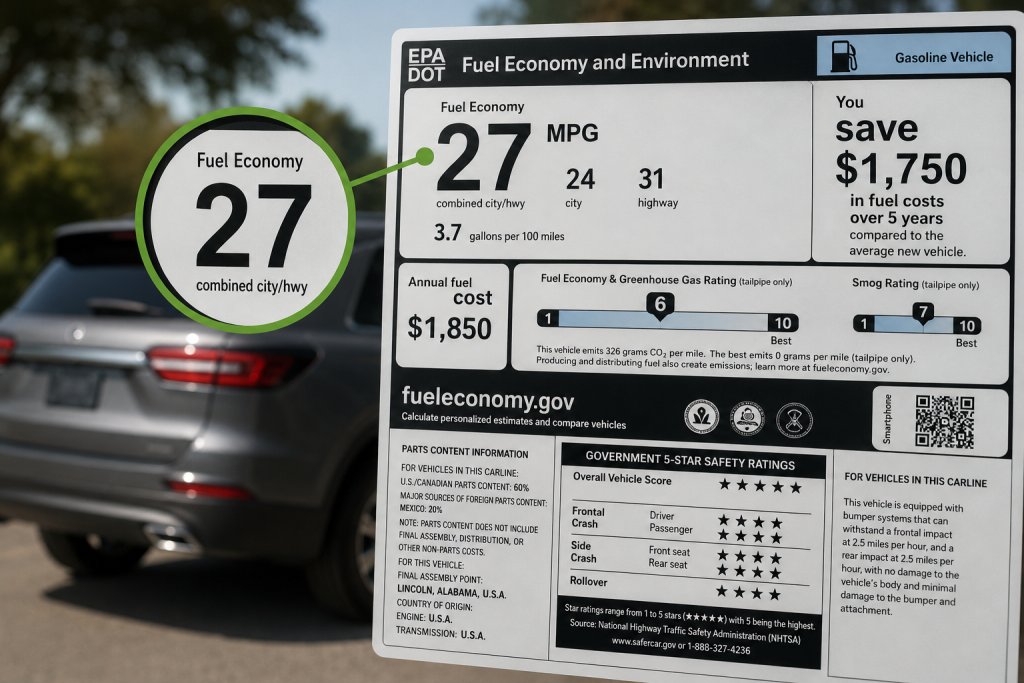
The correct interpretation is simple: 32 MPG combined does not mean the vehicle will return exactly 32 MPG every day.
It means the EPA label gives the vehicle a standardized combined fuel-economy estimate based on its testing and calculation procedures. Use it to compare vehicles, then consider whether your personal driving pattern resembles the city-highway mix behind the number.
3. EPA City MPG
The city MPG figure estimates how efficiently a gasoline-powered vehicle performs under standardized conditions intended to represent urban driving. A number such as 28 MPG in the city does not come from a manufacturer simply driving through a downtown area and reporting the best result.
EPA fuel-economy values are based on standardized test procedures, with manufacturers conducting testing and the EPA performing confirmation testing on a portion of vehicles.
City driving places different demands on a vehicle than steady highway travel. Frequent acceleration, deceleration, and periods of idling can increase fuel consumption in conventional gasoline cars. This helps explain why many non-hybrid vehicles display a lower city MPG number than their highway rating.
Hybrids can show a different pattern. Regenerative braking allows a hybrid to recover some energy during deceleration and store it in the battery. Electric assistance can also reduce gasoline-engine operation under certain conditions. As a result, some hybrid vehicles achieve city ratings that match or exceed their highway estimates.
Your own 28 MPG city result is not guaranteed. EPA states that fuel economy can vary because of driving style, temperature, road conditions, and other factors. Aggressive acceleration and excessive speed can reduce efficiency, while cold weather may also affect fuel use.
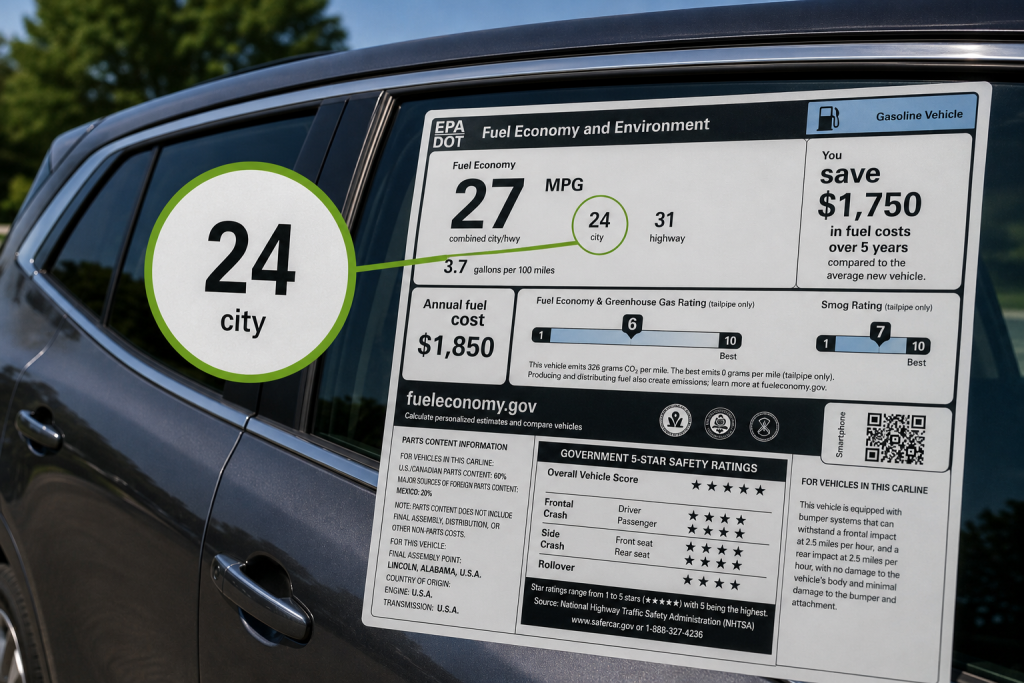
Use the city figure to compare vehicles if most of your driving involves urban streets, short trips, or frequent stop-and-go traffic. A buyer commuting through a congested metropolitan area may find this number more relevant than the larger highway MPG figure.
The city rating is therefore a standardized comparison tool. It estimates fuel economy under defined test conditions designed to represent city-type operation, helping shoppers identify which vehicles may use less fuel during their typical daily routine.
4. EPA Highway MPG
Highway MPG estimates fuel economy under standardized test conditions representing higher-speed driving. If the sticker displays 38 MPG highway, the figure gives buyers a consistent way to compare that vehicle with other new cars. It should not be interpreted as a promise that every highway trip will return exactly 38 MPG.
Steady-speed driving can favor conventional gasoline vehicles because the engine avoids repeated acceleration from a stop.
This is one reason many gasoline-powered cars achieve better fuel economy on the highway than in city driving. As vehicle speed increases, aerodynamic drag becomes a much greater force to overcome, causing fuel consumption to rise when driving at higher speeds.
EPA specifically warns that real-world fuel economy varies. Speed, aggressive acceleration, weather, vehicle condition, and cargo can influence the result. Using a roof-mounted cargo box or carrying additional weight may also change energy consumption.
The highway figure deserves particular attention from drivers with long interstate commutes. Comparing a 30-MPG highway vehicle with one rated at 40 MPG can reveal a meaningful efficiency difference when thousands of highway miles are accumulated each year.
Hybrid buyers should read the figure carefully as well. Some hybrids achieve exceptional city ratings but show a lower highway number because opportunities for regenerative braking and low-speed electric operation change during sustained higher-speed travel.
The lower highway rating does not mean the hybrid system has failed. It reflects different operating conditions.
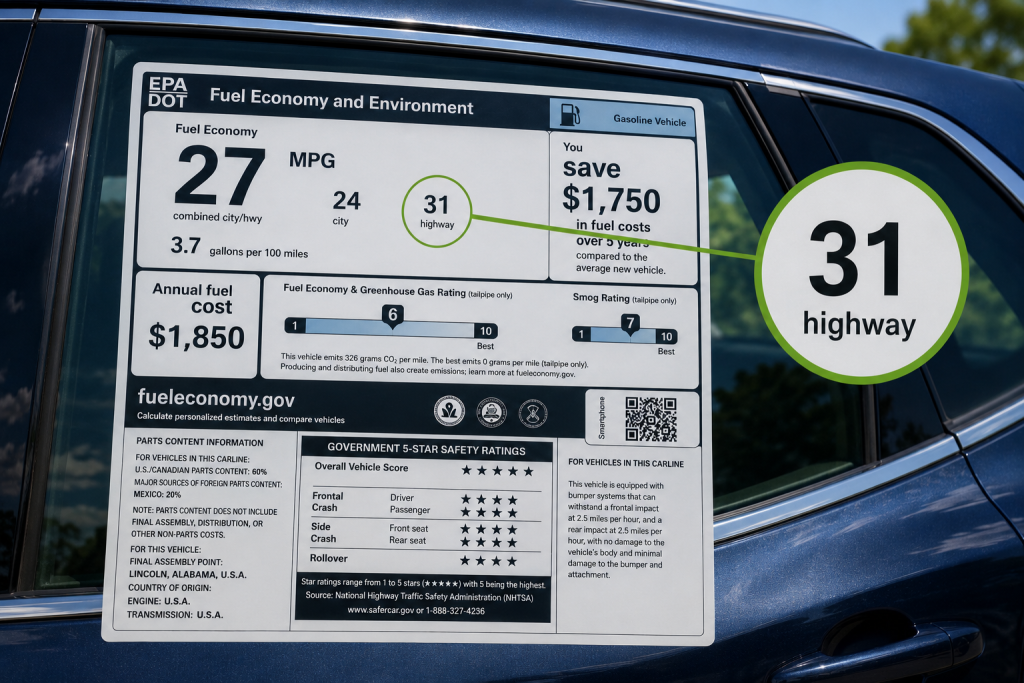
Treat highway MPG as a standardized federal estimate designed for comparison. Your personal result may be higher or lower, but the sticker gives every shopper a common reference point.
If most of your annual mileage occurs on freeways, this number may be more useful than the combined MPG figure when estimating how a vehicle fits your driving routine.
5. Estimated Annual Fuel Cost
The estimated annual fuel cost converts a vehicle’s energy use into a dollar figure that is easier to understand. A sticker might show $1,500 per year, but this does not mean every owner will spend exactly that amount. The EPA calculates the estimate using standardized assumptions printed on the Fuel Economy and Environment label.
EPA labels generally base annual fuel cost on 15,000 miles of driving per year and an assumed fuel price shown on the sticker. Because gasoline and electricity prices change, the displayed cost is primarily a comparison tool. Your location, annual mileage, and driving habits can produce a different result.
The number becomes useful when comparing two vehicles. If one sticker estimates $1,200 in annual fuel costs and another shows $2,200, the $1,000 difference can become substantial during several years of ownership. Multiplying the gap across five years gives a simple picture of why efficiency matters beyond the MPG number.
Always check the fuel type. A vehicle requiring premium gasoline may have different ownership costs from those of one designed for regular fuel, even when their MPG ratings appear similar. Electric vehicles use electricity price assumptions instead of gasoline prices.
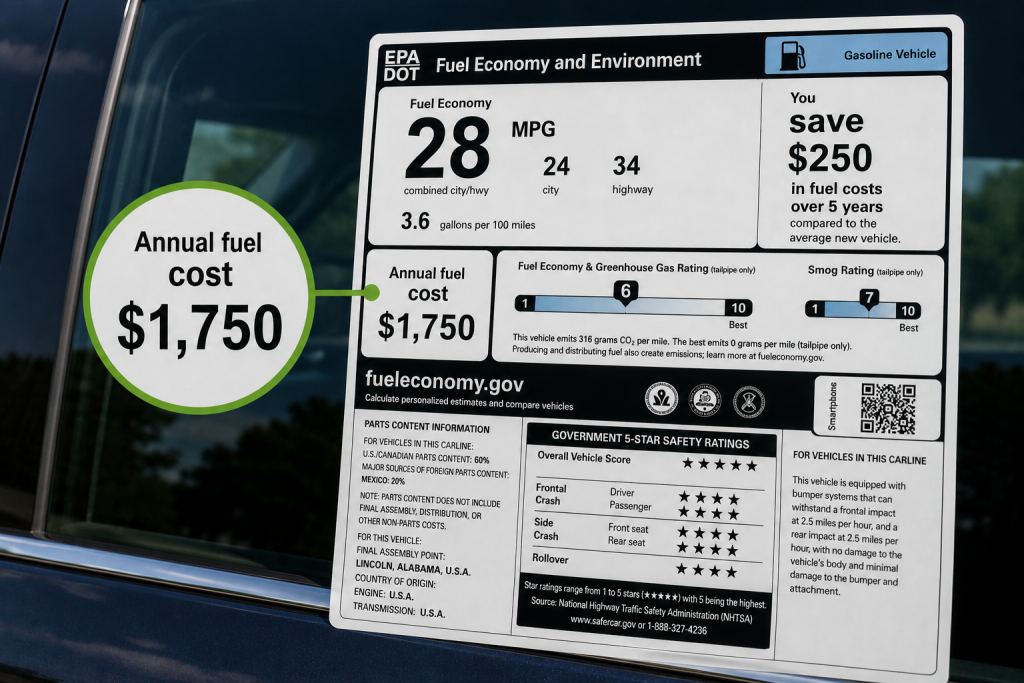
Do not treat annual fuel cost as a personalized forecast. It is based on federal label assumptions, not your commute. Use the number to compare new vehicles consistently, then calculate your own estimate using local energy prices and the number of miles you realistically drive each year.
6. Five-Year Fuel Cost Comparison
The sticker may state that you will save $3,000 in fuel costs over five years or spend a certain amount more than the average new vehicle. This figure is designed to put long-term energy expenses into context rather than showing fuel economy as an isolated MPG number.
EPA compares the vehicle with an average new vehicle and uses standardized assumptions. The label’s five-year comparison is based on driving 15,000 miles annually. Fuel prices used in the calculation are also identified on the label. These assumptions make comparisons consistent between vehicles displayed at dealerships.
The wording matters. “You save $3,000” does not mean the government or manufacturer gives the buyer a $3,000 rebate. It means the vehicle’s estimated fuel expenditure is $3,000 lower over five years than the comparison baseline under the label’s assumptions.
This number can be particularly useful when comparing a hybrid with a conventional gasoline model. A hybrid may carry a higher purchase price but display estimated fuel savings. The sticker gives buyers one data point for considering whether reduced fuel consumption could offset part of the price difference.
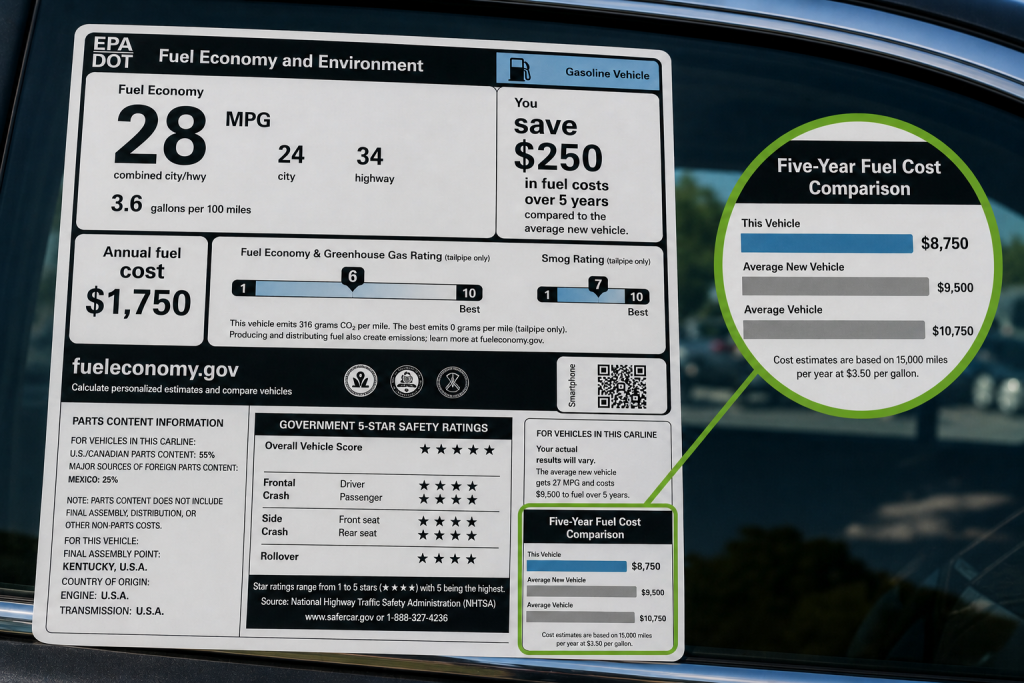
Your personal savings may vary considerably. Someone driving 25,000 miles per year could experience a larger fuel-cost difference, while a 5,000-mile-per-year driver may save much less. Local gasoline and electricity prices also matter.
Read this figure as a standardized long-term comparison. It helps translate fuel efficiency into dollars, but buyers should still calculate expected costs using their own mileage and local fuel prices before making a purchase decision.
7. MPGe for Electric and Plug-In Hybrid Vehicles
MPGe stands for miles per gallon equivalent, but it does not mean an electric vehicle contains a hidden gallon of gasoline. The EPA created MPGe to give shoppers a standardized way to compare the energy efficiency of electric vehicles, plug-in hybrids, and gasoline-powered vehicles on a similar scale.
The key number behind MPGe is 33.7 kilowatt-hours of electricity. The EPA treats 33.7 kWh as containing the same amount of energy as one gallon of gasoline. If an electric vehicle is rated at 100 MPGe, the figure describes how efficiently it uses an energy quantity equivalent to the energy in a gallon of gasoline.
MPGe should not be confused with driving range. A 120-MPGe EV does not automatically travel farther on a full charge than a 100-MPGe EV. Battery capacity and vehicle energy consumption also affect total range. A highly efficient EV with a smaller battery may have less range than a less efficient vehicle carrying a much larger battery pack.
For plug-in hybrids, the label can show separate information for electric operation and gasoline driving. Buyers should study both because real-world energy use depends heavily on charging frequency and trip length.
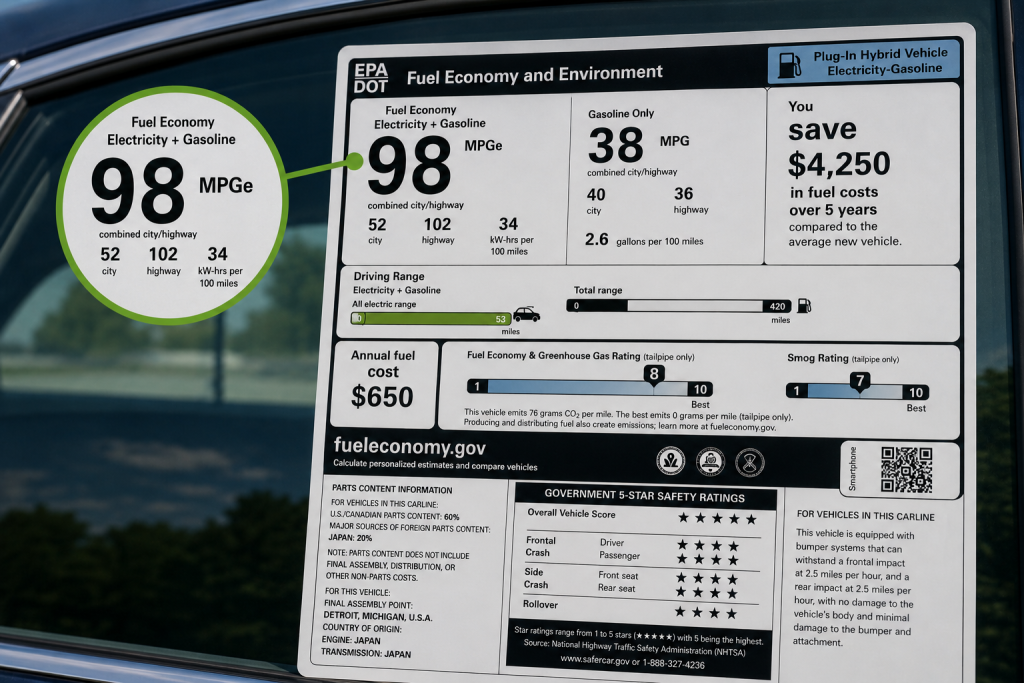
Use MPGe primarily as an efficiency comparison number. Higher MPGe generally indicates that a vehicle uses less energy to travel a given distance under standardized EPA procedures. Range tells you how far the vehicle may travel, while MPGe helps explain how efficiently it uses stored energy.
8. Electric Driving Range
The electric driving range number estimates how far an electric vehicle can travel on a full charge under EPA procedures. A label showing 300 miles of range gives shoppers a standardized comparison figure, but it should not be interpreted as a guarantee that every full battery will deliver exactly 300 miles.
Real-world range can change with driving conditions. The EPA and Department of Energy note that speed, aggressive driving, weather, cabin heating, air conditioning, and other factors can affect energy consumption.
Cold temperatures can be particularly important for EV owners because both battery performance and cabin heating demands may influence driving range.
Range is different from MPGe. An EV can have excellent energy efficiency but a smaller battery, producing a lower total range. Another model may be less efficient yet travel farther because it carries more usable battery energy. Buyers should read both figures instead of assuming the highest MPGe vehicle automatically has the longest range.
For plug-in hybrid vehicles, electric range indicates the estimated distance available using electricity before gasoline operation becomes necessary under applicable test conditions. Actual operation can vary depending on the vehicle and driving situation.
Think about your daily mileage when reading this number. A 250-mile EV may easily cover a 40-mile daily commute, while frequent long-distance travel introduces different charging considerations.
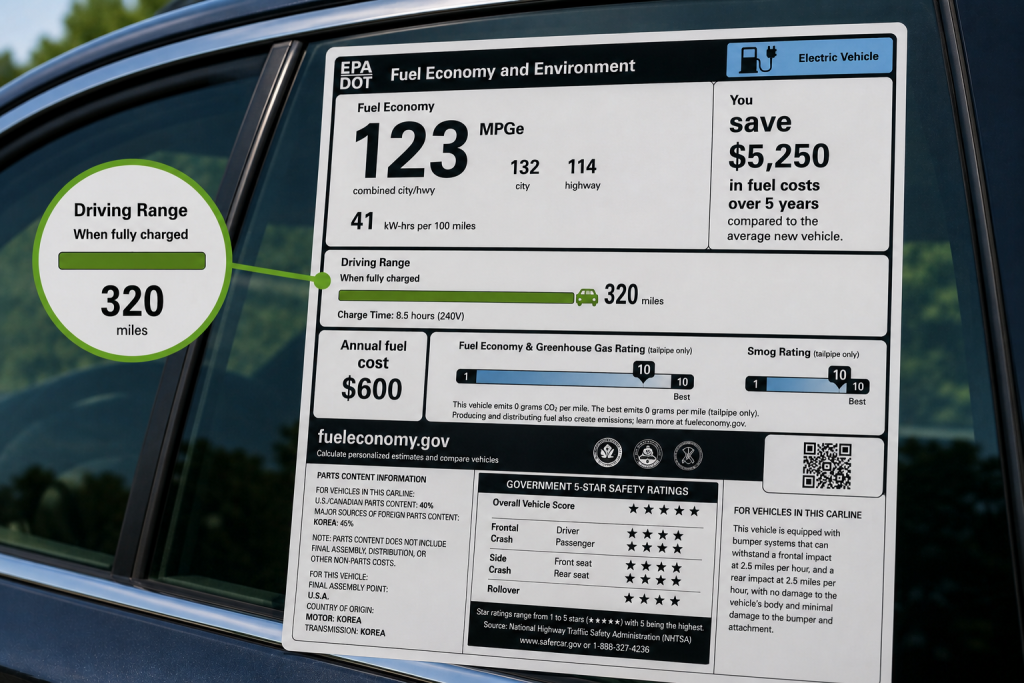
EPA electric range is a standardized estimate designed to make vehicle comparisons easier. Your dashboard estimate may rise or fall based on recent driving and conditions, but the window sticker provides a consistent federal reference before you buy.
9. Kilowatt-Hours Used Per 100 Miles
Electric vehicle window stickers commonly display a number such as 30 kWh per 100 miles. This figure measures how much electrical energy the vehicle is estimated to use to travel 100 miles under standardized EPA procedures. Unlike MPGe, the number is expressed directly in kilowatt-hours, making it especially useful for estimating charging expenses.
The most important detail is that a lower number indicates better energy efficiency. An EV rated at 25 kWh per 100 miles uses less electricity over the same distance than one rated at 40 kWh per 100 miles. This is similar to comparing gallons consumed per 100 miles rather than MPG.
The figure can also help estimate electricity costs. If an EV uses 30 kWh per 100 miles and electricity costs 15 cents per kWh, the basic energy calculation equals $4.50 for 100 miles. Actual charging costs can differ because electricity rates vary and charging losses may affect the amount of energy drawn from the electrical source.
Driving speed, weather, climate-control use, and other conditions can change real-world consumption. The EPA rating remains valuable because every vehicle is measured through standardized procedures.
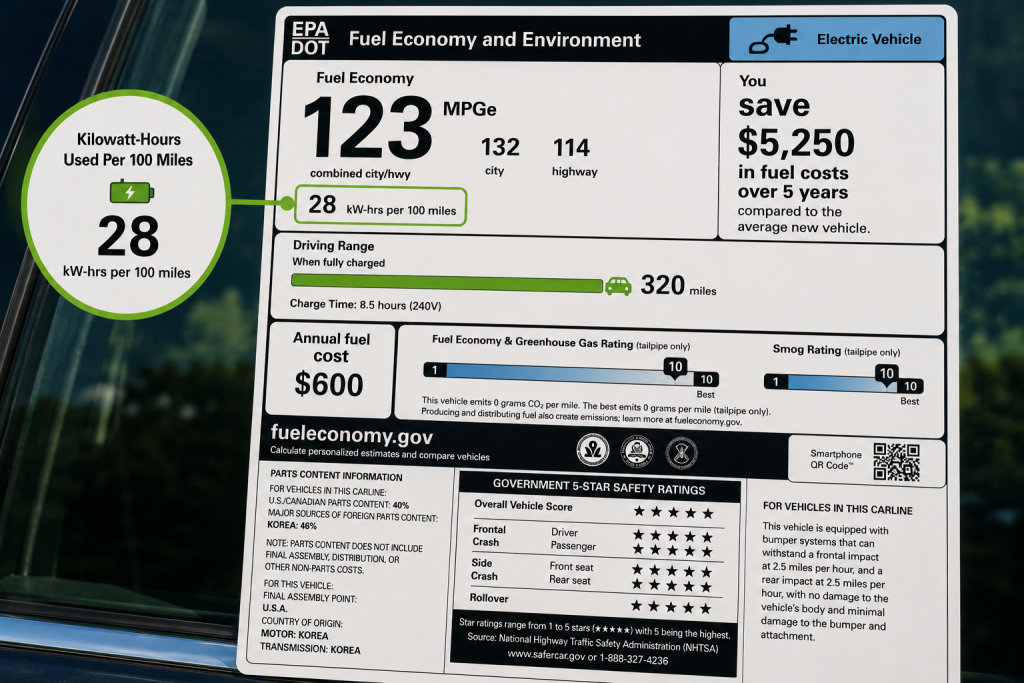
Do not confuse this number with battery capacity. A vehicle using 30 kWh per 100 miles does not necessarily have a 30-kWh battery.
For EV shoppers, this is one of the most informative figures on the label. Range tells you distance, while kWh per 100 miles shows how much electrical energy the vehicle needs to cover that distance.
10. Vehicle Identification Number
The 17-character Vehicle Identification Number, or VIN, may not look like a traditional performance or efficiency figure, but it is one of the most important identifiers printed on a new vehicle’s window sticker. Since the 1981 model year, vehicles sold in the United States have used a standardized 17-character VIN format.
A VIN identifies a specific vehicle rather than merely describing a model. NHTSA explains that VIN information can be used to identify details associated with a vehicle and check for open safety recalls. This makes the number valuable when confirming that the sticker belongs to the exact car parked in front of you.
Compare the VIN on the window sticker with the VIN visible on the vehicle. A common location is the driver’s side of the dashboard, where the number can be viewed through the windshield. The VIN may also appear on vehicle documentation and other manufacturer labels.
For recall research, NHTSA’s VIN lookup system allows consumers to check whether a specific vehicle has unrepaired safety recalls. NHTSA notes that its VIN search covers incomplete safety recalls and generally does not display completed recalls.
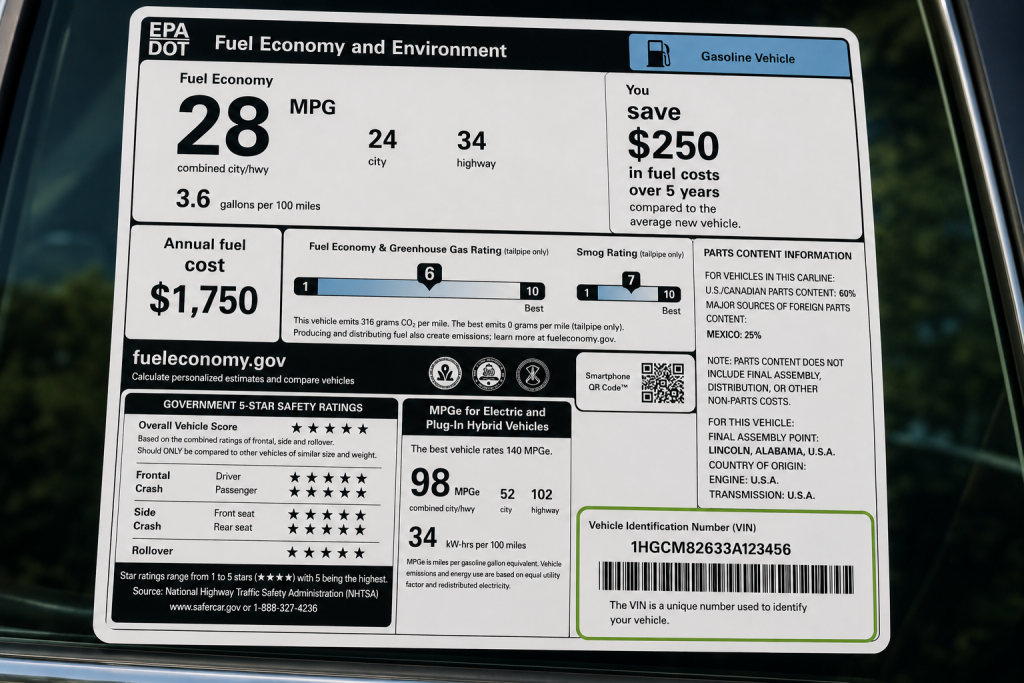
The VIN is also useful when reviewing insurance information, financing documents, and purchase paperwork. A single incorrect character can create confusion because the number is intended to identify one particular vehicle.
Do not treat the VIN as just a line of random letters and numbers. Before purchasing a car, verify that the identifier on the sticker matches the vehicle and transaction documents. It is the numerical and alphabetical fingerprint connecting the physical car to its official identity.