
The American automotive industry is entering one of its biggest supply chain transformations in decades as manufacturers race to eliminate Chinese-made connected vehicle technology before sweeping federal restrictions take effect.
What began as a national security initiative has quickly evolved into a massive engineering and procurement challenge that touches nearly every major automaker selling vehicles in the United States.
Under regulations finalized by the U.S. Department of Commerce, software linked to China or Russia will effectively be prohibited in new connected vehicles beginning with the 2027 model year, while restrictions on connected-car hardware will phase in by the 2030 model year, or January 1, 2029, for vehicles without a model year designation.
The rules are designed to prevent foreign adversaries from gaining access to sensitive vehicle data or remotely influencing critical automotive systems.
According to the Commerce Department, the restrictions cover Vehicle Connectivity Systems (VCS), including telematics control units, Bluetooth, Wi-Fi, satellite communication, and cellular modules, as well as software used in advanced automated driving systems.
The result is an industry-wide effort to redesign electronics supply chains that have become deeply intertwined with Chinese manufacturers over the past decade.
Also Read: 10 Popular Cars With Surprisingly High Insurance Premiums
Automakers Face a Costly and Complex Supply Chain Reset
Unlike replacing a single mechanical component, eliminating Chinese electronic technology requires manufacturers to trace thousands of interconnected parts across multiple supplier tiers. Modern vehicles contain dozens of electronic control units and millions of lines of software code supplied by companies spread across the globe.
According to Reuters, automakers are now accelerating supplier audits while demanding unprecedented transparency from electronics manufacturers regarding where hardware is produced and where software is developed, maintained, and updated.
Companies that once focused primarily on cost and production capacity are now evaluating suppliers based on geopolitical risk and regulatory compliance.
Industry executives acknowledge that the transition will not happen overnight. Connected vehicle modules are among the most difficult automotive components to replace because they integrate wireless communications, GPS functionality, cloud connectivity, smartphone integration, emergency services, and over-the-air software updates.
Replacing one supplier often means redesigning multiple electronic systems, validating new software, conducting cybersecurity testing, and obtaining fresh regulatory certifications before production can begin.
The challenge extends beyond automakers themselves. Many Tier 1 suppliers have historically sourced communication modules, semiconductors, antennas, and embedded software from Chinese manufacturers that built competitive advantages through scale and lower production costs. Those relationships now have to be unwound.
Reuters reported that the cost difference between Chinese communication modules and newly developed domestic alternatives can still range from roughly 5% to 15%, increasing pressure on manufacturers already dealing with rising material and labor expenses.
New Suppliers See Opportunity as Demand Surges
The federal restrictions are also creating opportunities for American electronics companies seeking to fill the gap left by Chinese suppliers.
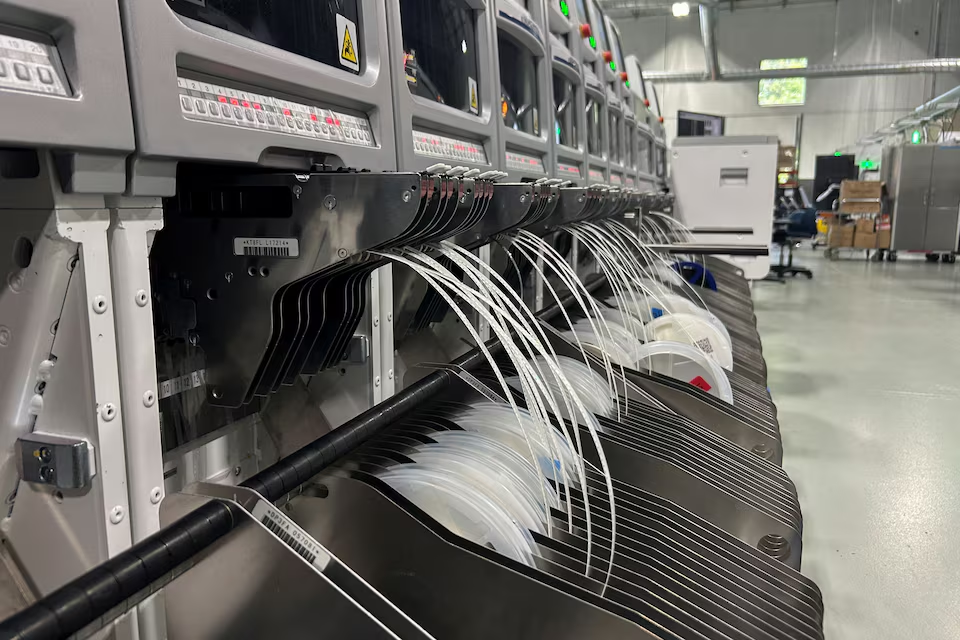
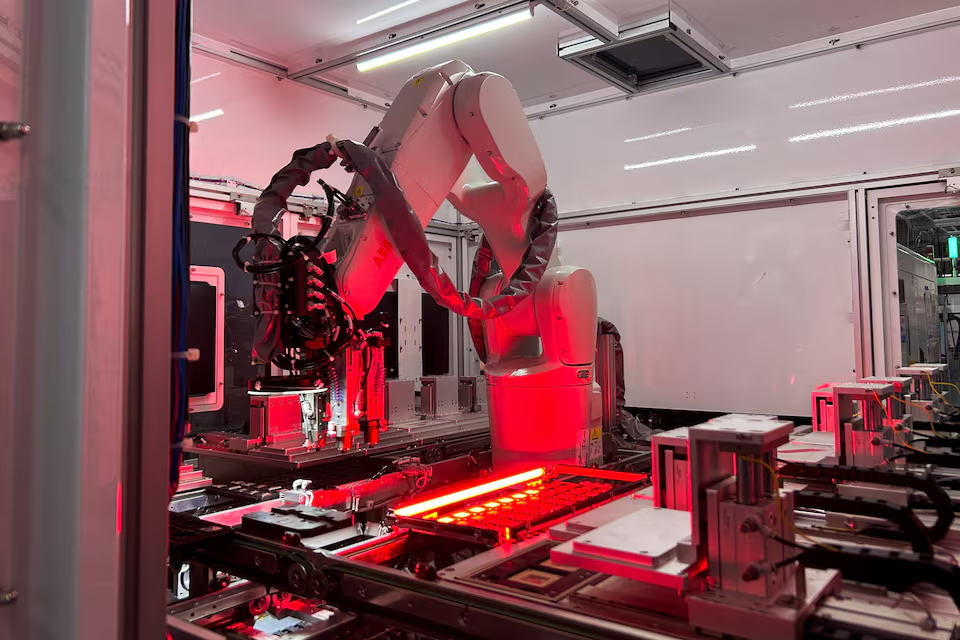
One of the clearest examples is Ohio-based Eagle Wireless, a company established in late 2025 specifically to manufacture connected vehicle communication modules compliant with the new regulations.
According to Reuters, the company has rapidly expanded production capacity and expects strong growth as automakers begin placing larger orders for domestically produced wireless modules.
Company executives told Reuters they expect employment to increase from roughly 140 workers today to nearly 1,000 over the coming years while targeting annual revenue approaching $100 million.
The company believes demand will continue climbing as manufacturers prepare for the software and hardware compliance deadlines. Even so, building an entirely domestic electronics ecosystem remains a long-term undertaking.
Many components still rely on internationally sourced semiconductors, printed circuit boards, and specialized manufacturing equipment.
Some newer American suppliers have also licensed technologies originally developed by Chinese companies, meaning they must gradually transition toward fully independent technology platforms before future compliance deadlines arrive.
That illustrates the broader reality facing the industry. Reducing dependence on Chinese automotive technology involves much more than moving factories. It also requires rebuilding intellectual property, software development capabilities, and manufacturing expertise that evolved over years of global integration.
Existing Models Present Immediate Challenges
While future vehicle programs can be redesigned around compliant technologies, currently marketed vehicles present a far more complicated situation.
Several automakers already sell vehicles in the United States that are assembled in China or contain software installed during Chinese production. Those vehicles now require special regulatory approval to remain on sale.
Ford is among the companies seeking authorization from the U.S. Commerce Department for its China-built Lincoln Nautilus. According to Reuters, although the vehicle’s software is developed in the United States, installation occurs during manufacturing in China, placing it within the scope of the new connected-car regulations.
Other manufacturers face similar questions as regulators evaluate whether existing products qualify for exemptions or temporary licenses.
Electric vehicle manufacturers have been particularly affected because many rely heavily on sophisticated connected technologies for navigation, battery management, charging networks, smartphone integration, and over-the-air software updates.
The regulations do not prohibit Chinese-built vehicles solely because of where they are assembled. Instead, they focus specifically on connected vehicle technologies considered capable of transmitting data or receiving remote commands.
This distinction has become increasingly important as regulators separate traditional automotive manufacturing from software-defined vehicle architecture.
National Security Drives Washington’s Strategy
Federal officials have consistently framed the regulations as a national security measure rather than a trade policy.
The Commerce Department concluded that connected vehicles generate enormous amounts of sensitive information, including driver locations, travel habits, home addresses, infrastructure mapping, and communication data.
Officials argue that foreign adversaries could potentially exploit these systems for intelligence gathering or cybersecurity attacks if critical hardware or software remains under foreign influence.
Connected vehicles increasingly function as computers on wheels. They continuously exchange information with smartphones, cloud servers, dealerships, emergency services, navigation providers, charging networks, and other connected infrastructure.
That expanding digital ecosystem has dramatically increased cybersecurity concerns across governments worldwide.
The regulations therefore extend beyond infotainment systems to include communication modules that enable Bluetooth connectivity, Wi-Fi access, satellite communications, cellular networking, and vehicle telematics.
The rules also cover software supporting advanced driver assistance and automated driving functions where national security risks may become even more significant as vehicle autonomy increases. Although originally finalized during the Biden administration, the regulatory framework has remained in place under the Trump administration.
U.S. Trade Representative Jamieson Greer indicated earlier this year that the administration had no plans to reverse the connected vehicle restrictions, reinforcing industry expectations that compliance deadlines will remain unchanged.
Industry Still Faces Significant Questions
Despite broad industry acceptance that the regulations are moving forward, several implementation questions remain unresolved. Automakers continue seeking clarification regarding software certification, supplier verification, licensing procedures, and acceptable documentation proving compliance.
Cybersecurity specialists have also noted that verifying millions of lines of software across multiple suppliers presents enormous practical challenges.
According to reporting by The Wall Street Journal, experts argue that proving the complete absence of Chinese-developed code throughout a complex automotive software stack may be considerably more difficult than tracing physical hardware origins.
Some analysts believe self-certification could become one of the industry’s largest compliance burdens over the next several years. Meanwhile, individual manufacturers are pursuing different strategies.
Some companies are redesigning future vehicle architectures entirely around new suppliers, while others continue requesting temporary government authorizations for existing models as they complete long-term transitions.
Volvo recently secured authorization allowing continued U.S. sales after satisfying government requirements, whereas Chinese-owned Polestar decided not to challenge restrictions affecting its future U.S. business, highlighting how differently manufacturers are responding to the evolving regulatory landscape.
For suppliers, compliance has become a competitive advantage. Companies capable of demonstrating transparent sourcing, secure software development, and manufacturing outside prohibited jurisdictions are likely to benefit from increasing demand as automakers diversify their supply chains.
The transition will undoubtedly increase costs across portions of the industry in the near term, but manufacturers increasingly view those expenses as necessary investments to ensure uninterrupted access to the U.S. market.
As software becomes just as important as engines and transmissions in defining modern vehicles, the federal connected-car regulations are reshaping not only where automotive technology is produced but also how global automakers think about security, supplier relationships, and the future architecture of connected transportation.
The changes unfolding today are likely to influence vehicle development strategies well into the next decade as the industry adapts to a new era where digital supply chains carry as much strategic importance as traditional manufacturing.
Also Read: 10 Most Reliable Volkswagen Jetta Generations Ranked
