
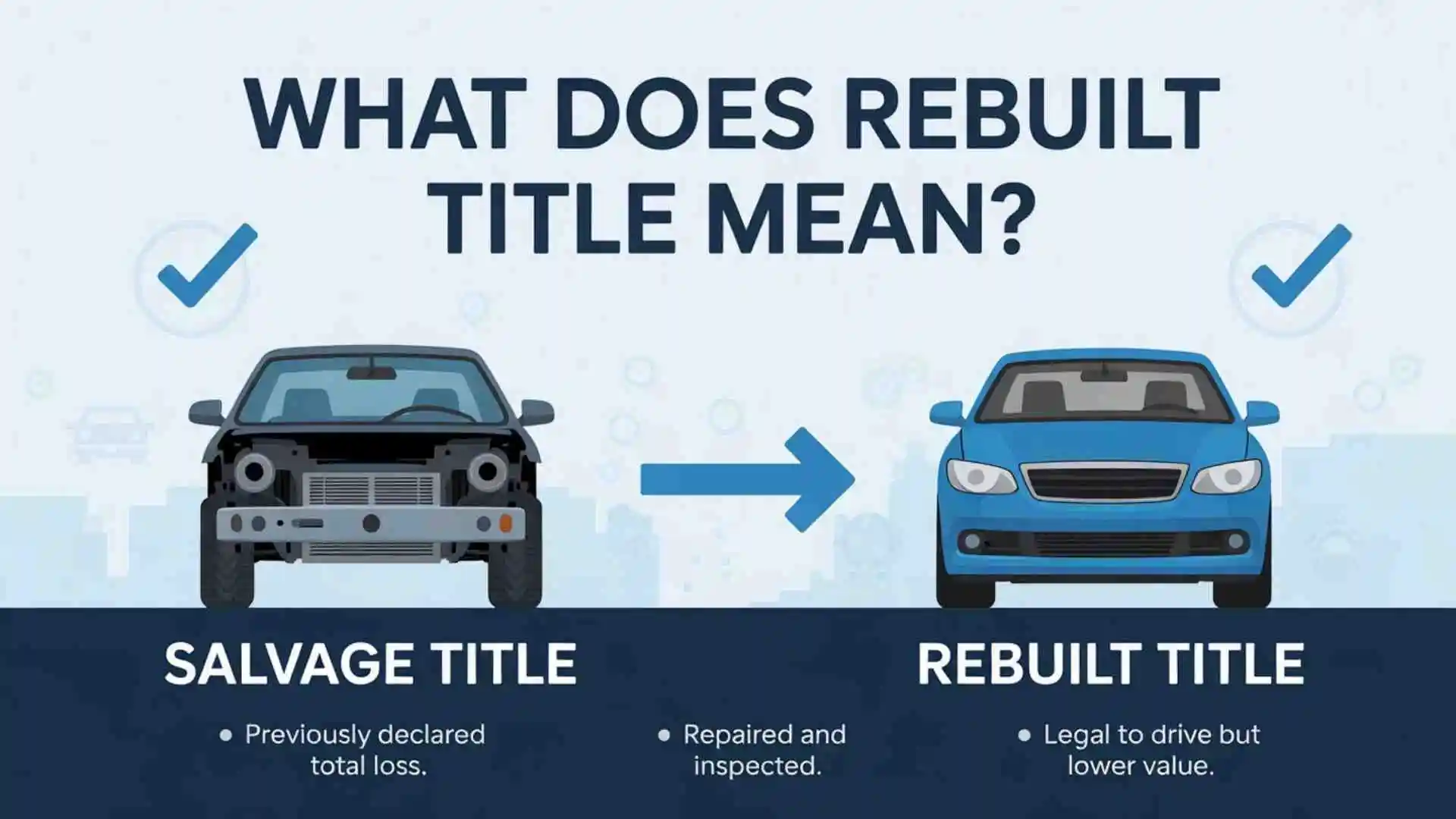
A vehicle’s title tells an important part of its history. While most cars carry a clean title throughout their lives, others receive a rebuilt title after being declared a total loss by an insurance company and later repaired, inspected, and approved for road use.
To many buyers, the term “rebuilt title” immediately raises concerns about safety, reliability, and resale value. Those concerns are reflected directly in the market, where rebuilt-title vehicles almost always sell for significantly less than comparable clean-title models.
The discount can be substantial. According to studies from iSeeCars, pricing data from Kelley Blue Book, auction results, and used-car marketplaces, rebuilt-title vehicles commonly sell for 20% to 40% less than similar clean-title examples, although the exact reduction varies by vehicle type, age, repair quality, and buyer demand.
Some luxury vehicles and high-performance models can lose even more value because buyers are less willing to accept a questionable history on expensive cars.
While the lower purchase price may seem attractive, a rebuilt title affects much more than resale value. Financing options become more limited, insurance coverage may be restricted, trade-in values decline, and future buyers often require additional inspections before completing a purchase.
Understanding why rebuilt-title cars lose value and how large those discounts can be helps buyers decide whether the savings truly outweigh the risks.
Also Read: 10 Monster Motorcycles That Prioritize Comfort Over Weight
What a Rebuilt Title Actually Means
A rebuilt title begins with a salvage title. When a vehicle is damaged in a collision, flood, fire, hailstorm, theft recovery, or another major event, the insurance company compares the estimated repair cost with the vehicle’s market value.
If repairs exceed the state’s total-loss threshold, which often ranges between 60% and 100% of the vehicle’s value depending on the state, the insurer declares it a total loss and issues a salvage title.
A salvage-title vehicle generally cannot be legally driven until it has been repaired and inspected.
Once repairs are completed, the vehicle undergoes a state inspection in jurisdictions that require one. Inspectors typically verify that major components were repaired correctly, stolen parts were not used, and the vehicle meets minimum roadworthiness standards.
If it passes, the title changes from “salvage” to “rebuilt,” “rebuilt salvage,” or similar terminology depending on state law. A rebuilt title does not automatically mean the car is unsafe.
Some rebuilt vehicles suffered relatively minor damage during periods of inflated used-car values or expensive parts shortages. Others experienced extensive structural damage that required major reconstruction. Because the severity of damage varies widely, every rebuilt-title vehicle must be evaluated individually.
However, the rebuilt designation remains permanently attached to the vehicle history in most states, making future buyers aware that the car was previously declared a total loss. That permanent record is the primary reason resale values decline.
How Much Value Does a Rebuilt Title Remove?
Numerous market studies have attempted to measure the effect of rebuilt titles on resale values.
According to iSeeCars, vehicles with branded titles often sell for approximately 20% to 40% below comparable clean-title vehicles. The discount becomes even larger for premium brands because buyers spending more money generally expect a perfect ownership history.
Consider a practical example.
Suppose a clean-title 2022 Toyota Camry XLE has a private-party market value of approximately $28,000.
- Typical rebuilt-title discount (20%): $22,400
- Moderate discount (30%): $19,600
- Significant discount (40%): $16,800
That represents a reduction of $5,600 to $11,200 simply because of the vehicle’s title history. Luxury vehicles often experience even steeper losses. Imagine a clean-title 2021 BMW X5 worth $48,000.
- 20% reduction: $38,400
- 30% reduction: $33,600
- 40% reduction: $28,800
In this example, the rebuilt title reduces market value by $9,600 to $19,200, illustrating why branded-title luxury vehicles appear dramatically cheaper than similar clean-title models. Sports cars can also experience heavy depreciation because performance buyers often avoid vehicles with previous structural damage.
Pickup trucks and economy cars sometimes retain value slightly better because buyers in those segments may place greater emphasis on affordability than perfect vehicle history. Vehicle age matters as well.
A rebuilt title has a larger financial impact on newer vehicles because clean-title values remain relatively high. On a 15-year-old commuter car already worth only a few thousand dollars, the percentage discount may remain similar, but the actual dollar difference becomes much smaller.
Why Buyers Pay Less Even After Professional Repairs
Many rebuilt-title cars receive excellent repairs using OEM parts and experienced technicians. Even so, buyers continue paying less because uncertainty remains.
The largest concern involves hidden structural damage. Modern vehicles rely on carefully engineered crumple zones that absorb crash energy during collisions. Even when repairs appear visually flawless, buyers cannot always verify whether structural measurements, weld quality, and frame alignment fully match factory specifications.
Insurance creates another challenge. Some insurers offer only liability coverage for rebuilt-title vehicles, while others provide collision and comprehensive coverage only after additional inspections. Premiums can also vary depending on the insurer’s underwriting guidelines.
Financing becomes more difficult as well. Many banks either refuse loans on rebuilt-title vehicles or require larger down payments because branded-title cars represent higher collateral risk. Credit unions and specialty lenders may finance them, but loan terms are often less favorable than those available for clean-title vehicles.
Trade-in values also suffer. Franchised dealerships frequently offer substantially lower trade-in amounts because rebuilt-title vehicles appeal to a smaller group of buyers. Some dealers avoid accepting them altogether, forcing owners to pursue private-party sales where explaining the vehicle’s history becomes essential.
Vehicle history reports further reinforce the discount. Services such as CARFAX and AutoCheck permanently record salvage and rebuilt title events, allowing future buyers to see the vehicle’s branded history even decades later.
When a Rebuilt Title Can Still Make Financial Sense
Despite the disadvantages, rebuilt-title vehicles are not always poor purchases. For mechanically knowledgeable buyers or those planning long-term ownership, a professionally repaired rebuilt-title vehicle can provide substantial savings.
Suppose two nearly identical SUVs differ only in title status.
- Clean-title vehicle: $30,000
- Rebuilt-title vehicle: $21,000
The buyer saves $9,000 upfront. If independent inspections confirm that repairs were completed properly using quality parts, and the owner plans to keep the vehicle for eight to ten years rather than resell it quickly, much of the resale disadvantage becomes less significant because depreciation has already been partially absorbed by the previous owner.
Documentation is critical. The best rebuilt-title purchases include repair invoices, photographs of the original damage, alignment reports, frame measurements, parts receipts, and detailed maintenance records. These documents increase buyer confidence and can improve future resale prospects.
Independent pre-purchase inspections remain essential. A qualified collision repair specialist can evaluate weld quality, paint thickness, frame alignment, suspension geometry, electronic safety systems, and evidence of hidden damage that may not appear during an ordinary mechanical inspection.
Flood-damaged rebuilt vehicles generally deserve additional caution because water intrusion can create electrical corrosion that develops years after repairs are completed. Likewise, vehicles repaired after severe structural impacts should receive especially careful evaluation.
Ultimately, a rebuilt title represents a permanent financial penalty rather than an automatic indication of poor quality. Market data consistently shows that most rebuilt-title vehicles sell for 20% to 40% less than comparable clean-title examples, with luxury and performance models often experiencing even larger discounts.
Those lower prices reflect buyer uncertainty, financing limitations, insurance challenges, and reduced resale demand rather than the current mechanical condition alone.
For informed buyers willing to perform careful research, inspect documentation, and accept lower future resale values, a rebuilt-title vehicle can offer meaningful savings. For buyers seeking maximum resale value, easy financing, and broad market appeal, a clean-title vehicle remains the safer long-term investment.
Also Read: The 1987 Buick GNX Outran Every Corvette Chevy Built That Year
