
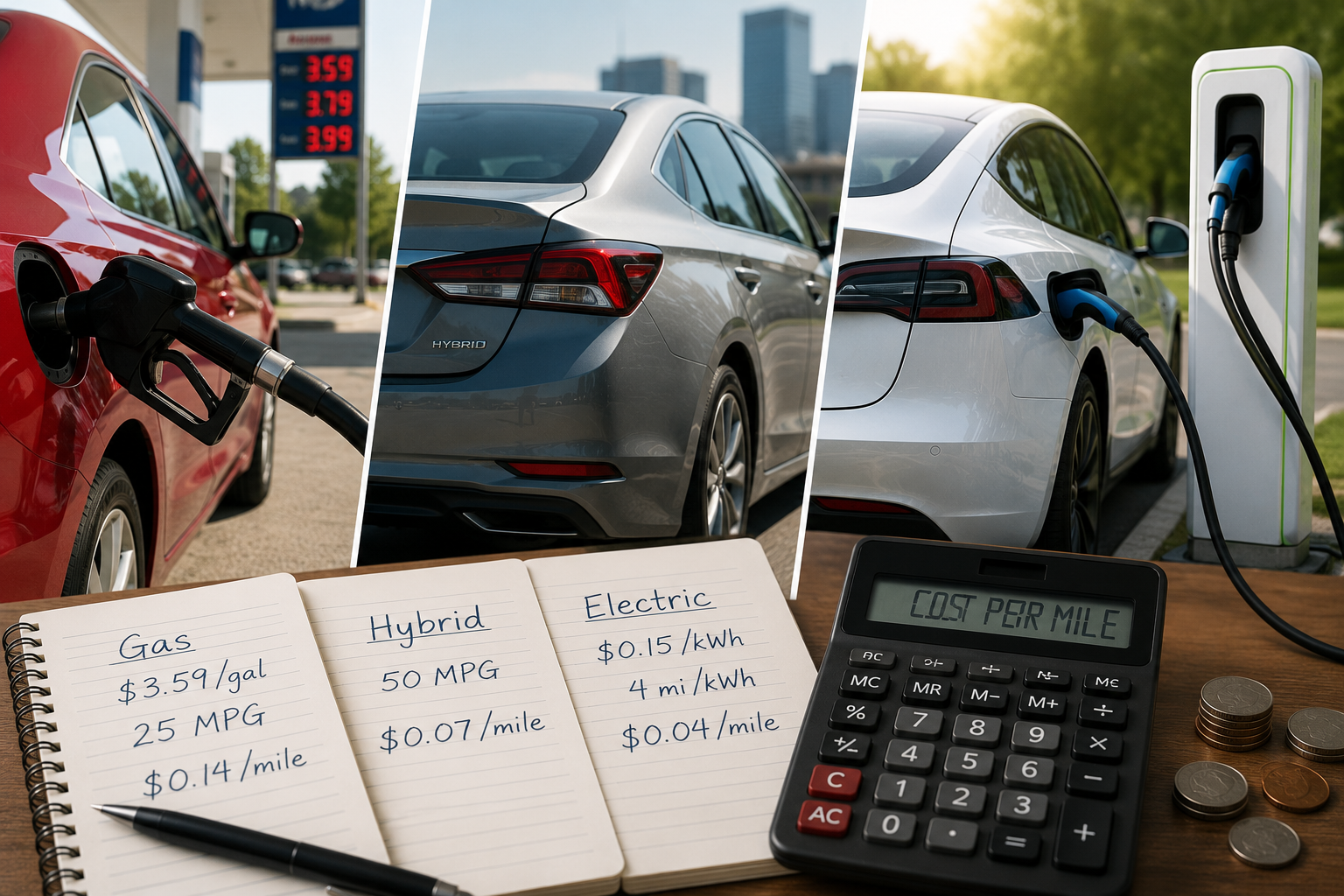
Buying a new vehicle has become far more complicated than simply choosing between a sedan, SUV, or pickup. Today’s shoppers must also decide whether a traditional gasoline engine, a hybrid powertrain, or a fully electric vehicle (EV) offers the best long-term value.
Manufacturers often highlight impressive fuel economy numbers or low charging costs, but those figures tell only part of the story. The real question is much broader: How much does each mile actually cost over the life of the vehicle?
Many buyers assume electric vehicles are automatically the cheapest to own because electricity usually costs less than gasoline.
Others believe hybrids provide the best compromise by combining excellent fuel economy with the convenience of refueling at any gas station. Meanwhile, conventional gasoline vehicles remain attractive because they generally cost less to purchase and have the widest selection in the marketplace.
In reality, the cost per mile is determined by far more than the price of gasoline or electricity. Fuel or charging expenses, maintenance, depreciation, insurance, repairs, tire wear, registration fees, and resale value all contribute to what owners ultimately spend.
A vehicle that saves thousands of dollars on fuel could lose those savings through rapid depreciation or higher insurance premiums. Likewise, a gasoline vehicle with a lower purchase price may become more expensive over several years because of higher fuel consumption and routine maintenance.
According to ownership data from the U.S. Department of Energy (DOE), EPA FuelEconomy.gov, AAA, Consumer Reports, J.D. Power, and Kelley Blue Book, no single powertrain is automatically the least expensive for every driver.
Annual mileage, local fuel prices, electricity rates, charging availability, and ownership length all influence the final numbers. Understanding these costs provides a much clearer picture of which vehicle truly delivers the best value.
Also Read: 10 Cars With Cabin Filters That Clog Before 8,000 Miles
Fuel and Energy Costs: The Most Visible Expense
Fuel remains the easiest ownership expense to calculate because drivers pay for it every week. Let’s compare three typical midsize vehicles driven 15,000 miles annually, roughly the average annual mileage for many American drivers.
Gasoline Vehicle
Assume a crossover averaging 28 mpg with gasoline priced at $3.50 per gallon.
Annual fuel usage:
15,000 ÷ 28 = 536 gallons
Annual fuel cost:
536 × $3.50 = $1,876
Fuel cost per mile:
12.5 cents
For larger SUVs and pickup trucks averaging closer to 20 mpg, fuel expenses can easily exceed 17 cents per mile, especially when gasoline prices rise above $4.00 per gallon.
Hybrid Vehicle
Now consider a hybrid averaging 50 mpg.
Annual fuel usage:
15,000 ÷ 50 = 300 gallons
Annual fuel cost:
300 × $3.50 = $1,050
Fuel cost per mile:
7 cents
Compared with the gasoline vehicle, the hybrid saves approximately $826 annually in fuel alone.
Over five years, that’s more than $4,000 before considering inflation or future gasoline price increases.
Battery-Electric Vehicle
Now examine an EV consuming 30 kWh per 100 miles, a figure representative of many modern electric crossovers.
Total annual electricity consumption:
15,000 miles = 4,500 kWh
Using the U.S. residential average electricity price of approximately 17 cents per kWh, annual charging costs become:
4,500 × $0.17 = $765
Cost per mile:
5.1 cents
That gives the EV an advantage over both gasoline and hybrid vehicles when owners primarily charge at home. However, public charging changes the equation considerably.
Fast chargers often charge between 35 and 60 cents per kWh, meaning drivers relying exclusively on DC fast charging could spend nearly as much per mile as hybrid owners. This is why home charging remains one of the biggest financial advantages of EV ownership. Regional energy prices also matter.
Drivers in California generally pay significantly more for electricity than drivers in states such as Texas or Tennessee. Likewise, gasoline prices differ dramatically across the country, affecting long-term ownership costs.
Maintenance Costs Tell a Different Story
Fuel savings receive most of the attention, but maintenance can significantly influence ownership expenses over several years.
Gasoline Vehicles
Internal combustion engines contain hundreds of moving components.
Routine maintenance includes the following:
- Oil and filter changes
- Spark plugs
- Air filters
- Transmission fluid
- Cooling system service
- Drive belts
- Fuel system maintenance
- Exhaust repairs
- Emissions components
According to AAA, maintenance and repair expenses average approximately 9 to 10 cents per mile across long-term ownership.
For a driver covering 15,000 miles annually, that equals roughly $1,350 to $1,500 each year before unexpected repairs. As mileage increases beyond 100,000 miles, larger repairs become increasingly common.
Water pumps, alternators, timing components, fuel injectors, catalytic converters, and transmission repairs can add thousands of dollars to ownership costs.
Hybrid Vehicles
Hybrids eliminate very little maintenance.
They still require:
- Engine oil
- Filters
- Spark plugs
- Cooling system service
However, hybrids benefit from one major advantage. Regenerative braking.
Instead of relying entirely on brake pads, the electric motor slows the vehicle while recovering energy. As a result, many hybrid owners report brake pads lasting well over 100,000 miles.
The gasoline engine also operates under lighter loads because the electric motor assists during acceleration. Consumer Reports has repeatedly found hybrids among the most reliable vehicle types, largely because both power sources share the workload.
Maintenance costs typically average 7 to 8 cents per mile, making hybrids noticeably less expensive to maintain than conventional gasoline vehicles.
Electric Vehicles
Electric vehicles contain far fewer mechanical components.
There are:
- No oil changes
- No spark plugs
- No engine belts
- No fuel pumps
- No catalytic converters
- No transmission fluid on most designs
- No exhaust system
Brake wear is dramatically reduced because regenerative braking handles much of the stopping.
According to Consumer Reports, EV maintenance and repair expenses can be approximately 40% lower than comparable gasoline vehicles during the first several years of ownership. That doesn’t mean EVs are maintenance-free.
Owners still replace:
- Tires
- Cabin air filters
- Brake fluid
- Coolant for battery thermal management systems
- Suspension components
Battery replacement remains the largest long-term concern. Fortunately, nearly every manufacturer now provides battery warranties lasting 8 years or 100,000 miles, with some extending coverage to 150,000 miles.
Modern battery packs have also proven more durable than many early critics predicted, with numerous studies showing relatively modest capacity loss after well over 100,000 miles.
Which Powertrain Delivers the Lowest Cost per Mile?
After combining fuel or electricity, maintenance, insurance, depreciation, and routine ownership expenses, the picture becomes much clearer. While every driver’s situation is different, ownership studies from AAA, the U.S.

The Department of Energy, Consumer Reports, and Kelley Blue Book consistently show that no single powertrain is the cheapest for everyone. Instead, the lowest cost per mile depends largely on how and where the vehicle is driven.
Drivers who log high annual mileage and have access to affordable home charging usually see the biggest financial advantage from an electric vehicle. Spending around 5 to 6 cents per mile on electricity instead of 12 to 15 cents per mile on gasoline can save thousands of dollars over several years.
Lower maintenance costs further strengthen the EV’s position, particularly during the warranty period. However, higher purchase prices, insurance premiums, and faster depreciation on some models can offset a portion of those savings.
Hybrid vehicles often provide the best complete balance. They deliver fuel economy close to many EVs in everyday driving while avoiding concerns about charging infrastructure or long-distance travel.
Their resale values have remained among the strongest in the industry, and maintenance costs are generally lower than conventional gasoline vehicles because regenerative braking reduces brake wear and the gasoline engine experiences less stress.
For buyers who cannot charge at home or regularly travel long distances, a hybrid frequently delivers the lowest full ownership cost.
Conventional gasoline vehicles continue to appeal because of their lower purchase prices, widespread service availability, and familiar ownership experience.
However, higher fuel consumption and greater routine maintenance requirements usually result in the highest operating cost per mile over long-term ownership, especially when gasoline prices rise.
The key takeaway is that fuel cost alone does not determine the cheapest vehicle to own. Depreciation, insurance, maintenance, repairs, and resale value often have a greater financial impact than the cost of gasoline or electricity.
Buyers who evaluate every ownership expense instead of focusing solely on fuel economy are more likely to choose the powertrain that offers the best long-term value.
For many households, hybrids currently provide the strongest all-around financial case, while EVs excel for drivers with consistent home charging and high annual mileage, and gasoline vehicles remain a practical option where affordability and convenience are the top priorities.
Also Read: 8 Trucks That Lose Value Fastest in Their First Three Years
