
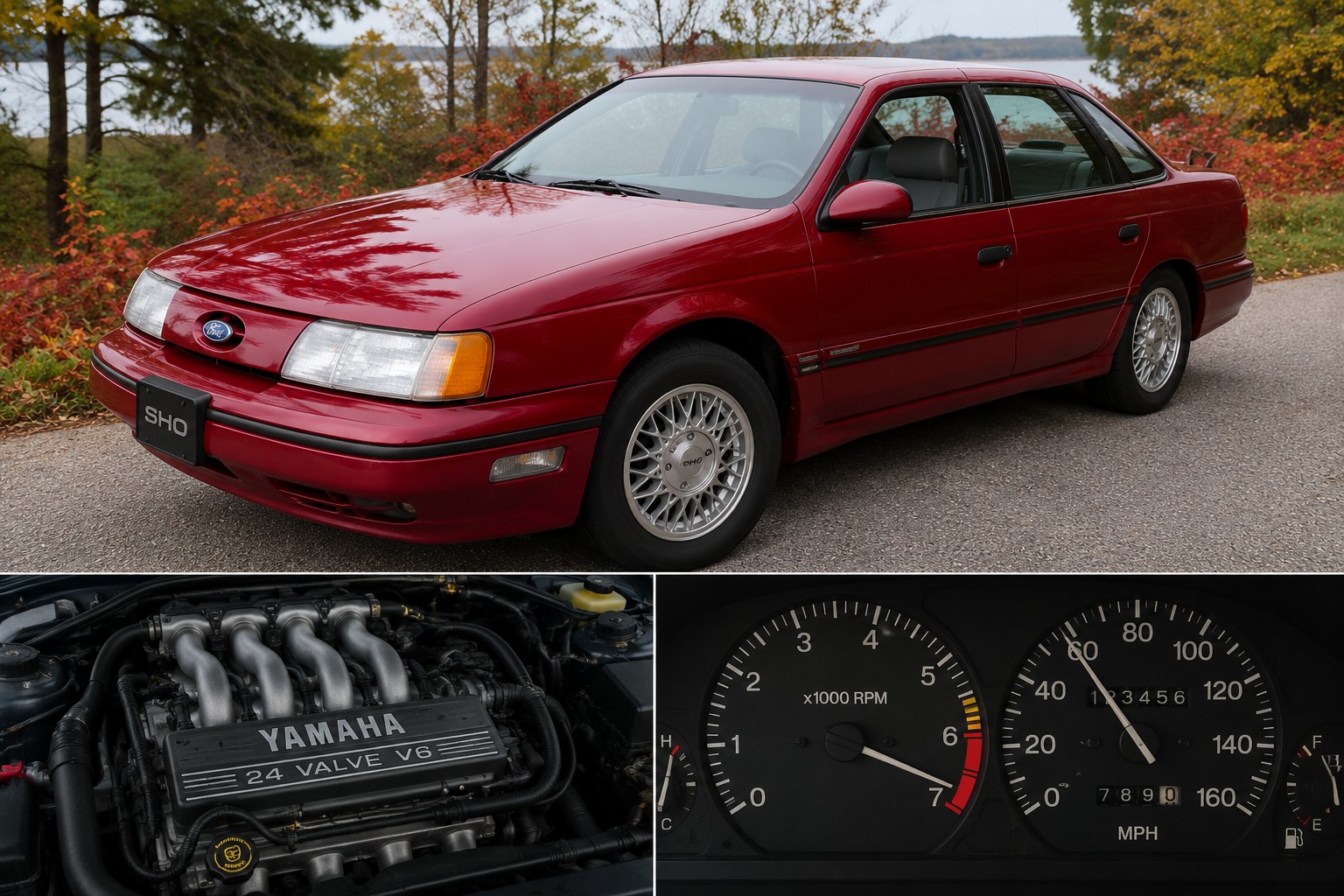
The Ford Taurus SHO looked like any other family sedan from the outside. Underneath its hood, though, sat one of the most surprising engines ever fitted to a mainstream American car.
Ford wanted a genuinely world-class performance sedan, not just a badge-engineered trim package. To get there, engineers turned to a Japanese partner known for building screaming motorcycle engines.
That partner was Yamaha, and the result was a 3.0-liter V6 that could spin all the way to 7,000 rpm. It arrived in 1989, paired exclusively with a manual gearbox, and it changed what people expected from a Ford sedan.
The story behind this engine involves a canceled supercar project, hand-finished cylinder heads, and an engineering team obsessed with high-rpm performance. It also involves a lot of surprised owners who discovered their “boring” sedan could keep pace with contemporary sports cars.
This article walks through how the engine came to be, what made its architecture so unusual, and why it still matters to enthusiasts decades later.
Origins Of A Secret Supercar Engine
Ford’s engineers were originally chasing something far more exotic than a family sedan. In the early 1980s, they secretly began developing a mid-engine supercar meant to rival Ferrari and Porsche.
That project carried the internal code name GN34, and it demanded an engine that could rev far higher than any typical American V6 of the era. Ford’s own 5.0-liter V8 simply wasn’t the right tool for the job.
So Ford’s engineers reached out to Yamaha, a company already respected for building high-revving motorcycle and outboard motor engines. Yamaha had the metallurgy and cylinder-head expertise that Ford lacked in-house.
Yamaha based its design loosely on Ford’s existing Vulcan V6, an engine already in development for other Ford products. The Vulcan gave Yamaha a starting point, but almost everything above the block would change.
Eventually, Ford’s mid-engine supercar project was shelved before it ever reached production. Rather than waste the engine work, Ford decided to drop this exotic V6 into something far more ordinary.
That vehicle turned out to be the Taurus, Ford’s mainstream family sedan. Pairing a supercar-derived engine with a sedan body was an unusual move, and it created an instant cult classic.
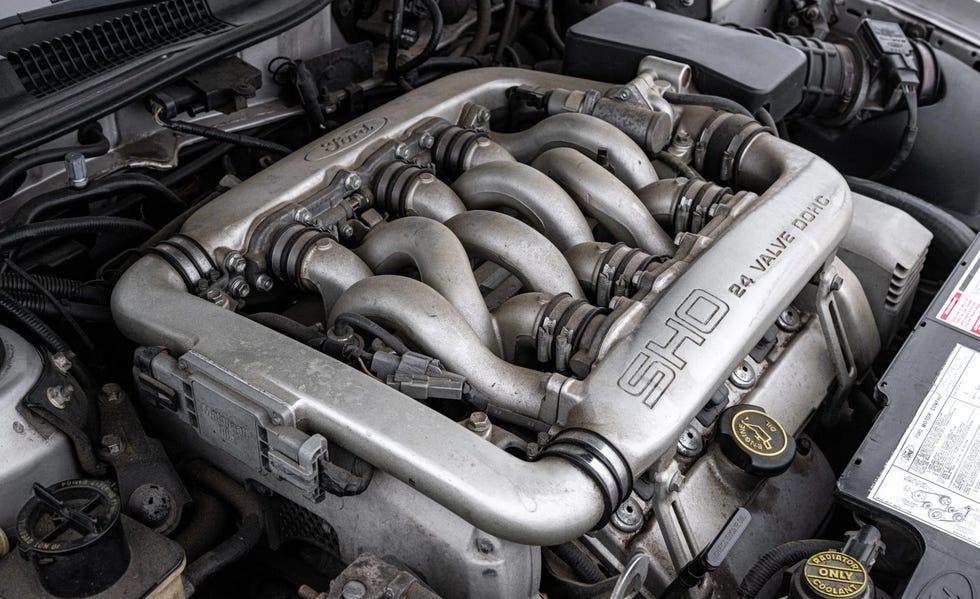
The resulting car debuted in 1989 as the Taurus SHO, with SHO standing for Super High Output. It was unlike anything else in Ford’s lineup at the time.
Enthusiast writers have described the Taurus SHO as a sedan hiding a genuine performance heart. That contrast between plain exterior and serious engineering became part of its lasting appeal.
The engine itself used a cast-iron block, a somewhat unusual choice given the aluminum heads sitting above it. Iron gave the block extra strength to handle high sustained rpm without shortcuts.
Yamaha strengthened this iron block considerably compared to the standard Vulcan casting. It needed to survive years of hard revving that a normal family-car V6 would never experience.
Bolted to that block were two aluminum cylinder heads, each featuring dual overhead camshafts. This DOHC layout allowed for more precise valve timing at high engine speeds.
Each cylinder received four valves, giving the engine 24 valves total across its six cylinders. That valve count was unusually high for a mainstream American car at the time.
The engine featured a 60 degree angle between its two cylinder banks. This configuration provided smooth engine balance while allowing the design to remain compact and space efficient.
Displacement started at 3.0 liters, or roughly 182 cubic inches, when the engine launched in 1989. Bore measured 89 millimeters, while stroke measured 80 millimeters, giving it a notably oversquare design.
An oversquare design, where bore exceeds stroke, generally allows an engine to rev higher safely. That characteristic was central to achieving the SHO V6’s dramatic 7,000-rpm redline.
Hand-Assembled Heads And High-Revving Engineering
Unlike a typical mass-production engine, the SHO V6’s cylinder heads required extensive manual finishing work. Yamaha’s technicians hand-assembled and hand-tuned these heads rather than relying purely on automated production lines.
This hands-on approach reflected Yamaha’s background building performance motorcycle engines in smaller batches. Precision mattered more than raw production speed for an engine meant to scream to redline.
The engine’s tachometer marked redline at 7,000 rpm, an extraordinary figure for a 1989 family sedan. Fuel cut-off actually occurred slightly higher, around 7,300 rpm, according to period documentation.
Remarkably, several accounts note the engine could mechanically handle spinning as high as 8,500 rpm. Ford limited it electronically well below that ceiling, largely to protect engine-driven accessories.
Components like the alternator and air conditioning compressor simply weren’t designed for such extreme rotational speeds. Prototype testing reportedly showed these accessories struggling once rpm climbed toward 8,000.
One of the engine’s most visually striking features was its variable-length intake manifold. Enthusiasts nicknamed it the “snake” manifold because of its tangled, chrome-plated runner design.
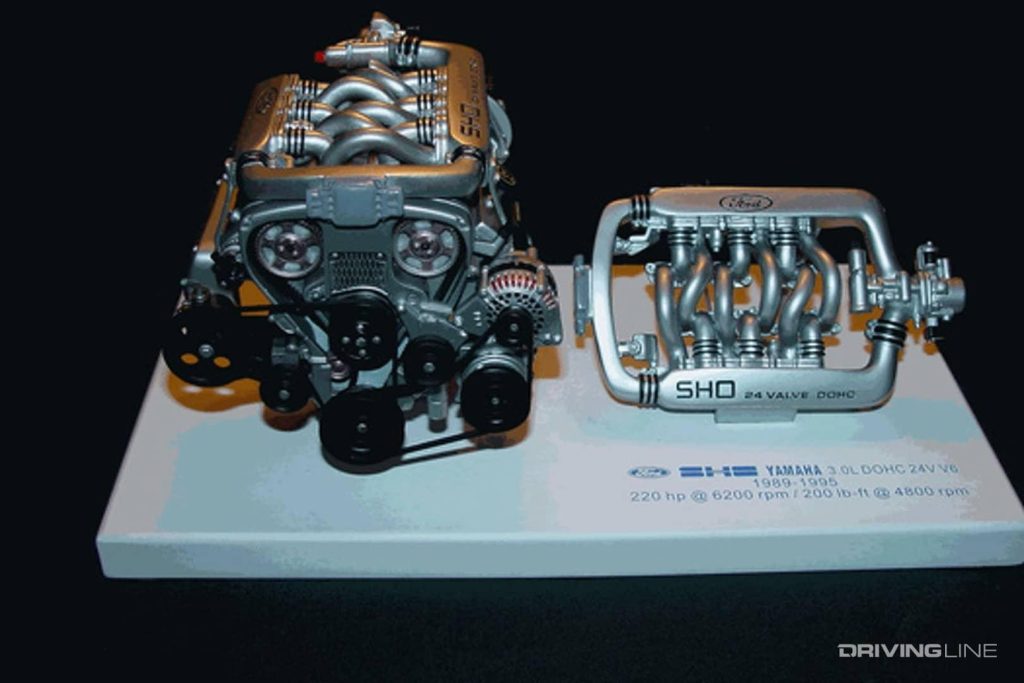
At lower engine speeds, longer intake runners were used to maximize everyday torque and drivability. This kept the SHO tractable enough for normal commuting and stop-and-go traffic.
Once the engine climbed past roughly 4,000 rpm, shorter runners opened up automatically. These shorter paths let the engine breathe more freely on its way toward redline.
This intake technology was genuinely advanced for a 1989 production vehicle. Many higher-end sports cars didn’t adopt similar variable-length intake systems until years later.
Fuel delivery came through sequential multiport fuel injection, another feature that felt ahead of its time. Ignition was distributorless, which improved reliability and timing precision at high rpm.
Output for the original 3.0-liter engine was rated at 220 horsepower. That figure arrived at 6,200 rpm, reflecting just how high in the rev range this engine liked to operate.
Torque peaked at 200 pound-feet, arriving around 4,800 rpm according to Ford’s published specifications. These numbers made the SHO V6 genuinely competitive with contemporary V8 performance engines.
In fact, period comparisons noted the SHO V6 produced only about five fewer horsepower than a contemporary Mustang GT V8. That was a remarkable achievement for a naturally aspirated V6 in 1989.
Car and Driver reportedly tested the 1989 Taurus SHO accelerating from zero to 60 mph in around 6.7 seconds. Some period road tests measured times closer to 6.5 or 6.6 seconds under ideal conditions.
Top speed reached approximately 143 miles per hour, an eye-opening figure for a mainstream four-door sedan. Contemporary journalists even called it the fastest four-door sedan available under fifty thousand dollars.
Notably, its actual base price sat closer to twenty thousand dollars, making that performance figure even more impressive. Buyers got exotic-feeling performance without paying anything close to exotic-car money.
Manual Transmission, Legacy, And Later Versions
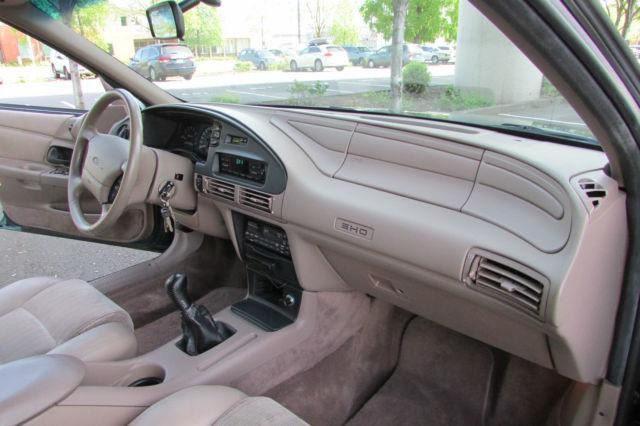
This first-generation SHO V6 was only ever offered paired with a manual transmission. Ford used a five-speed manual gearbox, which was manufactured by Mazda under contract.
That manual gearbox carried the internal designation MTX-IV within Ford’s transmission lineup. It featured carefully spaced gear ratios designed to keep the high-revving V6 in its powerband.
Documented gear ratios show first gear at 3.21, dropping progressively down to 0.74 in fifth gear. With a 3.74 final drive ratio, fifth gear allowed the car to reach its 143-mph top speed near 5,350 rpm.
Because it paired an unusual high-revving engine with three pedals, the SHO became the last Taurus available with a manual. Ford had previously offered a four-cylinder manual option, but that combination was discontinued the same year the SHO debuted.
For driving enthusiasts, this manual-only pairing made the early SHO feel genuinely special. It rewarded drivers who wanted to work the gearbox and chase that high-rpm powerband.
Ford and Yamaha didn’t stop development after the initial 3.0-liter version. Starting in 1993, a larger 3.2-liter version of the SHO V6 joined the lineup.
This 3.2-liter variant increased displacement to roughly 3,191 cubic centimeters, with slightly larger bore dimensions. Horsepower stayed at 220, though torque increased modestly to around 215 pound-feet.
Unlike the original engine, this larger version was paired exclusively with a four-speed automatic transmission instead of a manual. That change broadened the SHO’s appeal to buyers who preferred automatic gearboxes.
Some sources note that despite the larger displacement, performance didn’t meaningfully improve over the original engine. Milder camshaft profiles on the 3.2-liter version offset any gains from the extra displacement.
Both the 3.0-liter manual and 3.2-liter automatic versions were sold alongside each other from 1993 through 1995. This gave buyers a genuine choice between two distinct driving experiences within the same generation.
Production numbers for the original 1989 through 1991 Taurus SHO remained relatively limited. Estimates suggest around 32,700 units were built during that initial three-year run.
That limited production run has helped cement the SHO’s status as a genuine enthusiast favorite today. Owners and collectors still seek out clean examples, particularly early manual-transmission cars.
Ford eventually replaced the Yamaha V6 entirely for the third-generation Taurus SHO. That later car used a different Yamaha-developed engine, a 3.4-liter V8, starting in 1996.
The V8-powered SHO represented a completely different engineering approach from the original V6. It was based more directly on Ford’s Duratec engine architecture rather than the earlier compact V6 design.
Despite that successor, the original Yamaha-built V6 remains the engine most closely associated with the SHO name. Its combination of high-revving character and hand-finished construction still stands out decades later.
Owners and mechanics who’ve worked extensively with these engines often describe them fondly as genuinely special machines. Several long-time SHO owners have noted the engine’s distinctive sound and eagerness to rev as standout traits.
Today, the 1989 to 1991 Taurus SHO occupies a unique niche in automotive history. It proved that a genuinely exotic, hand-built engine could live comfortably inside an ordinary family sedan.
That unlikely pairing of understated styling and screaming Yamaha engineering is exactly why the car remains memorable. Few vehicles have ever hidden this much performance behind such an unassuming exterior.
Also Read: 10 Cars With the Biggest Heat-Related Reliability Issues
