
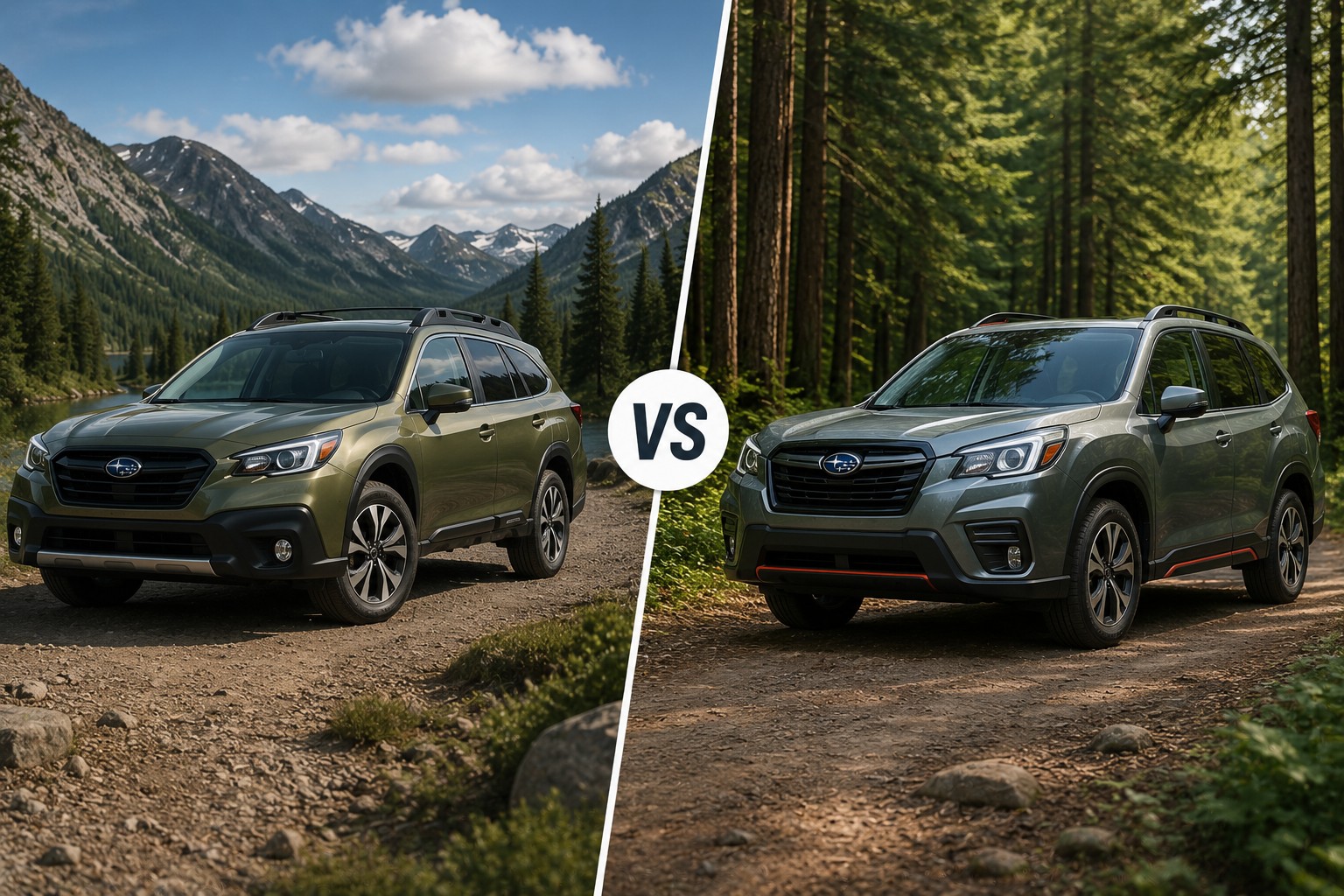
Choosing between the Subaru Outback and the Subaru Forester is a common dilemma for buyers who want Subaru’s trademark all-wheel drive dependability. Both vehicles share the same badge, similar engineering philosophy, and a loyal customer base. Yet they serve slightly different purposes on the road.
The Forester is a compact SUV built for everyday practicality and easy city driving. The Outback, on the other hand, is a midsize wagon-style crossover with a bit more space and ruggedness. For 2026, both models come standard with Subaru’s Symmetrical All-Wheel Drive and a 2.5-litre boxer four-cylinder engine producing 180 horsepower and 178 lb-ft of torque.
Beyond that shared foundation, the two SUVs start to differ in meaningful ways. Cargo space, engine options, pricing, and interior technology all separate these two Subaru siblings. This comparison breaks down design, performance, and value to help you decide which one truly fits your lifestyle better.
Design, Size, and Interior Space
The Forester and Outback look related, but their proportions tell a different story. The Forester keeps a clean, upright profile similar to a traditional SUV body style. It feels compact and easy to maneuver in tight parking lots.
The Outback leans into a different shape entirely. It has a longer, wagon-inspired silhouette with 18-inch wheels standard across the lineup for all-terrain capability. This gives it a sportier, more distinctive road presence.
Size is where the real separation begins. The Forester is officially classified as a compact SUV, while the Outback is considered a midsize model with a longer body. That extra length translates directly into more usable space.
Cargo capacity highlights this gap clearly. The Outback offers 34.6 cubic feet of cargo space behind the rear seats, expanding to 80.5 cubic feet when folded flat. The Forester falls behind in raw volume here.
The Forester provides 27.5 cubic feet behind the rear seats and 69.1 cubic feet with seats folded down. Still respectable, but noticeably smaller than its sibling.
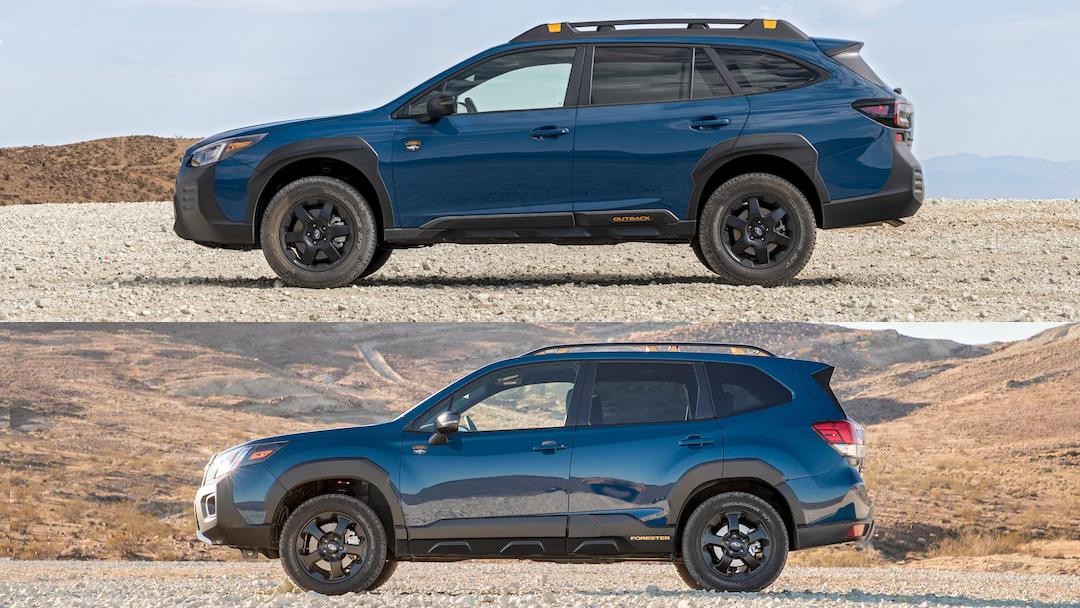
Loading gear is also easier in the Outback. It has a wider load floor and a lower liftover height, which helps when loading heavy items after a long day outdoors. Adventure-focused buyers will appreciate this detail.
The Forester counters with a different kind of convenience. Its more upright hatch and boxier shape make vertical stacking simpler, and installing car seats becomes noticeably less awkward. Families with young children may prefer this layout.
Interior technology also diverges between the two models. The Outback Premium trim comes standard with a 12.1-inch touchscreen, a 12.3-inch digital instrument cluster, and Subaru’s new DriverFocus Driver Monitoring System. These features are not standard on the equivalent Forester trim.
Control layout differs as well, based on design philosophy. The Forester uses a more traditional layout with fully digital climate controls, while the Outback uses two large displays alongside physical buttons for climate and seat heating. Each approach has its own fans.
The Forester suits buyers wanting simplicity and easy daily driving. The Outback suits those who want more cabin room, cargo flexibility, and a slightly more premium-feeling interior experience.
Performance, Engine Options, and Efficiency
Under the hood, both SUVs start from the same base engine. Both come with a 2.5-litre boxer four-cylinder producing 180 horsepower and 178 lb-ft of torque. Acceleration with this engine is adequate rather than thrilling.
Real-world performance numbers back this up clearly. The Forester reaches 60 mph in roughly 8.3 to 9.2 seconds, depending on trim level. Neither vehicle is built for speed enthusiasts.
Where things change is at the higher trim levels. The Outback’s Limited XT, Touring XT, and Wilderness trims come standard with a turbocharged 2.4-litre boxer four producing 260 horsepower and 277 lb-ft of torque. This is a significant jump in capability.
That turbocharged engine also boosts practical usability. It raises towing capacity to 3,500 pounds, making small boats and loaded trailers realistic options for owners. This is a clear advantage for outdoorsy buyers.
The Forester simply cannot match this option. The Forester has no turbocharged engine available at any trim or price point in 2026. For buyers wanting more power, this is an important limitation.
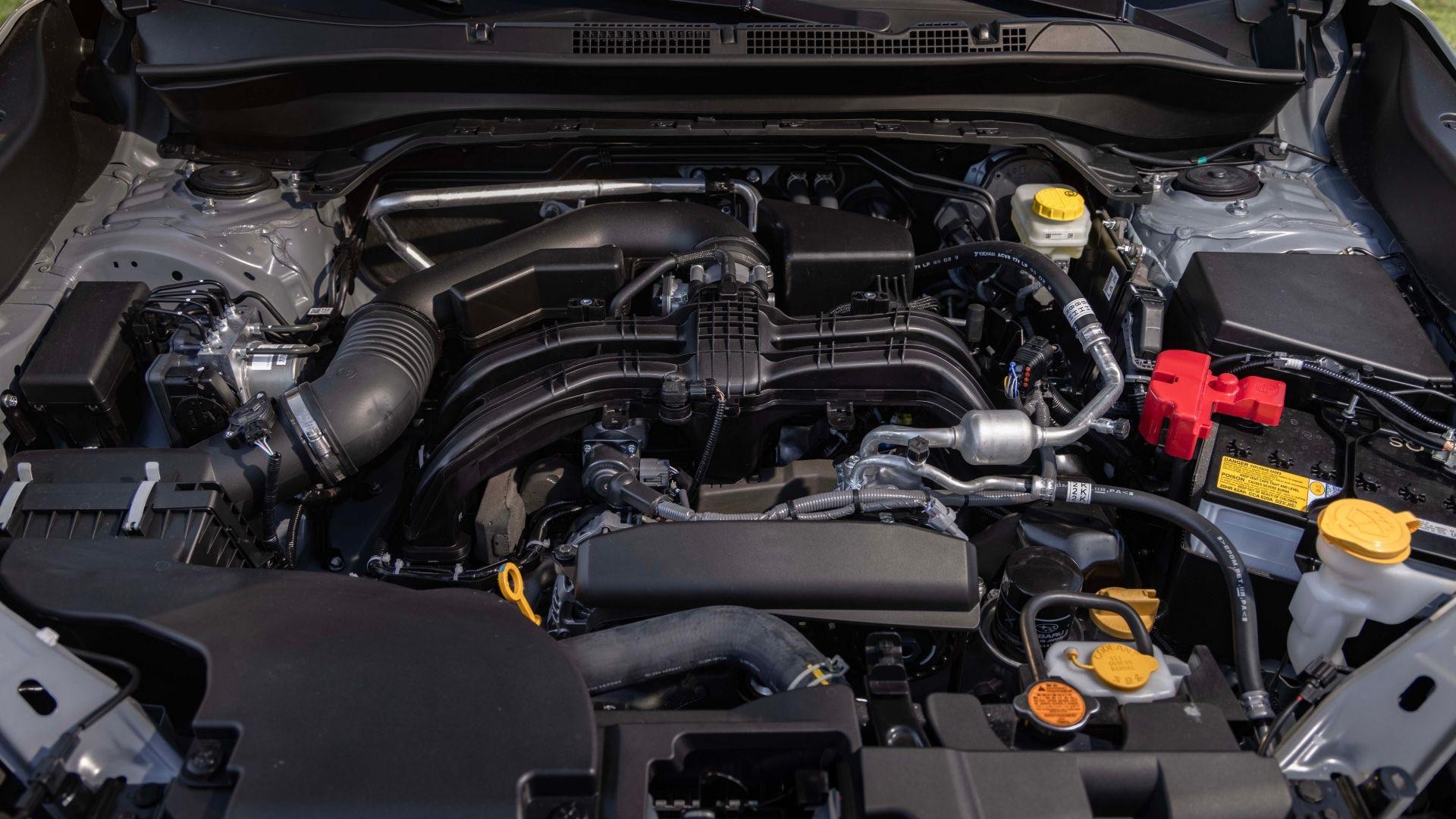
Hybrid technology adds another layer to the comparison. The 2026 Forester Hybrid returns with a series-parallel hybrid system paired with a 2.5-liter Boxer engine, electric motors, and a continuously variable transmission. This gives Forester buyers an efficiency-focused alternative.
Efficiency gains from this hybrid setup are substantial. Output is rated at 194 horsepower, with fuel economy improving by up to 40 percent compared to the non-hybrid Forester. The combined range also benefits significantly.
Range numbers reflect that efficiency boost well. The EPA rates the Forester Hybrid for a combined driving range of 581 miles on a single tank. That’s excellent for long road trips.
Standard fuel economy also favors the smaller SUV. The non-hybrid Forester achieves an EPA-estimated 26 mpg in the city and 33 mpg on the highway. This makes it a smart daily commuter choice.
The Outback’s turbocharged engine trades some efficiency for capability. Buyers who tow trailers or drive on rougher terrain regularly will likely value that trade-off. Those focused purely on fuel savings may lean toward the Forester Hybrid instead.
Handling characteristics also differ subtly between the two. The Forester’s shorter wheelbase makes it feel nimbler in city traffic and parking garages. The Outback feels more planted and stable at higher highway speeds.
Ground clearance remains strong on both models, a Subaru trademark. Off-road capability is comparable, though the Outback’s Wilderness trim pushes further into rugged terrain. Performance ultimately comes down to whether power or efficiency matters more to you.
Pricing, Value, and Final Verdict
Pricing is often the deciding factor for many shoppers comparing these two models. The 2026 Forester starts at $29,995, while the Outback starts at $34,995. That’s a meaningful gap right from the base trim.
The price difference doesn’t stay constant across every trim level. Comparing two Premium trims directly, the difference is $1,610, with the Forester Premium priced at $34,835. This narrower gap makes upper trims more competitive.
Higher up the lineup, the gap widens again noticeably. Touring trims are separated by $3,800, Limited trims by $4,020, and Wilderness trims by $6,610. Buyers on a strict budget should study trim pricing carefully.
Some outlets frame this differently based on starting trims. The Outback’s starting price is about $5,000 higher than the Forester’s, largely because the Outback begins at the Premium trim rather than a base trim. This makes direct comparisons slightly tricky.
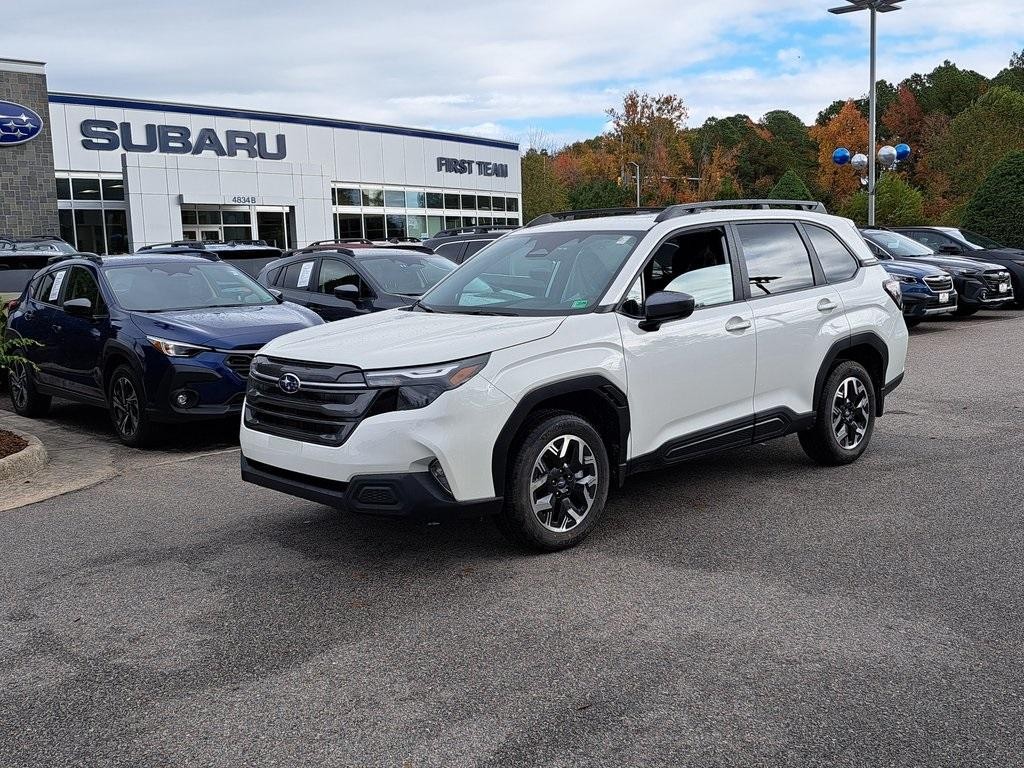
Despite the higher entry cost, some reviewers see clear value in the Outback. With extra interior space and additional convenience features, several reviewers argue the Outback is worth the upgrade over the Forester. Space and technology often justify the added cost.
Hybrid pricing adds another consideration to the mix. The Forester Hybrid starts at $34,730 before destination charges. That positions it close to Outback Premium pricing.
New trim additions continue to expand buyer choice further. A new Sport Onyx Edition joins the Forester lineup at $36,495, featuring 19-inch dark-finish wheels and a Harman Kardon audio system. This gives style-focused buyers another option.
The reputation for both models remains strong industry-wide. Both the Forester and Outback are highly rated in their respective vehicle classes and perform well as daily commuters or weekend adventure vehicles. Neither is considered a weak choice.
Expert opinions often frame the decision around personality and use case. The Forester is described as more refined and conventional, while the Outback is seen as more rugged with an added factor of visual coolness. Your personal driving needs should guide the final call.
So which one is genuinely better? There isn’t a single universal winner between these two Subarus. The answer depends entirely on your priorities as a driver.
If you want a smaller footprint, better fuel economy, and lower pricing, the Forester makes strong sense. It handles daily commuting and family duties with ease and efficiency. The available hybrid model only strengthens its case for budget-conscious buyers.
If you want more cargo space, added engine power, and stronger towing capability, the Outback pulls ahead. Its turbocharged option and wagon-style versatility suit active, outdoor-oriented lifestyles well. The higher price tag buys genuine practical benefits in return.
Both SUVs reflect Subaru’s core values of safety, all-weather capability, and long-term reliability. Test driving both back-to-back is the best way to feel the real differences yourself. Whichever one you choose, you’re getting a dependable, well-built vehicle either way.
