
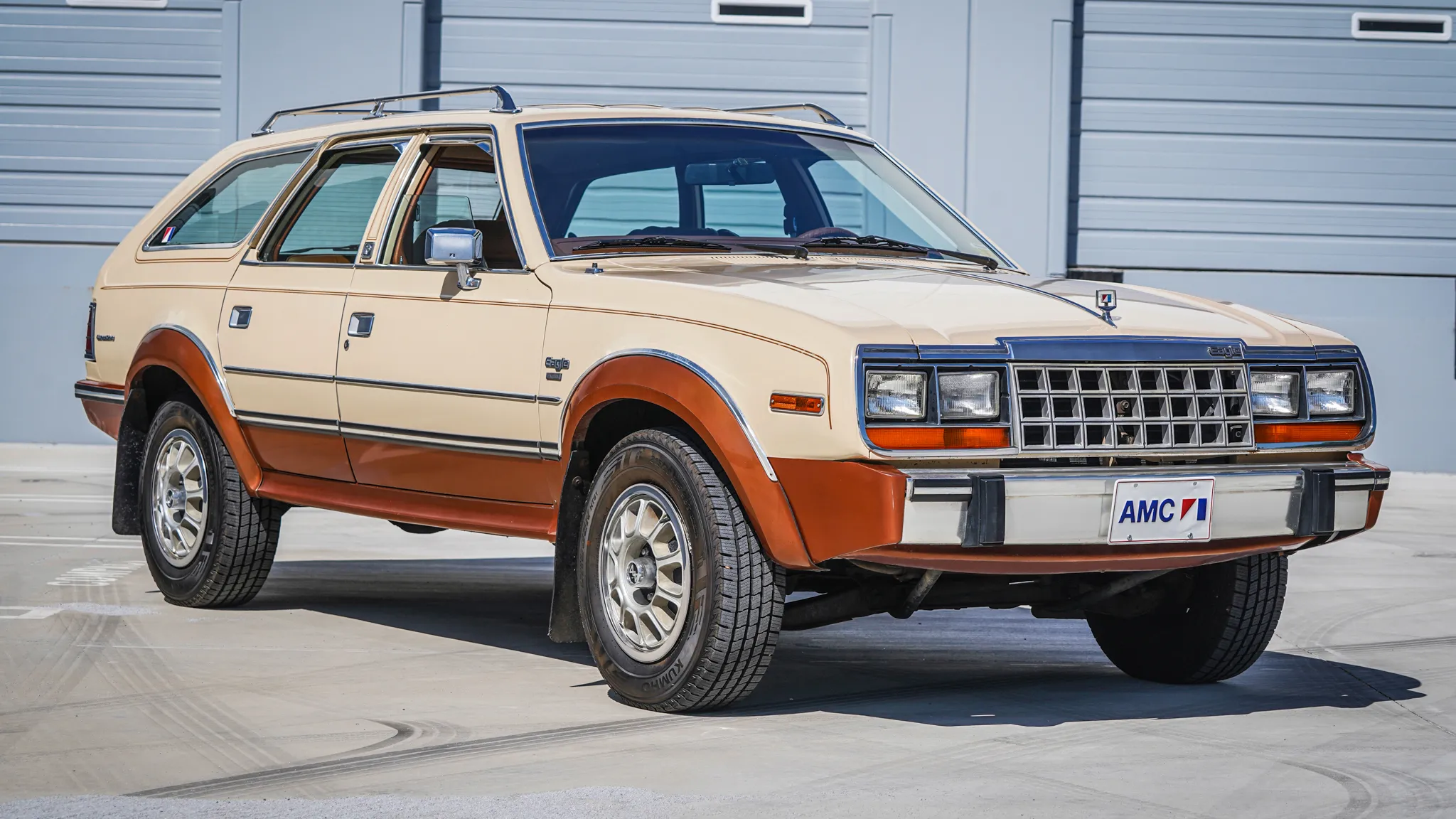
Long before the Toyota RAV4, Honda CR-V, Subaru Outback, or Ford Escape became household names, an unlikely American automaker introduced a vehicle that combined the comfort of a passenger car with the all-weather capability of a four-wheel-drive truck.
Today, this formula defines the modern crossover SUV, a segment that dominates the automotive industry. In 1980, however, it was a revolutionary idea. That pioneering vehicle was the AMC Eagle.
Introduced for the 1980 model year, the Eagle was based on AMC’s Concord passenger car but featured full-time four-wheel drive, increased ground clearance, and rugged styling that allowed it to travel confidently on snow, gravel, and muddy roads while retaining the ride quality of a traditional station wagon.
Although the term “crossover” had not yet been invented, automotive historians widely regard the AMC Eagle as America’s first crossover vehicle because it blended passenger-car comfort with SUV-like capability decades before the segment became mainstream.
According to AMC historical records and automotive historians, the Eagle represented one of the company’s boldest engineering achievements.
It arrived at a time when buyers typically had to choose between a comfortable family sedan or a truck-based four-wheel-drive vehicle. The Eagle successfully combined both characteristics into one package, creating a blueprint that nearly every major automaker follows today.
Also Read: 10 Hybrid Cars Ranked by Battery Replacement Cost
A Wagon That Could Go Almost Anywhere
By the late 1970s, American Motors Corporation faced stiff competition from Detroit’s larger manufacturers. Instead of trying to outspend Ford or General Motors, AMC focused on innovation.
Engineers started with the AMC Concord, a conventional rear-wheel-drive passenger car, and redesigned it to accommodate a sophisticated full-time four-wheel-drive system.
Unlike traditional part-time systems found in pickup trucks and Jeeps, the Eagle’s drivetrain allowed drivers to leave four-wheel drive engaged continuously, even on dry pavement. A center differential distributed power between the front and rear axles, improving traction without causing drivetrain binding during normal road use.
To complement the new drivetrain, AMC raised the suspension by approximately 3 inches, reinforced the underbody, fitted larger tires, and revised the steering and suspension geometry.
The result was a vehicle capable of handling snow-covered roads, muddy trails, and rough rural terrain while maintaining the smooth ride and predictable handling expected from a family car.
Power initially came from AMC’s reliable 4.2-liter (258-cubic-inch) inline-six, producing approximately 110 horsepower and 210 lb-ft of torque. Buyers could choose either a manual or automatic transmission depending on the model year and trim level.
While outright performance wasn’t the Eagle’s focus, the inline-six earned a reputation for durability and strong low-speed torque, qualities well suited to all-weather driving.
The Eagle launched primarily as a four-door station wagon, but AMC later expanded the lineup to include a two-door coupe, sedan, and hatchback, demonstrating the flexibility of the platform. No other American manufacturer offered anything quite like it.
Inside, the Eagle looked much like a conventional passenger car rather than an off-road utility vehicle. Comfortable seating, generous cargo space, air conditioning, power windows, and upgraded audio systems were available, making it practical for daily commuting as well as weekend adventures.
This combination of comfort and capability would later become the defining characteristic of the crossover segment.
Decades Ahead of the Crossover Boom
Although today’s buyers take crossover SUVs for granted, the Eagle introduced the concept nearly 15 years before vehicles like the Toyota RAV4 and Honda CR-V popularized the segment.
At the time, drivers seeking four-wheel-drive capability generally purchased vehicles such as the Jeep Cherokee, Ford Bronco, or Chevrolet Blazer. Those models excelled off-road but typically rode on truck frames, resulting in a firmer ride, heavier steering, and lower fuel economy.
The Eagle approached the problem differently. By using a passenger-car platform, it delivered better ride comfort, quieter highway cruising, and easier everyday driving while still offering exceptional winter traction.
The full-time four-wheel-drive system became especially popular in northern states and mountainous regions, where snow and ice frequently challenged conventional rear-wheel-drive cars.
Automotive journalists praised the Eagle’s versatility, recognizing that it filled a niche no competitor had addressed. While sales never reached the levels AMC had hoped for, the vehicle developed a loyal following among buyers who appreciated its unique combination of practicality and capability.
The Eagle also influenced future vehicle development in subtle ways. Subaru expanded its own all-wheel-drive passenger-car lineup during the 1980s, eventually leading to the Outback, while other manufacturers gradually recognized growing consumer demand for vehicles that blended passenger-car comfort with SUV versatility.
A Legacy Finally Receiving the Recognition It Deserves
Production of the AMC Eagle continued until 1988, by which time American Motors had been acquired by Chrysler Corporation. Although the Eagle name eventually disappeared, the concept behind it never did.
Today, nearly every major automaker builds crossovers using the same philosophy introduced by AMC more than four decades ago. Models such as the Toyota RAV4, Honda CR-V, Ford Escape, Hyundai Tucson, Chevrolet Equinox, and countless others all combine car-based platforms with all-wheel-drive capability, upgraded ride height, and family-friendly practicality.
The Eagle’s influence becomes even more impressive when viewed in hindsight. At a time when most manufacturers divided their lineups strictly between passenger cars and truck-based SUVs, AMC identified a new category that buyers would eventually embrace in enormous numbers.
Collectors have also begun recognizing the Eagle’s historical importance. Well-preserved wagons, particularly four-wheel-drive examples equipped with the inline-six engine, have become increasingly desirable because they represent the birth of one of the automotive industry’s most successful vehicle segments.
While it lacked the marketing terminology and commercial success associated with modern crossovers, the 1980 AMC Eagle unquestionably introduced the formula that now dominates global vehicle sales.
By combining full-time four-wheel drive, a comfortable station wagon platform, higher ground clearance, and year-round usability, AMC created a vehicle decades ahead of its time.
More than forty years later, its influence can still be seen in millions of crossovers on roads around the world. The Eagle may not have been called a crossover in 1980, but history has shown that it was the first American vehicle to define exactly what a crossover would become.
Why the AMC Eagle Was Commercially Underrated but Historically Important
Although the AMC Eagle never became a blockbuster sales success, its influence on the automotive industry is difficult to overstate.
American Motors sold more than 190,000 Eagles between the 1980 and 1988 model years, respectable numbers for a relatively small independent automaker competing against giants like General Motors, Ford, and Chrysler.
The Eagle arrived during a period of economic uncertainty marked by rising fuel prices, changing consumer preferences, and increasing competition from imported vehicles.
Many buyers still viewed four-wheel drive as something intended for pickup trucks and dedicated off-road vehicles rather than everyday family transportation, making the Eagle a difficult concept for the market to fully appreciate.
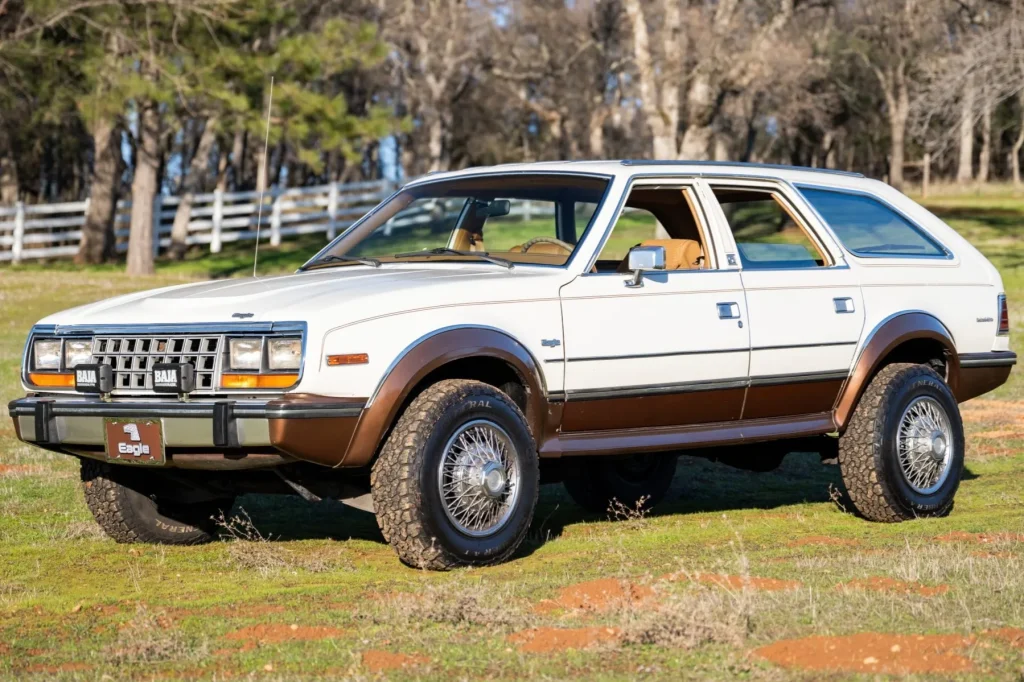
One reason the Eagle struggled to achieve larger sales was timing. In the early 1980s, the American market had not yet embraced the idea of a car-based utility vehicle.
Sport utility vehicles such as the Chevrolet Blazer, Ford Bronco, and Jeep Cherokee were becoming popular because of their rugged image, while traditional station wagons were gradually losing favor.
The Eagle sat between these two segments, offering the comfort of a wagon with the capability of an SUV. Unfortunately, many buyers simply didn’t know how to categorize it.
Automotive historians often point out that the Eagle was introduced at least a decade before the market was ready. When Toyota launched the RAV4 in 1994, and Honda followed with the CR-V in 1997, consumer attitudes had shifted dramatically.
Buyers were looking for vehicles with higher seating positions, all-weather confidence, and passenger-car comfort, exactly the qualities the Eagle had pioneered years earlier. By then, however, AMC no longer existed as an independent company.
The Eagle’s engineering philosophy also influenced later all-wheel-drive passenger vehicles. Its permanent four-wheel-drive system demonstrated that improved traction could be achieved without sacrificing ride quality or requiring drivers to manually engage four-wheel drive.
This concept eventually became standard practice across the crossover segment, where electronically controlled all-wheel-drive systems automatically distribute power to maximize traction.
Today, the AMC Eagle enjoys growing recognition among collectors and automotive historians. Well-preserved examples, particularly the station wagon equipped with the dependable 258-cubic-inch inline-six engine, are increasingly sought after because they represent an important turning point in automotive design.
Enthusiasts appreciate the Eagle not only for its rarity but also because it predicted one of the industry’s biggest trends decades before it became mainstream. Looking back, the AMC Eagle was far more than an unusual wagon with four-wheel drive.
It was a visionary vehicle that introduced a formula now used by millions of crossovers sold around the world every year, earning its place as one of the most influential yet underappreciated American vehicles ever produced.
Also Read: 10 Monster Motorcycles That Prioritize Comfort Over Weight
