
A monthly car payment should result from a transparent calculation involving the vehicle price, taxes, fees, down payment, trade equity, annual percentage rate, loan term, and optional products. Payment packaging reverses that process. The salesperson first learns the buyer’s maximum monthly budget, then structures the transaction so the final payment reaches that ceiling while hidden costs or unnecessary products absorb the remaining financial room.
The Federal Trade Commission describes payment packing as obtaining agreement to a payment larger than necessary for the negotiated vehicle price, then filling the difference with add-ons. Not every payment near your budget proves misconduct, but several warning signs together justify stopping the transaction.
The safest response is to compare the out-the-door price, amount financed, APR, term, finance charge, and total of payments before signing anything. These figures reveal whether the payment reflects the car you selected or a more expensive package quietly constructed around your stated limit.
1. The First Question Is Your Maximum Monthly Payment
A legitimate affordability discussion can include a monthly budget, but trouble begins when the salesperson treats that number as the main price of the car. If the first serious question is “What payment can you handle?” before the selling price, fees, trade value, interest rate, or loan term are settled, the dealer has learned exactly how much room exists to build the deal backward.
For example, suppose you say your limit is $600 a month. A straightforward deal might require only $535 based on the negotiated price and available financing. In a payment-packed transaction, the remaining $65 can become room for a service contract, GAP coverage, theft protection, paint treatment, accessories, or additional dealer profit while the salesperson still announces, “Good news, we kept you under budget.”

The FTC defines payment packing as obtaining agreement to a payment larger than necessary for the agreed vehicle price and then using the difference to insert add-ons.
Protect yourself by declining to negotiate from a payment ceiling. Ask for the vehicle’s itemized out-the-door price first, including taxes and every dealer fee. Negotiate the trade-in separately, then compare financing by APR, term, amount financed, finance charge, and total of payments.
The FTC specifically advises buyers to obtain the out-the-door price in writing before discussing financing and to focus on total cost rather than only the monthly payment.
A monthly budget is useful for your private planning. It should not become the dealer’s target price.
2. The Payment Lands Suspiciously Close to Your Exact Limit
Another warning sign is a final payment that repeatedly lands just below the maximum you disclosed, even after the vehicle price, down payment, or trade allowance improves. If you said $550 was your limit, and every version of the deal returns at $548 or $549, ask why the savings are not producing a noticeably lower payment.
There can be innocent explanations. Taxes, lender requirements, credit tier, and term changes can affect the calculation. The concern is the pattern: every concession creates financial room that is immediately consumed elsewhere.
A $1,000 price reduction may be offset by a protection package. A larger down payment may be followed by a service contract or changed interest rate. The buyer sees no meaningful benefit because the dealer keeps rebuilding the transaction around the same payment target.

The FTC’s description of payment packing directly addresses this tactic: the dealer persuades the consumer to accept a payment above what is needed for the agreed vehicle price, then fills the difference with add-ons. The agency also warns that optional products are not free and should not be tucked into a deal without the buyer’s knowledge or permission.
Ask for the earlier and revised worksheets side by side. Compare the selling price, fees, trade credit, payoff, cash down, amount financed, APR, term, and every product. Each changed number should have a traceable effect.
If the dealer cannot show where your negotiated savings went, do not rely on the payment alone. A budget ceiling should limit your spending, not invite the transaction to expand until every available dollar is occupied.
3. The Loan Term Quietly Becomes Longer
A payment can look affordable without reducing the vehicle’s price. The dealer only has to spread the same or a larger amount over more months. That is why a term that quietly shifts from 60 months to 72 or 84 months is a clear sign the transaction may have been built backward from your monthly budget.
Consider an illustrative $30,000 loan at 7 percent APR. The payment would be approximately $594 for 60 months, $511 for 72 months, or $453 for 84 months. The lower payment may feel like a discount, but the estimated total interest rises from about $5,642 to $6,826 and then $8,034.
Nothing became cheaper. Repayment simply lasted longer. These calculations assume equal monthly payments, no additional fees, and the same interest rate throughout the loan.

The Consumer Financial Protection Bureau notes that extending the length of an auto loan can lower the monthly payment, but it also increases the amount of interest paid over the life of the loan. A longer repayment period may also leave borrowers owing more than the vehicle’s value for an extended time. The FTC also cautions that offers featuring lower monthly payments frequently rely on longer loan terms, which can result in a higher total cost.
Before accepting a payment quote, ask the salesperson to state the term in months. Do not accept “around six years” or a worksheet showing only the payment.
Compare the finance charge and total of payments for each term. If the dealer reached your target by adding one or two years without clearly discussing it, the payment was engineered for appearance rather than affordability. A suitable vehicle should fit both your monthly cash flow and a reasonable repayment period.
4. The APR Is Missing, Delayed, or Treated as Unimportant
When a dealer repeatedly talks about monthly payment but avoids stating the annual percentage rate, the financing may carry more cost than the payment reveals. APR matters because it expresses the cost of credit as a yearly rate and incorporates certain mandatory credit charges. It is not interchangeable with the vehicle price or simple interest rate.
A dealer-arranged loan can be convenient, but the dealer may profit from financing and may not initially present the lowest rate available. The CFPB says auto-loan interest rates are negotiable and recommends comparing offers from multiple lenders.
The FTC also advises buyers to obtain financing preapproval and compare the APR, term, and amount financed before choosing dealership financing.

Be cautious if you hear statements like, “The interest rate is not important as long as the monthly payment fits your budget,” or “We will go over the details in the finance office.” Focusing only on the monthly payment can make it easier to overlook a higher interest rate, a longer loan term, or a combination of both. It may also make the dealer’s financing appear more attractive than a preapproved loan, even though the financing could end up costing significantly more over the life of the loan.
Before agreeing, request the lender’s name, APR, term, amount financed, finance charge, and total of payments in writing.
Under the Truth in Lending disclosure framework, these figures reveal the structure and cost of the credit transaction. The CFPB identifies APR, finance charge, amount financed, and total of payments as key auto-loan disclosures.
If the salesperson cannot explain how the quoted payment was calculated from those numbers, stop. A payment that cannot be independently reconstructed is not a reliable financing offer.
5. Optional Products Appear Without Separate Prices
Payment packing often becomes visible when the finance office presents products as a bundle rather than as individual purchases. You may hear that the payment “includes protection,” that a warranty is “already built in,” or that GAP coverage, tire-and-wheel protection, theft identification, maintenance, or appearance treatment changes the payment by only a few dollars.
The missing question is how much each product actually costs.
A small monthly figure can disguise a large financed price. An add-on costing $2,400 may be described as roughly $40 per month, but that shorthand can omit the loan term and the interest charged on the product.
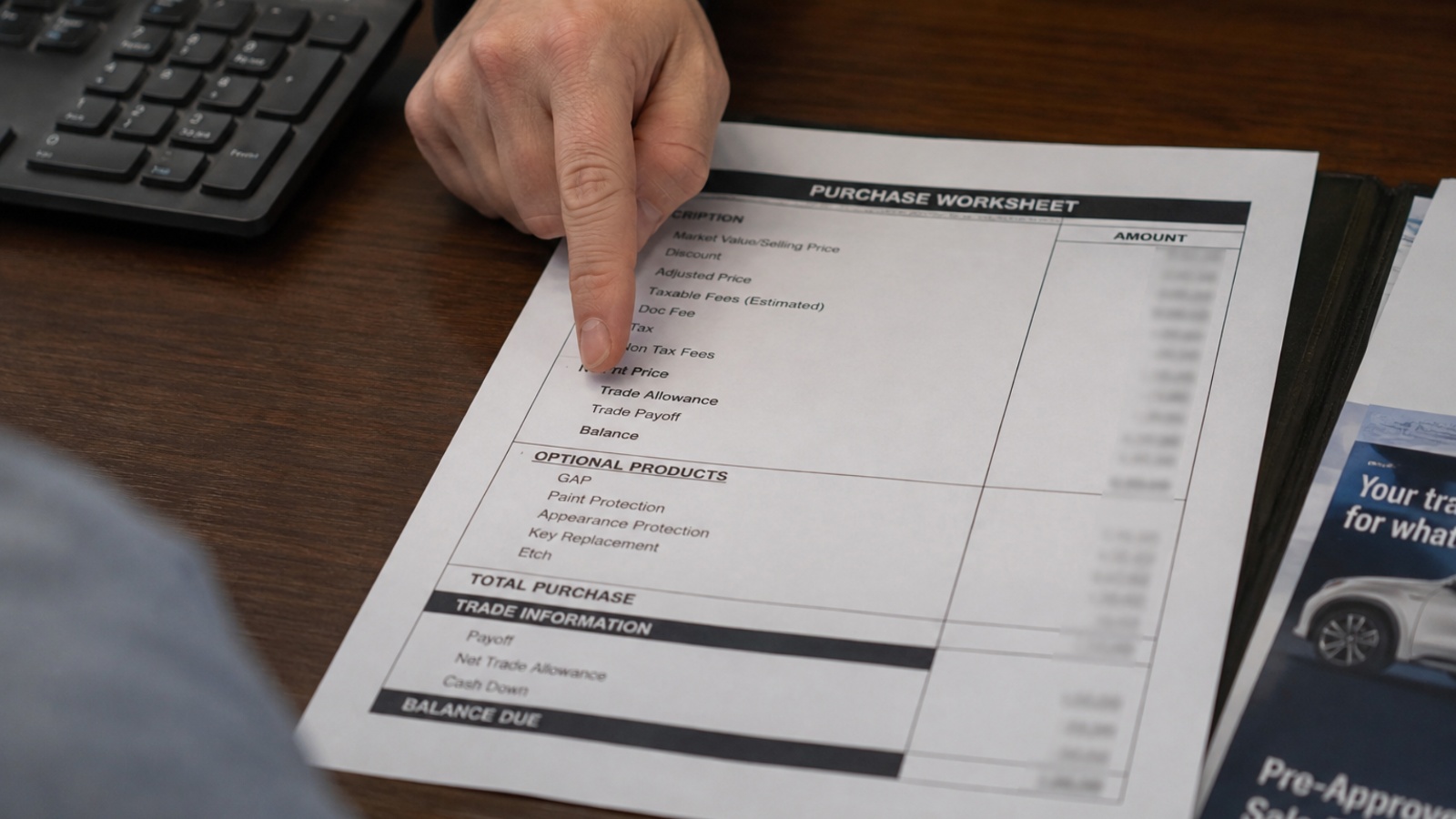
Because add-ons are commonly included in the amount financed, the buyer may pay interest on them for several years. The CFPB states that optional add-ons increase both the monthly payment and the total amount borrowed and repaid. The FTC says add-ons are not free and advises buyers to demand the price of each proposed product.
Treat every product as a separate purchasing decision. Ask for its cash price, financed cost, coverage period, exclusions, cancellation terms, and whether the lender genuinely requires it. Do not accept a package choice without itemized prices.
The FTC has alleged in dealership enforcement matters that consumers were charged for costly add-ons they did not authorize or were falsely told were required.
Remove every optional item, recalculate the loan, and compare the revised payment. If it falls well below the number initially presented, the transaction may have been built to fill your available budget rather than meet your actual needs.
6. The Amount Financed Does Not Match the Deal You Negotiated
The strongest numerical warning sign is an amount financed that is higher than you can explain. Once the vehicle price is settled, the transaction should be traceable.
Start with the out-the-door price, add any legitimate negative equity or optional products you knowingly accepted, then subtract cash down, rebates, and positive trade equity. The result should be close to the amount financed shown in the credit documents.
Suppose the written out-the-door price is $31,500. You put down $3,000 and have no trade payoff or add-ons. The amount financed should be approximately $28,500, subject to clearly disclosed adjustments.
If the contract shows $31,200, the $2,700 difference requires an item-by-item explanation. It might represent products, a rolled-in trade payoff, or another charge, but it should never remain an unexplained gap.
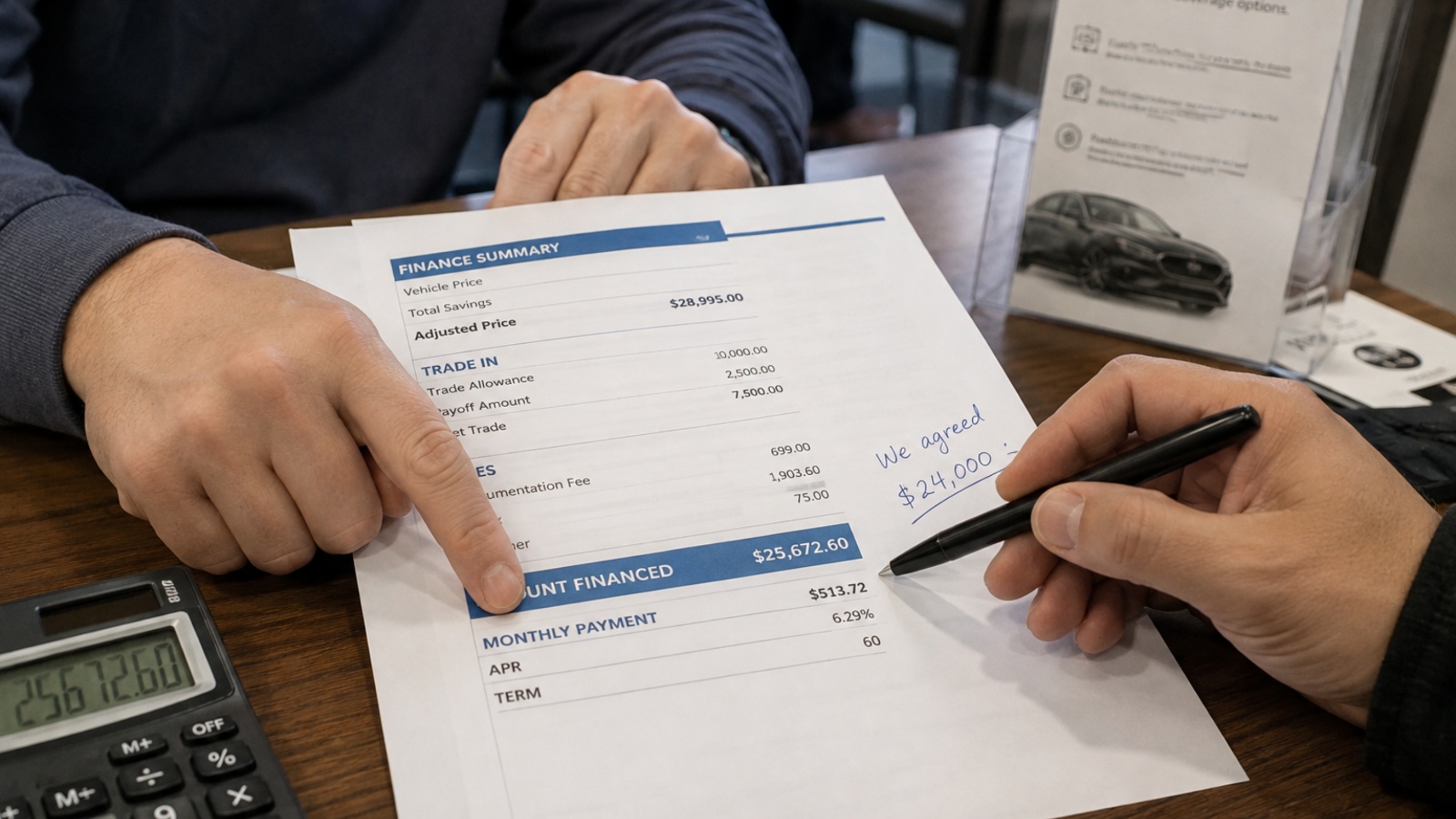
The CFPB defines the amount financed as the amount borrowed. Its auto-loan worksheet separates the vehicle price, taxes, fees, add-ons, trade details, down payment, and total amount to finance. The FTC also recommends obtaining the full out-the-door price in writing so buyers can identify extra charges introduced later.
Reconstruct the deal before signing. Compare the buyer’s order, retail installment contract, add-on agreements, and trade paperwork.
Ask for every unexplained difference to be corrected in writing, not merely described verbally. If dealership staff insist that only the monthly payment matters, that response is itself a warning. An unexplained increase in the amount financed can affect your payment and total cost throughout the entire loan.
7. Your Trade-In, Down Payment, or Rebate Does Not Lower the Payment
When you contribute more money to a transaction, the financial benefit should appear somewhere. A higher down payment, stronger trade allowance, or valid rebate should ordinarily reduce the amount financed, lower the payment, shorten the loan term, or decrease the total cost.
If none of those figures improve, the value may have been absorbed by a higher vehicle price, added products, negative equity, or altered financing terms.
Trade-ins make payment-focused negotiations difficult because several numbers can move simultaneously. A dealer can appear generous on the trade while increasing the replacement vehicle’s price. Positive trade equity can disappear into accessories or protection products.

If you owe more than the trade is worth, the negative equity may be rolled into the new loan, increasing the amount financed. The FTC advises consumers to negotiate the replacement vehicle’s price before discussing the trade and to ask exactly how negative equity affects the new financing.
Insist on a written breakdown showing the trade allowance, remaining payoff, net equity, cash down, rebates, and their precise application. Compare the worksheet before and after each change. A $2,000 increase in cash or equity should not disappear behind an unchanged payment without a clear mathematical explanation.
For rebates, confirm that you qualify, verify whether the advertised price already includes them, and determine whether accepting one changes any promotional interest-rate offer. The FTC advises obtaining incentive terms in writing.
If your contribution increases but your obligation remains essentially the same, pause the transaction. Your money should produce a measurable improvement, not create room to rebuild the package around your original budget.
8. The Final Paperwork Is Rushed and Only the Payment Is Repeated
Payment packing is easiest to miss when signing becomes a speed exercise. The finance manager may scroll quickly through a tablet, point only to the monthly payment, and present the signatures as routine.
You may be told that the payment is exactly what you approved even though the contract contains a different term, higher amount financed, added products, or changed APR.
The FTC tells buyers not to be rushed, especially during electronic signing, and to examine every fee and charge before agreeing. It also advises consumers to compare the final contract with the written terms previously provided and to leave with a signed copy of the completed credit agreement.

Before signing, read the Truth in Lending box and the itemized purchase documents. Confirm the APR, finance charge, amount financed, total of payments, payment schedule, down payment, trade figures, and every optional product.
Verify that the contract’s selling price matches the negotiated out-the-door quote. The CFPB explains that a monthly payment includes principal, interest, and financed add-ons. Therefore, seeing the same payment does not prove that the underlying transaction remained unchanged.
Do not accept “You can cancel it later” as a substitute for removing an unwanted product before signing. Cancellation rules depend on the contract, and a refund may not immediately reduce the scheduled monthly payment. Request corrected documents before proceeding.
The most important warning sign is resistance to review. A transparent seller should allow enough time to reconcile every number. If dealership staff insist that the payment is all you need to know, walk away before your signature converts a simple budget target into an expensive long-term obligation.
Also read: 5 Cars With the Highest Theft Rates in Missouri, 5 With the Lowest