
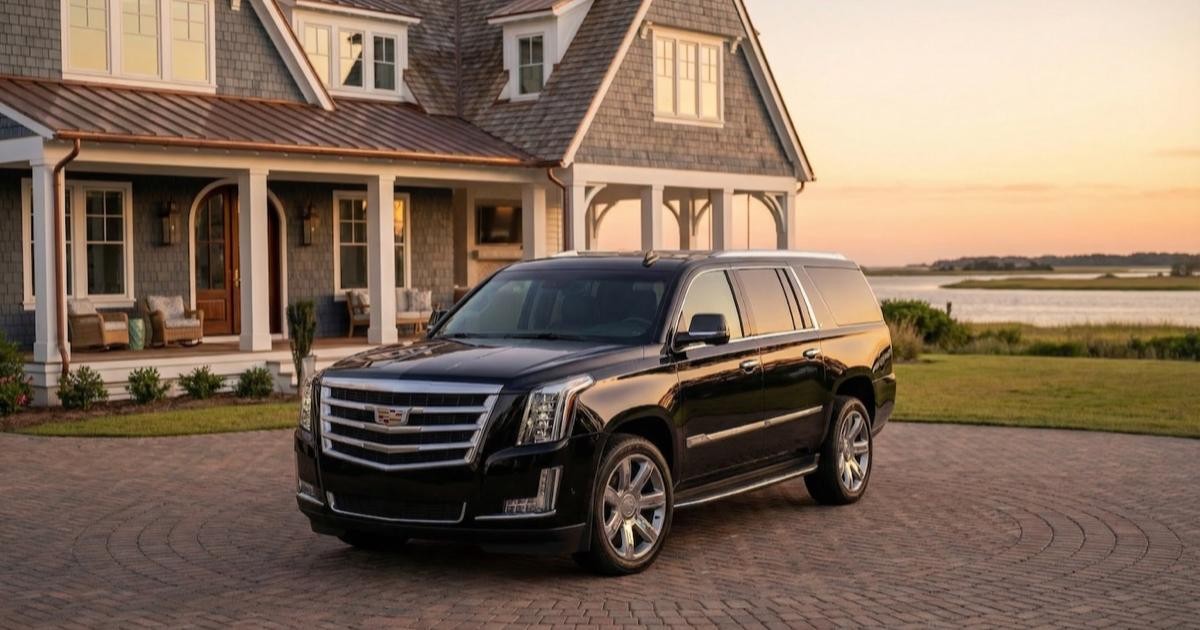
Full-size SUVs sit at the top of most automotive budgets. A single trim jump can add $15,000 to $30,000 to the final number. That gap is rarely about horsepower or towing capacity alone. Often it comes down to branding, badge engineering, and dealer markup dressed up as luxury.
This comparison looks at eight 2026 full-size SUVs. Four genuinely earn their sticker price through engineering, value, or a real ownership advantage.
Four others ask buyers to pay a premium for styling and badges layered onto mechanicals shared with cheaper siblings. The goal isn’t brand-bashing.
It’s showing where the extra money actually buys something, and where it mostly buys a nameplate. Specifications, pricing, and towing figures below come from 2026 model-year manufacturer and industry data.
Body-style shoppers comparing Tahoe-class rigs against Escalade-class luxury barges need this kind of honest breakdown. Sticker price alone tells you almost nothing.
5 Worth the Sticker
The Chevrolet Tahoe leads on value, offering three engine options and class-leading cargo space from $60,700. The Toyota Sequoia’s hybrid V6 delivers 583 lb-ft of torque and strong resale value.
The Ford Expedition tops independent reviews with 9,600 lbs of towing and standout tech. The Jeep Grand Wagoneer cut its price by over $20,000 while still leading the class with 10,000 lbs of towing capacity.
1. Chevrolet Tahoe
The Chevrolet Tahoe has long stood as the definitive benchmark in the full-size American SUV segment, balancing immense utility, family-friendly packaging, and competitive pricing that consistently undercuts its closest rivals.
Built upon General Motors’ proven T1 body-on-frame architecture, the Tahoe delivers a compelling value proposition by offering three distinct engine choices, a flexibility that completely separates it from single-engine competitors.
Buyers can choose between traditional small-block power or a genuinely efficient turbo-diesel engine, with the latter serving as an incredible sleeper pick for road-tripping families.
The 3.0-liter Duramax turbo-diesel delivers monumental cruising range, pushing roughly 600 miles on a single tank a level of highway efficiency that remains rare in a segment where traditional V8 options frequently struggle to surpass 18 miles per gallon combined.
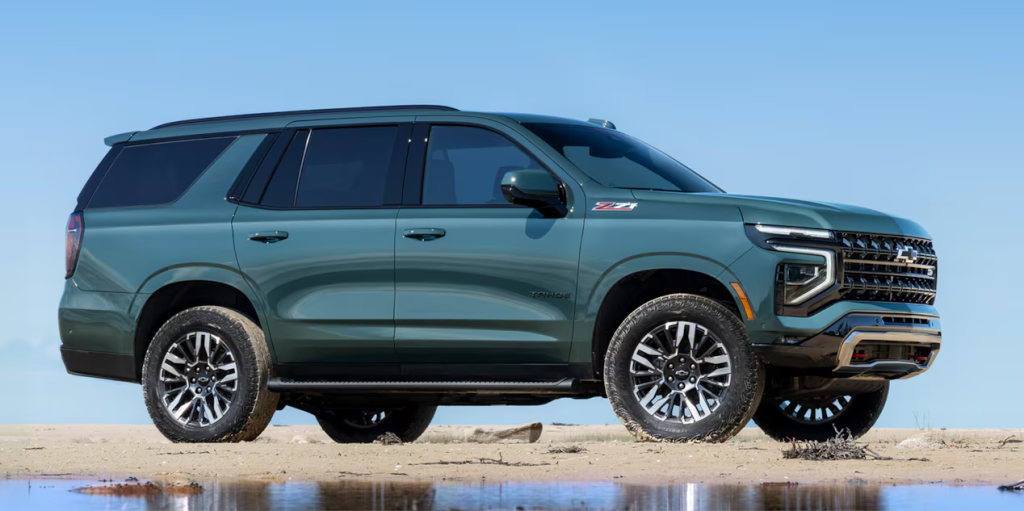
Inside the cabin, the Tahoe is engineered for true three-row family use, offering generous legroom across all rows and an expansive cargo capacity that stretches to a class-leading 122.9 cubic feet with the rear seats folded flat.
Unlike older truck-based SUVs that suffered from stiff, bouncing rear axles, the independent rear suspension introduced in this generation provides a remarkably smooth, planted ride quality.
Higher trim levels can also be outfitted with advanced Magnetic Ride Control and adaptive air suspension, further raising comfort over rough pavement.
Towing capability tops out at a respectable 8,400 pounds, easily handling most recreational boats, utility trailers, and weekend campers. Ultimately, the Tahoe wins on value density, providing massive interior volume, modern digital architecture, and proven mechanical capability without forcing buyers to pay a luxury tax for an upscale brand badge.
Specifications:
- Engine: 5.3L V8 standard; 6.2L V8 and 3.0L Duramax turbo-diesel available
- Horsepower: 355 hp (5.3L) / Torque: 383 lb-ft
- Length: 211.3 inches
- Width: 93.6 inches (including mirrors)
- Towing: up to 8,400 lbs
- Starting price: $60,700
2. Toyota Sequoia
The Toyota Sequoia occupies a unique and commanding position in the large SUV market as the only hybrid, body-on-frame full-size utility vehicle currently available for purchase.
That single engineering distinction fundamentally shifts the entire value equation for truck-based family haulers. Eschewing a stripped-down, underpowered base motor designed merely to advertise a low entry-level price, every single Sequoia trim comes standard with Toyota’s robust twin-turbocharged V6 hybrid i-FORCE MAX powertrain.
This advanced system churns out a massive 437 horsepower and an earth-moving 583 lb-ft of torque figures that effortlessly eclipse the output of most traditional V8 competitors while returning an impressive EPA-estimated 22 miles per gallon combined in daily driving.
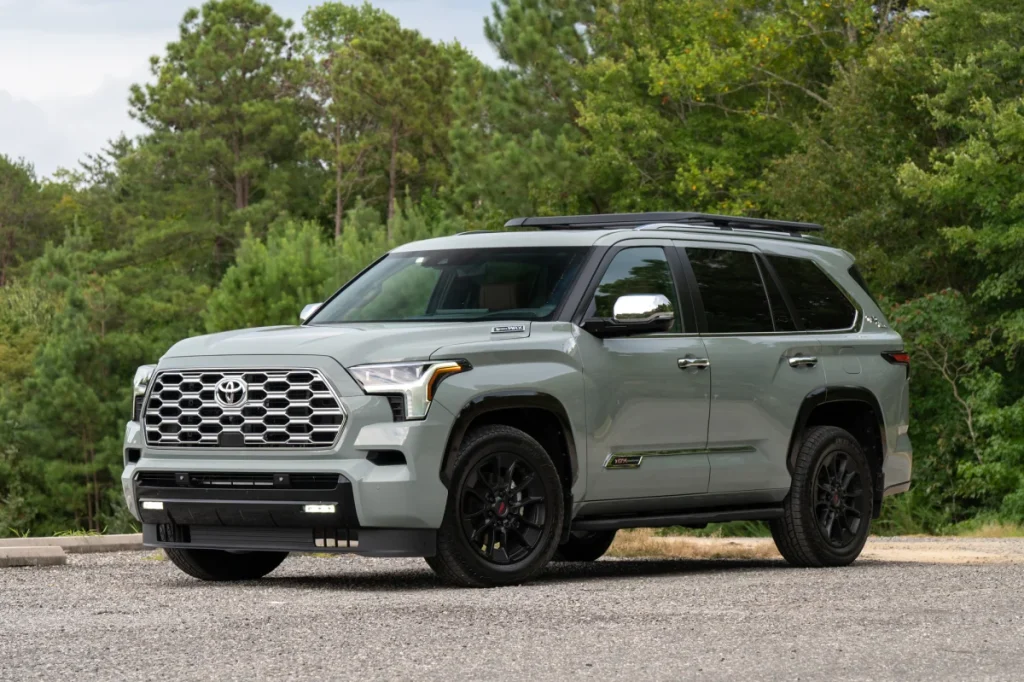
Long-term reliability and exceptional asset retention remain Toyota’s strongest cards. Historically, resale values for Sequoia and Land Cruiser-family vehicles consistently outperform the full-size segment average over a five-year ownership window, shielding buyers from the aggressive depreciation curves that plague domestic rivals.
While the vehicle’s unique hybrid battery packaging and solid rear axle design slightly limit maximum cargo space to 86.9 cubic feet behind the front row, trailing competitors like the Tahoe, it compensates with a heavy-duty towing capacity of up to 9,500 pounds.
For families planning to keep their vehicle for a full decade or more, the Sequoia’s lower long-term operating costs, stellar fuel savings, and bulletproof reliability heavily offset its higher initial sticker price.
Specifications:
- Engine: 3.4L twin-turbo V6 hybrid (i-FORCE MAX)
- Horsepower: 437 hp / Torque: 583 lb-ft
- Length: 208.1 inches
- Width: 79.6 inches
- Towing: up to 9,500 lbs
- Starting price: around $64,825
3. Ford Expedition
The Ford Expedition consistently claims top scores among large full-size SUVs in independent automotive evaluations, a testament to its real-world performance, comfort, and engineering depth.
To accommodate diverse family needs, Ford offers the vehicle in two distinct body lengths the standard wheelbase and the extended MAX version, both of which deliver genuine, uncompromised three-row usability for adults and children alike.
Under the hood, the standard 3.5-liter EcoBoost twin-turbocharged V6 produces robust acceleration, while an available high-output version pushes power even further for owners who demand serious heavy-duty towing capability, topping out at a massive 9,600 pounds when properly equipped.
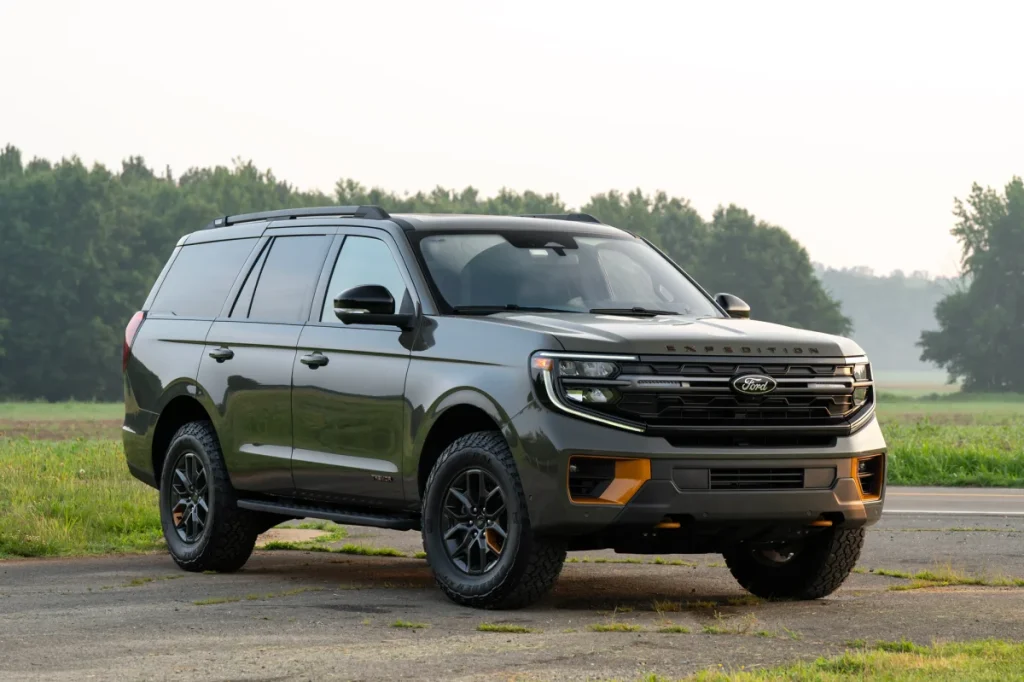
Inside, the cabin features a modern layout anchored by expansive display screens, high-end materials, and comprehensive driver-assist technology.
Crucially, Ford includes its Co-Pilot360 safety suite as standard equipment across most trims rather than hiding vital safety features behind expensive, premium-tier package requirements.
In terms of market positioning, the Expedition undercuts its closest direct competitor, the GMC Yukon, by thousands of dollars while matching or exceeding the luxury and mechanical refinement of higher-priced alternatives.
While upper-tier trim levels like the King Ranch lean heavily into distinct heritage styling themes, savvy buyers looking for genuine technological and comfort upgrades can easily find maximum value by stopping at the exceptionally well-appointed Platinum trim.
Specifications:
- Engine: 3.5L EcoBoost twin-turbo V6 (High-Output V6 available)
- Horsepower: 400 hp / Torque: 480 lb-ft (440 hp / 510 lb-ft on High-Output)
- Length: 210.9 inches (224.6 inches, MAX)
- Width: 80.9 inches
- Towing: up to 9,600 lbs
- Starting price: $65,495
4. Jeep Grand Wagoneer
The Jeep Grand Wagoneer stands at the center of the most dramatic pricing strategy shift in the full-size SUV segment, following a massive market realignment that saw its starting cost drop significantly compared to prior years.
Positioning itself more aggressively against mainstream heavyweights rather than exclusively targeting ultra-luxury flagships, the revised pricing structure brings the entry point down to the mid-$60,000 range, making high-end American utility far more accessible.
Crucially, this aggressive cost reduction has been achieved without stripping away the core identity of the vehicle; the cabin continues to deliver genuine luxury materials, sophisticated electronic air suspension, and expansive second-row legroom that rivals vehicles costing tens of thousands more.
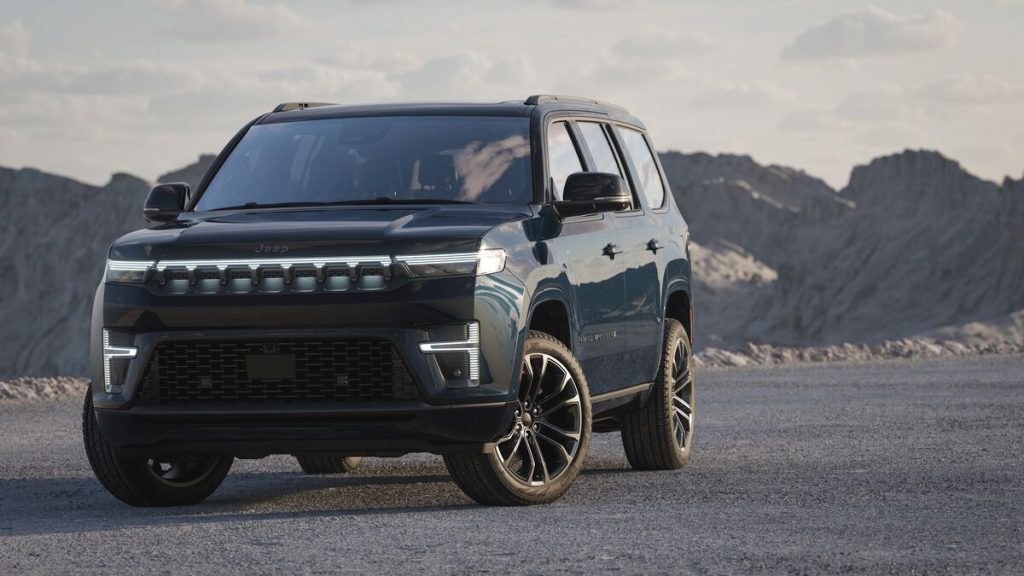
Capability remains a massive strong suit, highlighted by a class-leading towing capacity that reaches up to 10,000 pounds when properly configured, surpassing every major mainstream competitor in the segment.
Innovation is also reshaping the powertrain lineup, including the integration of advanced forced-induction mechanics alongside planned range-extended hybrid (REEV) configurations designed to pair massive horsepower outputs with hundreds of miles of combined driving range.
While top-tier Summit and Summit Reserve trims still climb past the six-figure mark with every luxury option ticked, the base and mid-range trims represent where the genuine value now lives.
For buyers chasing the road presence, hauling power, and interior volume of an Escalade without the traditional six-figure penalty, the revised Grand Wagoneer completely closes the gap.
Specifications:
- Engine: 3.0L Hurricane twin-turbo inline-6
- Horsepower: 420 hp / Torque: 468 lb-ft
- Length: 216.1 inches
- Width: 83.6 inches (94 inches with mirrors)
- Towing: up to 10,000 lbs
- Starting price: $63,995
Also Read: Tesla Tests Bidirectional Charging: Cybertruck Sends Power Back to Texas Grid
4 Not Worth the Sticker
The GMC Yukon shares Tahoe mechanics but costs $9,000-$12,000 more. The Cadillac Escalade’s carryover V8 trails rivals on power and efficiency. The Lincoln Navigator lacks a V8 option despite six-figure pricing. The Infiniti QX80 offers strong power but suffers steep depreciation and less cargo space.
1. GMC Yukon
The GMC Yukon shares its core platform, mechanical architecture, and drivetrain options almost identically with the Chevrolet Tahoe, as both full-size SUVs ride on General Motors’ proven T1 body-on-frame framework.
Yet, despite sharing the exact same factory assembly roots, the Yukon carries a noticeable price premium, starting roughly $9,000 to $12,000 higher than an equivalent Tahoe, with that financial gap widening dramatically as buyers climb the trim ladder into luxury iterations like the Denali and Denali Ultimate.
Underneath the hood, the standard 5.3-liter V8 engine is completely identical between both vehicles, meaning horsepower, low-end torque, and maximum towing figures do not change regardless of which badge adorns the grille.
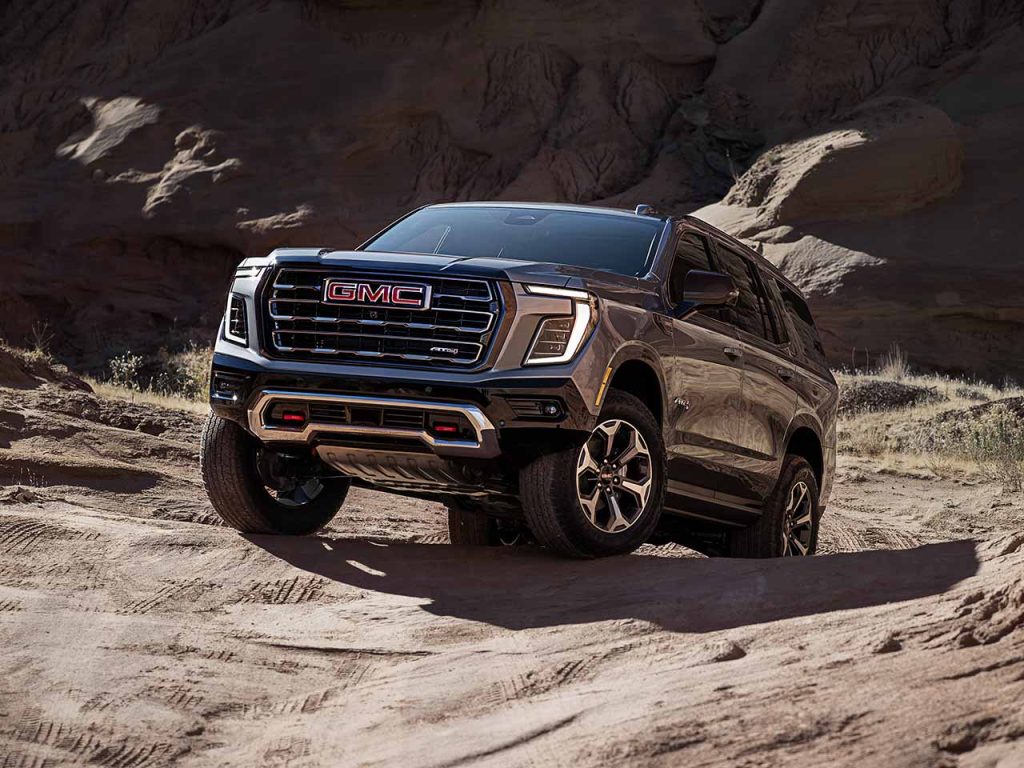
GMC attempts to justify the added cost by incorporating exclusive touches, such as sophisticated Night Vision thermal assist systems, unique exterior lighting animations, and an upgraded Bose Performance Series audio setup on upper trims.
However, those high-end features only arrive deep in the upper echelons of the price structure. Basic interior volume, family cargo capacity, and foundational safety ratings remain effectively tied with the Tahoe.
Independent automotive comparisons consistently categorize the two mechanical twins as nearly identical in day-to-day utility. Ultimately, paying the GMC premium buys exterior badge prestige and slightly more stylized interior trim garnishes, rather than fundamentally different engineering capability.
For shoppers prioritizing pure mechanical value over upscale nameplates, the Tahoe remains the more rational financial choice, leaving the Yukon as a purchase driven primarily by personal styling preference.
Specifications:
- Engine: 5.3L V8 standard; 6.2L V8 and 3.0L Duramax available
- Horsepower: 355 hp / Torque: 383 lb-ft
- Length: 210.1 inches
- Width: 81.0 inches (without mirrors)
- Towing: up to 8,400 lbs
- Starting price: around $69,200
2. Cadillac Escalade
The Cadillac Escalade occupies the pinnacle of American full-size luxury, delivering undeniable road presence, striking exterior styling, and a breathtaking cabin anchored by an expansive 55-inch curved digital display integration.
Nobody questions its heavy visual impact or its ability to turn heads in an executive parking lot. However, beneath its opulent sheet metal, the standard powertrain relies on a carryover 6.2-liter V8 engine producing 420 horsepower, an output that surprisingly trails the standard twin-turbocharged V6 powerplants found in competing modern imports like the Infiniti QX80.
Pricing strategy introduces another steep hurdle. A base Escalade routinely starts well north of $93,000 before adding a single option, while fully loaded trims, specialized packages, and extended ESV variants routinely rocket past $170,000.
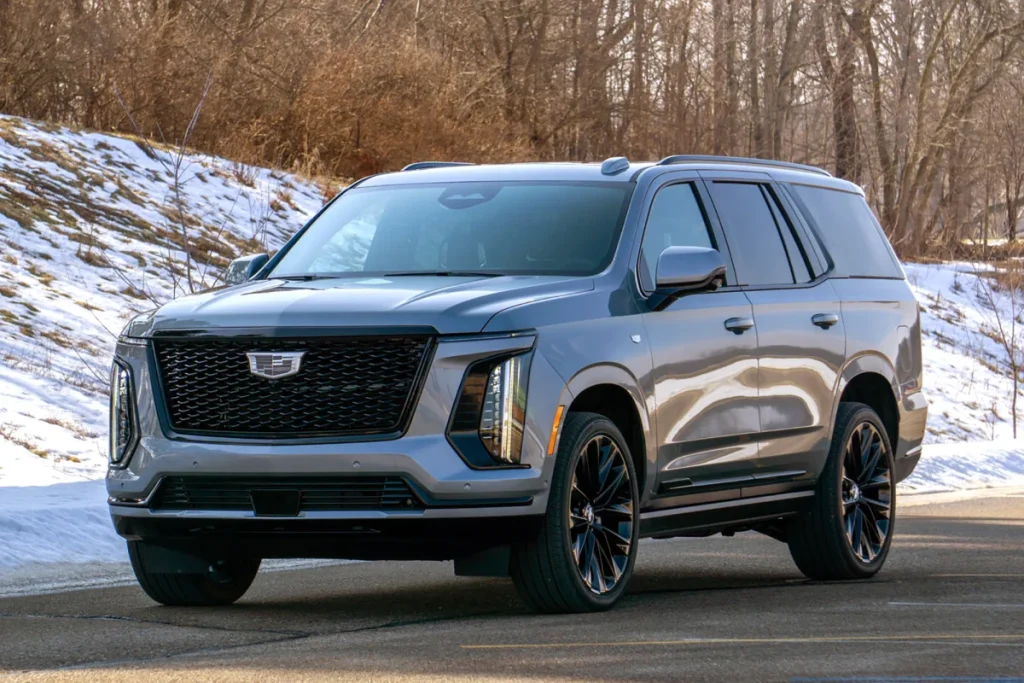
Daily fuel economy is predictably poor for a heavy luxury mastodon, hovering around sluggish city and combined averages that trail several segment competitors.
Furthermore, heavy initial depreciation hits the luxury fll-size class with brutal force; a five-year value loss approaching 60 percent is entirely common for these high-end trucks, meaning owners absorb massive financial hits upon resale.
While the ultra-high-performance supercharged V-Series variant delivers staggering thrills with 682 horsepower, that specialty engine sits buried deep in the option sheet at an exorbitant price point. For buyers seeking peak opulence, the Escalade delivers, but it demands an exceptionally heavy toll in both initial sticker price and long-term depreciation.
Specifications:
- Engine: 6.2L V8 standard; 6.2L supercharged V8 optional (V-Series)
- Horsepower: 420 hp / Torque: 460 lb-ft (standard)
- Length: 211.9 inches (226.9 inches, ESV)
- Width: approximately 81 inches
- Towing: up to 8,100 lbs
- Starting price: around $93,995
3. Lincoln Navigator
The Lincoln Navigator offers a plush, highly polished cabin experience designed to pamper occupants, highlighted by features like the Rejuvenate wellness system, exquisite multi-contour massaging seats, and a sweeping panoramic display setup.
However, despite sitting firmly in the six-figure luxury bracket, it relies strictly on a single powertrain choice across its entire lineup: a twin-turbocharged V6 engine. There is no alternative V8 option available for traditionalists, nor is there a high-performance variant designed to compete with the heavy-hitting sports trims offered by domestic rivals.
Output ranges between 432 and 440 horsepower depending on the exact configuration, which is respectable for daily driving but hardly exceptional given the vehicle’s steep baseline.
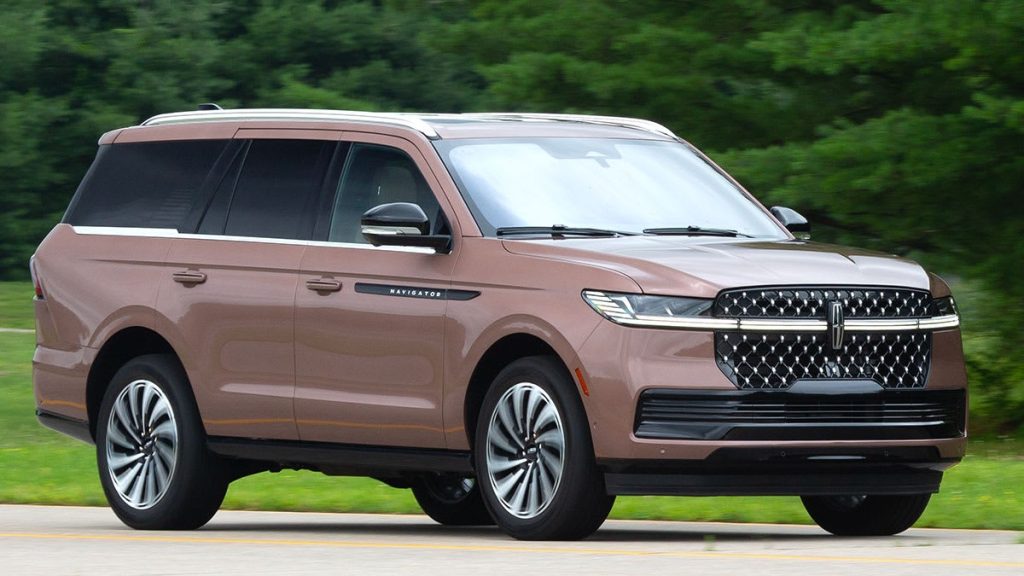
Pricing regularly starts above $100,000 for well-equipped versions, while top-tier Black Label trims climb significantly higher. When stacked against segment competitors, cargo volume trails behind vehicles like the Cadillac Escalade, though the Navigator counters with generous third-row legroom.
Depreciation heavily impacts the Navigator, mirroring the aggressive downward trends seen across the luxury full-size class. Five-year value retention lags behind mainstream body-on-frame alternatives like the Chevrolet Tahoe or Toyota Sequoia.
Well-equipped versions of alternative full-size SUVs can often deliver comparable luxury ambiance and superior towing metrics for tens of thousands of dollars less, leaving the Navigator’s high premium paying more for brand styling than unmatched capability.
Specifications:
- Engine: 3.5L twin-turbo V6 (sole engine offered)
- Horsepower: approximately 432-440 hp / Torque: 510 lb-ft
- Length: 210 inches (up to 221.9 inches, Navigator L)
- Width: approximately 81.9 inches
- Towing: up to 8,700 lbs
- Starting price: around $100,000-plus for well-equipped trims
4. Infiniti QX80
The Infiniti QX80 arrives with a genuinely impressive engineering win under the hood, featuring a potent twin-turbocharged V6 that outperforms Cadillac’s standard V8 on paper, producing 450 horsepower and 516 lb-ft of torque.
Yet, despite its strong mechanical foundation, the vehicle’s market positioning presents several major hurdles for prospective buyers. Pricing has climbed steeply, with upper-tier Autograph trims easily cresting past the $110,000 threshold before dealer markups or custom options are factored into the final bill.
Depreciation remains a profound pain point for the nameplate. Five-year value loss rates for the flagship Infiniti run aggressively high, often trailing behind the domestic competition it attempts to challenge.
Furthermore, independent consumer comparisons frequently show reliability scores and long-term owner satisfaction leaning in favor of segment leaders like the Escalade.
Practicality also takes a surprising hit regarding interior packaging; cargo room behind the third row is notably restricted compared to American full-size alternatives, creating a tangible compromise for heavy-duty family road trips.
Ultimately, the QX80 asks luxury buyers to spend deep into six-figure territory for a vehicle that suffers from severe asset depreciation and tighter cargo constraints, meaning its horsepower advantage alone struggles to offset those long-term compromises.
Specifications:
- Engine: 3.5L twin-turbo V6
- Horsepower: 450 hp / Torque: 516 lb-ft
- Length: 211.2 inches
- Width: 92.5 inches (including mirrors)
- Towing: up to 8,500 lbs
- Starting price: $89,040
Also Read: What Public Fast Charging Costs per Mile vs Gasoline
