
Cadillac is now one of America’s most recognizable luxury names, but its origins are surprisingly connected to one of Henry Ford’s earliest failures.
Before Ford created the company that would eventually produce the Model T, he had already walked away from another automobile business. That company did not simply disappear. Its factory, equipment, and financial backing became the foundation for Cadillac.
In 1902, Henry M. Leland was brought in to assess the remains of the struggling Henry Ford Company. Rather than recommend liquidation, Leland saw an opportunity.
He believed his precision-engineering expertise and a promising single-cylinder engine could turn the failed operation into a viable automaker. The result was the Cadillac Automobile Company, established in August 1902.
The irony became even greater years later. Leland eventually sold Cadillac to General Motors, while Ford went on to build his own enormously successful company. The two men would cross paths again when Ford purchased Leland’s Lincoln Motor Company in 1922.
Ford Walked Away, and Leland Saw an Opportunity. Henry Ford’s first serious attempt to build automobiles came through the Detroit Automobile Company, organized in 1899.
The business struggled and was dissolved after roughly 18 months. Ford continued experimenting with cars and racing machines, and his 1901 racing success helped persuade investors to finance another venture.
The result was the Henry Ford Company, established in November 1901. Ford served as chief engineer, but his relationship with the financial backers deteriorated quickly. Ford was interested in engineering and racing, while investors wanted a production automobile that could be sold commercially.
Ford eventually left the company in early 1902. Ford Motor Company’s own historical account confirms that he departed that year and that the business subsequently became Cadillac Motor Car Company.
Once Ford was gone, his former investors faced a major problem. They had a factory and equipment but no Henry Ford producing cars. Their initial plan was essentially to liquidate what remained.
That is where Henry Leland entered the story. Leland was already one of Detroit’s accomplished precision machinists.
Born in Vermont in 1843, he developed mechanical skills through work involving farm equipment and firearms and later gained experience with precision manufacturing at Brown & Sharpe. That background taught him the importance of accurate machining and interchangeable parts.
After moving to Detroit, Leland established his own machine business. Leland & Faulconer became known for precision manufacturing and eventually entered the automotive supply business. By the late 1890s, the company was producing components and engines for Ransom Olds and Oldsmobile.
When William Murphy and other former Ford investors asked Leland to examine the failed operation, he was initially expected to determine the value of its machinery and facility.
Instead, he saw the possibility of starting again. Leland convinced the former Ford backers that he could create a viable company using an engine he had developed for the Olds Motor Vehicle Company. Rather than sell the factory, the investors agreed to reorganize the operation.
The new company was named Cadillac after Antoine de la Mothe Cadillac, the French explorer associated with the founding of Detroit. The Cadillac Automobile Company was launched in August 1902, with Leland serving as its director.
This is why saying Cadillac was literally “assembled from Henry Ford’s failed company” is accurate in a historical sense but needs qualification. Cadillac was not simply Ford’s unfinished car with a new name. Leland fundamentally changed the engineering and manufacturing direction of the business.
The factory and some existing infrastructure came from the failed Ford operation. The engineering philosophy that made Cadillac important came largely from Leland.
Leland Turned a Failed Factory Into a Precision-Car Company
The first Cadillac was very different from the luxury cars Americans would recognize decades later.
The earliest models were extremely simple. The Smithsonian’s 1903 Cadillac Model A used a one-cylinder, water-cooled engine built by Leland & Faulconer and originally sold for $850.
The early Cadillac’s importance came less from luxury than from manufacturing accuracy. Leland believed precision was a competitive advantage.
At a time when many automobiles were essentially hand-built machines with components that could vary considerably from one vehicle to another, Leland emphasized standardized production and interchangeable parts. That philosophy would become one of Cadillac’s defining characteristics.
The early Cadillacs also benefited from an interesting combination of engineering sources. The Detroit Historical Society notes that they used a Ford-designed body together with Leland’s Cadillac engine.
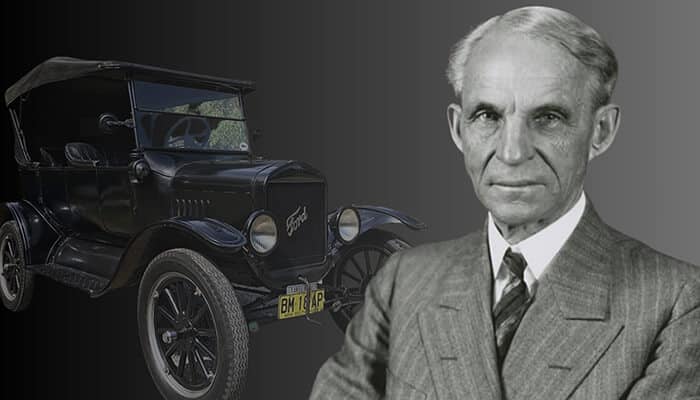
That detail makes the connection to Ford even more fascinating. Cadillac inherited part of the physical foundation of Ford’s failed venture while combining it with Leland’s engineering approach.
Cadillac quickly began gaining attention. The cars were displayed at the 1903 New York Auto Show, where sales manager William Metzger reportedly took more than 1,000 orders.
By 1904, the company was producing four-cylinder models. Leland and his son Wilfred increasingly took control of operations, and in 1905 Leland & Faulconer was consolidated with Cadillac. The resulting organization became the Cadillac Motor Car Company.
The most famous demonstration of Cadillac’s precision came in 1908 in England. Cadillac entered the Royal Automobile Club’s Dewar Trophy competition, which tested manufacturing consistency.
Three Cadillacs were dismantled, their components were mixed with other stock parts, and mechanics then reassembled the vehicles. According to the Detroit Historical Society, the cars were subsequently driven for 500 miles without incident. Cadillac won the Dewar Trophy that year.
The achievement demonstrated that Cadillac could manufacture components with unusual consistency. Parts could be removed from one car and replaced with equivalent components without extensive hand-fitting.
Leland’s precision philosophy had become a genuine manufacturing advantage. By this point, the company that emerged from Henry Ford’s failed business was no longer simply surviving. It had become one of America’s leading automakers.
General Motors noticed. In 1909, William Durant’s General Motors acquired Cadillac for $4.5 million. Leland remained involved after the acquisition, continuing to enforce the precision standards that had helped establish Cadillac’s reputation. But Leland’s story did not end with Cadillac.
The Ford and Leland Story Came Full Circle
In 1917, Leland and his son Wilfred left General Motors following disagreements with Durant over the company’s priorities during World War I. They established the Lincoln Motor Company, initially producing Liberty aircraft engines for the war effort. After the war, Lincoln entered automobile production.
That eventually brought Henry Ford and Henry Leland back together. Lincoln struggled financially during the postwar period, and Ford purchased the company in 1922.
The Henry Ford Museum records that Ford and Leland were photographed together during the acquisition, nearly two decades after Leland had transformed Ford’s abandoned automobile operation into Cadillac.
The irony is hard to miss. Ford left the Henry Ford Company because he could not agree with its investors about how the business should proceed. Leland then took its remains and created Cadillac.
Cadillac became successful enough to be purchased by General Motors, while Ford created his own automobile company in 1903 and eventually became one of America’s most influential industrialists.
Then, in 1922, Ford bought the company Leland had created after leaving Cadillac. The early Cadillac story is therefore much more than a footnote to Ford history. It demonstrates how fragile the early American automobile industry was.
Companies could fail because of disagreements between engineers and investors, yet their factories, machinery, and ideas could be reused to create something entirely new.
Leland’s contribution was particularly important because he understood that building successful automobiles required more than designing a clever machine. It required manufacturing discipline.
The first Cadillac was not a V8-powered luxury icon. It was a relatively simple single-cylinder automobile. But its precision manufacturing established a foundation that allowed Cadillac to grow into a major American brand.

The company later introduced increasingly sophisticated engines and technologies, including V8, V12, and V16 powerplants, along with innovations such as electric starting, ignition, and lighting.
That transformation began inside the remnants of Henry Ford’s failed second automobile company.
So the headline is not simply an exaggeration designed to make Cadillac’s history sound dramatic. There is a real historical connection. Ford’s second automobile venture failed; Ford left in 1902, and Henry Leland persuaded its investors not to liquidate the operation.
He reorganized it into the Cadillac Automobile Company and supplied the engineering expertise that turned the abandoned business into a major automaker.
The most fascinating part is what happened afterward. Ford eventually built the company that carried his name into industrial history. Leland took the remains of one of Ford’s failures and built Cadillac. General Motors then bought Cadillac for $4.5 million, turning it into one of the pillars of America’s emerging automotive industry.
Cadillac’s rise therefore began with a failure, but it was not Ford’s engineering that ultimately made the company successful. Henry Leland decided to look at a failed factory and see an opportunity rather than scrap it.
In 1902, Ford walked away from the company bearing his name. Leland walked into the same operation and built something that would outlive them both.