
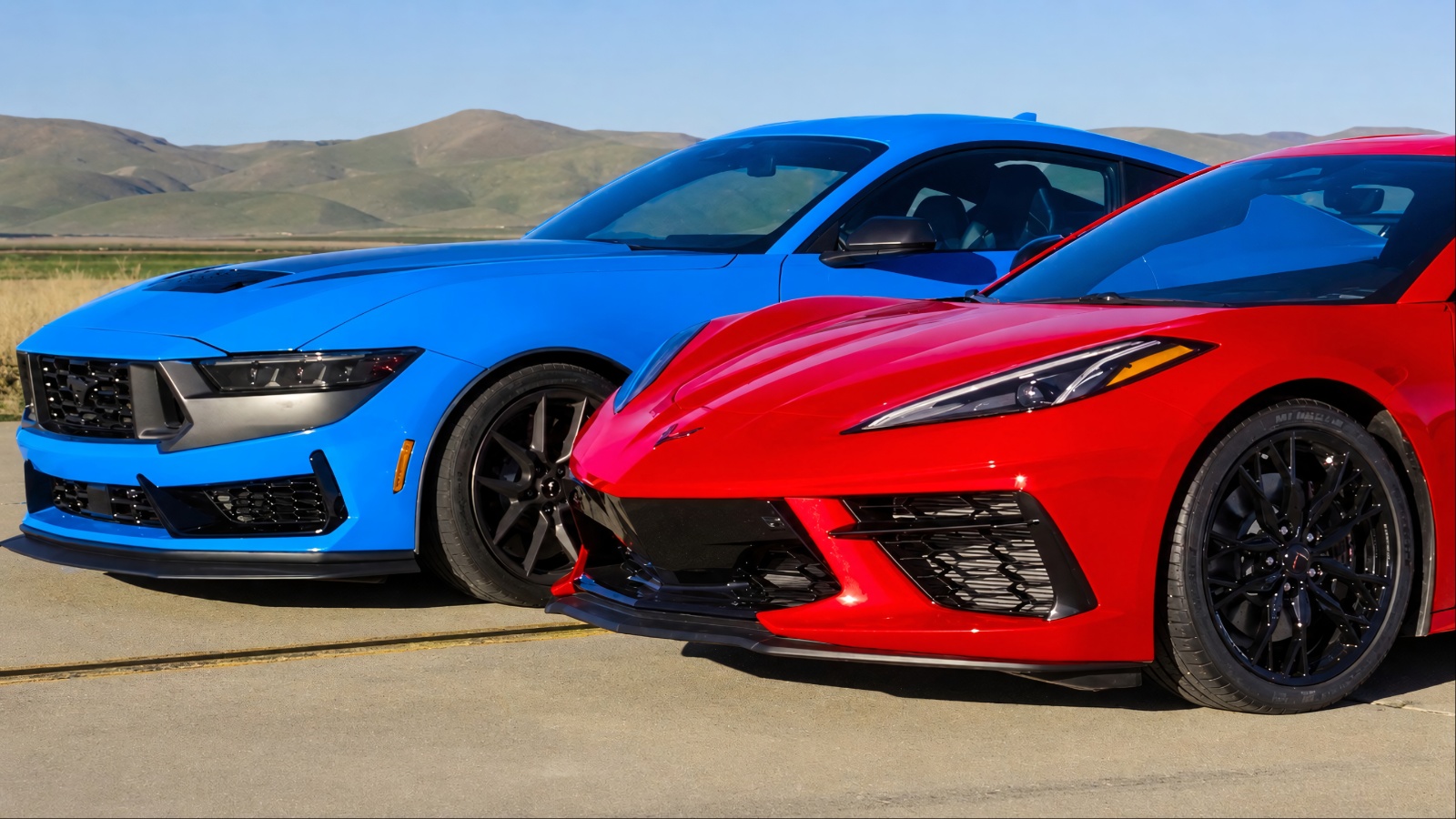
Few performance-car comparisons are as interesting as putting the Chevrolet Corvette, Ford Mustang, and Toyota GR Supra against one another. They are very different machines, but each delivers serious performance without requiring buyers to step into the world of six-figure exotic cars.
For 2026, the differences are even more obvious. The Corvette Stingray is a mid-engine two-seat sports car with a naturally aspirated 6.2-liter V8 producing up to 495 horsepower.
The Mustang remains a front-engine, rear-wheel-drive muscle car with several powertrains, including the 486-horsepower GT and 500-horsepower Dark Horse. The GR Supra uses a turbocharged 3.0-liter inline-six producing 382 horsepower and offers both six-speed manual and eight-speed automatic transmissions.
Pricing also puts them in an interesting position. The 2026 Corvette Stingray starts at $70,000, the GR Supra starts at $58,300, while current Ford listings place the Mustang GT around the $50,000 mark before options and dealer-specific pricing.
That makes the Mustang the least expensive way into a V8-powered version of this group, while the Supra sits between the Mustang and Corvette in price. But price and horsepower alone cannot determine which one is better.
The Corvette brings exotic-car architecture and tremendous performance. The Mustang combines muscle-car character with greater practicality. The Supra focuses on compact dimensions, balance, and driver involvement.
To find the strongest overall package, here is how the three compare across six categories that matter most to performance-car buyers.
Performance and Engine Choices
The Corvette wins the first category because its basic mechanical formula gives it the strongest combination of power and sports-car hardware.
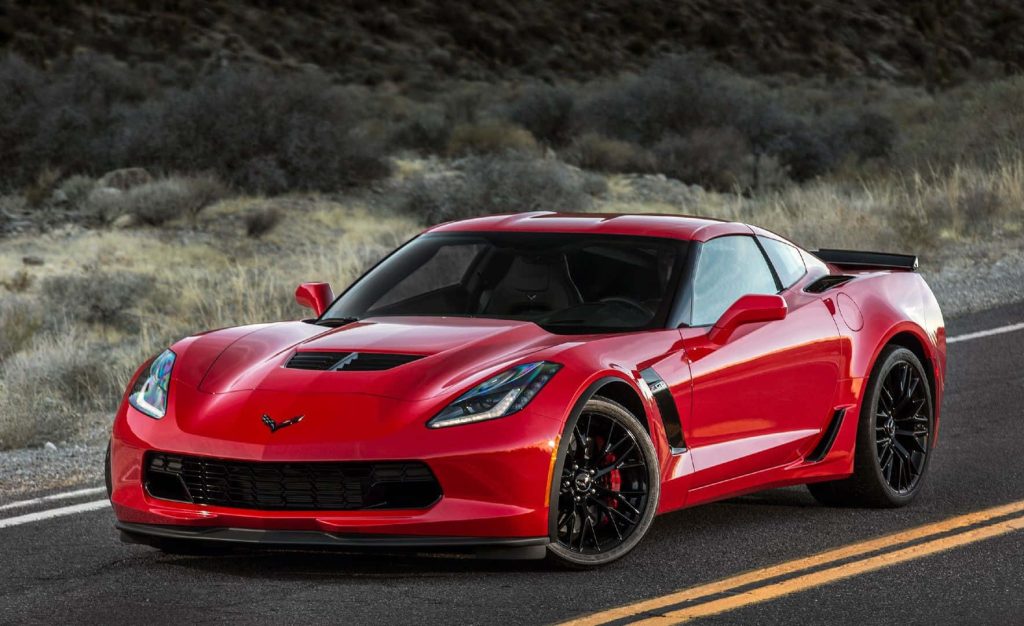
The 2026 Corvette Stingray uses a naturally aspirated 6.2-liter LT2 V8 positioned behind the passenger compartment. Chevrolet lists 490 horsepower and 465 lb-ft of torque, with output increasing to 495 horsepower and 470 lb-ft when equipped with the available performance exhaust as part of the Z51 package.
That engine is paired with an eight-speed dual-clutch transmission and rear-wheel drive. Unlike a traditional front-engine muscle car, the Corvette’s mid-engine layout places the mass closer to the center of the vehicle, helping improve weight distribution and traction.
Chevrolet quotes an available 0-to-60-mph time of just 2.9 seconds for the Stingray. Its top track speed is listed at 194 mph. The Mustang takes a completely different approach.
The 2026 Mustang GT uses a 5.0-liter naturally aspirated Coyote V8 producing 480 horsepower, or 486 horsepower with the available active-valve performance exhaust. The Dark Horse raises output to 500 horsepower and 418 lb-ft of torque.
Ford also gives the Mustang an important advantage for enthusiasts who want mechanical involvement. The GT has a six-speed manual transmission available, while the Dark Horse uses a six-speed Tremec manual as standard. A 10-speed automatic is also available.
The Supra is smaller and uses forced induction. Its 3.0-liter turbocharged inline-six produces 382 horsepower and 368 lb-ft of torque. Toyota offers either a six-speed manual or eight-speed automatic transmission, and the automatic version can reach 60 mph in a manufacturer-estimated 3.9 seconds.
The Supra’s engine is smooth and responsive, and its turbocharged torque makes the car feel considerably stronger than its horsepower figure might suggest.
But the Corvette’s combination of 495 horsepower, a mid-engine layout, and sub-three-second acceleration gives it the most impressive mechanical package.
The Mustang is not far behind in power, and the Dark Horse actually produces more horsepower than the standard Corvette’s 490-horsepower rating. Yet the Corvette’s chassis architecture changes how effectively that power can be used.
The Supra is the smallest and lightest-feeling of the three, but it simply does not have the output of its rivals.
For maximum performance hardware and the strongest engine-and-chassis combination, the Corvette takes the first category.
Winner: Chevrolet Corvette
Handling and Driving Dynamics
The Corvette wins again because its mid-engine architecture gives it a fundamental advantage when the road becomes technical.
Moving the engine behind the cabin changes the balance of the car. The Corvette’s layout allows Chevrolet to put more mass toward the center of the chassis while giving the rear tires substantial traction under acceleration.
The Stingray is not simply a straight-line machine. Chevrolet offers a range of drive modes and performance equipment, including the Z51 package with upgraded brakes, performance suspension, performance exhaust, and Michelin Pilot Sport 4S summer tires. The available Performance Data Recorder also gives drivers the ability to analyze their driving.
That makes the Corvette equally comfortable being driven quickly on a winding road or taken to a track. The Supra is arguably the most naturally nimble-feeling car here.
Toyota designed the GR Supra around a short wheelbase, low center of gravity, and rear-wheel drive. The car is only 172.5 inches long with a 97.2-inch wheelbase, making it considerably more compact than the Mustang. Toyota also provides adaptive variable suspension, an active differential, and sport-oriented steering.
Those dimensions give the Supra a distinctive advantage on narrow, technical roads. Toyota has also continued refining the chassis. The 2026 MkV Final Edition receives improved braking performance, increased body rigidity, revised suspension tuning, and aerodynamic changes.
The Mustang has become considerably more sophisticated than its traditional muscle-car image suggests.
The current Mustang uses independent rear suspension, a double-ball-joint front suspension, and available MagneRide adaptive damping. The Dark Horse also receives more specialized hardware, including a Torsen limited-slip differential and larger performance brakes.
The Mustang can therefore corner far harder than older generations of the car. But it remains the largest vehicle of the three. The 2026 Mustang is 189.4 inches long in GT form, compared with 172.5 inches for the Supra.
That difference is noticeable on tight roads. The Supra’s smaller footprint makes it feel agile and responsive, while the Mustang’s chassis delivers excellent stability at higher speeds.
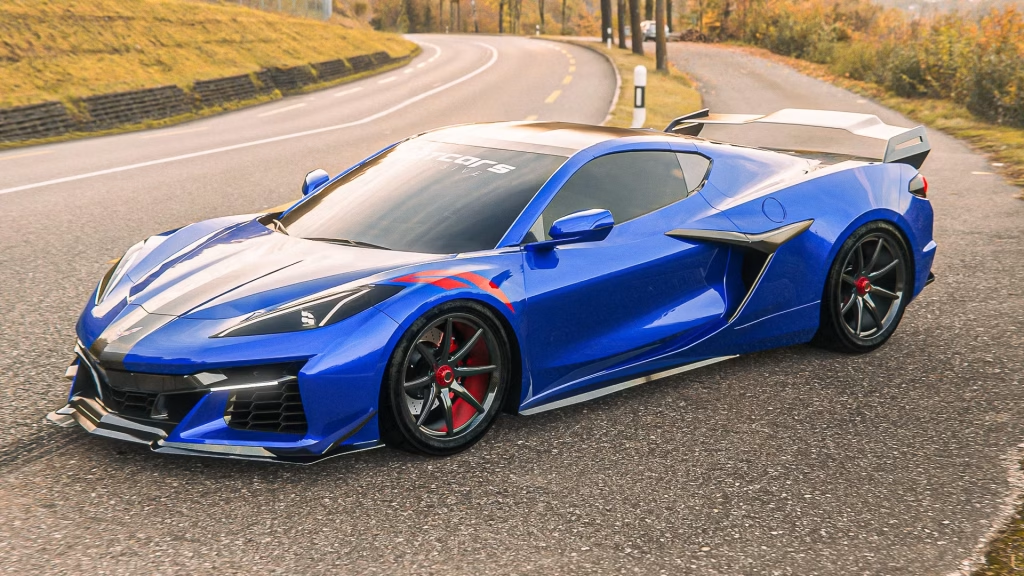
The Corvette combines both traits. Its mid-engine layout gives it the balance of a purpose-built sports car, while its wide stance and performance hardware provide tremendous grip.
The Supra may feel more playful at moderate speeds, and the Mustang Dark Horse is a serious track machine. But the Corvette’s architecture gives it the strongest foundation for high-performance driving. For cornering confidence, balance, and track capability, the Corvette has the edge.
Winner: Chevrolet Corvette
Straight-Line Speed and Acceleration
This category is extremely close on paper because the Mustang can produce 500 horsepower and the Corvette can produce up to 495 horsepower. But horsepower does not tell the whole story.
The Corvette’s mid-engine configuration gives the rear tires an important traction advantage, particularly when launching from a standstill. Chevrolet claims an available 0-to-60-mph time of 2.9 seconds for the Stingray.
That puts the Corvette firmly into exotic-car acceleration territory. The Mustang GT is extremely quick, particularly with its 10-speed automatic transmission. The Dark Horse adds more power and specialized chassis equipment, but Ford’s approach is still based around a front-engine layout and traditional rear-wheel-drive muscle-car proportions.
The Mustang’s advantage is that its performance can be accessed at a substantially lower price. A buyer does not need to spend Corvette money to get a V8 Mustang capable of serious acceleration.
The Supra takes a different approach. Its 382-horsepower turbocharged inline-six allows Toyota to quote a 3.9-second 0-to-60-mph time for the automatic model. That is still remarkably quick.
The Supra’s turbocharged engine also provides 368 lb-ft of torque, with peak torque arriving much lower in the rev range than the Corvette’s naturally aspirated V8. That makes the Supra responsive in everyday driving and gives it strong midrange acceleration.
However, the Corvette has another advantage: its eight-speed dual-clutch transmission. A dual-clutch transmission can shift extremely quickly while keeping the engine in its strongest operating range. Combined with the mid-engine layout, this allows the Corvette to put its power down with remarkable efficiency.
The Mustang’s 10-speed automatic is also quick and provides a wide spread of gearing, while the manual transmission gives enthusiasts a more involving experience.
But if the objective is simply to reach 60 mph as quickly as possible, the Corvette has the clearest advantage.
The difference is especially impressive considering the Stingray is not the extreme Corvette Z06 or ZR1. It is the entry-level Corvette.
That means a relatively accessible Corvette can deliver acceleration numbers that rival much more expensive sports cars.
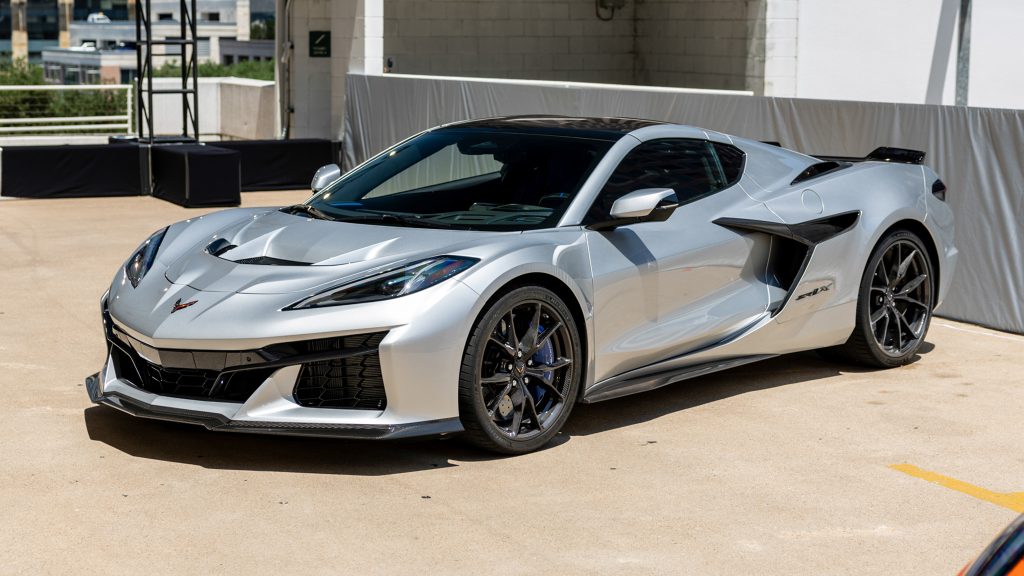
The Supra is the quickest-feeling compact car of this group, while the Mustang provides the strongest performance value.
Yet the Corvette combines traction, power, transmission response, and weight distribution in a way neither rival can fully match. For acceleration and straight-line performance, the mid-engine Chevrolet takes the win.
Winner: Chevrolet Corvette
Everyday Usability and Practicality
The Corvette may dominate performance, but the Mustang fights back strongly when practicality enters the conversation. The biggest advantage is seating.
The Mustang can accommodate up to four people, while both the Corvette and Supra are two-seat sports cars. Ford’s rear seats are not spacious enough to replace a family SUV, but they can be useful for children, smaller passengers, or occasional additional occupants.
That alone gives the Mustang a major usability advantage. The Mustang also offers a fastback body style with a useful cargo opening. Owners can fold the rear seatbacks to carry longer items, making the car more practical than its aggressive appearance suggests.
The Corvette is surprisingly practical for a two-seat sports car. Chevrolet specifically highlights the Stingray’s cargo capacity as part of its everyday usability. The mid-engine layout allows the Corvette to provide both front and rear storage compartments.
That makes it more useful for weekend trips than many traditional two-seat sports cars. The Corvette also offers a removable roof panel on the coupe, while the convertible uses a power-retractable hardtop.
The Supra has a useful hatch-style rear cargo area, but its cargo capacity is limited compared with the Mustang. Toyota lists 10.2 cubic feet of cargo capacity for the GR Supra.
The Supra’s compact dimensions make it easy to place on a narrow road or in a crowded parking space, but its two-seat layout limits how much the car can accomplish.
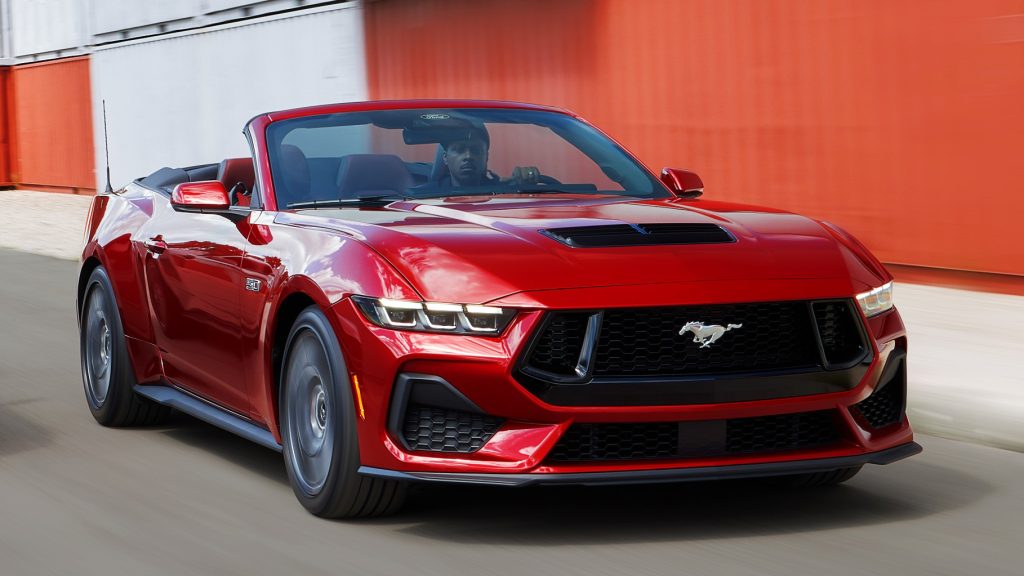
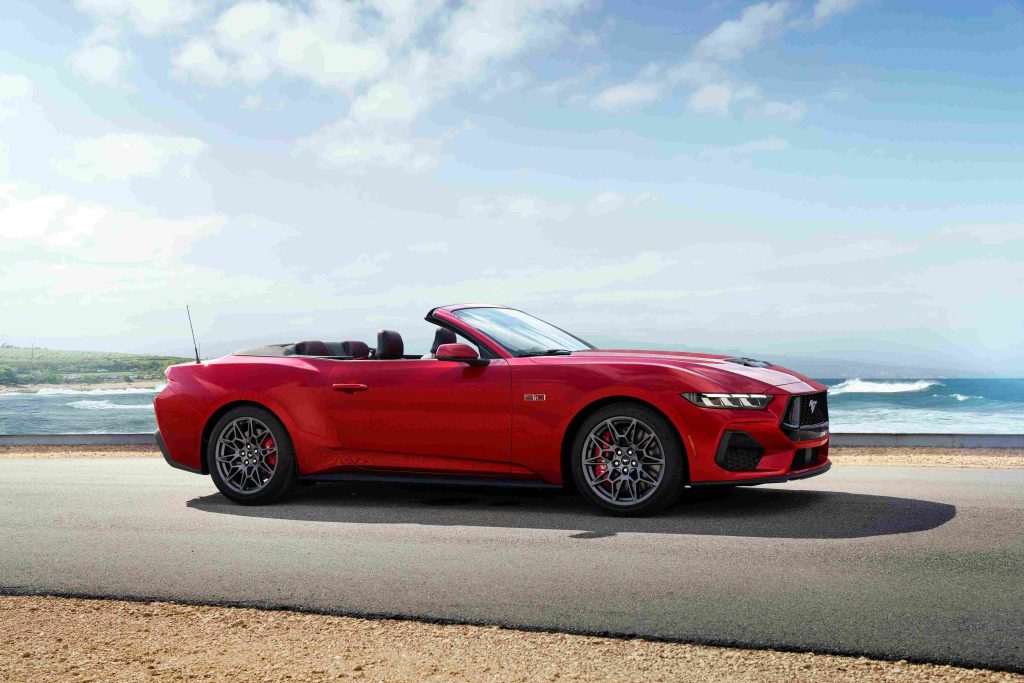
The Mustang is also offered as a convertible, giving buyers another body-style option. Ford lists both fastback and convertible versions in the 2026 lineup.
Fuel economy also matters for daily use. The 2026 Supra is rated at 22 mpg city and 29 mpg highway with the automatic transmission.
The Mustang GT is less efficient because of its V8, while the Corvette’s naturally aspirated V8 also consumes more fuel than the Supra’s turbocharged six-cylinder.
But practicality is not simply about fuel economy. A performance car becomes much easier to justify when it can carry more than two people, accommodate luggage, and function as a regular commuter.
That is where the Mustang shines. The Supra is more compact, and the Corvette provides useful storage for a two-seat sports car, but neither can match the Mustang’s combination of seating and cargo flexibility.
The Mustang therefore wins this category despite being the least exotic-looking vehicle of the three.
Winner: Ford Mustang
Technology and Features
The Corvette takes this category because Chevrolet has equipped it with technology that directly supports both performance and everyday driving.
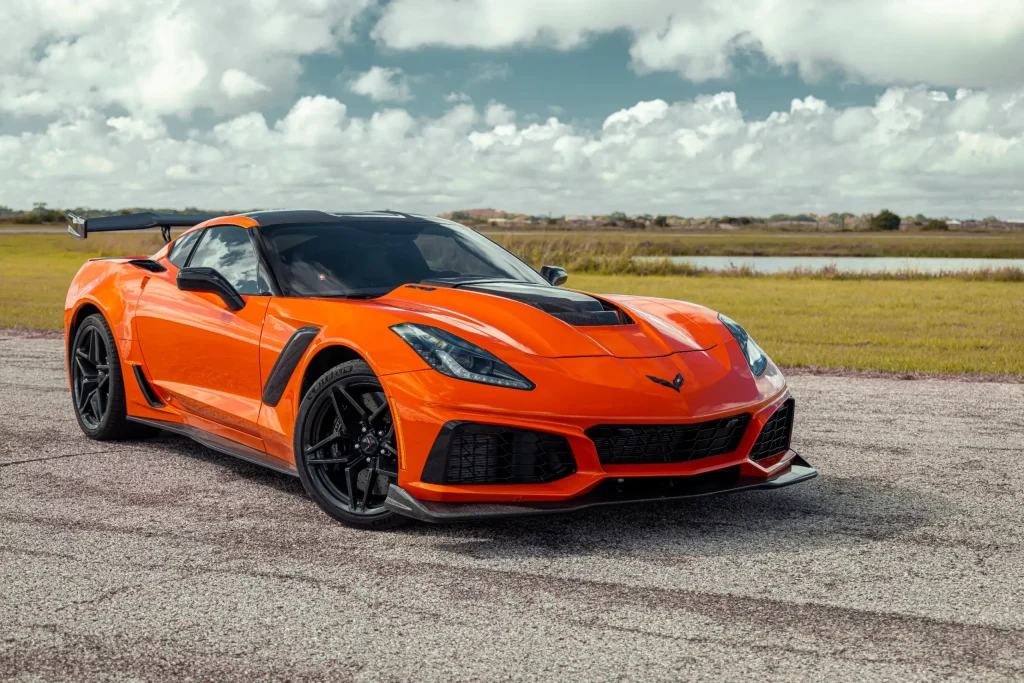
The Stingray offers an available performance data recorder, head-up display, wireless phone charging, multiple camera systems, and premium Bose audio. The 2LT adds features such as a 14-speaker Bose Performance Series sound system, an HD curb-view camera, and a rear cross-traffic alert.
The Corvette also has a driver-focused cockpit. Its controls are positioned around the driver rather than arranged like a conventional family car. That makes the cabin feel specialized.
The Mustang has arguably the most visually dramatic digital interface of the three. Its current-generation cabin uses a large digital instrument display and a 13.2-inch center touchscreen. Ford also provides wireless smartphone connectivity and multiple selectable drive modes.
The Dark Horse adds more performance-oriented equipment, including MagneRide damping and specialized chassis hardware. The Mustang also benefits from its broader model range.
A buyer can choose a basic EcoBoost, a GT, a GT Premium, or a Dark Horse, allowing the technology and equipment level to be matched to the budget.
The Supra has a more compact technology package, but Toyota still provides useful equipment. The 2026 model includes a Toyota Supra Connect with navigation, wireless Apple CarPlay compatibility, a digital display, and available JBL audio. The Premium model adds 14-way heated power-adjustable leather seats and a 12-speaker JBL system.
Toyota also provides performance technology such as launch control, an active differential, adaptive suspension, and Sport mode.
The Supra’s technology is therefore closely connected to the driving experience. But the Corvette’s available equipment is more comprehensive.
Its Performance Data Recorder can be particularly useful for drivers who want to improve their track performance. The system can record driving information, allowing enthusiasts to review how they drove a particular section of road or circuit.
The Corvette also offers a head-up display, reducing the need to look away from the road while driving quickly.
The Mustang’s technology is excellent for the price, and the Supra provides an appealing mix of performance and convenience.
But the Corvette combines digital technology with specialized performance equipment in a way that makes its systems feel purpose-built for the car.
For technology that supports both performance and everyday driving, the Corvette takes the category.
Winner: Chevrolet Corvette
Price, Value, and Long-Term Appeal
The Mustang gets its strongest advantage in the final category because it provides serious performance at a considerably lower entry price.
Current Ford listings show 2026 Mustang GT models around the $50,000 mark, while the 2026 Corvette Stingray starts at $70,000 and the GR Supra starts at $58,300.
That makes the Mustang GT roughly $20,000 less expensive than the base Corvette before options and about $8,000 less than the Supra. The price difference becomes even more important when horsepower is considered.
The Mustang GT produces up to 486 horsepower, meaning buyers can get almost Corvette-level output without spending Corvette money. The Dark Horse produces 500 horsepower and remains considerably cheaper than stepping into a higher Corvette variant.
The Supra has a strong value proposition of its own. Its $58,300 starting price provides a 382-horsepower turbocharged inline-six, an eight-speed automatic or six-speed manual, and a 3.9-second claimed 0-to-60 mph time.
For someone who wants a compact sports car rather than a muscle car, that package is difficult to dismiss.
The Corvette is the most expensive starting point, but its performance value is still remarkable. A $70,000 Stingray can reach 60 mph in 2.9 seconds and deliver 495 horsepower with the appropriate performance configuration.
That is performance that once required a much more expensive European sports car. But value is about more than performance per dollar.
The Mustang’s four-seat layout makes it useful as a daily car, and Ford offers both fastback and convertible versions. The massive Mustang aftermarket also gives owners countless options for modifications, wheels, suspension upgrades, and performance parts.
The Supra has strong enthusiast appeal because of its compact dimensions, rear-wheel-drive layout, and manual transmission.
The Corvette has perhaps the strongest long-term performance identity because the C8’s mid-engine architecture represents a major turning point in Corvette history.
Still, for the average buyer, the Mustang is easier to justify financially. It delivers V8 performance at a significantly lower price while retaining enough practicality for regular use.
The Supra is more specialized, and the Corvette is more expensive. For someone who wants maximum performance regardless of price, the Corvette remains the better machine.
For someone who wants the strongest balance between purchase price, performance, and everyday usability, the Mustang wins.
Winner: Ford Mustang
The Corvette, Mustang, and Supra are separated by philosophy more than horsepower. The Chevrolet Corvette is the most serious sports car. Its mid-engine layout, 6.2-liter V8, and 495 available horsepower allow it to deliver performance that reaches into exotic-car territory. Chevrolet quotes a 2.9-second 0-to-60-mph time for the Stingray.
The Ford Mustang is the most versatile performance car. Its 5.0-liter V8 produces up to 486 horsepower in GT form and 500 horsepower in Dark Horse specification, while the car remains available with four seats, a manual transmission, and convertible body styles.
The Toyota GR Supra is the compact sports-car specialist. Its 382-horsepower turbocharged inline-six, rear-wheel drive, short wheelbase, and available six-speed manual give it a distinctive driving character.
The six-category results are
| Category | Winner | The Edge |
|---|---|---|
| Performance and Engine Choices | Chevrolet Corvette | The mid-engine V8 delivers exceptional power with sports-car architecture. |
| Handling and Driving Dynamics | Chevrolet Corvette | A balanced mid-engine layout provides outstanding grip and cornering confidence. |
| Straight-Line Speed and Acceleration | Chevrolet Corvette | An available 2.9-second 0-to-60 performance puts it ahead of rivals. |
| Everyday Usability and Practicality | Ford Mustang | Four seats and fastback cargo space make it substantially more practical. |
| Technology and Features | Chevrolet Corvette | Performance-focused technology combines data, convenience, and advanced driver information. |
| Price, Value, and Long-Term Appeal | Ford Mustang | Lower pricing delivers serious V8 performance without Corvette-level financial commitment. |
