Some collector cars were never truly worthless, but there was a time when enthusiasts could buy certain classics for surprisingly little money. Fuel crises, unpopular styling, expensive maintenance, changing tastes, and doubts about a car’s pedigree all pushed once-desirable machines into bargain territory. Then collectors changed their minds.
The transformation has been remarkable. Cars that once sold for relatively modest prices on the used market can now fetch six-figure sums at auction.
This ranking focuses on documented examples where the market story is particularly dramatic, using historical pricing evidence and recorded auction sales rather than claiming that every example of a model followed the same trajectory.
10. Porsche 356 Speedster
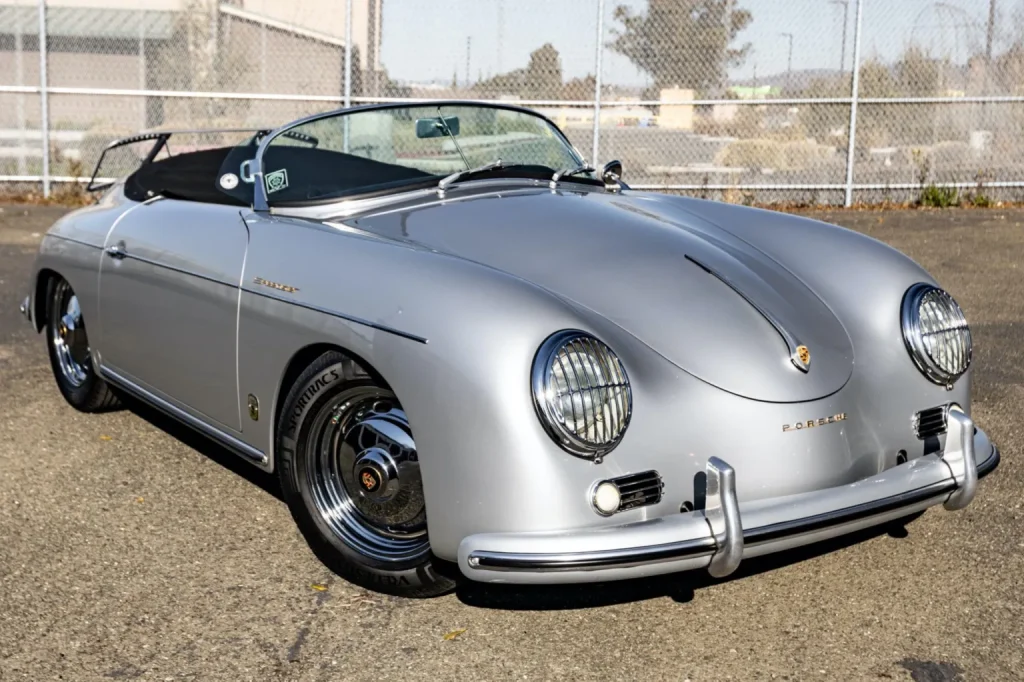
The Porsche 356 Speedster is one of the clearest examples of a car that started as an intentionally inexpensive performance machine and eventually became a six-figure collectible.
When Porsche introduced the Speedster for the American market in 1954, the idea was not to create a precious collector car. It was to make a lightweight, stripped-down Porsche that enthusiasts could actually afford.
Porsche’s own historical material states that the 356 1500 Speedster cost $2,995 in the United States. The car used a low windshield, minimal equipment, a simple folding top, and a two-seat cabin. Its lightweight construction also made it attractive to amateur racers. Porsche says the Speedster quickly became a hit, particularly in sunny U.S. states.
The transformation in value is remarkable. Mecum’s historical auction material similarly records the original $2,995 price, while noting that original Speedsters now regularly exceed $100,000.
Modern auction results show just how far the market has moved. Hagerty recorded a 1955 Porsche 356 Speedster selling for $395,500 at Broad Arrow’s Amelia Island auction in March 2024. Another 1955 example sold for $322,500 through Bring a Trailer in August 2025, while a separate 1955 Speedster brought $304,491 later that year.
That does not mean every 356 is worth hundreds of thousands. Condition, originality, provenance, body style, and mechanical specification matter enormously. Still, the contrast between a $2,995 new-car price and documented six-figure auction results tells the story beautifully.
The Speedster began as the affordable Porsche. It ended up becoming one of the company’s most coveted early collectibles.
9. Ferrari Dino 246 GT
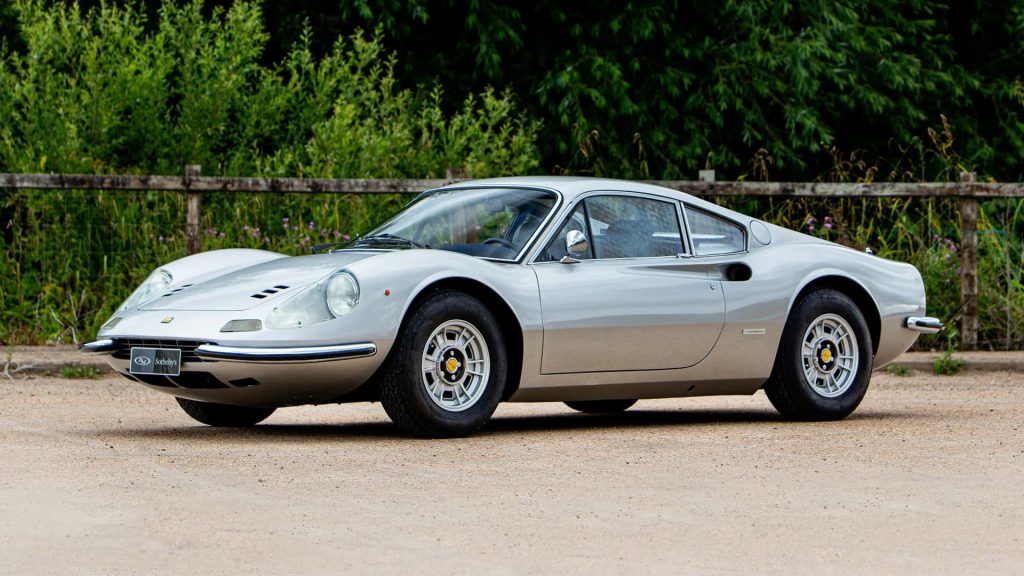
Few cars have experienced a turnaround as remarkable as the Ferrari Dino. Today, a well-kept 246 GT is recognized as a highly desirable collector car, but its reputation was very different in the past. The Dino faced an unusual identity issue for years. It had Ferrari styling, Ferrari engineering, and Ferrari origins, but its badge initially carried a different name.
The 246 GT used a 2.4-liter V6 and was produced from 1969 through 1974. Hagerty notes that the Dino was built in relatively significant numbers for a Ferrari, with 3,569 examples produced across the 246 GT and GTS.
That volume, combined with the car’s lower status within the Ferrari hierarchy, contributed to its comparatively modest reputation for years.
The market eventually changed dramatically. MotorTrend notes that the 1970s fuel crisis pushed exotic-car values down and that many Dinos spent years languishing on used-car lots at relatively low prices. The article describes the model’s eventual transformation into a six-figure collectible.
Historical prices make the Dino’s transformation even more remarkable. One contemporary account recalls a Dino being advertised for about $8,000 in the early 1980s. By the end of the decade, good examples were reportedly selling for around $160,000.
The modern auction market confirms that the transformation was not temporary. Hagerty reports a 1973 Ferrari Dino 246 GTS selling for approximately $218,948 equivalent at RM Sotheby’s Paris sale. A 1968 Ferrari 206 Dino GT, an even rarer predecessor, reached an astonishing $868,500 at RM Sotheby’s Amelia Island.
The Dino’s rise demonstrates how quickly collector opinion can change when rarity, design and historical significance overcome an old reputation.
8. Porsche 911 Carrera RS 2.7
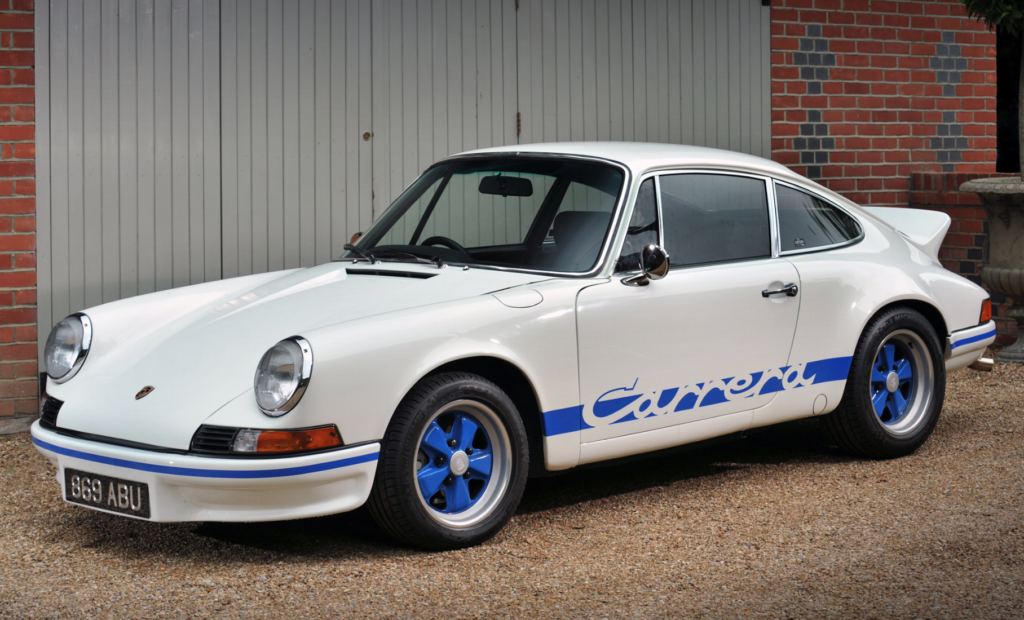
The Porsche 911 Carrera RS 2.7 is one of those cars whose reputation changed dramatically as collectors began appreciating what Porsche had actually created. When it arrived for the 1973 model year, it was essentially a homologation special built to satisfy motorsport regulations, not a future multimillion-dollar investment.
Porsche produced the RS specifically so the 911 could compete in racing, and its lightweight construction, distinctive ducktail spoiler, and high-output flat-six eventually made it one of the most recognizable 911s ever built.
The car used a 2.7-liter mechanically fuel-injected flat-six producing 210 horsepower. Porsche developed the RS around weight reduction, with the lightweight version weighing roughly 2,150 pounds. Its combination of low mass and 210 horsepower gave it a level of performance that was exceptional for its era.
What makes the financial transformation remarkable is the enormous gap between ordinary 911 values and genuine RS examples. Hagerty’s auction database records a 1973 Carrera RS 2.7 selling for $485,635 at Bonhams in February 2024.
An even more spectacular example, chassis 9113600508, sold for $1,985,000 at Gooding & Company during the 2024 Amelia Island auctions.
That second result is particularly revealing because ordinary 1973 911s can still trade for far less. Hagerty’s database shows numerous standard 911 sales in the tens of thousands of dollars, demonstrating just how much the RS name, specification, originality and history can change the equation.
The RS therefore represents more than an old Porsche becoming expensive. It demonstrates how a homologation car once valued primarily for its racing purpose can become a blue-chip collector asset decades later.
7. Lamborghini Miura
The Lamborghini Miura helped invent the modern supercar, yet its status as a multimillion-dollar collectible developed much later than its reputation as a spectacular 1960s exotic. When the Miura was new, it was certainly expensive, but collectors did not immediately treat surviving examples as untouchable pieces of automotive history.
The car’s mechanical layout was revolutionary. Lamborghini placed a 3.9-liter V12 transversely behind the passenger compartment, creating a mid-engine configuration that would become a defining feature of future supercars. Early Miuras produced around 350 horsepower, while later SV versions gained further performance and chassis improvements.
The model’s long-term market transformation is extraordinary. Hagerty reported that 15 years ago many Miuras were still trading in the mid-six-figure range, but the median #2 condition value had subsequently increased by 687 percent. The company described the Miura as having evolved into a blue-chip collector car capable of reaching millions of dollars.
Recent auction results demonstrate how far the market has traveled. A 1968 Miura sold for $1.325 million at RM Sotheby’s Los Angeles auction in October 2024, while another 1968 P400 reached $2.315 million at Gooding & Company in Pebble Beach in August 2024.
The most impressive result involved a 1972 Miura P400 SV, which sold for about $5 million in 2024 and set a model record at the time. Hagerty reported that the sale price was significantly higher than its valuation for a #1-condition example.
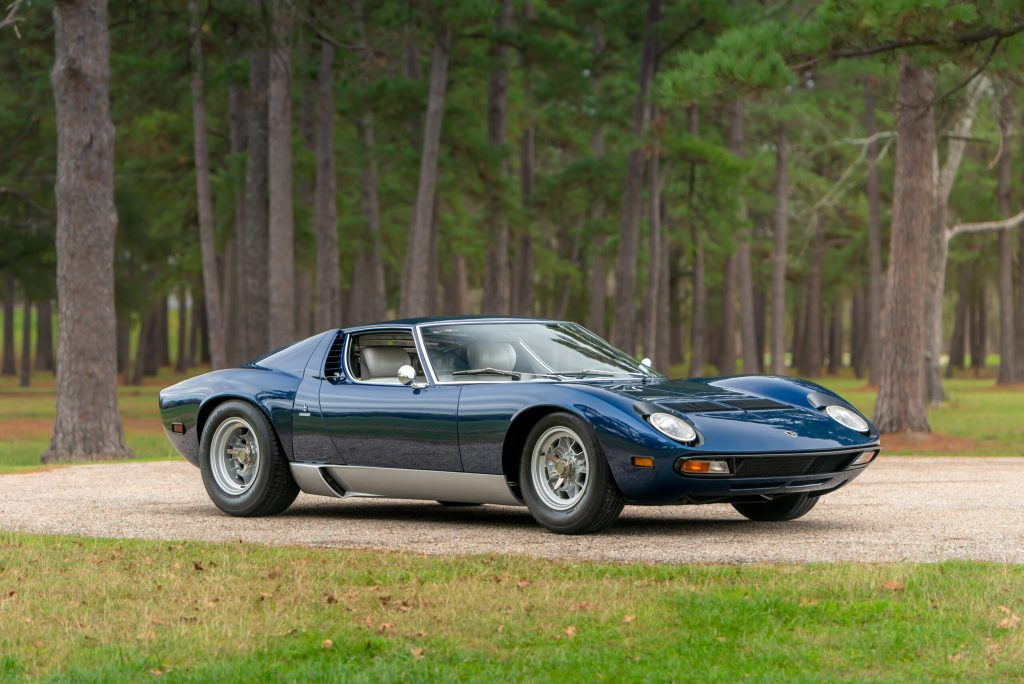
The key lesson is that not every Miura followed this trajectory equally. Condition, originality, specification, provenance, and the highly desirable SV version can make enormous differences. Still, the model’s transformation from an old exotic into a multimillion-dollar collector centerpiece is undeniable.
The Miura’s greatest advantage was that history eventually caught up with it. Collectors stopped seeing it merely as an old Lamborghini and started recognizing it as one of the cars that fundamentally changed the sports-car industry.
6. Mercedes-Benz 300SL Gullwing
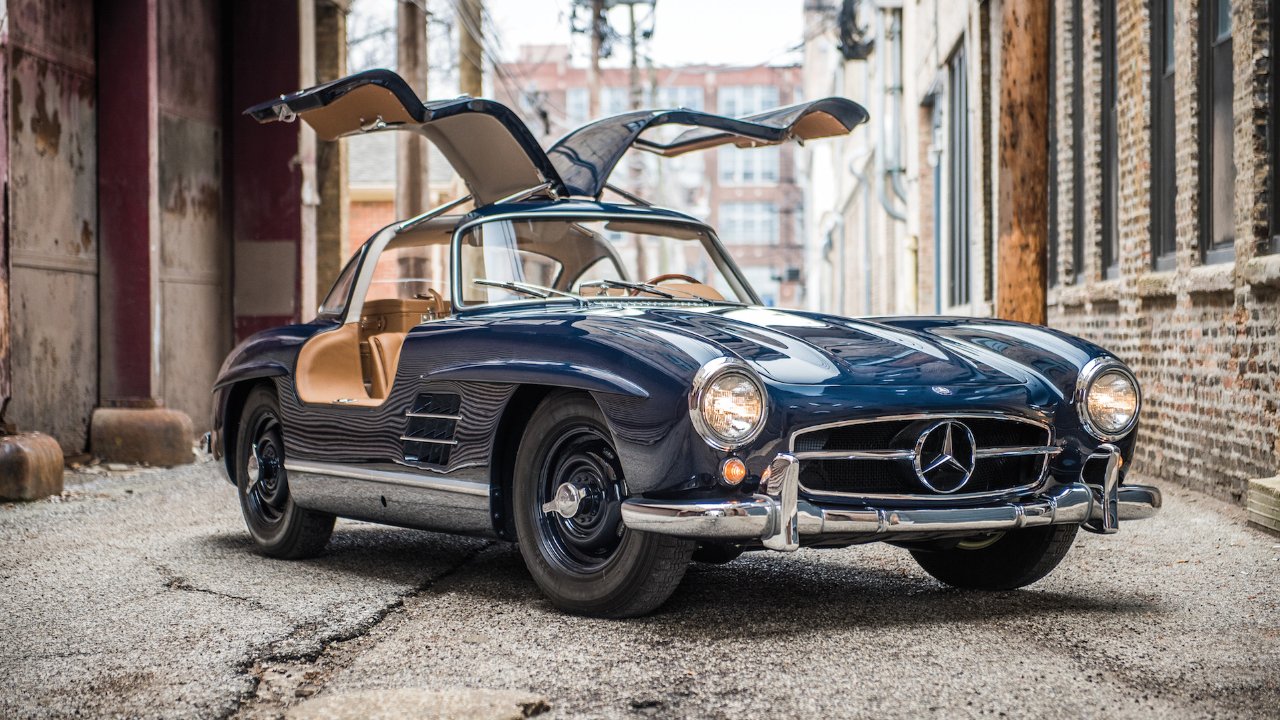
The Mercedes-Benz 300SL Gullwing is a perfect example of a car whose significance became much clearer with time. When the road-going 300SL arrived in the 1950s, it was already an expensive and technically advanced sports car, so it was never literally a worthless used car.
Yet decades later, examples that once could be purchased for comparatively modest collector prices became million-dollar automobiles.
The 300SL was derived from Mercedes-Benz’s successful racing car and brought several unusual technologies to the road. Its tubular space frame forced engineers to use the famous upward-opening doors, while the 3.0-liter inline-six used Bosch mechanical fuel injection. Hagerty lists the engine at 240 horsepower for the 1955 model.
The market transformation is easier to see through actual transactions. Hagerty records a 1955 Gullwing selling for $134,500 in 1996. By 2019, another 1955 example had reached $1.21 million at Russo and Steele in Monterey.
The market has climbed further. A 1956 300SL sold for $1,572,500 at Gooding & Company during Pebble Beach in August 2025, while a 1954 example brought $1,462,500 at Broad Arrow’s Amelia Island auction in March 2026.
Not every Gullwing reaches seven figures. Condition, originality, mileage, documentation, color combination, and desirable equipment can create enormous differences. Hagerty’s valuation data also shows that exceptionally rare versions can command dramatically higher figures.
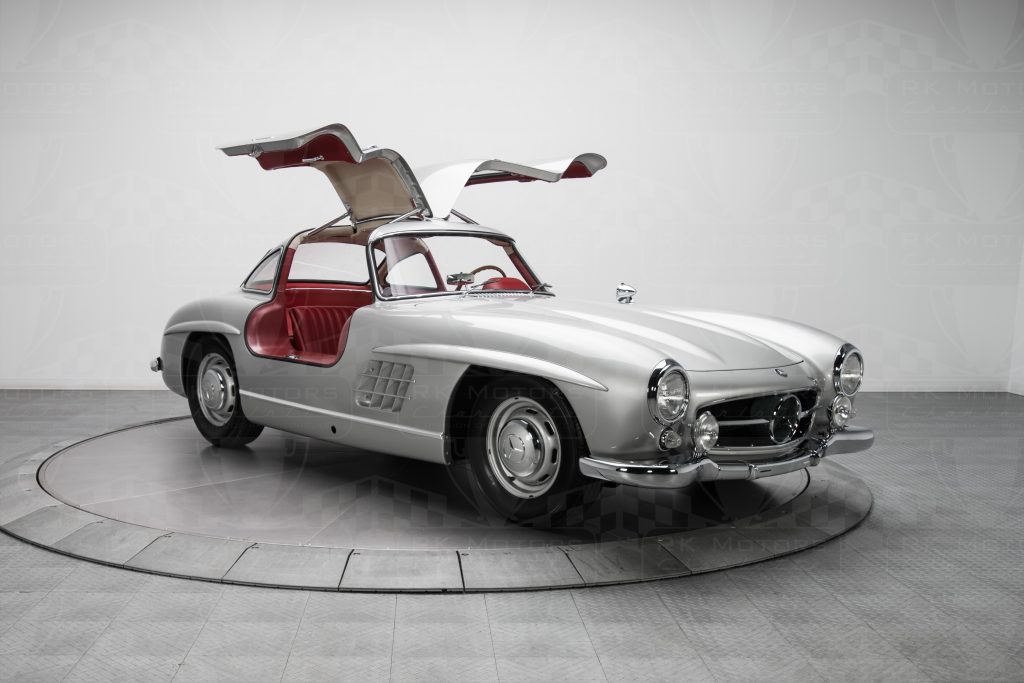
What makes the 300SL fascinating is that its value did not come from rarity alone. Collectors gradually recognized the importance of its racing-derived construction, iconic doors, and place in postwar automotive history.
A car that once represented cutting-edge engineering eventually became one of the defining blue-chip collectibles of the classic-car world.
5. Shelby Cobra 427
The Shelby Cobra 427 made an extraordinary leap from high-performance sports car to coveted collector piece. Carroll Shelby’s concept was remarkably straightforward. He paired a lightweight British roadster chassis with a powerful American V8 engine.
The result was a car that was extraordinarily fast for its time, but its production numbers were tiny enough to eventually make genuine Cobras extremely desirable.
The 427 version used Ford’s massive 7.0-liter 427-cubic-inch V8. Hagerty lists the standard 1965 Cobra 427 at 425 horsepower, while 427 S/C examples are listed at 485 horsepower. Competition versions could be rated even higher.
The modern market demonstrates just how valuable original examples can become. Hagerty’s current valuation data places a concours-condition 1965 Cobra 427 in the multimillion-dollar range, while genuine competition cars can command even more.
There is an important caveat when discussing Cobra values. Not every car carrying Cobra styling is an original Shelby-built Cobra. Continuation cars and replicas exist in substantial numbers, and their prices can be dramatically lower. Auction buyers therefore pay enormous attention to chassis numbers, documentation, provenance, and authenticity.
Recent auction results demonstrate the difference. Genuine competition-specification cars can sell for extraordinary sums, while later continuation Cobras may trade for six figures rather than millions. Hagerty’s database records several 2026 Cobra transactions, including continuation examples selling between roughly $110,000 and $247,500.
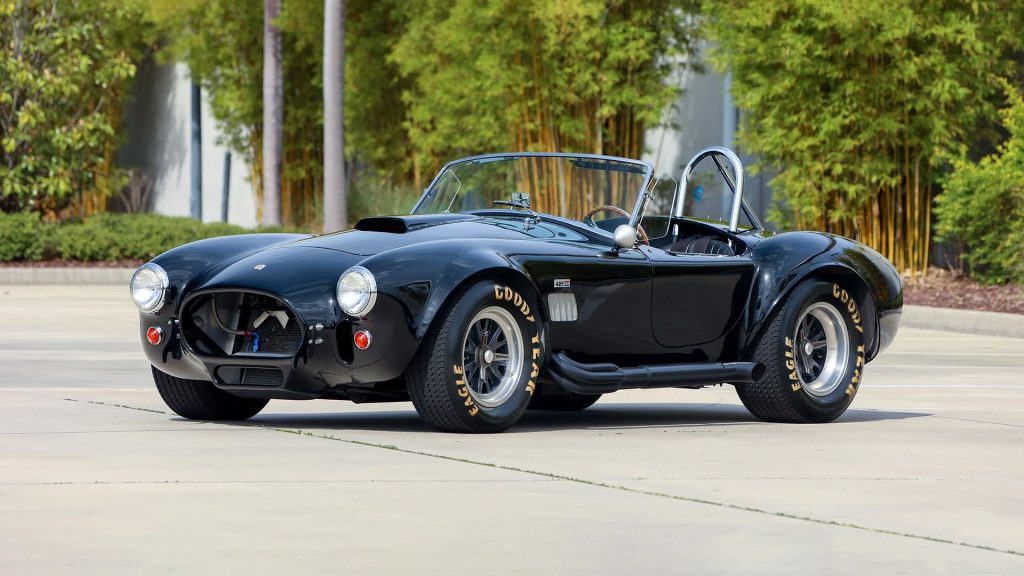
The Cobra’s transformation therefore rests on scarcity and authenticity as much as performance. Its compact body, enormous V8, and racing history created a combination that could not easily be reproduced by ordinary muscle cars.
For collectors, the Cobra became something much more valuable than an old sports car. It became a piece of Carroll Shelby’s racing legacy, and the market now treats the best original examples accordingly.
4. Jaguar E-Type Series 1
The Jaguar E-Type is one of the strongest examples of a car that spent years being treated like an ordinary used sports car before collectors fully recognized its importance.
When the E-Type debuted in 1961, Jaguar priced the roadster at about $5,900 in Britain. Hagerty estimates that the original price would be equivalent to roughly $66,000 today after inflation. While the E-Type was expensive when new, its journey in the collector market became far more remarkable.
The car suffered steep depreciation in its early years. By 1967, Hagerty had found an E-Type advertised for roughly $2,000, or about one-third of its original price. During the 1970s, the model was largely viewed as an older used car rather than a prized collectible. That perception began to shift as interest in classic cars grew during the 1980s.
Values then climbed sharply. Hagerty’s valuation for an excellent Series 1 roadster reached about $112,000 in 2012. By 2014, it had more than doubled to approximately $240,000. The same category reached around $295,000 by 2016 before the market later declined.
The American market produced some particularly impressive results. Hagerty reported that by 2022, several Series 1 E-Types had sold for more than $300,000 on Bring a Trailer, with four examples crossing that threshold during the year.
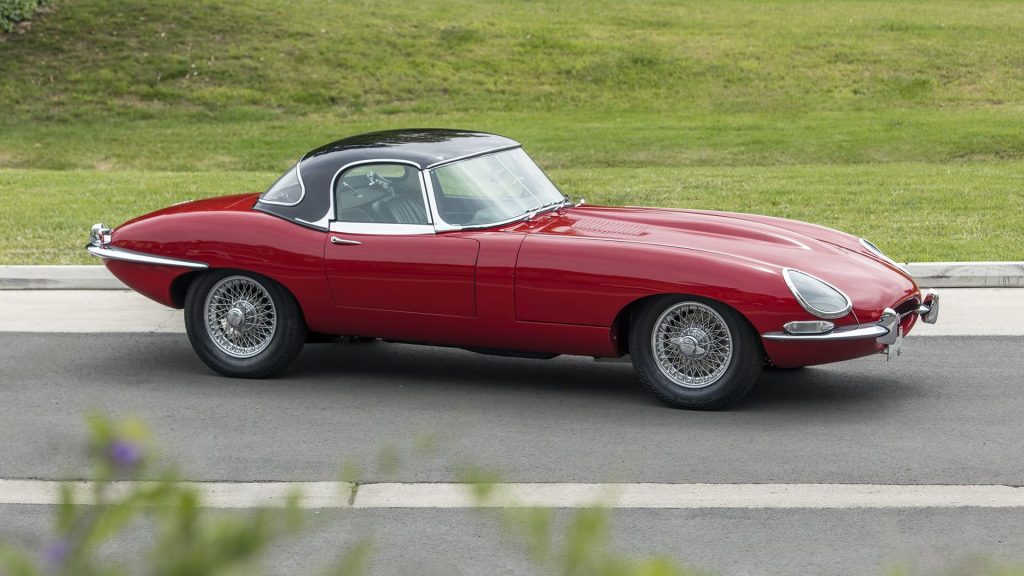
Recent auction records prove that six-figure demand remains strong for desirable examples. Hagerty Marketplace recorded a 1961 E-Type Series I 3.8 coupe selling for $142,798 in February 2026, while a 1967 Series I roadster was bid to $83,000.
The E-Type’s transformation was therefore not a simple story of steady appreciation. It fell hard, spent years undervalued, surged during the classic-car boom, and later experienced market corrections.
Yet its combination of design, engineering, and historical importance ultimately pushed the best examples firmly into six-figure territory.
3. Ferrari 250 GT SWB
The Ferrari 250 GT SWB represents one of the most extreme transformations on this list. Unlike some classics that merely climbed from modest used-car prices into six figures, the finest examples of the short-wheelbase 250 GT have progressed into the multimillion-dollar category.
The 250 GT SWB was produced from 1959 through 1961 and is considered one of Ferrari’s defining competition-derived road cars. Its compact dimensions, lightweight construction and Colombo-designed V12 gave it extraordinary performance for its era.
Hagerty’s auction records show just how high the market can go. A 1961 Ferrari 250 GT SWB California Spider with chassis number 2277GT sold for $7.55 million at Gooding & Company in Pebble Beach in August 2025. The same Hagerty record lists earlier comparable 250 GT transactions exceeding $5 million and even $11 million.
The California Spider is particularly valuable because of its rarity and desirability, so its price should not be used as a normal valuation for every 250 GT SWB. Condition, body style, competition history, originality, provenance and chassis identity can produce enormous differences.
That distinction is crucial when discussing cars that became valuable after being overlooked. A rare Ferrari could become expensive for reasons that have little to do with its original retail price. As collectors began placing greater importance on Ferrari’s racing heritage and limited production, cars associated with the 250 family became increasingly sought after.
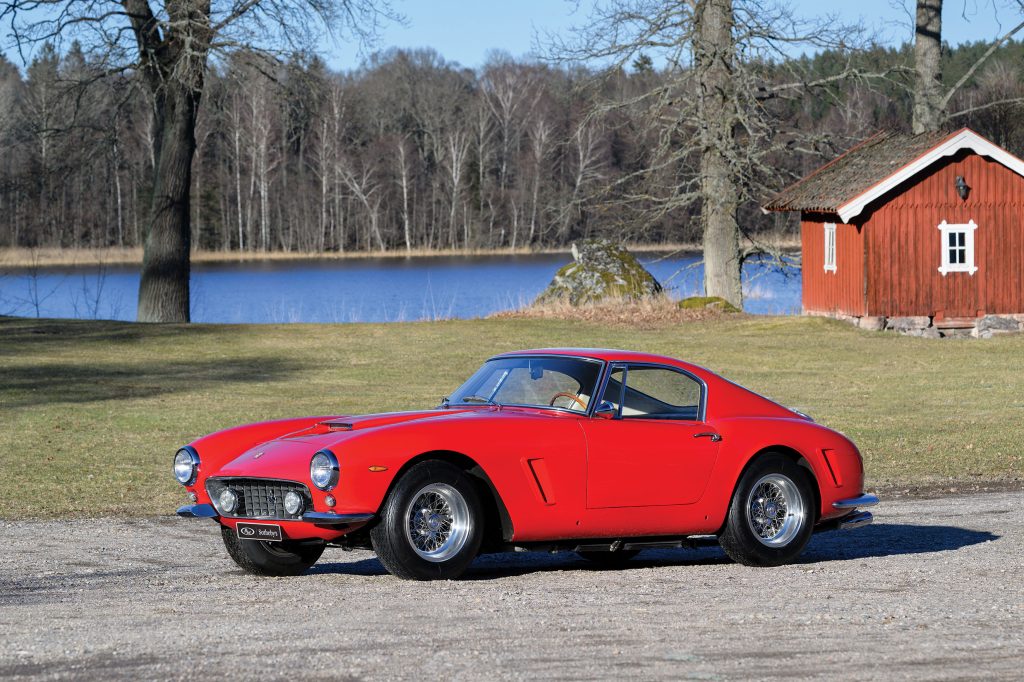
The 250 GT SWB’s significance goes beyond its auction price. Its engineering represents a period when Ferrari could produce a road-going machine that was closely related to the company’s competition philosophy. The short wheelbase improved agility, while the V12 provided the performance that made the car competitive on both road and track.
Today, a genuine example with the right history can be worth several million dollars. That makes the 250 GT SWB one of the clearest demonstrations of how collector demand can completely redefine the financial meaning of an old automobile.
2. Ferrari 250 GTO
Few cars demonstrate the transformation from used machinery to elite collector asset more dramatically than the Ferrari 250 GTO. Today, the model is associated with eight-figure and even higher private-sale valuations. Yet its legendary status was not guaranteed when these cars were simply older racing machines with relatively little mainstream collector demand.
Only 36 Ferrari 250 GTOs were built, giving the model extraordinary scarcity from the beginning. RM Sotheby’s describes the GTO as the final evolution of Ferrari’s 250 series and highlights its exceptional competition record, including championship victories and Targa Florio class wins.
The really fascinating part is what happened after the cars stopped being competitive. In the late 1960s and early 1970s, the 250 GTO could be treated as an old race car rather than an untouchable historical artifact.
Contemporary market history shows that examples changed hands for only four-figure dollar amounts during that era, a staggering contrast with today’s valuations.
The market eventually recognized the combination of rarity, racing history, Ferrari provenance and beautiful engineering. By 2000, the particular chassis 3413 GT that later became famous at RM Sotheby’s had reportedly been purchased by Microsoft executive Greg Whitten for $7 million.
Then came the extraordinary auction result. RM Sotheby’s sold that same 1962 Ferrari 250 GTO, chassis 3413 GT, for $48,405,000 in 2018, including buyer’s premium. It became the most expensive car ever sold at a public auction at that time.
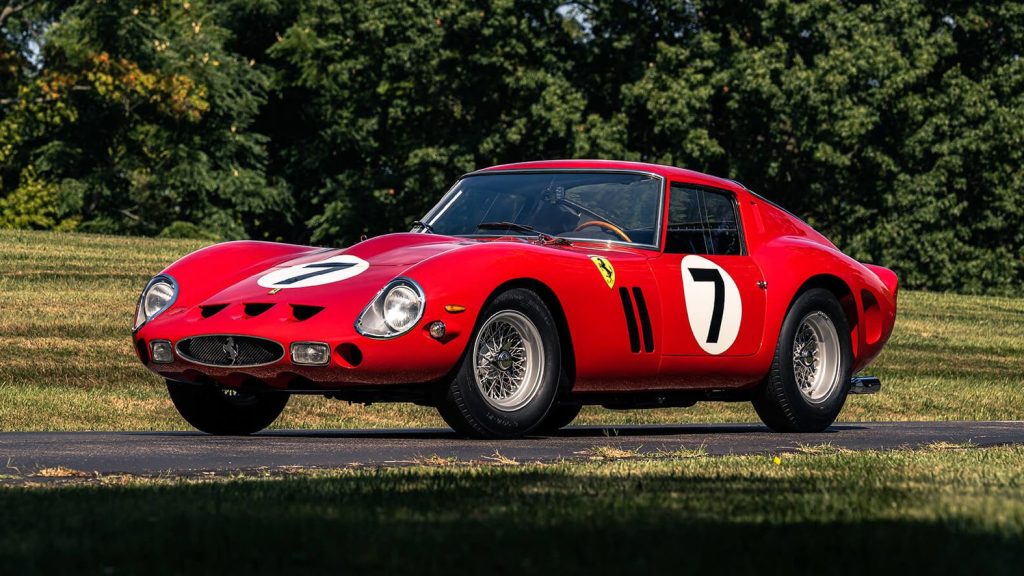
Private transactions have gone even higher. A 1963 250 GTO was reportedly sold privately for $70 million in 2018, although private-sale figures are not directly comparable with public auction results because they are not independently disclosed in the same way.
The GTO therefore represents the ultimate collector-car transformation. A machine once viewed as aging racing hardware became one of the most valuable automobiles ever created.
1. Shelby Cobra Daytona Coupe
The Shelby Cobra Daytona Coupe takes the top spot thanks to its remarkable transformation from a purpose-built race car into a multimillion-dollar piece of American automotive history. Unlike traditional production sports cars, the Daytona Coupe was designed for a single goal. It was built to challenge Ferrari in international GT racing.
Only six Daytona Coupes were completed by Shelby American, making genuine examples extraordinarily rare. The aerodynamic body was designed by Peter Brock, while Ken Miles played an important role in development.
The car’s competition history cemented its reputation, including its contribution to Shelby American winning the 1965 FIA World Sportscar Championship.
For decades, however, the Daytona Coupe was primarily viewed through the lens of racing history rather than as an ultra-expensive collector object. The market eventually changed as collectors began placing greater value on documented competition history, originality and links to Carroll Shelby himself.
The transformation reached a spectacular point in 2026, when CSX2300 sold for $42,905,000 at Gooding Christie’s during Monterey Car Week, becoming the most expensive American automobile ever sold at auction.
The car’s provenance was exceptional. CSX2300 was the only Daytona Coupe personally owned by Carroll Shelby, who reacquired it in 1975 and retained it until 1998. It also had a documented racing career after its original competition period, including racing in Japan and continued road use.
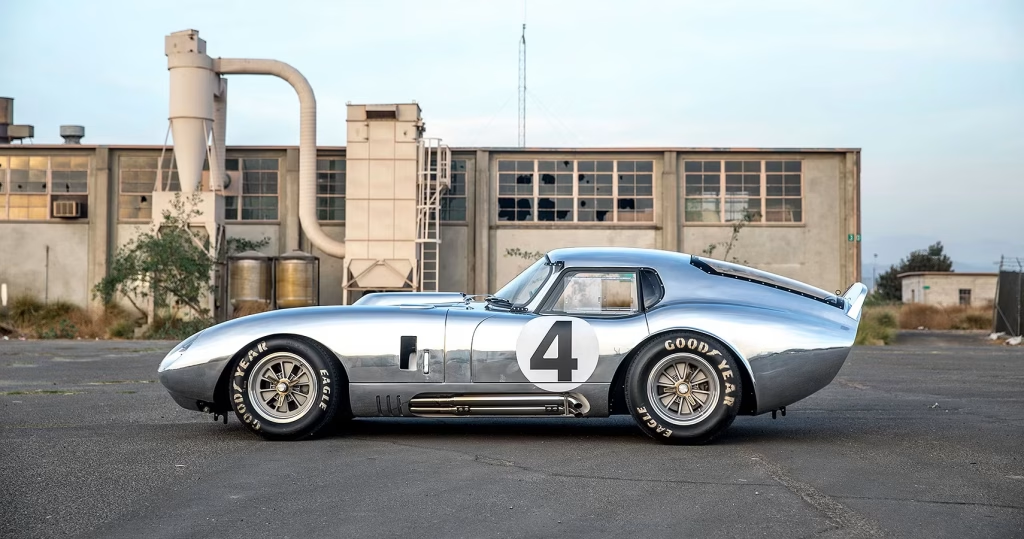
The result is particularly impressive when compared with the model’s previous auction record. Another Daytona Coupe had sold for $7.685 million in 2009, meaning the 2026 result represented an enormous increase in just 17 years.
That does not mean every Cobra Daytona is worth $42.9 million. With only seven examples generally recognized in the historical record and substantial differences in provenance, racing history and ownership, each chassis has its own market story.
Still, CSX2300 demonstrates how a relatively obscure racing special can eventually become an irreplaceable piece of American automotive history.