
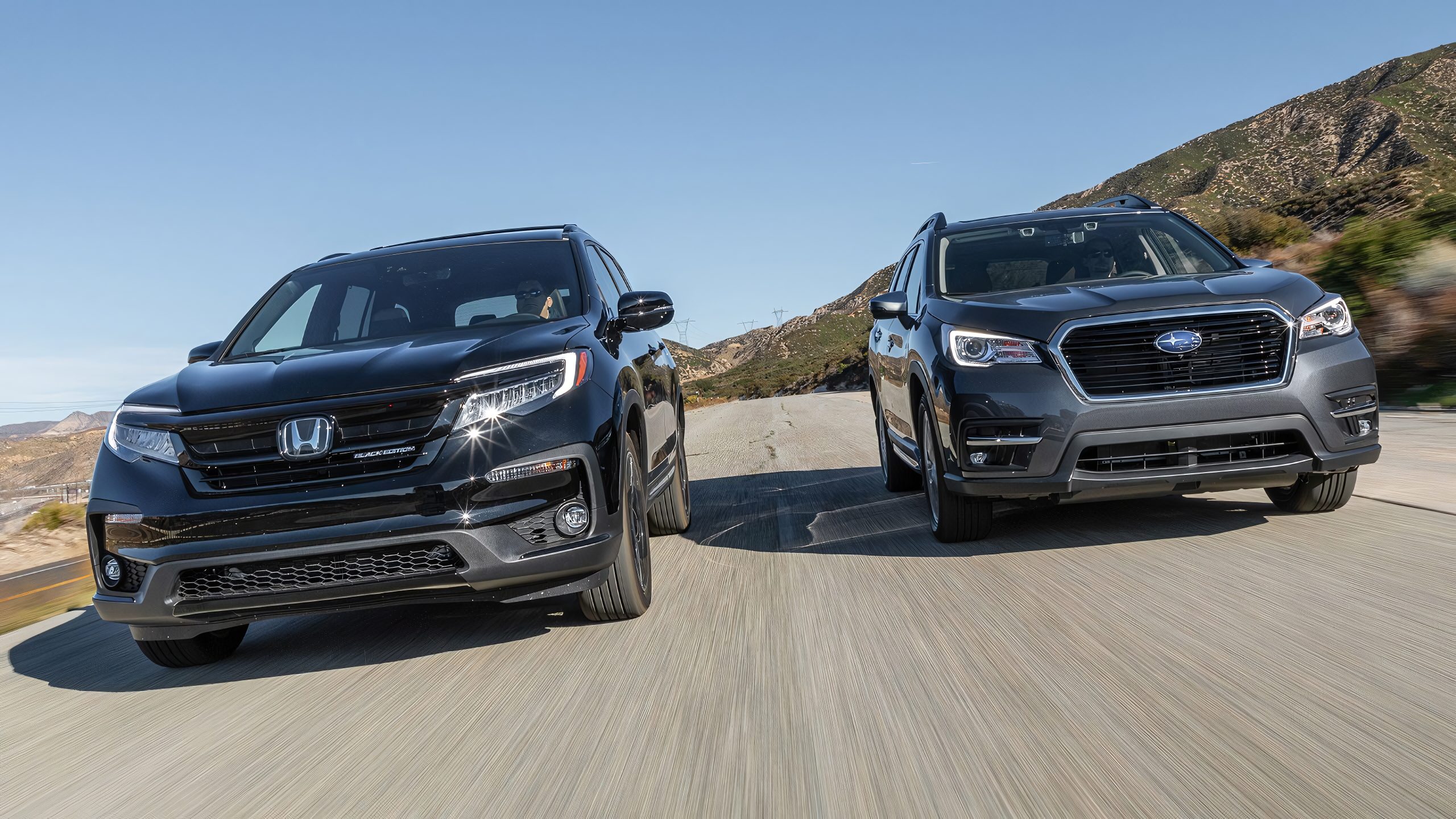
The Hyundai Santa Fe, Honda Pilot, and Subaru Ascent all offer three rows, but they are designed around different priorities. The Santa Fe combines a turbocharged engine, a modern cabin, strong fuel economy, and an attractive starting price.
The Pilot puts greater emphasis on passenger room, V6 power, towing, and family practicality. The Ascent counters with standard all-wheel drive, a turbocharged engine, strong ground clearance, and confident all-weather capability.
That makes this comparison more complicated than simply asking which SUV has the most horsepower or the lowest price. A family that spends most of its time commuting may value the Santa Fe’s efficiency, while someone regularly carrying seven or eight people may prefer the Pilot.
Drivers who frequently encounter snow or poor roads may find the Ascent’s standard AWD more important than either rival’s other advantages.
To separate them properly, this comparison examines six important areas: power and performance, fuel economy, passenger and cargo space, towing and capability, interior technology and safety, and pricing and value. Each section has a clear winner, followed by a final table that shows where each SUV has the edge.
Power and Performance
The Honda Pilot takes the first category with the strongest horsepower figure and a powertrain designed for carrying a full load of passengers without feeling strained.
Every 2026 Pilot uses a 3.5-liter naturally aspirated V6 producing 285 horsepower and 262 lb-ft of torque. It is paired with a 10-speed automatic transmission. All-wheel drive is available, and Honda offers several drive modes depending on configuration, including Sport, Snow, Tow, Trail, and Sand.
The Hyundai Santa Fe uses a completely different formula. Its 2.5-liter turbocharged four-cylinder produces 277 horsepower and 311 lb-ft of torque. It comes with an eight-speed automatic transmission, while HTRAC all-wheel drive is available.
The Santa Fe actually has more torque than the Pilot, which gives it a strong response during normal driving. Turbocharged torque arrives relatively low in the rev range, making the Hyundai feel energetic when accelerating from a stop or passing slower traffic.
The naturally aspirated V6 Pilot has a different character. It builds power progressively and provides 285 horsepower, the highest figure among these three SUVs. The 10-speed automatic also gives the Honda a broad range of gearing for highway cruising and acceleration.
The Subaru Ascent uses a 2.4-liter turbocharged BOXER four-cylinder producing 260 horsepower and 277 lb-ft of torque. Subaru pairs it with a continuously variable transmission and makes Symmetrical All-Wheel Drive standard.
The Ascent’s turbo engine provides respectable torque, but its 260 horsepower puts it behind both competitors. Its strength is less about outright acceleration and more about delivering predictable performance while maintaining traction in difficult weather.
For everyday driving, the Santa Fe may actually feel more responsive than its horsepower figure suggests. Its 311 lb-ft of torque gives it a substantial low-end advantage over the Pilot. However, when the SUV is filled with passengers and luggage, the Pilot’s V6 provides a strong and consistent power reserve.
The Pilot also has a major advantage for buyers who want a conventional automatic transmission. Its 10-speed unit gives the SUV a more familiar response under hard acceleration than the Ascent’s CVT.
The Ascent remains attractive for drivers who live in regions where snow, rain, and slippery roads are common. Standard AWD means traction is available without moving to a higher trim or paying for an optional drivetrain.
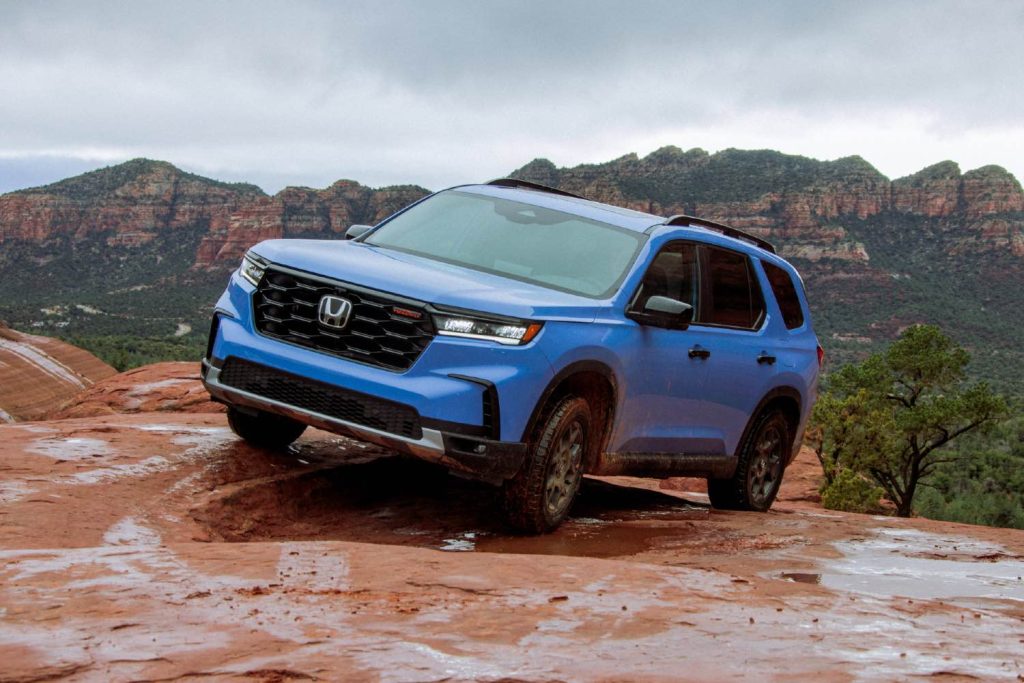
Still, this category is about power and performance rather than traction alone. The Pilot has the highest horsepower, a conventional 10-speed automatic, and several drive modes designed for different conditions.
The Santa Fe comes close because its turbocharged engine produces more torque, while the Ascent has useful turbocharged response and standard AWD. But the Pilot offers the strongest complete performance package.
Winner: Honda Pilot
Fuel Economy
The Santa Fe answers the Pilot’s performance advantage with a significant lead in fuel economy.
The 2026 Santa Fe with front-wheel drive is rated at 20 mpg city, 29 mpg highway, and 24 mpg combined. With HTRAC AWD, the figures are 20 city, 28 highway, and 23 combined. The XRT AWD is rated at 19 city, 25 highway, and 21 combined.
The Honda Pilot’s most efficient configuration reaches 19 city and 27 highway mpg. Honda’s official rating is 19/27 mpg for city/highway driving, while the TrailSport is rated at 18/23 mpg.
The Subaru Ascent reaches up to 19 city and 26 highway mpg. Higher trims are generally rated at 19 city and 25 highway mpg.
The difference may appear small, but it matters when these SUVs are used as primary family vehicles. Daily commuting, school runs, shopping trips, weekend travel, and vacations can put thousands of additional miles on the odometer each year.
The Santa Fe’s 29-mpg maximum highway rating gives it the strongest long-distance efficiency of the three. Its 24-mpg combined rating also leads the gasoline versions of the Pilot and Ascent.
The Hyundai has another advantage for efficiency-focused buyers because front-wheel drive is available. Buyers who do not need AWD can avoid the additional mechanical hardware and select the most economical configuration.
The Pilot’s V6 provides stronger horsepower but requires more fuel. That is a reasonable trade-off for buyers who regularly carry heavy loads or tow trailers, but it makes the Honda less attractive for someone whose main concern is operating cost.
The Ascent faces a different compromise. Subaru makes AWD standard on every Ascent, which is excellent for traction but does not help fuel economy. The vehicle is still reasonably efficient for a three-row SUV with standard AWD, but it cannot match the Santa Fe.
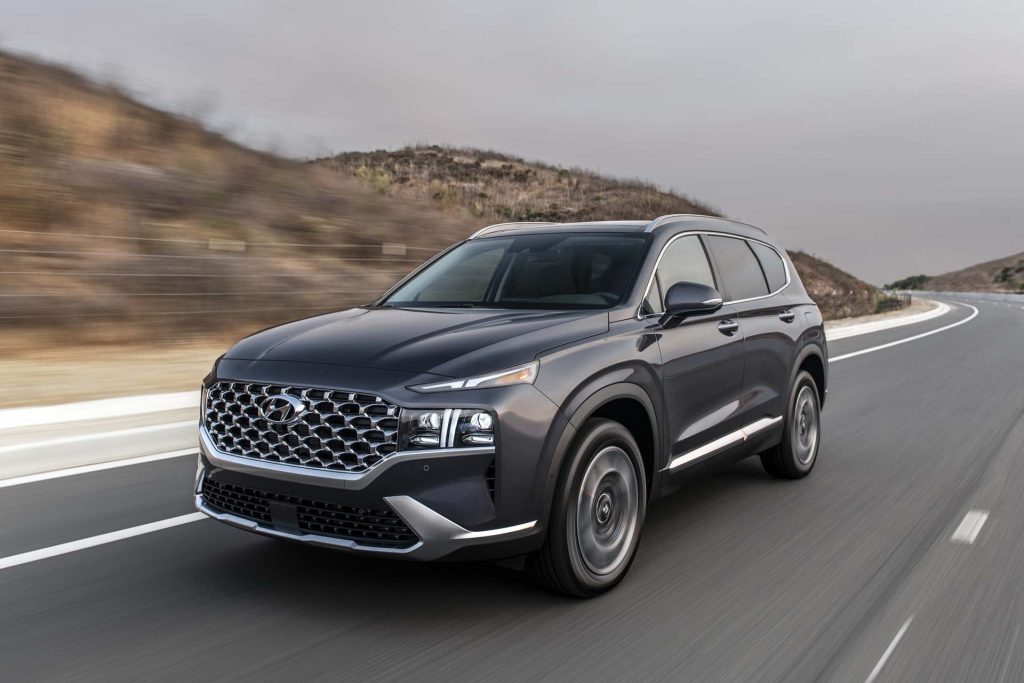
There is also a second Santa Fe powertrain worth mentioning. Hyundai offers a hybrid Santa Fe with significantly higher EPA fuel-economy ratings, including up to 36 mpg combined in front-wheel-drive form. That gives the Santa Fe lineup an efficiency option neither the Pilot nor Ascent currently matches in this comparison.
For buyers who cover substantial mileage, the Santa Fe therefore has the strongest fuel-economy story. The Pilot is more powerful, and the Ascent provides standard AWD, but the Hyundai requires fewer compromises at the fuel pump.
Winner: Hyundai Santa Fe
Passenger and Cargo Space
A three-row SUV should be useful with all three rows occupied, not just when the rear seats are folded. That is where the Pilot has a meaningful advantage.
Honda designed the Pilot around family transportation, and its third row is more usable for adults and older children than the rear seats in many midsize three-row SUVs.
The Pilot also provides flexible seating arrangements. Depending on trim, the second-row center seat can be stowed, allowing owners to switch between a bench-style arrangement and easier access to the third row. Honda offers seating for up to eight passengers on applicable versions.
The Santa Fe has a different advantage. Its upright body and squared-off rear section create a surprisingly useful cargo area. The design gives the Hyundai a more spacious feel than its exterior dimensions might suggest.
Hyundai lists 40.5 cubic feet of cargo space behind the second row and 79.6 cubic feet with the rear seating folded. Behind the third row, the Santa Fe provides 14.6 cubic feet.
Those figures make the Santa Fe practical for families that use the third row occasionally. Grocery runs, sports equipment, luggage, and everyday cargo can all be accommodated without requiring the third row to remain folded permanently.
The Ascent also offers flexible seven- and eight-passenger configurations. Subaru lists 17.8 cubic feet of cargo volume behind the third row and up to 75.6 cubic feet with the rear seatbacks folded.
The Ascent, therefore, provides a useful amount of cargo room, but its maximum cargo volume remains below the Pilot’s.
The pilot’s biggest advantage is passenger usability. Families frequently carrying adults in the third row will appreciate the additional room. It is also easier to use when multiple passengers need access to the rear seats.
The Santa Fe’s third row is more suitable for children or shorter passengers, especially on longer journeys. That does not make it a poor three-row SUV, but it changes how buyers should think about it.
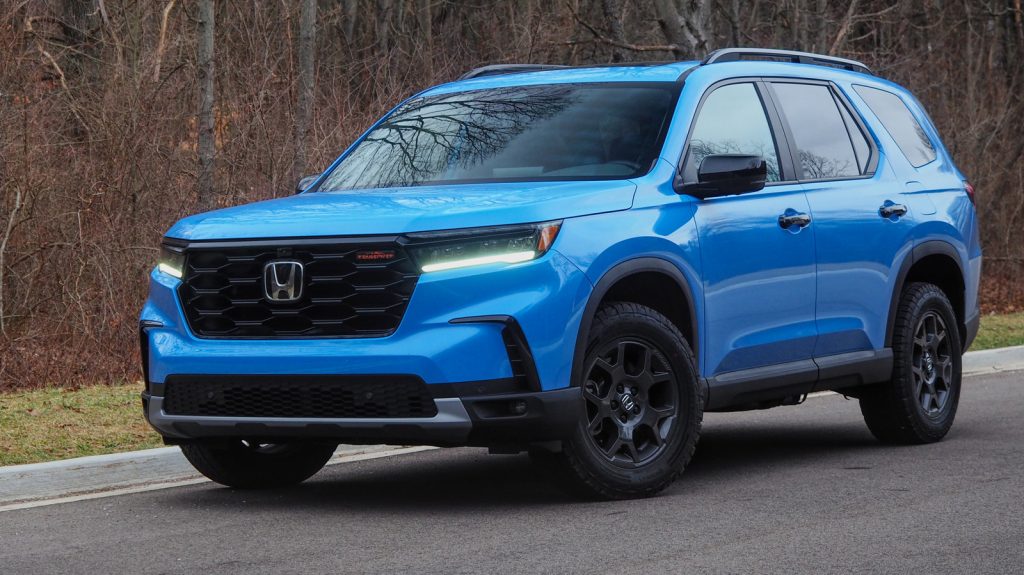
For a couple with children who only occasionally need the third row, the Santa Fe can be plenty practical. But for a large family that regularly fills every seat, the Pilot’s larger passenger compartment makes more sense.
The Ascent sits between them. Its standard AWD and available eight-passenger layout are useful, and its cargo space is competitive. But it does not provide the same combination of passenger room and maximum cargo capacity as the Honda.
Winner: Honda Pilot
Towing and Capability
The Pilot and Ascent are closely matched when it comes to towing, while the Santa Fe trails them.
With the appropriate all-wheel-drive configuration, the 2026 Pilot can tow up to 5,000 pounds. Honda also provides a Tow mode and available i-VTM4 AWD with torque-management features.
The Subaru Ascent also reaches 5,000 pounds of maximum towing capacity. Its 2.4-liter turbocharged engine produces 277 lb-ft of torque, while standard Symmetrical All-Wheel Drive gives every Ascent strong traction.
The Santa Fe is less capable in this area. Standard versions are rated at 3,500 pounds with trailer brakes, while the XRT AWD increases the rating to 4,500 pounds.
For many owners, 3,500 pounds will be enough for a small utility trailer, boat, or lightweight camper. But buyers who regularly tow larger recreational equipment will benefit from the extra capacity provided by the Pilot and Ascent.
The pilot’s advantage comes from its engine as well. Its 285 horsepower gives it the highest output of the three, which is useful when accelerating onto highways or climbing grades while towing.
The Ascent has an important counterargument. AWD is standard, so every version comes prepared for slippery conditions. Subaru also provides 8.7 inches of ground clearance, making the Ascent particularly useful for buyers who travel on gravel roads, snowy routes, or uneven surfaces.
The Pilot is not simply a highway towing machine, either. Higher trims such as TrailSport receive all-terrain tires, off-road-tuned suspension, recovery points, skid plates, and TrailWatch camera technology.
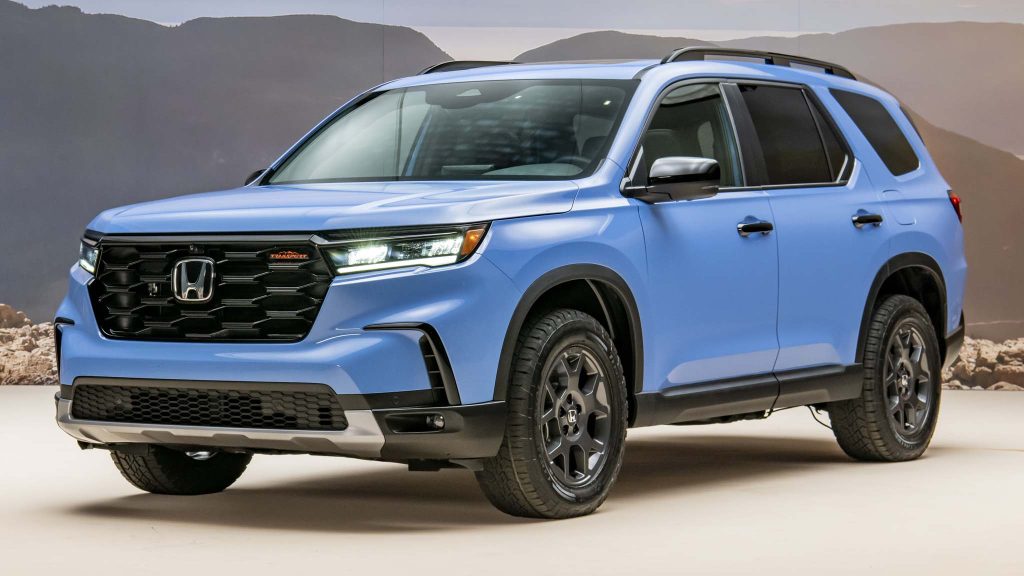
The Santa Fe XRT brings a more rugged character to Hyundai’s lineup, but its 4,500-pound maximum towing capacity remains below the 5,000-pound figures of the other two.
For occasional towing, all three can work. For heavier trailers, the Pilot and Ascent are clearly better suited.
Between those two, the Pilot has the horsepower advantage and a traditional automatic transmission. The Ascent’s standard AWD and ground clearance make it particularly attractive in poor weather.
Winner: Honda Pilot
Interior Technology and Safety
The Santa Fe gains another category through its modern cabin and technology-focused design.
Hyundai has given the latest Santa Fe a much more contemporary interior than the previous generation. The dashboard uses large digital displays, and higher trims add premium materials and convenience features that help the SUV feel more upscale.
The Pilot is also well equipped. Honda provides a 12.3-inch color touchscreen, Google built-in, wireless Apple CarPlay and Android Auto, and a 10.2-inch digital instrument cluster on relevant trims.
Honda Sensing adds driver-assistance systems, including collision mitigation braking, road departure mitigation, blind-spot monitoring, and adaptive cruise control.
The Pilot’s advantage is its straightforward approach. Its controls are easy to understand, and the cabin is designed around family use rather than trying to overwhelm occupants with screens.
The Ascent takes a similar practical approach. Subaru makes EyeSight Driver Assist Technology standard, providing features such as adaptive cruise control with lane centering and pre-collision braking. Standard Symmetrical All-Wheel Drive is another important safety and traction feature.
The Santa Fe, however, has the most modern visual presentation. Its wide displays, digital features, available premium equipment, and distinctive dashboard make the cabin feel newer and more technology-focused.
Hyundai also provides useful family conveniences. The upright body makes loading cargo easier, while the available hands-free smart liftgate can be useful when approaching the vehicle with bags.
The Pilot counters with its own family-focused details, including available CabinTalk, multiple USB ports, second-row sunshades, and a flexible second-row center seat. Higher trims add features such as a head-up display, heated and ventilated front seats, and premium audio.
The Ascent’s strength is its safety-focused equipment and all-weather design. It is not as visually dramatic inside, but Subaru’s standard EyeSight system and AWD provide substantial practical benefits.
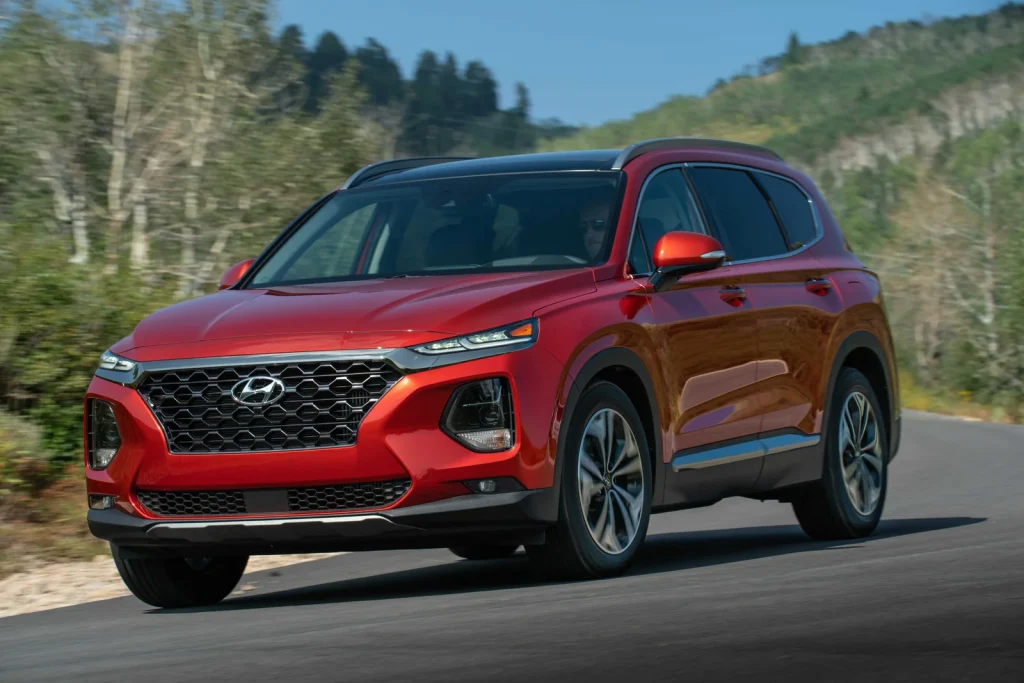
Safety ratings should always be checked for the exact model year and configuration, since testing standards change. Subaru says the 2026 Ascent earned an IIHS Top Safety Pick+ designation under the organization’s current criteria.
For the complete interior experience, though, the Santa Fe has the strongest combination of modern design, digital technology, and convenience.
Winner: Hyundai Santa Fe
Pricing and Value
Price changes the equation considerably because the three SUVs begin at noticeably different points.
The 2026 Santa Fe starts at $35,050 before freight, taxes, title, license, and other charges. Hyundai’s lineup includes several trims that allow buyers to add equipment without moving directly into the most expensive version.
The Honda Pilot starts at $42,395. The EX-L starts at $44,695, while the TrailSport begins at $50,595. Higher trims climb beyond $50,000.
The Subaru Ascent starts at $40,795 for the Premium trim, with both seven- and eight-passenger versions available at that starting point.
The Ascent’s price requires some context because Subaru includes Symmetrical All-Wheel Drive as standard. A buyer who specifically wants AWD gets it without moving to an optional drivetrain.
The Pilot’s higher price also buys meaningful advantages. It has the strongest passenger capacity, a larger cargo area, a 285-horsepower V6, and up to 5,000 pounds of towing capability. For families that need those attributes, the extra money can be justified.
The Santa Fe makes a different argument. Its entry price is substantially lower, while its 277-horsepower turbocharged engine and 311 lb-ft of torque provide plenty of performance for everyday use. It also has the strongest gasoline fuel economy of the three.
The Santa Fe’s available hybrid further strengthens its ownership-cost argument. Buyers who drive significant annual mileage can choose a hybrid version with EPA ratings reaching 36 mpg combined in FWD form.
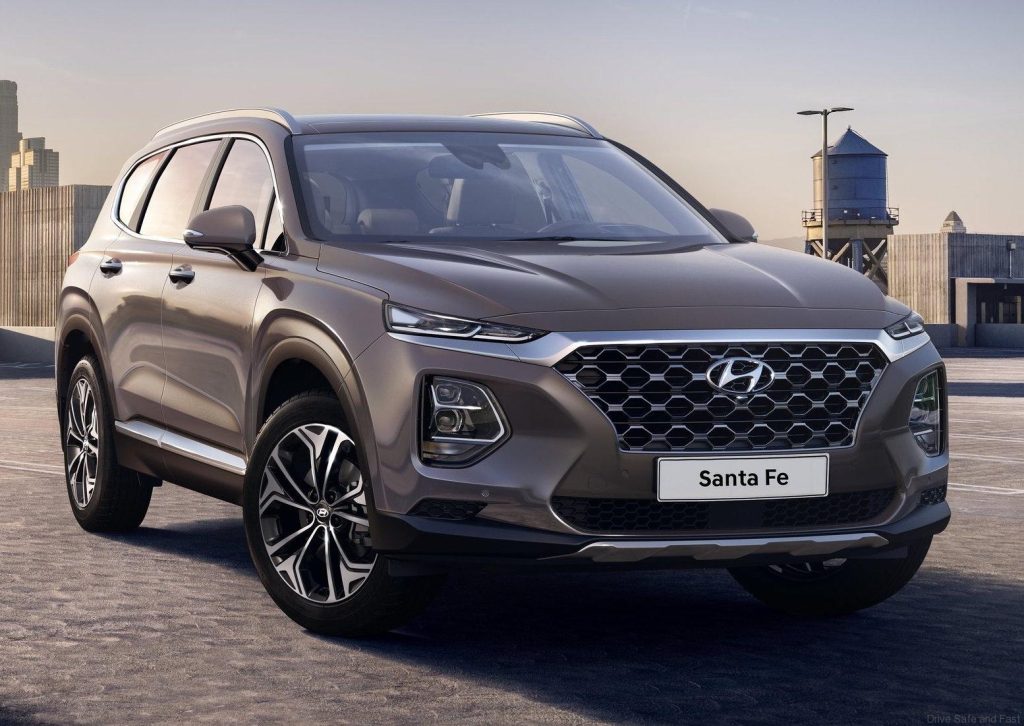
That gives Hyundai an advantage that goes beyond the showroom price. The Ascent remains a strong value for buyers who specifically need AWD, while the Pilot is worth its premium for larger families and frequent towing.
But when price, fuel consumption, equipment, and everyday capability are considered together, the Santa Fe offers the broadest package for the money.
Winner: Hyundai Santa Fe
The Honda Pilot is the strongest choice for buyers who need maximum family utility. Its V6 produces the most horsepower, its third row is the most accommodating, and its 5,000-pound towing capacity makes it well suited to larger trailers. It is also packed with useful family features and offers an available off-road-oriented TrailSport model.
The Subaru Ascent is the specialist for all-weather driving. Standard Symmetrical All-Wheel Drive, 8.7 inches of ground clearance, 5,000 pounds of towing capacity, and standard EyeSight technology make it a sensible choice for buyers who regularly deal with snow, rain, gravel, or mountain roads.
The Hyundai Santa Fe takes a different approach. It has the lowest starting price, the best gasoline fuel economy, a strong turbocharged engine, a modern cabin, and a hybrid option. Its main weakness is towing, where it falls behind the Honda and Subaru.
The category results are tied:
Honda Pilot: 3 category wins
Hyundai Santa Fe: 3 category wins
Subaru Ascent: 0 category wins
That tie highlights how differently these two SUVs approach the needs of their owners. The Pilot has the edge in areas that matter most to families seeking a larger vehicle, including performance, interior space, and towing ability. The Santa Fe focuses more on everyday practicality, with advantages in fuel efficiency, cabin technology, and value.
The Ascent does not win one of the six categories, but it remains a strong alternative because standard AWD is a major advantage that the category structure does not fully capture.
For a large family that frequently uses all three rows and tows, the Honda Pilot is the better choice.
For drivers who face difficult weather and want AWD without paying extra for it, the Subaru Ascent is the more appealing option.
For buyers seeking the best combination of purchase price, efficiency, technology, and everyday usability, the Hyundai Santa Fe is the winner.
Winner’s Table
| Category | Winner | The Edge |
|---|---|---|
| Power and Performance | Honda Pilot | Its 285-hp V6 provides the strongest horsepower and performance combination. |
| Fuel Economy | Hyundai Santa Fe | Its 24-mpg combined rating and 29-mpg highway rating lead both rivals. |
| Passenger and Cargo Space | Honda Pilot | Its larger third row and cargo area better suit growing families. |
| Towing and Capability | Honda Pilot | Its 5,000-pound rating and higher horsepower provide stronger towing confidence. |
| Interior Technology and Safety | Hyundai Santa Fe | Its modern displays and digital features create the freshest cabin experience. |
| Pricing and Value | Hyundai Santa Fe | Its lower starting price delivers strong power, efficiency, and technology. |
