
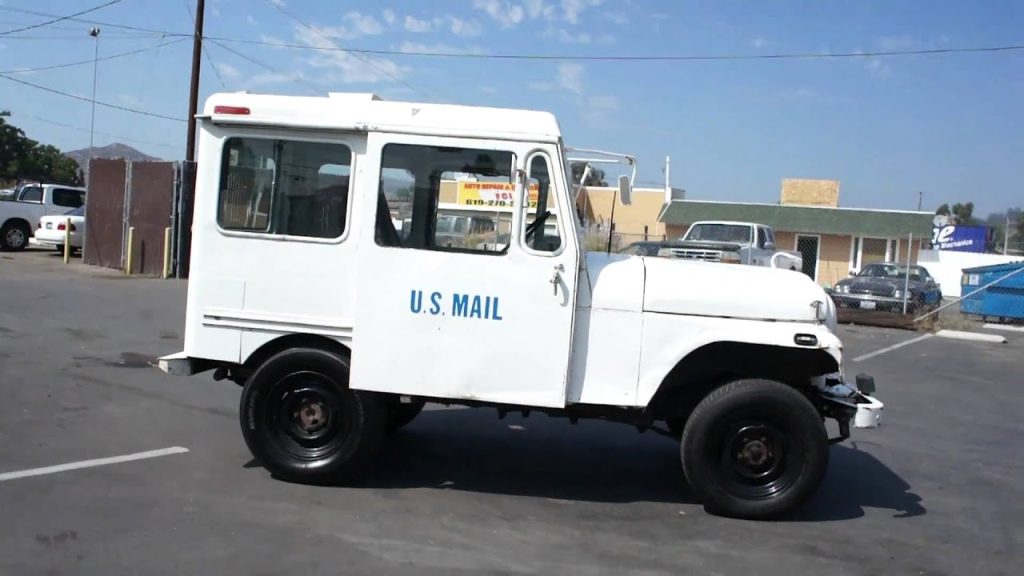
For decades, the unmistakable boxy mail truck was one of the most familiar vehicles on American streets. The Grumman Long Life Vehicle (LLV) was designed specifically for the U.S. Postal Service, with priorities that had little to do with speed, comfort, or fuel economy. It was built to deliver mail reliably while surviving thousands of hours of repetitive urban driving.
The LLV entered production in 1987 and remained in production through 1994. It used an aluminum body, a right-hand-drive configuration, and a General Motors-based chassis derived from the Chevrolet S-10.
Most early examples received GM’s 2.5-liter Iron Duke four-cylinder engine paired with a three-speed automatic transmission. The consumer guide identifies that combination as the primary powertrain for the LLV, while later trucks received a 2.2-liter four-cylinder engine.
The LLV was engineered for a completely different type of driving from an ordinary passenger car. Postal carriers repeatedly accelerated, stopped, parked, restarted, and moved only short distances throughout a route. That operating pattern made fuel consumption dramatically worse than it might have been during normal highway driving.
The LLV was designed around a 17-mpg average fuel-economy target, according to U.S. Postal Service Inspector General reporting cited by The Guardian.
In actual postal service, constant stop-and-go operation pushed fuel economy down to approximately 10 mpg. Some automotive references have reported figures as low as 8 mpg under particularly demanding conditions.
That gap between the intended figure and real-world consumption reveals just how unusual the LLV’s working environment was.
Built for Mail Delivery, Not Conventional Driving
The LLV was created around the specific needs of postal carriers. The Consumer Guide notes that the USPS wanted low operating costs, easy entry and exit, a tight turning radius, and at least a 500-pound payload. The resulting vehicle had a 1,000-pound payload capacity and 121 cubic feet of cargo space.
Its right-hand-drive layout allowed carriers to reach curbside mailboxes without repeatedly leaving the truck.
The body was essentially a large aluminum delivery box mounted on a GM-based chassis. Rather than prioritizing aerodynamic efficiency, its design emphasized cargo space and accessibility. Its shape was therefore poorly suited to high-speed travel, but that was not its intended job.
The mechanical components were similarly selected for durability and simplicity. The 2.5-liter Iron Duke inline-four was an established GM engine used in numerous vehicles. In the LLV, it produced roughly 90 horsepower, according to period specifications and automotive references.
That output sounds extremely modest today, but the LLV did not need to accelerate quickly. Its routes were concentrated largely in neighborhoods, where low speeds and repeated stops mattered more than highway performance.
The three-speed automatic was equally basic. The transmission was suited to the low-speed work the LLV performed, providing a straightforward powertrain with fewer components than today’s six-, eight-, or ten-speed automatics.
The combination was slow but adequate for its purpose. Fuel economy became a different story once the truck began working a full postal route.
Why the Mileage Could Fall So Far
The biggest reason was how the vehicle was operated. A normal passenger car might travel several miles before stopping. A mail truck could move only a few hundred feet before stopping again. The driver might pull forward, brake, sort mail, accelerate toward the next mailbox, and repeat the process hundreds of times.
That environment is extremely difficult for an internal-combustion engine. Every acceleration requires energy to move the vehicle from a standstill. Braking then converts much of that energy into heat instead of recovering it. Modern hybrids can recover some energy through regenerative braking, but the LLV had no such system.
The engine also spent considerable time idling. An idling engine consumes fuel without moving the vehicle. A postal truck could therefore burn gasoline while travelling zero miles, causing its miles-per-gallon figure to deteriorate rapidly.
The USPS experience illustrates this clearly. According to The Guardian, the vehicles were designed for roughly 17 mpg, but constant stop-and-go operation resulted in many LLVs averaging around 10 mpg.
Other automotive references have placed real-world consumption around 8 to 10 mpg under demanding service.
The headline figure of eight mpg should therefore be understood as a harsh operating-condition result rather than a universal rating for every LLV.
Age also became a factor. Many surviving examples accumulated enormous mileage while operating under severe conditions. Engine wear, transmission condition, tire pressure, maintenance, and driving habits can all affect consumption.
The trucks were also never optimized for modern fuel economy. A three-speed automatic lacks the closely spaced gears and overdrive ratios found in modern transmissions.
Contemporary engines can operate at lower speeds during highway cruising, while fuel injection, variable valve timing, stop-start systems, and hybrid technology further reduce consumption.
The Iron Duke had none of those advantages. Yet judging the LLV purely by modern standards misses why it became so successful.
A Simple Powertrain Built for a Demanding Job
The Iron Duke was not selected because it was powerful or particularly efficient. Its appeal came from being a relatively simple, established engine capable of performing repetitive fleet duty. That made it suitable for an application where reliability mattered more than acceleration.
The LLV was designed for an expected service life of approximately 24 years, according to historical accounts of the USPS specification. Many trucks ultimately remained in service well beyond their intended lifespan.
Consumer Guide describes the LLV as an aluminum-bodied vehicle based on GM’s S-10 architecture, with the Iron Duke providing the mechanical foundation for much of the early fleet.
The vehicle was extremely basic by modern standards. Contemporary accounts describe minimal cabin equipment and little of the comfort or safety technology found in today’s vehicles. Its purpose was to transport a postal worker and mail through a route, not provide a refined passenger-car experience.
Its low-speed environment also helped hide some mechanical shortcomings. A vehicle with poor acceleration by today’s standards did not necessarily need strong performance between suburban mailboxes. The three-speed transmission and Iron Duke were adequate for that task.
Problems became more apparent during higher-speed travel. The boxy body generated substantial aerodynamic drag, while the engine and transmission were not designed around modern highway cruising. The LLV was therefore far better suited to neighborhood delivery routes than extended freeway travel.
Fuel consumption was also affected by payload. A postal vehicle could carry hundreds of pounds of mail and packages while making repeated stops. Moving that additional mass requires more energy, and constant acceleration cycles magnified the effect.
This led to an unusual outcome. A vehicle with a relatively small four-cylinder engine could still use fuel at a rate that would seem surprisingly high compared with today’s passenger cars.
The irony is that the Iron Duke itself was not necessarily the main reason for the poor mileage. The mission was.
A modern engine placed into the same operating cycle would still face major efficiency challenges because the vehicle would spend so much time idling and repeatedly accelerating.
That helps explain the difference between the LLV’s intended 17 mpg and real-world figures around 10 mpg. The truck’s fuel economy was ultimately a product of its entire operating environment.
The Grumman LLV remains a notable example of purpose-built fleet engineering. It featured an aluminum body, a compact GM four-cylinder engine, and a three-speed automatic transmission, all developed around the demands of postal delivery.
Its reported 8-to-10-mpg real-world consumption was poor by modern standards, but the LLV was never designed to behave like a modern passenger vehicle. It was built to survive an exhausting cycle of stops, starts, idling, and curbside deliveries.
That mission helps explain why such an inefficient-looking machine remained useful for so many years.
The Iron Duke was slow. The three-speed automatic was outdated. The boxy body was hardly aerodynamic. Yet the combination was durable enough to become one of the longest-serving postal vehicle platforms in American history.
The old mail truck’s fuel economy needs some context. Eight miles per gallon may sound extremely poor by today’s standards, but those miles involved frequent stops, constant acceleration, long periods of idling, and daily mail delivery through residential neighborhoods.
For the LLV, efficiency was never simply about how many miles it could travel on a gallon of gasoline. It was about completing the route.
