
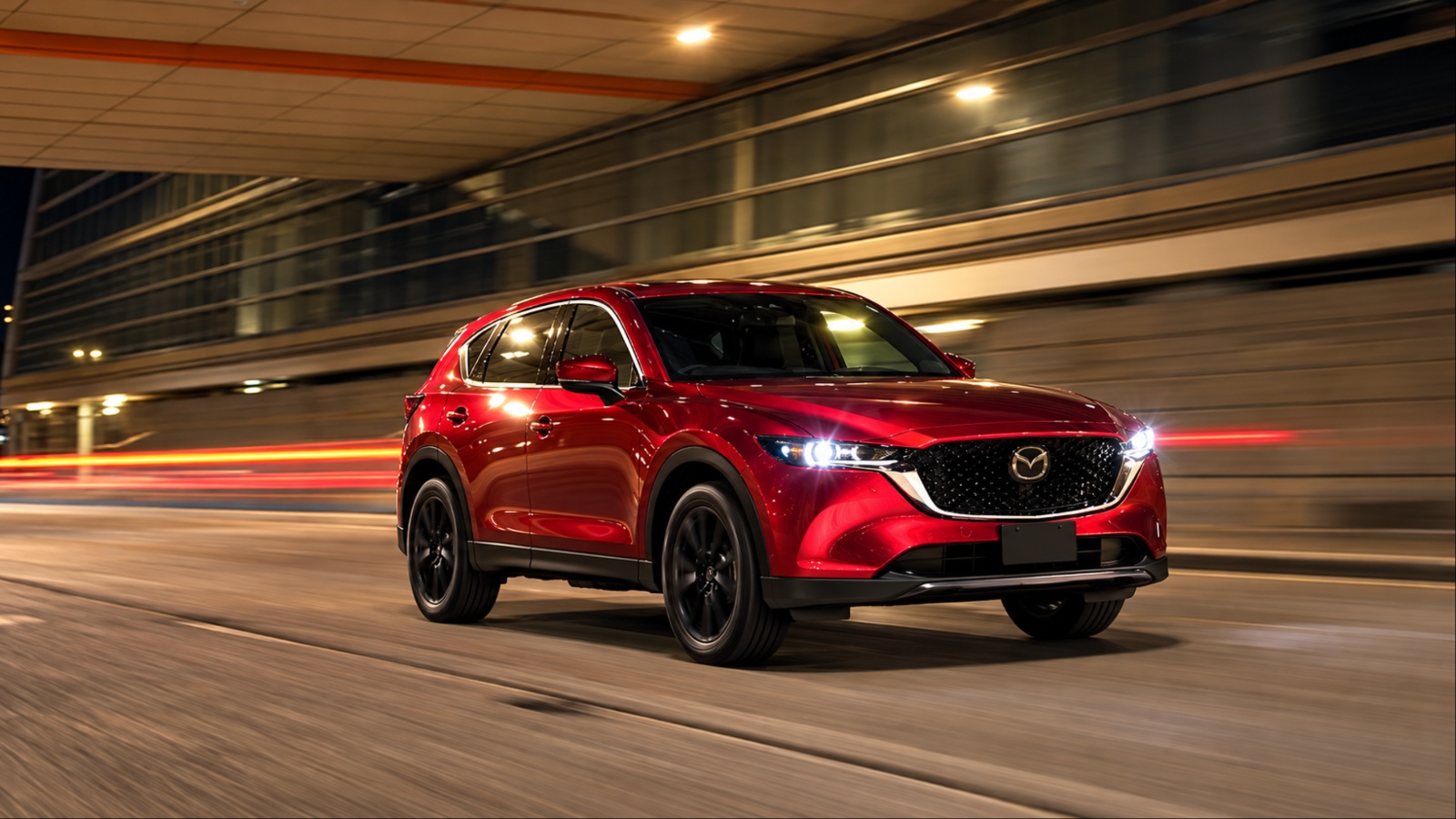
The Mazda CX-5 has long been praised as one of the safest compact SUVs on the market. It regularly earns top honors from the Insurance Institute for Highway Safety (IIHS), including the coveted Top Safety Pick+ award.
But safety scores are rarely uniform across every version of a vehicle. Headlights, in particular, often vary significantly between trims because of differences in hardware like auto-leveling systems, beam adjustment, and curve-adaptive technology.
For the CX-5, this variation is especially notable. According to IIHS testing on the redesigned CX-5, the top-end 2.5 S Premium Plus trim scored a Good rating for headlight beam coverage, while lower trims scored a slightly lower Acceptable rating.
The difference largely comes down to one important feature. Curve-adaptive headlights are available only on the range-topping trim, giving it an advantage over the other CX-5 versions. For shoppers comparing trims, this feature may be more significant than it first appears, particularly for drivers who regularly travel at night or navigate winding rural roads.
This article breaks down exactly how the IIHS tests headlights, what separates the top trim from the rest, and why this distinction is worth factoring into a purchase decision.
How IIHS Headlight Testing Works and Why the Top Trim Stands Out
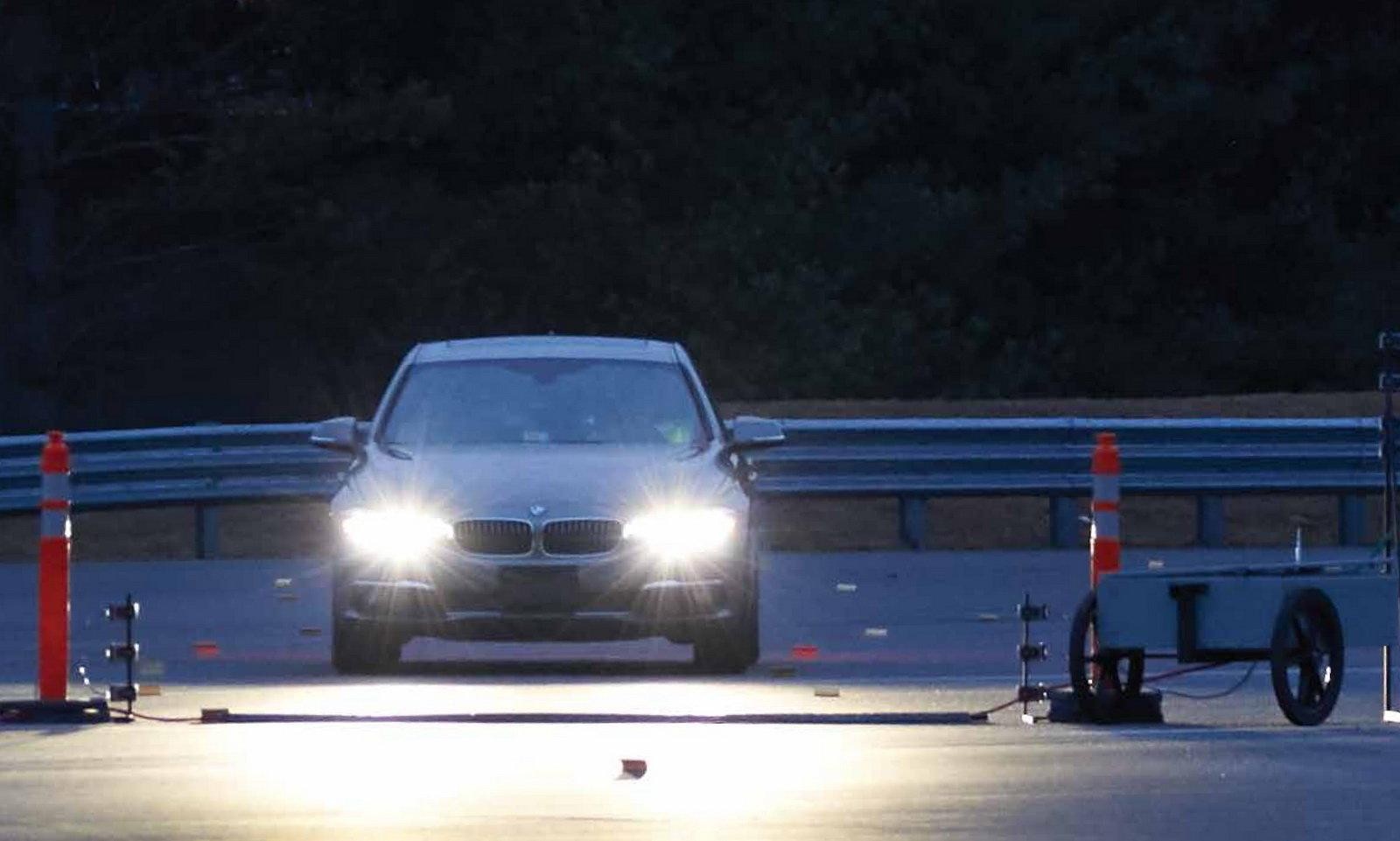
IIHS headlight testing provides a detailed look at how effectively a vehicle illuminates the road at night. The evaluation considers both visibility and glare, with headlights tested on straight roads as well as gradual and sharp curves in both directions. Low beams and high beams are evaluated separately, allowing the agency to identify weaknesses that may not be obvious during ordinary driving.
For the current-generation Mazda CX-5, IIHS evaluates two different headlight configurations. The strongest results come from the range-topping 2.5 S Premium Plus trim, which uses adaptive headlight technology. During testing, this version earned good visibility ratings on both sides of the road during straightaway driving. It also performed well through most curve tests, keeping the CX-5 in Good territory.
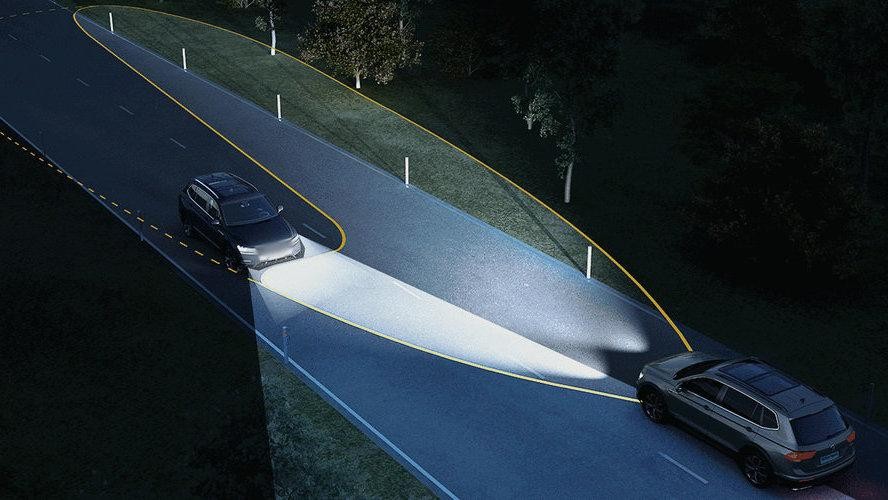
This is important because curves are often where conventional headlights struggle. Fixed-beam headlights point forward regardless of steering angle, which can leave portions of a curved road poorly illuminated. Adaptive headlights address this problem by swiveling slightly as the driver turns the steering wheel. The result is a beam that follows the direction of travel more effectively.
Lower CX-5 trims do not receive this steering-responsive technology. Instead, they use conventional fixed-beam LED headlights. This hardware difference accounts for much of the performance gap between the trims.
Historical IIHS testing suggests this difference has appeared across multiple CX-5 model years. In testing for the 2024 model year, several trims received good visibility on the right side of the road but only fair visibility on the left during straightaway testing. The 2023 model year showed a similar pattern, with multiple trims again receiving good results on the right and fair results on the left.
Curve performance also differed among the lower trims. Some curves received good ratings, while others were rated only fair. This indicates that nighttime performance in the CX-5 lineup is strongly influenced by the specific headlight technology fitted to each trim rather than simply its price or level of equipment.
Glare is another key factor in the evaluation. Several lower trims produced some glare for oncoming drivers when using their low beams. Too much glare can create a safety concern for other motorists, even when the headlights provide enough illumination for the driver. Proper beam alignment and cutoff control are therefore important factors in headlight performance.
High beams reveal another difference. Non-top trims received fair ratings for straightaway high-beam visibility on both sides of the road. High-beam assist helps compensate to some extent by automatically switching between high and low beams based on traffic conditions. However, this system does not increase the physical range or uniformity of the headlight beam itself.
The CX-5’s history also shows why buyers should examine IIHS results for the exact model year and trim they are considering. Headlight ratings can sometimes vary in unexpected ways. In one earlier generation, for example, the Sport trim received a better headlight rating than the Touring trim even though the Touring model had more advanced auto-leveling headlights. IIHS linked the difference to headlight aim sensitivity rather than equipment alone.
The CX-5 demonstrates how a single technology can create a meaningful difference in nighttime performance. The Premium Plus trim’s adaptive headlights provide stronger illumination through curves and more consistent straightaway performance. For drivers who frequently travel at night or on winding roads, the additional lighting capability could be an important reason to consider the higher trim.
At the same time, the historical results show that buyers should not assume a more expensive trim will automatically provide better headlight performance without checking the specific IIHS test results.
What This Means for CX-5 Buyers and Overall Safety Context
Despite this headlight gap, it’s important to understand this doesn’t mean lower CX-5 trims are unsafe. IIHS still recognizes the CX-5 among the safest vehicles in its class.
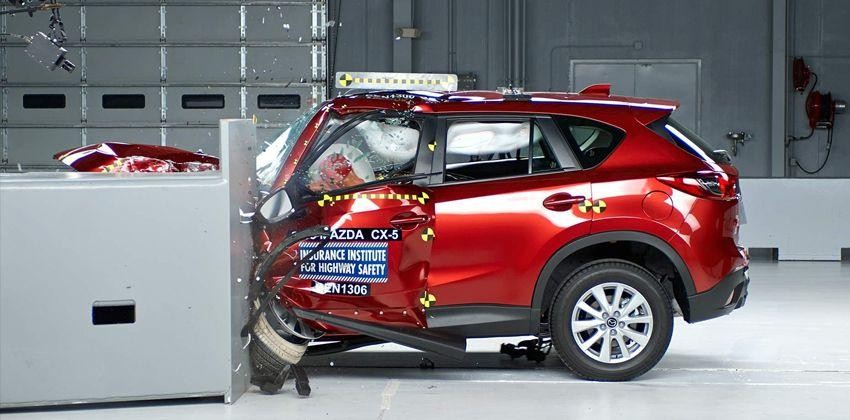
The vehicle passed the IIHS’s full battery of front crash prevention tests, successfully avoiding collisions with other vehicles and pedestrians while also providing timely warnings. This means the automatic braking and collision-avoidance systems function well across the lineup, independent of the headlight differences.
The redesigned CX-5 also earned the agency’s top distinction. The IIHS awarded the new-generation CX-5 its Top Safety Pick+ designation, placing it alongside other well-regarded small SUVs.
This award considers a wide range of tests, not headlights alone, so a single Acceptable headlight score on lower trims doesn’t disqualify the vehicle from earning top marks. The CX-5 joined other Mazda SUVs and rival compact SUVs, including the Hyundai Tucson, Kia Sportage, and Subaru Forester, in receiving this recognition.
This pattern of strong safety alongside headlight variability has actually been consistent for years. In earlier assessments, the CX-5 earned Top Safety Pick honors after scoring well across the IIHS’s core crashworthiness categories.
The agency’s testing process evaluates several categories together, including frontal and side crash tests, headlights, front crash prevention systems, seat belt reminders, and child seat anchor systems. Headlights are just one piece of a much larger safety puzzle, even though they carry real weight for nighttime driving.
For consumers, the practical takeaway is fairly simple. Anyone who drives frequently at night, especially on unlit rural roads or winding routes, may find genuine value in stepping up to the top trim.
The adaptive headlight system isn’t just a “nice to have” feature; it delivers measurably better road illumination in IIHS’s own controlled testing. Buyers who mostly drive in well-lit urban or suburban environments may find the difference less critical to their daily experience, since ambient street lighting reduces reliance on a vehicle’s own headlights.
It’s also worth remembering that headlight performance can be sensitive to small adjustments, not just hardware differences. As documented in older generation testing, the IIHS itself acknowledged that headlight aim is highly sensitive, and small aiming differences between trims can meaningfully shift results even when the underlying hardware looks similar.
This means dealership-level headlight aiming and maintenance could, in theory, influence real-world performance even within the same trim. Owners should ensure their headlights remain properly aimed over time, since misalignment can degrade visibility regardless of which trim they own.
Finally, buyers should recognize that Mazda has generally maintained a strong safety reputation across CX-5 generations. The underlying safety story from the 2017 through 2022 model years has been consistent, with strong crash performance, excellent roof strength, and steadily improving driver assistance technology.
The current headlight gap between trims doesn’t reflect an decline in safety commitment. It instead reflects a deliberate feature-gating decision, where curve-adaptive lighting is reserved for the flagship trim, similar to how many automakers reserve certain advanced safety features for higher-priced configurations.
In short, the data clearly shows a real and repeatable gap in headlight performance between the CX-5’s top trim and the rest of the lineup. Buyers prioritizing maximum nighttime visibility should strongly consider the 2.5 S Premium Plus.
Those choosing a lower trim aren’t getting a dangerous vehicle, but they are getting headlights that perform modestly worse in independent, standardized testing. Understanding this distinction allows shoppers to make a more informed decision based on their own driving habits rather than assumptions about trim level alone.
