
Modern performance cars have made it increasingly difficult to judge an engine by displacement alone. A four-cylinder that once seemed modest can now produce numbers that would have belonged to a much larger engine not long ago.
Turbocharging, direct injection, sophisticated cooling, variable valve timing, and advanced engine management have completely changed what manufacturers can extract from compact powerplants.
This list focuses on engines that made serious horsepower from relatively small displacements while remaining available in production vehicles sold in the United States. Some rely on high revs, others on substantial boost, and a few combine both approaches.
The result is a fascinating collection of compact engines that proved big performance does not always require a big engine under the hood.
1. Toyota GR Corolla 1.6-Liter Turbo Three-Cylinder
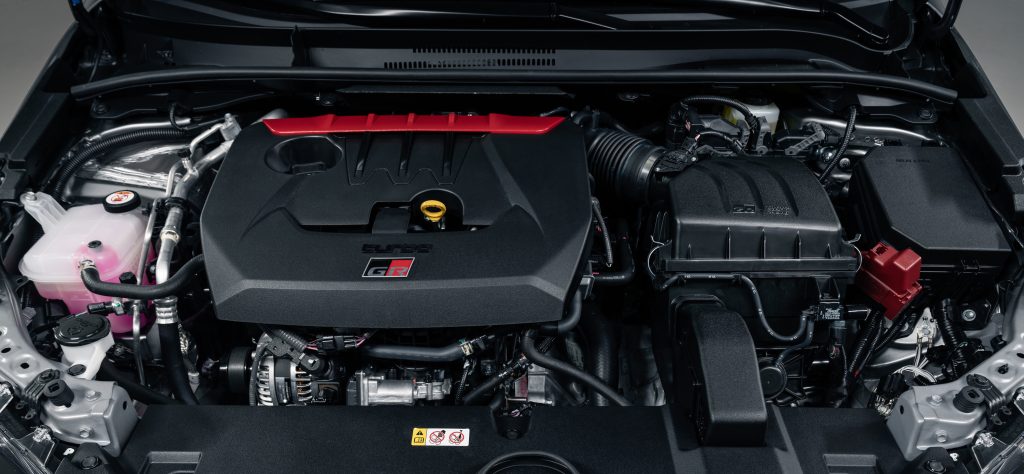
Toyota did something rather unconventional when it developed the GR Corolla. Instead of turning to a traditional four-cylinder, the company fitted a 1.6-liter turbocharged three-cylinder engine and pushed it to a factory-rated 300 horsepower.
That figure is striking because the engine displaces only 1,618 cc, yet it produces 273 lb-ft of torque in the U.S.-market GR Corolla. Toyota’s 2024 specifications list peak torque from 3,000 to 5,500 rpm, giving the engine a broad operating range rather than concentrating its strength at one point in the rev band.
The engine is known as the G16E-GTS and uses DOHC cylinder heads, 12 valves, direct fuel injection, and a turbocharger capable of generating up to 25.2 psi of boost.
Toyota also gives it a 7,200-rpm redline, which is an impressive ceiling for a production three-cylinder designed for everyday road use. The engine itself weighs just 240 pounds dry according to Toyota’s U.S. specifications.
The numbers become even more interesting when placed against the car’s performance. Toyota rated the GR Corolla at 4.99 seconds from zero to 60 mph and gave it an electronically controlled top track speed of 142.9 mph.
The compact engine works with Toyota’s GR-FOUR all-wheel-drive system, allowing its 300 horsepower to become useful traction rather than merely a specification-sheet headline.
What makes the G16E-GTS particularly memorable is not simply its horsepower figure. It demonstrates how far three-cylinder technology has progressed, turning an engine layout normally associated with economy cars into the centerpiece of a serious performance hatchback.
2. Mercedes-AMG CLA 45 S 2.0-Liter Turbo Four-Cylinder
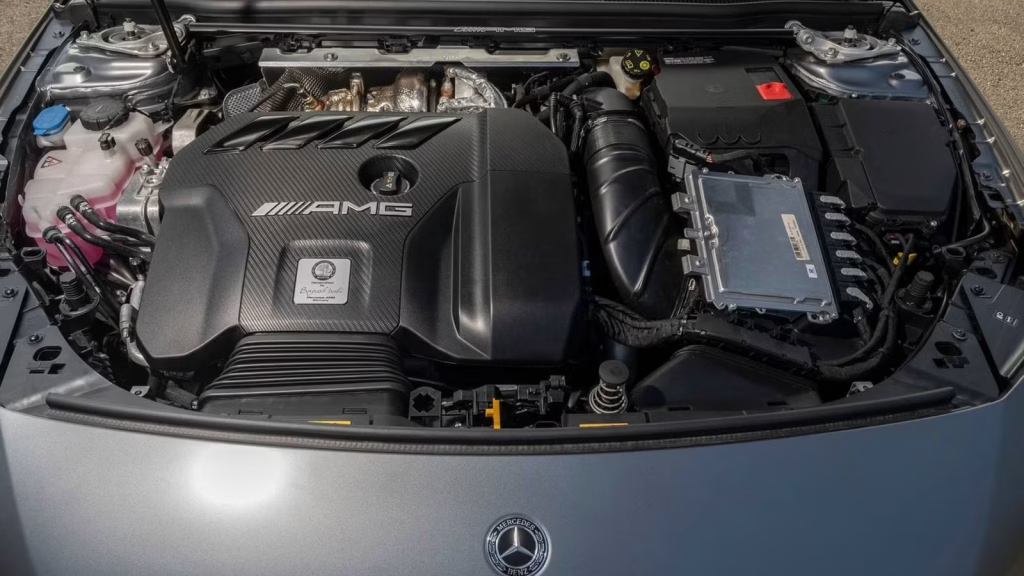
A 2.0-liter engine producing 416 horsepower sounds excessive until you look at what Mercedes-AMG actually built. The CLA 45 S uses a handcrafted 2.0-liter turbocharged four-cylinder that develops 416 horsepower at 6,750 rpm and 369 lb-ft of torque at 5,000 rpm.
For a compact U.S.-market luxury sedan, those figures put the engine firmly into territory traditionally associated with much larger performance powerplants. Mercedes-Benz USA lists the same 416-hp output for the AMG CLA 45 S.
The engine’s character comes from its combination of high specific output and sophisticated turbocharging. Mercedes-AMG builds each engine according to its “One Man, One Engine” philosophy, with the powerplant assembled by a single technician.
The result is an engine producing more than 200 horsepower per liter, an extraordinary figure for a factory production engine intended for road use.
The numbers are not merely theoretical. The CLA 45 S sends its output through an eight-speed automated manual transmission and 4MATIC+ all-wheel drive. Mercedes-Benz USA quotes a 4.0-second zero-to-60-mph time, while the car’s compact dimensions remain relatively manageable at 184.8 inches long and 73.1 inches wide without mirrors.
There is also an interesting contrast between the engine and its surroundings. The CLA 45 S is not an exotic two-seat sports car. It is a practical four-door machine with five-passenger seating and a trunk.
That makes the 2.0-liter engine’s output even more remarkable because the powerplant brings supercar-like intensity to a vehicle that can still function as everyday transportation.
Its significance goes beyond the horsepower number. The CLA 45 S demonstrated that a modern turbocharged four-cylinder could deliver the kind of acceleration and output that enthusiasts once expected from six- or eight-cylinder machinery.
3. Ford Mustang 2.3-Liter EcoBoost Four-Cylinder
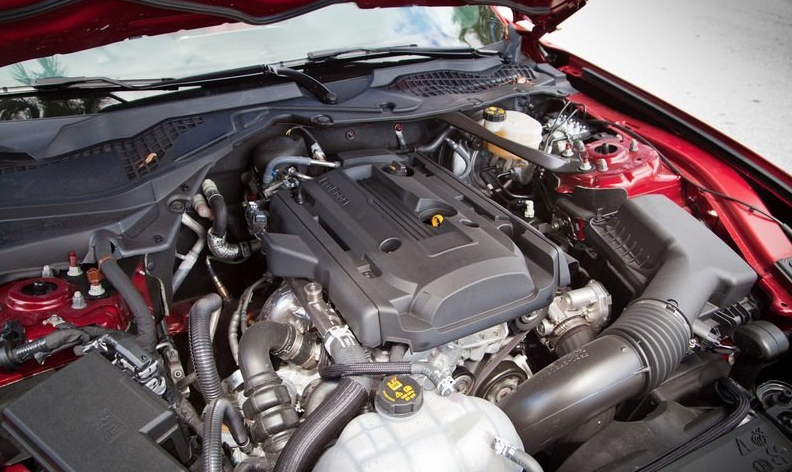
The Ford Mustang has long been associated with V8 power, which makes its modern 2.3-liter EcoBoost engine particularly interesting. The turbocharged four-cylinder produces 315 horsepower at 5,500 rpm and 350 lb-ft of torque at 3,000 rpm when running on 93-octane fuel.
Those figures give the Mustang a remarkably strong output for a four-cylinder engine in a rear-wheel-drive sports coupe. Ford’s current U.S. specifications continue to list the 2.3-liter EcoBoost at those ratings.
This is not simply an older engine carried into a new Mustang. Ford redesigned the 2.3-liter for the seventh-generation car using its Modular Power Cylinder architecture. The engine combines direct and port fuel injection, twin-independent variable cam timing, an integrated exhaust gas recirculation system, and a twin-scroll turbocharger.
Ford Performance also offers the engine as a crate powerplant, where it is listed at 309 pounds without the front-end accessory drive and flexplate.
The numbers are especially notable because the Mustang remains a genuine rear-drive performance car rather than a lightweight front-drive hatchback. Power reaches the rear wheels through a 10-speed automatic transmission in the current EcoBoost configuration.
The Mustang’s 189.4-inch length and 81.9-inch width, including mirrors, also give the car a substantial road presence despite the relatively compact engine under its hood.
What makes this engine memorable is the contrast between its displacement and the badge on the car. Ford managed to keep the Mustang name attached to a four-cylinder while giving that smaller engine enough torque to make the car feel convincingly muscular.
4. Honda Civic Type R 2.0-Liter VTEC Turbo
Honda took a very different route to big four-cylinder performance with the Civic Type R. Its 2.0-liter turbocharged and intercooled VTEC engine produces 315 horsepower and 310 lb-ft of torque in the U.S. market.
Honda’s specifications put the engine’s output at the heart of a front-wheel-drive performance hatchback, making the power figure even more intriguing because the drivetrain has to manage all of that output through the front axle.
The engine’s personality comes from its combination of turbocharging and high-rpm capability. Honda pairs the powerplant with a six-speed manual transmission featuring rev-match control.
The Type R also uses a limited-slip differential to help make better use of the engine’s 310 lb-ft of torque. Rather than relying on an automatic gearbox to mask shifts, Honda puts the driver directly in control of the power delivery.
The Civic Type R’s weight helps explain why its performance is so impressive. At 3,188 pounds and 315 horsepower, it delivers a strong power-to-weight ratio without sacrificing everyday practicality. There is still room for five passengers, along with 24.5 cubic feet of cargo space behind the rear seats.
The body measures 180.9 inches long and 74.4 inches wide, making the car considerably more compact than many performance sedans.
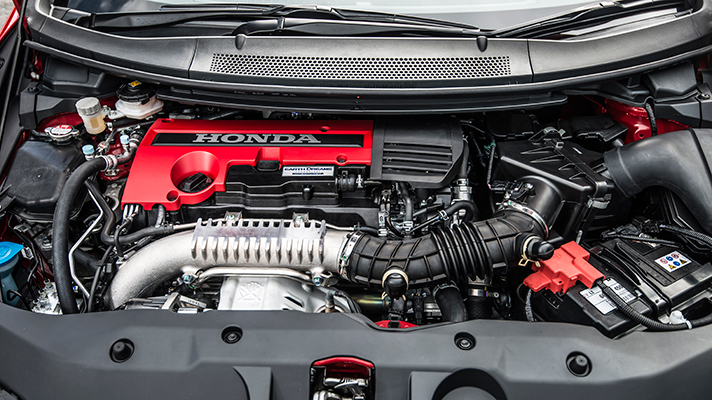
The result is an engine that does not need six or eight cylinders to create an unmistakably serious performance car. It turns a familiar 2.0-liter displacement into the mechanical centerpiece of one of the most powerful Civic models Honda has ever sold in America.
5. Porsche 718 Cayman GTS 4.0 4.0-Liter Flat-Six
The Porsche 718 Cayman GTS 4.0 takes a different approach to making serious power from a relatively compact engine. Instead of using turbocharging to inflate the output of a small displacement, Porsche fitted the Cayman GTS 4.0 with a naturally aspirated 4.0-liter horizontally opposed six-cylinder.
The engine produces 394 horsepower at 7,800 rpm and 309 lb-ft of torque at 5,000 rpm. Those numbers are particularly impressive because the engine remains naturally aspirated, meaning no turbocharger or supercharger is supplying additional boost. Porsche lists a 7,800-rpm power peak, reinforcing the high-revving character of the engine.
The flat-six is closely related to the architecture used in Porsche’s motorsport-inspired performance engines, and the Cayman GTS 4.0 gives it a relatively focused environment. A six-speed manual transmission is standard, with Porsche’s seven-speed PDK dual-clutch automatic available.
That choice matters because the manual gearbox lets drivers make full use of the engine’s willingness to climb toward its upper rev range rather than relying exclusively on forced induction for acceleration.
The GTS 4.0 also demonstrates why displacement should not be considered in isolation. At 394 horsepower, it produces nearly 100 horsepower per liter while retaining naturally aspirated throttle response.
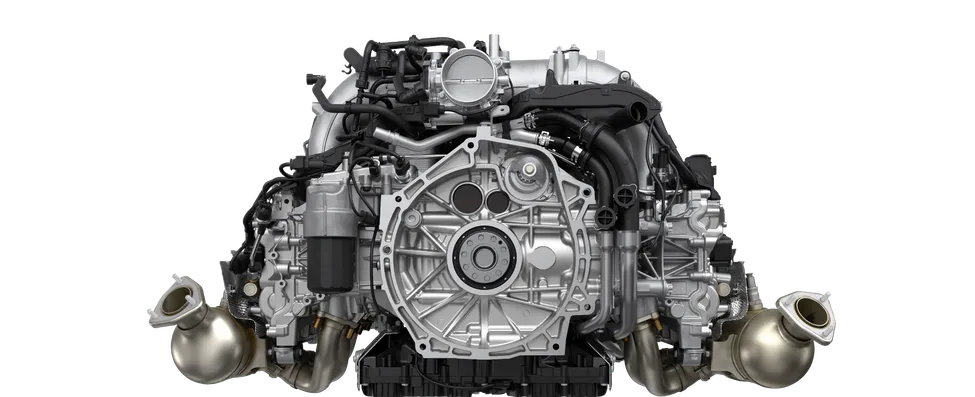
Porsche’s U.S. specifications give the car a length of approximately 172.4 inches and a width of 70.9 inches, dimensions that keep the mid-engine sports car relatively compact.
Its performance figures put the engine’s output into context. Porsche rates the Cayman GTS 4.0 at 4.3 seconds from zero to 60 mph with the Sport Chrono package and a top track speed of 182 mph.
The combination of high revs, compact dimensions, and rear-mid-engine balance makes this one of the most distinctive compact performance powerplants sold in America.
6. Mitsubishi Lancer Evolution X 2.0-Liter Turbo Four-Cylinder
The Mitsubishi Lancer Evolution X showed just how much performance engineers could extract from a 2.0-liter four-cylinder. In its U.S.-market form, the turbocharged 4B11T engine produced 291 horsepower and 300 lb-ft of torque.
Those numbers may look modest beside some modern supercharged and turbocharged engines, but the Evolution’s reputation was built on how effectively its compact engine worked with the rest of the drivetrain.
The aluminum-block 4B11T replaced the iron-block 4G63 used in earlier Evolution generations and brought a different engineering philosophy to Mitsubishi’s legendary rally-bred sedan.
Its turbocharger and intercooling system allowed the engine to produce substantial torque from relatively low engine speeds, while the aluminum construction helped reduce weight. Mitsubishi paired the engine with its sophisticated Super All-Wheel Control system, allowing the available power to be distributed through all four wheels.
The Evolution X could also be ordered with Mitsubishi’s Twin-Clutch Sportronic Shift Transmission, better known as TC-SST. A five-speed manual was available as well. That gave buyers two very different ways to experience the same 2.0-liter engine, from direct mechanical gear changes to rapid computer-controlled shifts.
The sedan itself measured 177.0 inches long and 72.0 inches wide, making the 291-hp powerplant look even more substantial when considered against the car’s relatively compact footprint.
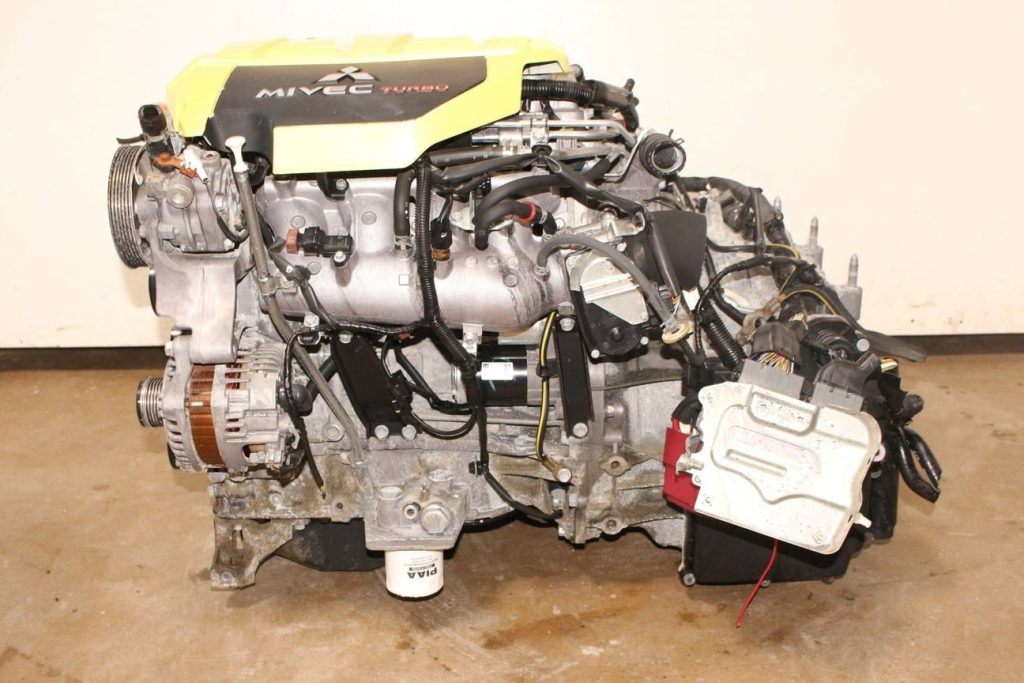
The engine’s 300 lb-ft of torque was especially important because the Evolution was engineered around traction and cornering rather than simply straight-line acceleration.
Its significance comes from the complete package. The 4B11T was not designed merely to produce an impressive dyno figure.
It served as the centerpiece of a performance system developed from Mitsubishi’s rally experience, giving a compact four-cylinder the responsibility of powering one of America’s best-known high-performance sport sedans.
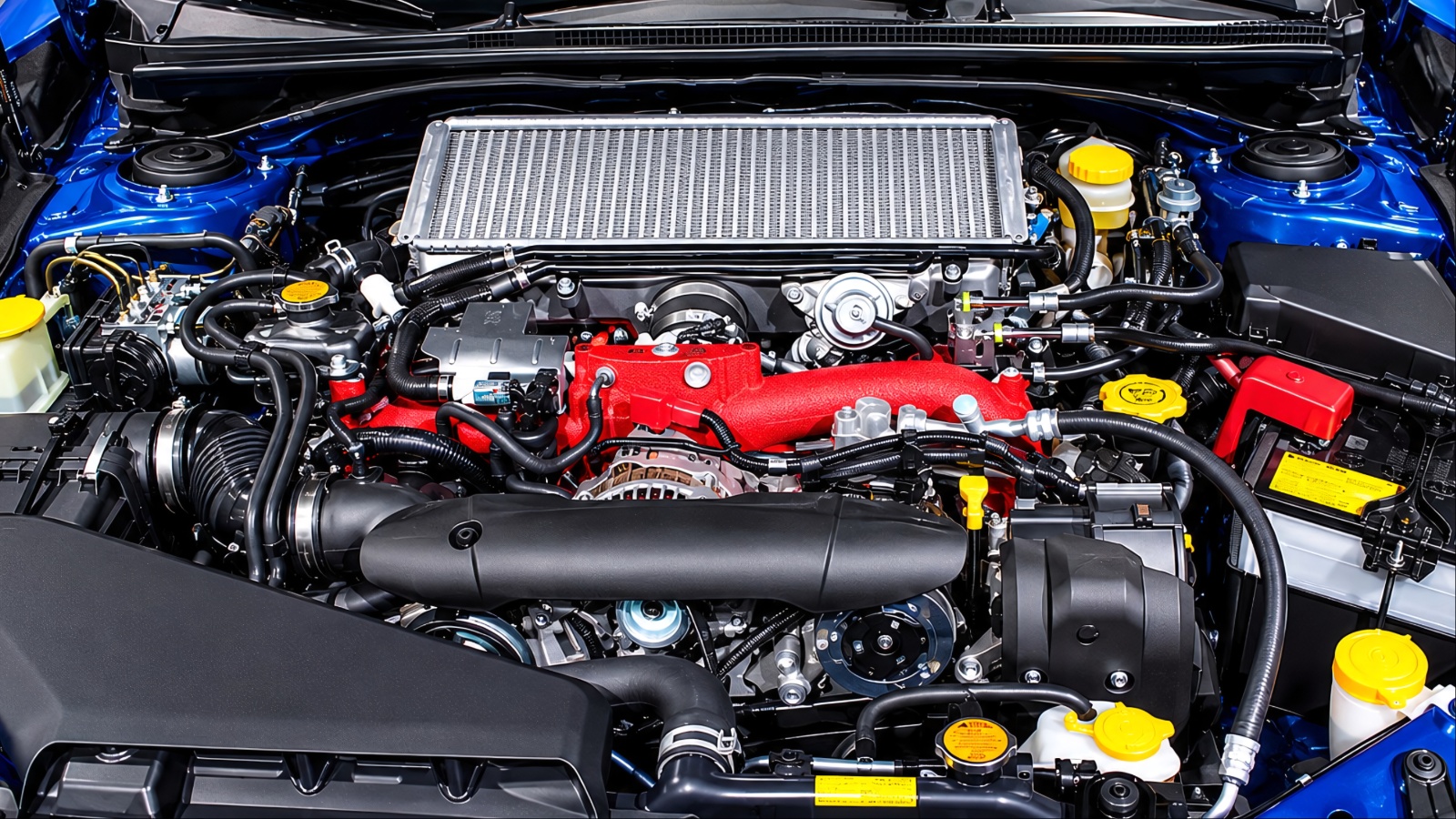
7. Subaru WRX STI 2.5-Liter Turbocharged Boxer Four-Cylinder
The Subaru WRX STI built its reputation around an engine that looked relatively ordinary on paper but delivered the kind of character enthusiasts wanted from a performance car.
Its 2.5-liter turbocharged horizontally opposed four-cylinder, known as the EJ257 in the U.S. market, produced 310 horsepower and 290 lb-ft of torque in its final American-market specification.
Subaru paired that engine exclusively with a six-speed manual transmission and symmetrical all-wheel drive, creating a drivetrain that became closely associated with the STI name.
Unlike a conventional inline-four, the boxer configuration places its cylinders horizontally on opposite sides of the crankshaft. That arrangement gives the engine a low center of gravity and contributes to the distinctive exhaust note for which the STI became known.
The turbocharger and intercooler allowed the 2.5-liter engine to generate substantial torque without requiring a larger displacement.
The STI’s numbers were competitive even as the model approached the end of its U.S. run. Subaru listed 310 horsepower at 6,000 rpm and 290 lb-ft of torque at 4,000 rpm. The car also incorporated a driver-controlled center differential and front and rear limited-slip differentials, giving the engine a drivetrain capable of putting its output down effectively.
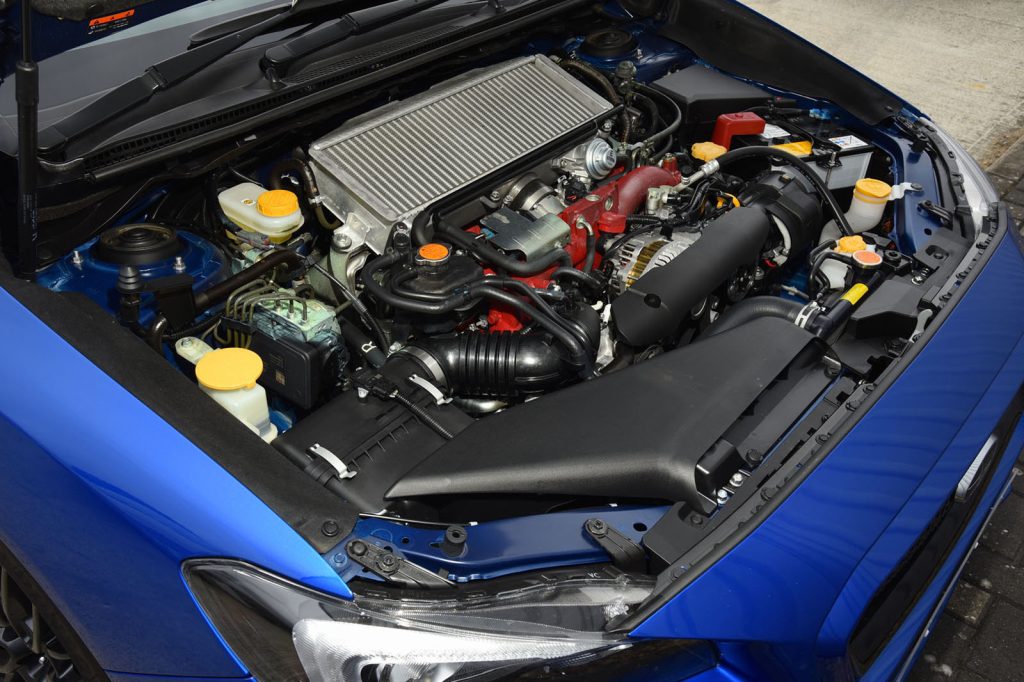
The final STI measured 180.9 inches long and 71.7 inches wide. That relatively compact body helped maintain the agile personality that separated the STI from larger performance sedans. Its 310 horsepower also represented a substantial output for a production four-cylinder engine that traces its lineage to Subaru’s long-running EJ family.
What made the EJ257 special was not a single spectacular specification. Its appeal came from the way turbocharged torque, a boxer layout, manual transmission, and sophisticated all-wheel drive were combined into one mechanical package. For American enthusiasts, it became one of the defining turbocharged four-cylinder engines of its era.
8. BMW M3/M4 S55 3.0-Liter Twin-Turbocharged Inline-Six
BMW’s S55 engine demonstrated how a compact six-cylinder could deliver power figures once associated with much larger engines.
Introduced in the F80 M3 and F82 M4, the 3.0-liter twin-turbocharged inline-six produced 425 horsepower and 406 lb-ft of torque in standard U.S. specification. BMW achieved those numbers from an engine displacing only 2,979 cc.
The S55 was derived from BMW’s N55 architecture but was substantially reworked for high-performance use. It received two mono-scroll turbochargers, a closed-deck aluminum crankcase, forged components, and a sophisticated cooling system designed to cope with sustained performance driving.
The engine also used BMW’s Double-VANOS variable camshaft timing and Valvetronic variable valve lift.
Its output was particularly notable because the engine remained relatively compact physically. The F80 M3 and F82 M4 could be equipped with either a six-speed manual transmission or BMW’s seven-speed M-DCT dual-clutch transmission. With the latter, the M3 was capable of reaching 60 mph in around four seconds, depending on configuration and testing conditions.
The S55 also delivered its maximum torque over a broad 1,850 to 5,500-rpm range, giving the engine a very different personality from naturally aspirated performance engines that relied on high revs for their strongest acceleration. The broad torque band made the M3 and M4 exceptionally responsive in everyday driving while preserving serious track capability.
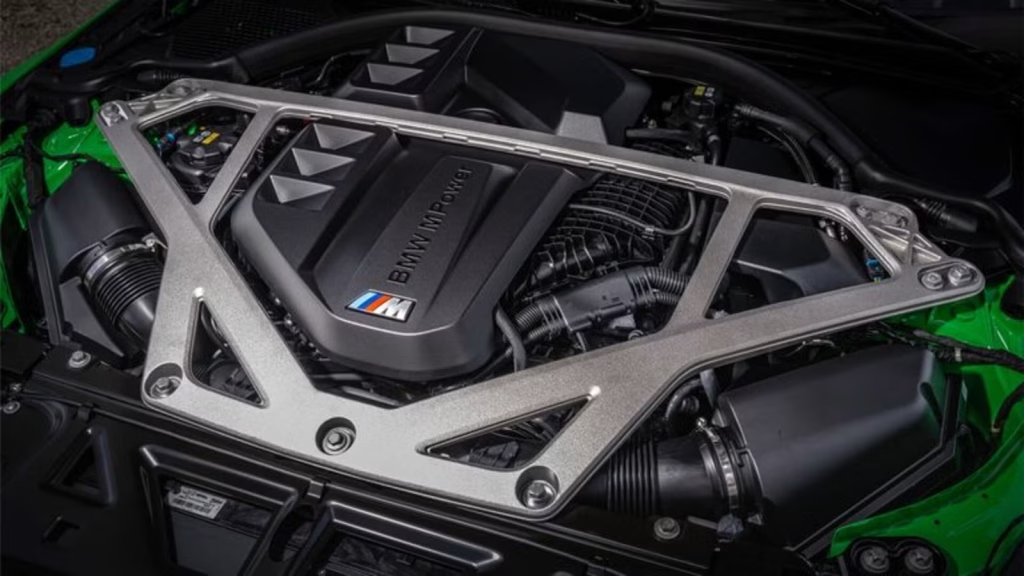
The M3 measured about 184.5 inches long and 73.9 inches wide, while the M4 coupe was slightly different in length. Rather than being enormous, these cars packaged a 400-plus-horsepower engine into relatively manageable dimensions.
The S55’s achievement was not simply reaching 425 horsepower. It showed how turbocharging could transform the traditional BMW inline-six formula without abandoning the compact architecture that had made the configuration so important to the brand.
9. Volvo S60 Polestar Engineered 2.0-Liter Twin-Charged Four-Cylinder
Volvo’s approach to compact high-output engines was unusually ambitious. The S60 Polestar Engineered combined a 2.0-liter four-cylinder with both a turbocharger and a supercharger, then added electric assistance to create a powertrain that could deliver 455 horsepower in U.S. specification.
The gasoline engine itself uses Volvo’s Drive-E architecture, while the electrified system adds another layer of performance to the compact powertrain.
The twin-charged arrangement solves two different problems. The supercharger provides immediate boost at lower engine speeds, while the turbocharger takes over as engine speed and airflow requirements increase.
This allows the relatively small four-cylinder to produce strong torque across a wide operating range instead of relying exclusively on one form of forced induction.
For the 2022 S60 Recharge Polestar Engineered, Volvo listed 455 total horsepower and 494 lb-ft of combined torque. The gasoline engine contributes a substantial portion of that output, while the electric motor supplies additional torque through the rear axle.
A lithium-ion battery pack and plug-in hybrid system therefore form an important part of the performance equation.
The numbers were remarkable for a luxury sedan using only four gasoline cylinders. Volvo’s U.S. specifications put the S60 at roughly 188 inches long and 72.4 inches wide. The sedan could also operate on electric power alone for shorter trips, giving the powertrain a dual personality that conventional high-output engines could not match.
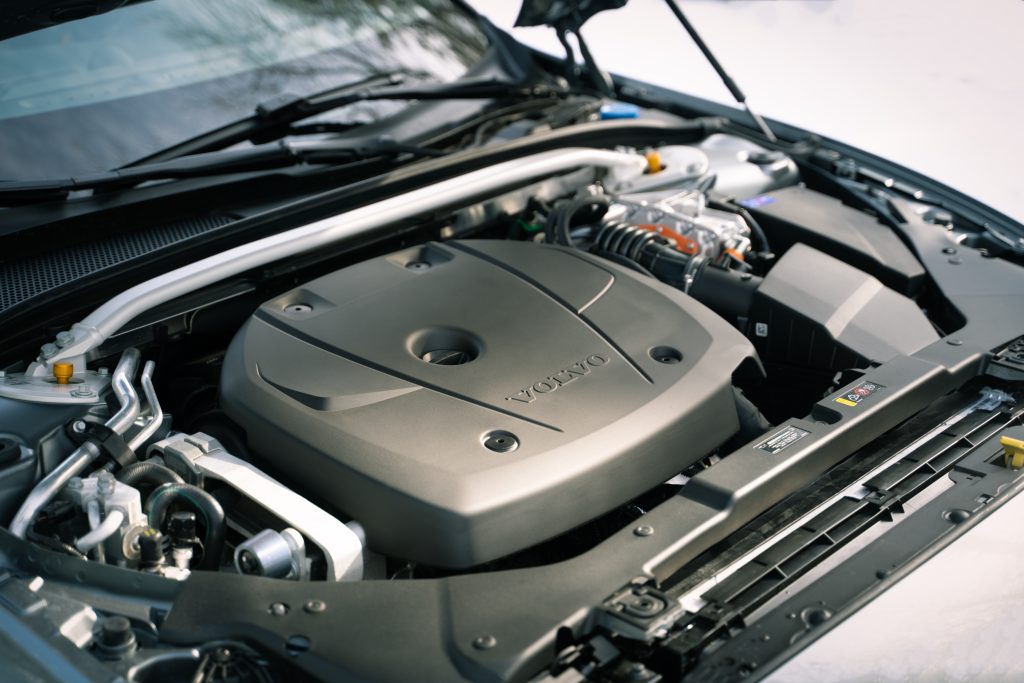
This powertrain highlights an intriguing approach to building compact performance engines. Instead of relying on a larger engine, Volvo packed a small four-cylinder with advanced technology, combining a supercharger, turbocharger, direct injection, and electric assistance to deliver more performance from less displacement.
The result was a powertrain capable of producing output that would have seemed extraordinary for a 2.0-liter engine just a generation earlier.
10. Mercedes-AMG A 45 S 2.0-Liter Turbocharged Four-Cylinder
The Mercedes-AMG A 45 S belongs on any discussion of extreme compact-engine output, although its availability in the United States requires an important distinction.
The A 45 S itself was not sold as a U.S.-market model, but its M139 2.0-liter turbocharged four-cylinder was closely related to the engine used in the U.S.-market Mercedes-AMG CLA 45 S. In its highest factory specification, the M139 produces 416 horsepower and 369 lb-ft of torque.
Mercedes-AMG developed the M139 as a high-output successor to the earlier M133. The engine was rotated 180 degrees compared with its predecessor, positioning the turbocharger and exhaust system toward the rear of the engine bay.
This helped engineers create a more favorable intake and exhaust arrangement while supporting the compact packaging demanded by modern front-engine performance cars.
The 416-horsepower version produces more than 200 horsepower per liter. That is the kind of specific output that makes the M139 remarkable even before considering the vehicles in which it operates.
The engine uses a twin-scroll turbocharger, direct fuel injection, and sophisticated thermal management to cope with its extremely high cylinder pressures and sustained performance demands.
In the U.S.-market CLA 45 S, Mercedes-Benz combines the engine with AMG Performance 4MATIC+ all-wheel drive and an eight-speed dual-clutch transmission. The result is a compact luxury sedan capable of reaching 60 mph in about four seconds.
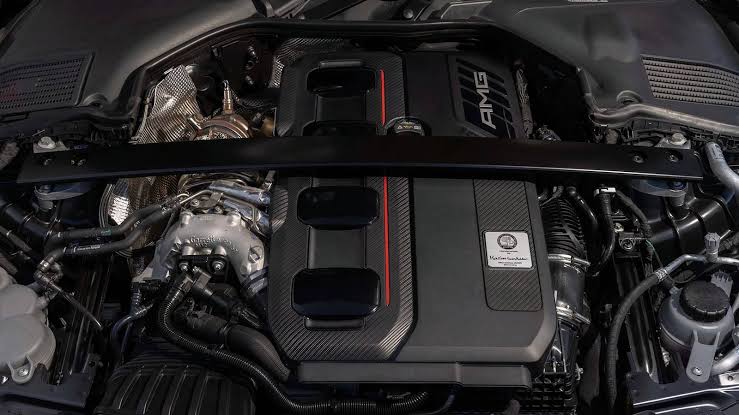
The CLA’s 184.8-inch length and 73.1-inch width also show that this enormous output is being generated in a vehicle that remains relatively compact by modern performance-car standards.
The M139 ultimately represents where compact internal-combustion engineering reached one of its most impressive points. A four-cylinder engine of only 2.0 liters can now deliver more than 400 horsepower from the factory while still being integrated into a road-going luxury car with everyday usability.
