
Landscaping puts unusual demands on a pickup truck. A typical workday can involve towing a trailer loaded with zero-turn mowers, carrying mulch or soil, transporting ladders and tools, and traveling between multiple properties.
That means the right truck needs more than a powerful engine. Payload capacity, towing ability, bed dimensions, durability, maneuverability, and useful storage can directly affect how efficiently a landscaping crew works.
The best choices also offer different configurations, allowing small operators and larger landscaping businesses to select a truck that fits their workload. Here are eight trucks that stand out for professional landscaping work in the U.S.
1. Ford F-150
Landscaping work rarely asks a truck to perform just one job. The same vehicle may carry a bed full of mulch in the morning, tow a trailer loaded with a mower in the afternoon, and haul several workers and tools to another property afterward. That flexibility is where the Ford F-150 makes a strong case for professional landscapers.
The 2025 F-150 offers several powertrains, allowing operators to match the truck to the size of their business. The 2.7-liter EcoBoost V6 produces 325 horsepower and 400 lb-ft of torque, while the 5.0-liter V8 produces 400 horsepower and 410 lb-ft.
The 3.5-liter EcoBoost raises output to 400 horsepower and 500 lb-ft, with a maximum available towing rating of 13,500 pounds.
Payload can matter just as much as towing for landscaping. Ford rates a properly equipped 3.5-liter EcoBoost F-150 for up to 2,440 pounds of payload. That capacity can be useful when the bed is carrying bags of soil, fertilizer, pavers, hand tools, and other equipment instead of a trailer.
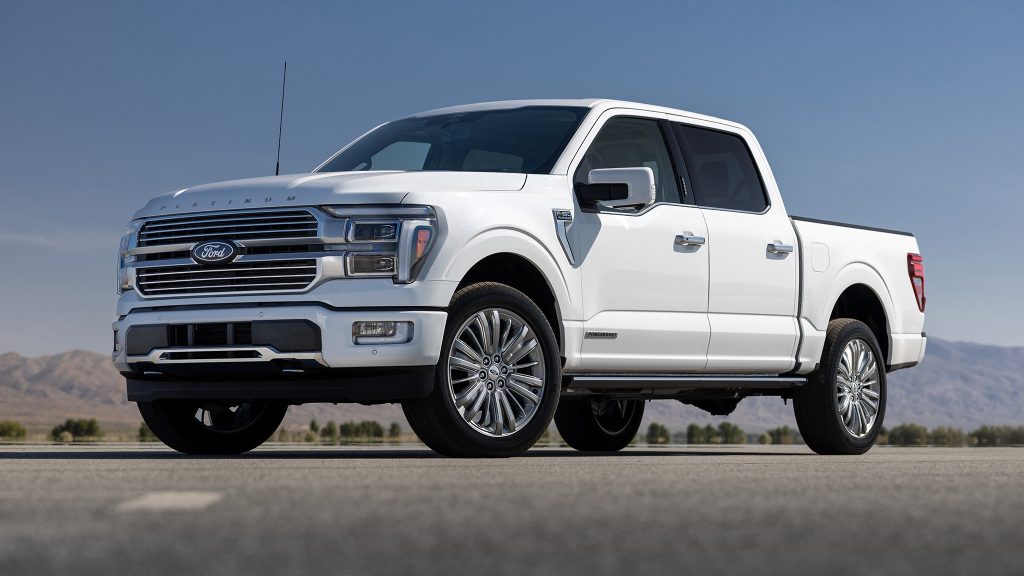
The F-150 also gives contractors multiple cab and bed configurations. Bed lengths include 5.5, 6.5, and 8 feet, while available cab styles include Regular Cab, SuperCab, and SuperCrew. The maximum exterior length ranges from 231.8 to 243.5 inches depending on configuration.
For a landscaping company that needs one pickup to cover several different tasks, the F-150’s combination of payload, towing capacity, and configuration choices is difficult to ignore. It can be specified as a relatively straightforward work truck or equipped for heavier-duty trailer work without moving into a much larger class.
2. Chevrolet Silverado 1500
A landscaping truck spends plenty of time doing things that have little to do with towing. It needs a useful bed, practical storage, enough payload for materials and equipment, and the ability to pull a trailer when the job demands it.
The Chevrolet Silverado 1500 addresses those requirements with a particularly work-focused range of configurations.
For 2025, Chevrolet offers four engines, including the 2.7-liter TurboMax, 5.3-liter V8, 6.2-liter V8, and 3.0-liter Duramax turbo-diesel. The TurboMax produces 310 horsepower and 430 lb-ft of torque, while the Duramax generates 305 horsepower and 495 lb-ft. Properly configured, the Silverado can tow up to 13,300 pounds.
The truck’s Durabed is especially relevant to landscapers because Chevrolet emphasizes its cargo capacity and standard tie-down points. Keeping equipment secured matters when a truck carries chainsaws, trimmers, blowers, shovels, and other loose gear alongside heavier materials. Chevrolet lists 12 standard tie-downs in the bed.
Payload also deserves attention. The Silverado’s maximum available payload is 2,260 pounds, although the actual rating changes with configuration and equipment. That distinction is important for commercial operators because passengers, accessories, and tongue weight all count against the truck’s available capacity.
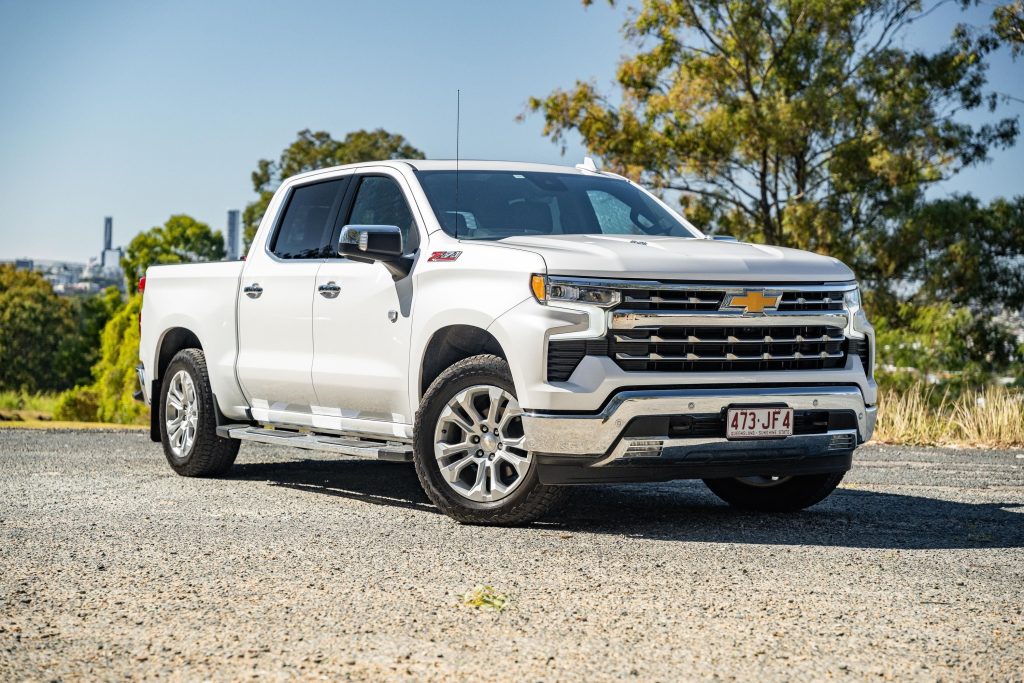
The Silverado can be configured with different cab and bed combinations, and Chevrolet lists exterior lengths from approximately 211 to 242 inches depending on configuration. For landscapers, the choice can therefore be tailored around whether maneuverability, passenger capacity, or maximum bed length matters most.
Its broad engine selection is another advantage. A small landscaping crew may find the TurboMax sufficient, while businesses regularly towing heavier equipment can step up to the diesel or larger gasoline engines.
3. Ram 1500
Landscapers often have to balance trailer work with the less glamorous task of carrying everything needed for a day’s jobs. The Ram 1500 is well suited to that combination because its capabilities can be tailored around the type of equipment a contractor actually moves.
For 2025, the Ram 1500 offers a 3.6-liter Pentastar V6 with eTorque and two versions of the 3.0-liter Hurricane inline-six.
The standard-output Hurricane produces 420 horsepower and 469 lb-ft of torque, while the high-output version produces 540 horsepower and 521 lb-ft. The standard-output engine can tow as much as 11,610 pounds when properly configured.
For many landscaping businesses, however, maximum horsepower is less important than payload. A properly equipped 2025 Ram 1500 with the Pentastar V6 can carry up to 2,370 pounds, giving it useful capacity for materials, tools, and equipment placed directly in the bed.
The truck’s 6-foot-4-inch bed provides 76.3 inches of cargo length, while the shorter 5-foot-7-inch bed measures 67.4 inches.
That makes the Ram particularly interesting for crews that carry long-handled tools, compact equipment, or several bags of landscaping materials without always needing a trailer. The available bed configurations also allow businesses to prioritize cargo length or passenger space.
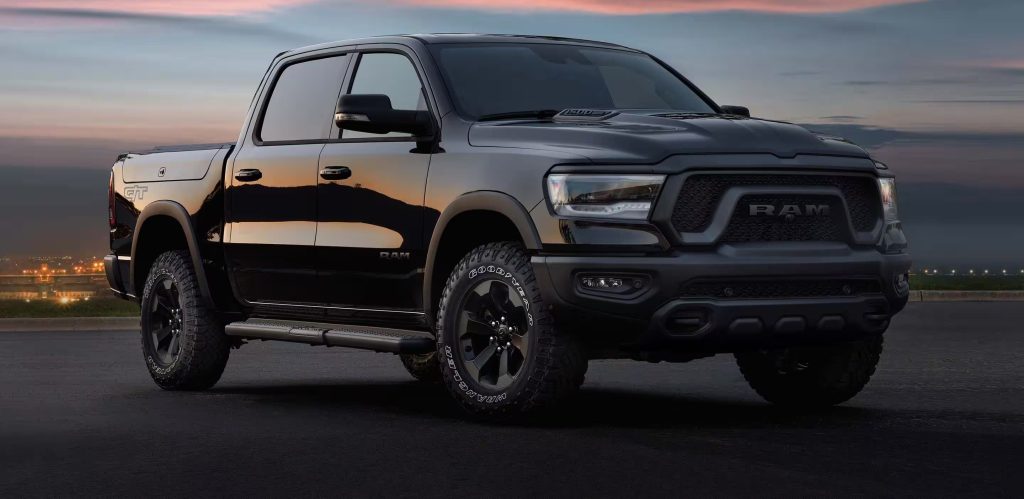
The truck is substantial, with exterior width listed at 82.1 inches and lengths varying by cab and bed combination. A Quad Cab with the 6-foot-4-inch bed measures 228.4 inches, while a Crew Cab with the same bed stretches to 241.3 inches.
The Ram 1500 therefore works best for landscapers who want a full-size pickup that can alternate between hauling materials and towing equipment without becoming a dedicated heavy-duty work truck.
4. GMC Sierra 1500
The GMC Sierra 1500 has a useful advantage for landscapers who want a truck that can spend its day doing actual work without requiring a heavy-duty chassis. Its available powertrains cover different levels of hauling, while the bed and towing equipment can be configured around the needs of a landscaping operation.
The 2025 Sierra 1500 starts with GMC’s 2.7-liter TurboMax four-cylinder, which produces 310 horsepower and 430 lb-ft of torque.
That torque figure is particularly useful when pulling a loaded mower trailer away from a job site or accelerating onto a highway. GMC lists up to 9,500 pounds of available towing capacity with this engine.
Landscaping businesses that regularly tow heavier trailers can move to the available 3.0-liter Duramax turbo-diesel, 5.3-liter V8, or 6.2-liter V8. The diesel is rated at 495 lb-ft of torque, giving it strong low-speed pulling ability without requiring a larger HD pickup.
The Sierra also has a practical bed design. GMC uses a high-strength steel pickup bed and offers its MultiPro tailgate, which can be particularly handy when loading equipment or reaching items toward the front of the bed. For a landscaper, that can mean easier access to smaller tools without climbing completely into the cargo box.
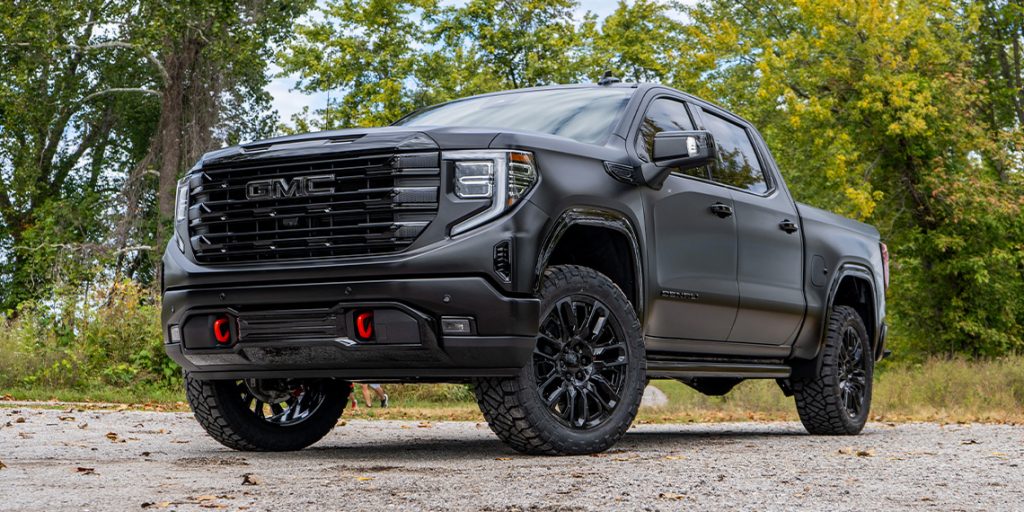
There is another reason the Sierra works well for commercial use. Its towing technology is designed specifically for trailer operation. Available features can provide trailer-camera views and added visibility around the truck and trailer, while Tow/Haul mode adjusts transmission behavior when carrying or towing heavy loads.
The Sierra 1500 is therefore a good middle ground. It offers substantially more capability than a midsize pickup while avoiding the size and expense of moving immediately into a heavy-duty truck.
5. Toyota Tundra
For landscaping businesses that put a premium on towing muscle and a durable cargo bed, the Toyota Tundra brings a different set of strengths to the job. Its power comes from twin-turbocharged V6 engines rather than a traditional V8, and the available hybrid system delivers particularly high torque.
The standard i-FORCE engine produces up to 389 horsepower and 479 lb-ft of torque. Buyers can also select the i-FORCE MAX hybrid, which combines the twin-turbo V6 with an electric motor to produce 437 horsepower and 583 lb-ft of torque.
Toyota rates the Tundra for up to 12,000 pounds of maximum towing capacity, while maximum payload reaches 1,940 pounds.
That combination makes the Tundra especially interesting for landscaping contractors who regularly tow trailers carrying commercial mowers, aerators, compact equipment, or large quantities of material. The hybrid’s 583 lb-ft of torque arrives at low engine speed, giving it substantial pulling capability.
Toyota also gives landscapers several bed choices. The Tundra is available with 5.5-foot, 6.5-foot, and 8.1-foot beds, with the longest version providing 96.5 inches of interior bed length.
The standard composite bed is designed to resist dents, impacts, dings, and rust, which are all relevant concerns for a truck that spends its life around equipment and landscaping materials.
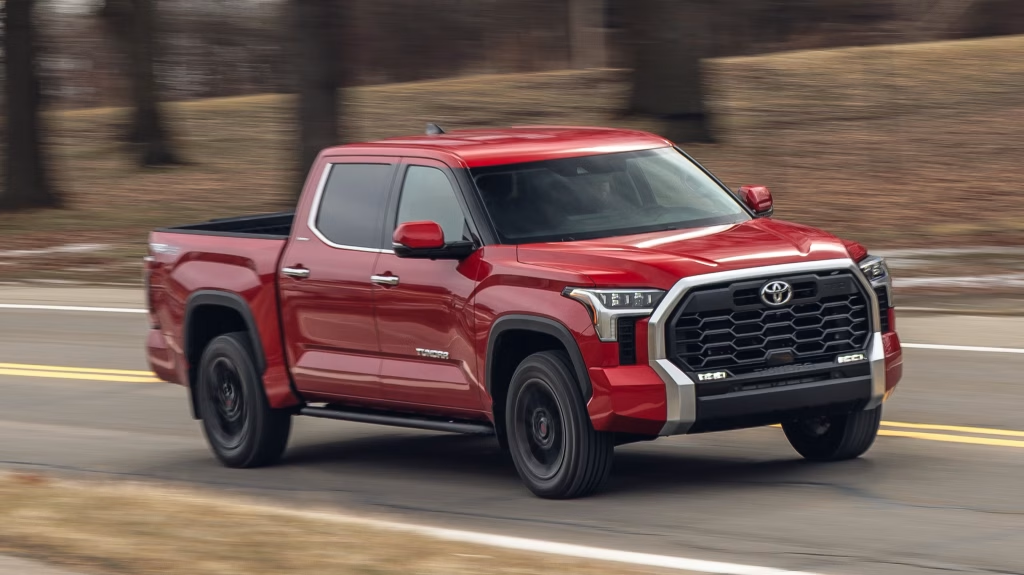
Dimensions depend heavily on configuration. A double cab with the 6.5-foot bed measures 233.6 inches long, while the double cab with the 8.1-foot bed stretches to 252.5 inches. The width is 80.2 inches across these configurations.
The Tundra’s biggest advantage for landscapers is straightforward. It combines strong torque, an available long bed, and up to 12,000 pounds of towing capacity in a full-size pickup.
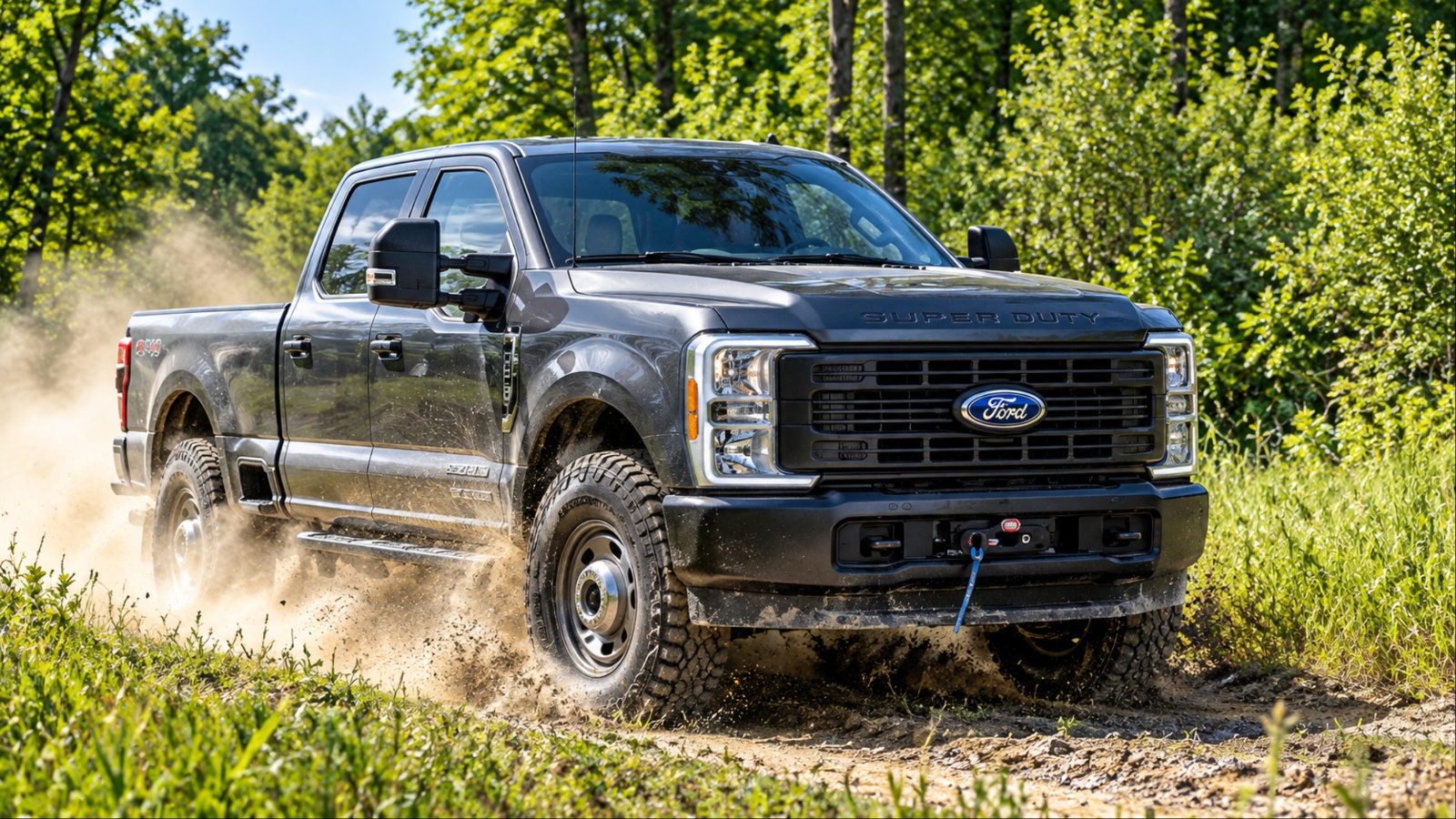
6. Ford F-250 Super Duty
Once landscaping equipment gets heavy enough, a half-ton pickup can become the limiting factor. That is where the Ford F-250 Super Duty starts making more sense. It is built for contractors who may routinely pull large equipment trailers rather than occasionally tow a small utility trailer.
The 2025 F-250 offers a 6.8-liter gas V8, a 7.3-liter gas V8, and an available 6.7-liter Power Stroke diesel V8. The 6.8-liter produces 405 horsepower and 445 lb-ft of torque, while the 7.3-liter increases output to 430 horsepower and 485 lb-ft.
The standard-output Power Stroke produces 475 horsepower and 1,050 lb-ft of torque. Ford rates the Super Duty lineup for up to 40,000 pounds of towing capacity in the most capable configuration.
A landscaping company does not necessarily need that extreme maximum, but the extra capacity provides useful headroom.
A trailer loaded with multiple commercial mowers, compact equipment, fuel, and landscaping materials can become surprisingly heavy. The F-250 gives operators a much larger margin before approaching the limits of a half-ton truck.
Ford also offers Pro Power Onboard with up to 2.0 kW of available output on certain Super Duty configurations. That can provide portable electrical power at a job site for compatible tools and equipment without bringing a separate generator.
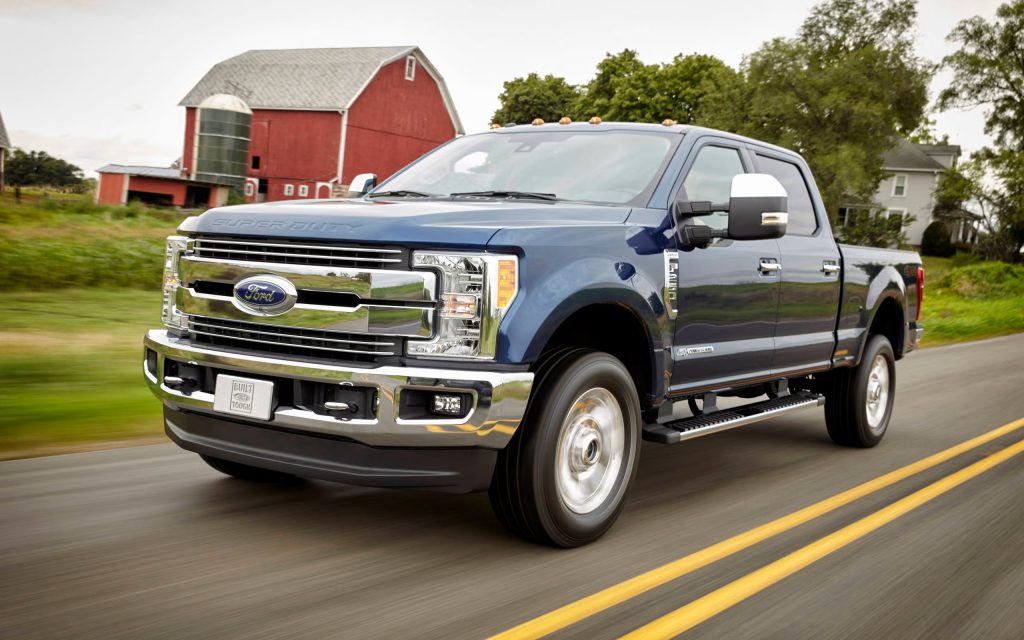
The F-250 is available as a regular cab, super cab, or crew cab, with multiple bed lengths. That makes it possible to build a relatively straightforward work truck around equipment hauling rather than paying for features that do not contribute to the job.
For landscapers with substantial trailers, the F-250’s biggest advantage is not simply its headline towing figure. It is the ability to handle demanding trailer work repeatedly while retaining the bed space and configuration flexibility expected from a full-size pickup.
7. Chevrolet Silverado 2500 HD
The Chevrolet Silverado 2500 HD is aimed at landscaping businesses that have moved beyond light trailer duty and need serious towing capacity without necessarily stepping into a 3500-class truck. Its capability becomes particularly useful when a trailer carries several large commercial machines at once.
Chevrolet offers two engine options for the 2025 Silverado HD. The 6.6-liter gasoline V8 produces 401 horsepower and 464 lb-ft of torque, while the 6.6-liter Duramax turbo-diesel V8 delivers 470 horsepower and 975 lb-ft of torque.
Both are paired with a 10-speed Allison automatic transmission. The 2500 HD can tow up to 22,070 pounds in its maximum Crew Cab configuration, depending on equipment.
That capability gives landscaping contractors considerable flexibility. A business carrying several zero-turn mowers, stand-on mowers, and other commercial equipment can use a properly equipped 2500 HD without immediately needing to move into a larger chassis.
The truck’s Durabed is another practical feature. The Chevrolet lists 12 standard tie-downs, each rated at 500 pounds per corner, along with available Multi-Flex tailgate functionality. The bed can provide up to 83.5 cubic feet of cargo volume, making it useful when the trailer is already occupied, or a job requires additional loose materials in the pickup itself.
The Silverado HD also offers extensive trailer-camera technology, including available views designed to make hitching, reversing, and monitoring a trailer easier. For a landscaping crew that connects and disconnects trailers frequently, those features can save time during routine operations.
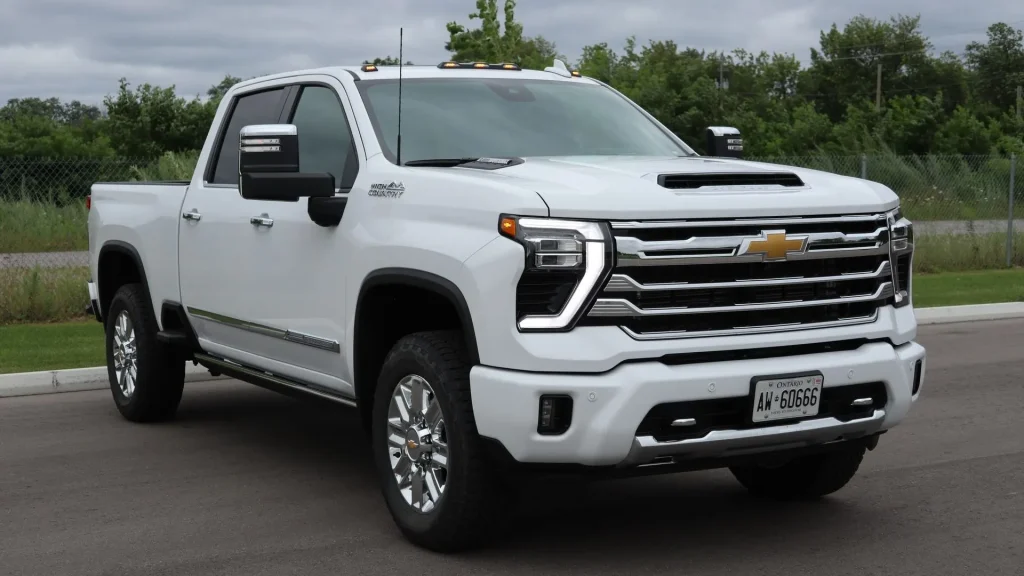
Its Crew Cab provides 44.53 inches of front legroom, while the truck can be ordered with either a standard or long bed depending on the configuration.
The Silverado 2500 HD makes the most sense for landscapers whose trailers are too demanding for a half-ton pickup but who do not need the maximum payload and towing capabilities of the largest heavy-duty trucks.
8. GMC Sierra 3500 HD
For a landscaping company that regularly moves multiple commercial machines, the GMC Sierra 3500 HD provides a level of capability that can make sense when a 2500-class truck is getting close to its limits. It is particularly suited to operators who tow heavy equipment trailers while still needing a conventional pickup bed for tools and materials.
The 2025 Sierra 3500 HD uses a 6.6-liter gasoline V8 as standard, producing 401 horsepower and 464 lb-ft of torque. An available 6.6-liter Duramax turbo-diesel V8 raises those figures to 470 horsepower and 975 lb-ft. Both engines are paired with a 10-speed Allison automatic transmission.
The numbers become more significant when the truck is configured for demanding trailer work. GMC lists up to 20,000 pounds of conventional towing capacity for the Sierra 3500 HD, while maximum available gooseneck or fifth-wheel ratings reach 31,440 pounds on certain configurations. The maximum available payload reaches 6,658 pounds.
A landscaper does not necessarily need those maximum figures, but having substantial capacity available can be valuable as a business grows. A trailer carrying several zero-turn mowers, a compact loader, and additional equipment can quickly become much heavier than a typical homeowner’s landscaping setup.
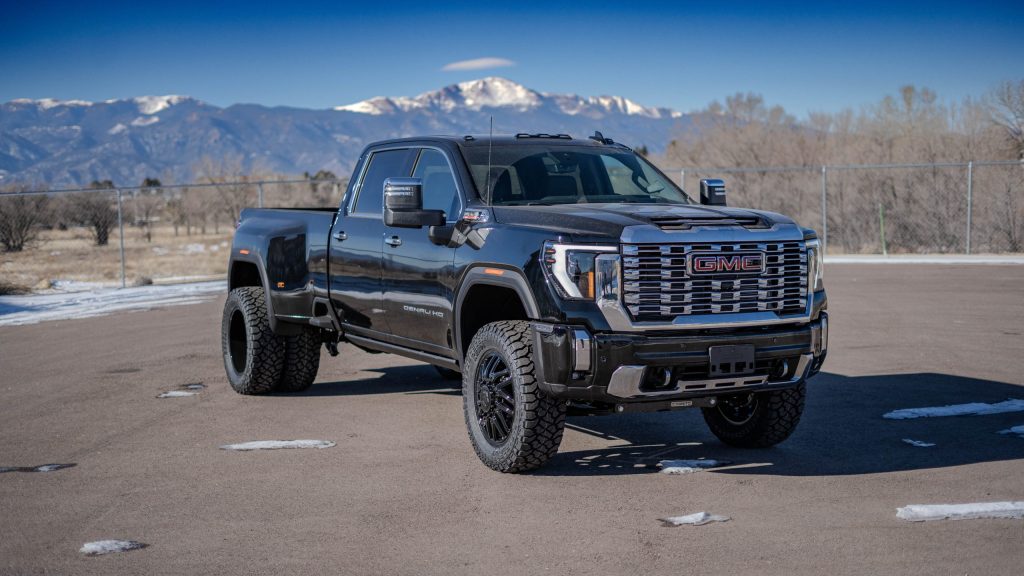
The Sierra also offers a choice of Regular Cab, Double Cab, and Crew Cab configurations. The long-bed versions provide an 8-foot-plus cargo box, while GMC lists as much as 83.5 cubic feet of cargo volume.
There is a practical advantage to choosing the 3500 HD for a growing landscaping business. Its high towing and payload capacities mean the truck can handle larger equipment as the operation expands, reducing the need for an immediate upgrade to a larger vehicle.
