
Tires can completely change what an SUV can do away from pavement. Two vehicles with similar ground clearance, four-wheel drive, and suspension hardware can behave very differently once loose gravel, mud, rocks, or sand appear.
Purpose-built off-road tires provide stronger sidewalls, deeper tread patterns, and more effective traction in difficult terrain, while street-oriented tires prioritize quietness, fuel efficiency, braking, and predictable highway manners.
This comparison separates five SUVs equipped with genuinely trail-focused rubber from five that rely primarily on road-biased tires. The distinction matters because an SUV’s advertised off-road capability means little when its tires cannot effectively transfer that capability to the ground.
5 SUVs With Real Off-Road Tires
1. Ford Bronco
The Ford Bronco is one of the clearest modern examples of an SUV whose tires were selected with serious off-road use in mind. Depending on trim and configuration, the Bronco can be equipped with 35-inch Goodyear mud-terrain tires, while certain versions use 33-inch all-terrain rubber.
Those aren’t simply oversized wheels intended to make the SUV look tougher. The tire dimensions and tread choices are integrated into a vehicle designed around substantial wheel travel and difficult terrain.
The available 35-inch Goodyear tires provide a large contact footprint and considerable sidewall height. That sidewall is useful away from pavement because drivers can reduce tire pressure to increase the tire’s ability to conform to uneven surfaces.
The larger diameter also contributes to the Bronco’s ability to clear obstacles without placing the underbody as close to rocks and ledges.
Ford’s available Sasquatch package makes the connection between tires and hardware particularly obvious. It combines 35-inch tires with beadlock-capable wheels, Bilstein position-sensitive dampers, and locking front and rear differentials.
The tire therefore operates as part of a coordinated package rather than functioning as an isolated styling feature.
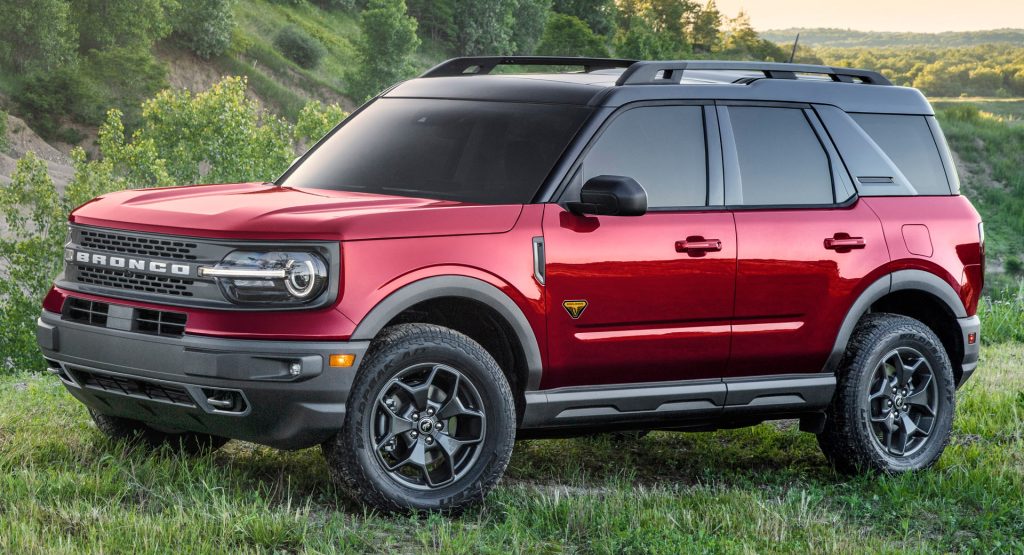
Mud-terrain tread also changes how the Bronco behaves when the surface becomes soft. Large tread blocks and open voids can shed mud more effectively than ordinary highway tires, allowing the tire to regain contact with firmer material beneath the loose surface.
That is why the Bronco belongs at the front of this comparison. Its tire options are not an afterthought. Ford built specific configurations around aggressive rubber, giving the suspension, gearing, and traction systems a tire capable of making use of their abilities.
2. Jeep Wrangler
Few SUVs have a stronger connection between factory tires and off-road capability than the Jeep Wrangler. Its trail-oriented versions can be equipped with substantial all-terrain or mud-terrain tires, with the Rubicon standing out because its tire package is designed specifically for demanding terrain rather than simply improved appearance.
The Wrangler’s available 33-inch and larger tire configurations provide useful sidewall height and ground clearance. On rocky trails, that sidewall becomes part of the suspension system in a practical sense. At appropriate pressures, the tire can deform around irregular surfaces instead of behaving like a rigid wheel rolling over them.
The Rubicon’s hardware makes this particularly meaningful. Jeep pairs aggressive tire options with features such as electronically disconnecting front sway bars and locking front and rear differentials. The result is a vehicle in which tire grip and suspension movement are intended to work together.
Another advantage comes from tread design. An all-terrain tire offers a compromise between pavement manners and off-road traction, while mud-terrain rubber sacrifices more road refinement to increase performance on loose and soft terrain. Wrangler buyers can therefore select a tire configuration that matches how aggressively they intend to use the vehicle.
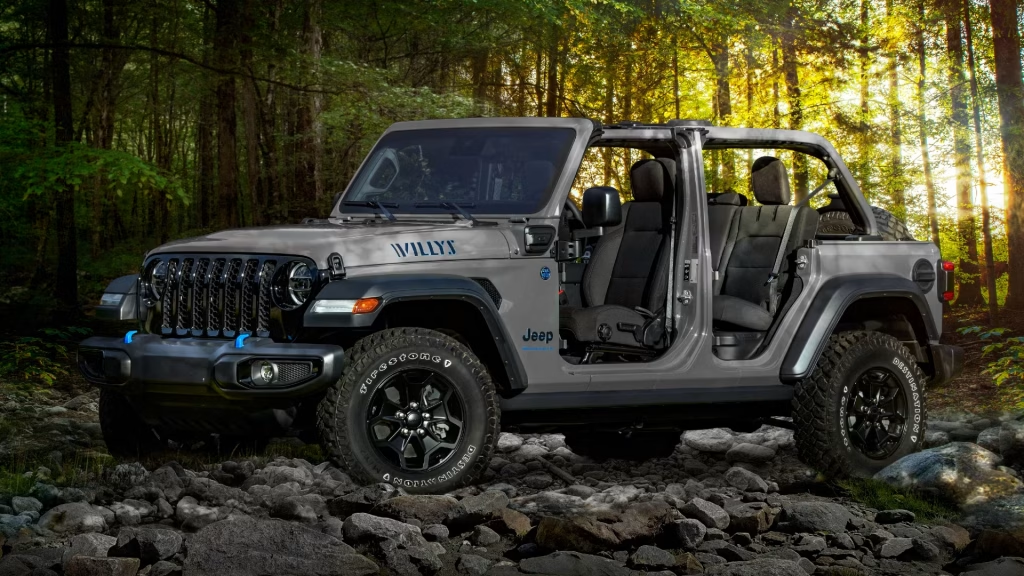
The Wrangler’s traditional body-on-frame architecture also gives its tire package a useful mechanical environment. Its short overhangs and strong approach and departure geometry allow the tires to reach obstacles without the bumpers becoming immediate limitations.
This SUV earns its place because Jeep designed the Wrangler’s tires to work as part of its overall off-road setup. The aggressive tread, reinforced sidewalls, and available trail-focused equipment are built to complement each other. Rather than simply adding rugged-looking tires for appearance, the Wrangler is engineered to take advantage of them when the road ends and the terrain becomes more challenging.
3. Toyota Land Cruiser
The Toyota Land Cruiser has spent decades developing a reputation for operating in environments where road surfaces are unreliable or nonexistent. Modern versions continue that philosophy, and their factory tire selections reflect a vehicle intended to travel well beyond ordinary paved roads.
The current Land Cruiser uses all-terrain tires on trail-focused configurations, with the available 18-inch wheel setup leaving meaningful sidewall between the rim and the ground.
That matters because sidewall height provides flexibility when negotiating uneven surfaces and allows appropriate pressure adjustments without immediately exposing the wheel to every impact.
Toyota’s approach is somewhat different from the extreme tire strategy seen on the most aggressive Bronco configurations.
The Land Cruiser combines moderate all-terrain rubber with sophisticated electronic systems, a full-time four-wheel-drive system, and a low-range transfer case. The tire therefore does not need to carry the entire burden of making the vehicle capable.
Its tread pattern is particularly useful on loose surfaces such as gravel, dirt, and sand. The open spaces between tread blocks provide channels for debris to move away from the contact area, while the relatively balanced design remains suitable for long highway journeys.
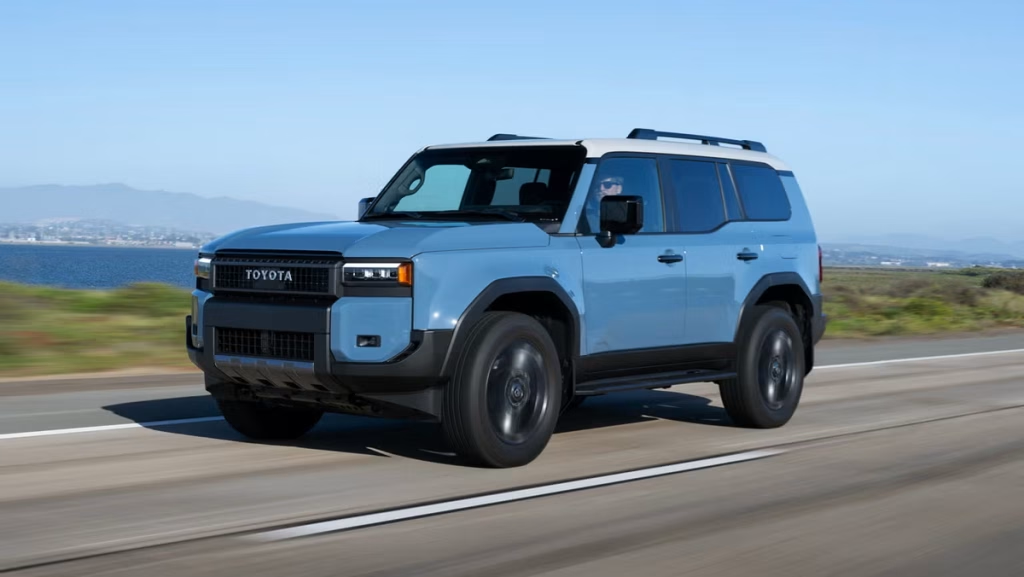
This dual-purpose character is important. Many Land Cruiser owners travel considerable distances before reaching the trail. A tire that performs impressively in mud but produces excessive road noise and poor highway behavior would undermine the SUV’s usefulness.
That balance explains its place on this list. The Land Cruiser demonstrates that a genuine off-road tire does not have to be an extreme mud tire. Properly selected all-terrain rubber can provide meaningful traction away from pavement while preserving the long-distance manners expected from a premium adventure SUV.
4. Lexus GX
The Lexus GX proves that an SUV does not have to look like a stripped-down trail machine to have serious off-road tire hardware. Recent GX models, particularly the Overtrail variants, receive all-terrain tires specifically selected to complement their off-road equipment.
The Overtrail’s 33-inch all-terrain tires are especially important because they provide a useful combination of diameter and sidewall height.
Larger tires can help the vehicle roll over uneven terrain, while the additional sidewall provides some ability to absorb and conform to obstacles. That is valuable on rocky trails where maintaining tire contact is more important than achieving high speeds.
Lexus also equips the Overtrail with a locking rear differential and Multi-Terrain Select, giving the tire a strong electronic and mechanical support system. These features can adjust how the vehicle manages wheelspin according to the surface, allowing the available traction to be used more effectively.
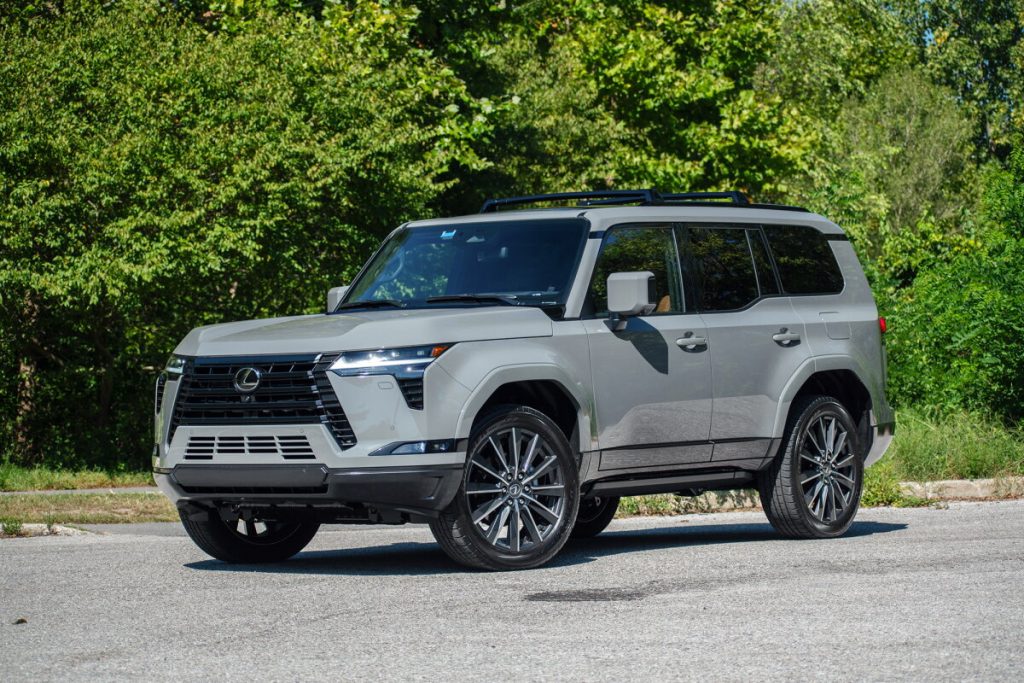
The tire itself remains critical. Electronic traction systems can only redistribute available torque. If a tire cannot generate sufficient grip on loose soil or wet rock, sophisticated software has limited physical traction to work with.
Another advantage of the GX is the sidewall’s role when air pressure is reduced for difficult terrain. Lower pressures can enlarge the contact patch and allow the tread to conform more effectively to rocks and irregular ground, although drivers must stay within safe operating practices and reinflate before returning to normal road speeds.
The GX earns its place because its aggressive factory tire package is supported by genuine trail equipment. Lexus has effectively taken the comfort expected from a luxury SUV and combined it with hardware that makes its all-terrain rubber useful beyond the pavement.
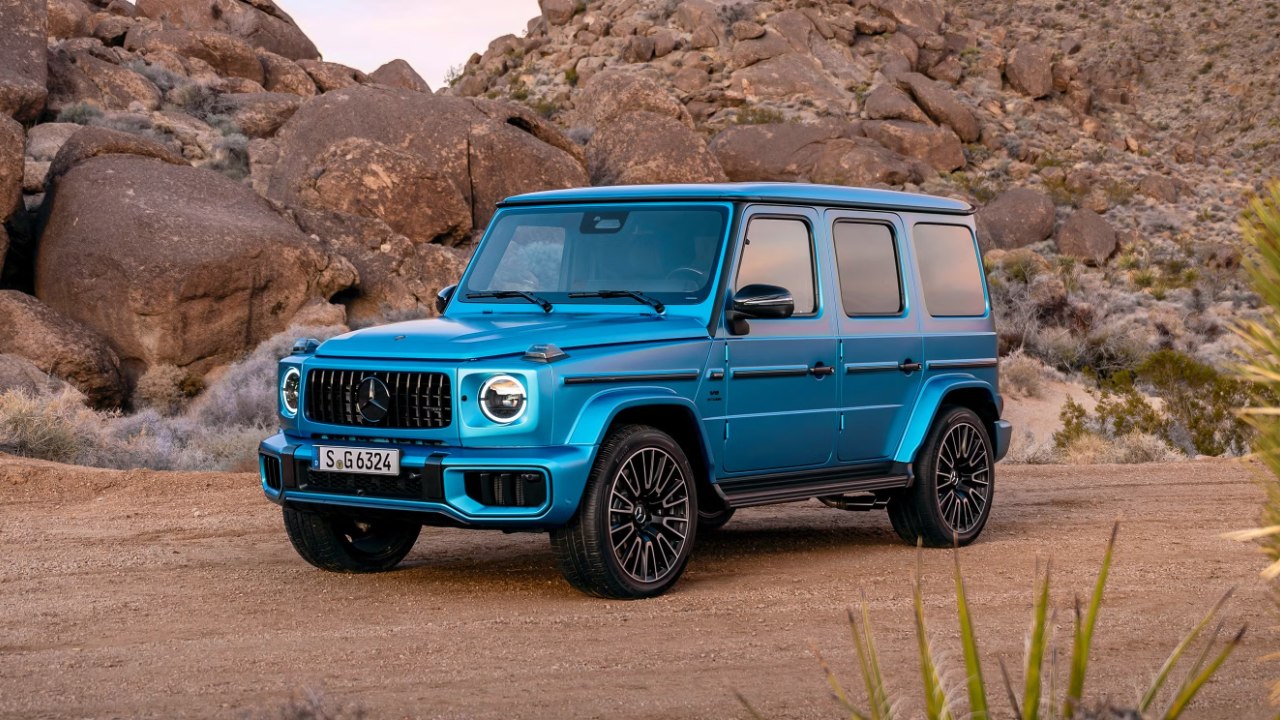
5. Mercedes-Benz G-Class
The Mercedes-Benz G-Class has an unusual position in this category because it combines luxury with a chassis originally developed for serious off-road work.
Its factory tires vary by market and specification, but certain G-Class configurations use all-terrain-oriented rubber that complements the SUV’s three-locking-differential architecture and substantial ground clearance.
The importance of the tire becomes apparent when the G-Class encounters a surface with dramatically different grip levels under each wheel. Its available front, center, and rear differential locks can mechanically prevent torque from simply escaping through a wheel with poor traction.
But those systems are most useful when the tires themselves can find purchase on the terrain. All-terrain tires provide a compromise that suits the G-Class’s dual identity. The vehicle may spend much of its life on asphalt, where excessive mud-terrain tread would produce unnecessary noise and compromise road behavior.
At the same time, the SUV retains the ability to leave the road without immediately being handicapped by highway-only rubber.

Its tall body and long-travel suspension also work with the tire’s sidewall. On rough surfaces, the tire can absorb smaller impacts before the suspension has to deal with them directly. That can help maintain a smoother contact patch across irregular terrain.
The G-Class demonstrates why tire selection should be considered alongside drivetrain hardware. Its legendary off-road systems would be less useful if paired exclusively with tires designed for smooth pavement. Instead, Mercedes gives appropriate versions a tire setup that allows the mechanical hardware to perform its intended job.
That combination makes the G-Class a convincing member of this group. It remains a luxury vehicle, but its tire and drivetrain choices acknowledge that its capabilities extend far beyond city streets.
5 SUVs With Street Rubber
1. Honda Pilot
The Honda Pilot is designed primarily as a family SUV, and its factory tire choices reflect that mission. Depending on trim, the Pilot uses highway-oriented or all-season tires developed around pavement comfort, wet-road performance, and everyday usability rather than serious trail work.
That makes sense for the pilot’s typical environment. Families are more likely to encounter highways, city streets, and wet parking lots than deep mud or rocky obstacles. A road-focused tread can deliver lower noise and smoother steering behavior, while the suspension and cabin are optimized for long-distance comfort.
The limitation appears when the vehicle is taken beyond maintained roads. The pilot’s available all-wheel-drive system can send torque where it is needed, but the tires still determine how much of that torque becomes forward movement.
On loose gravel, the tires can perform adequately. In deeper mud or over rough rocks, however, a less aggressive tread offers fewer edges for the surface to grip.
Sidewall construction also matters. Highway-oriented tires generally prioritize ride quality and road stability rather than the impact resistance expected from dedicated trail tires. That means sharp rocks and deep ruts demand more caution.
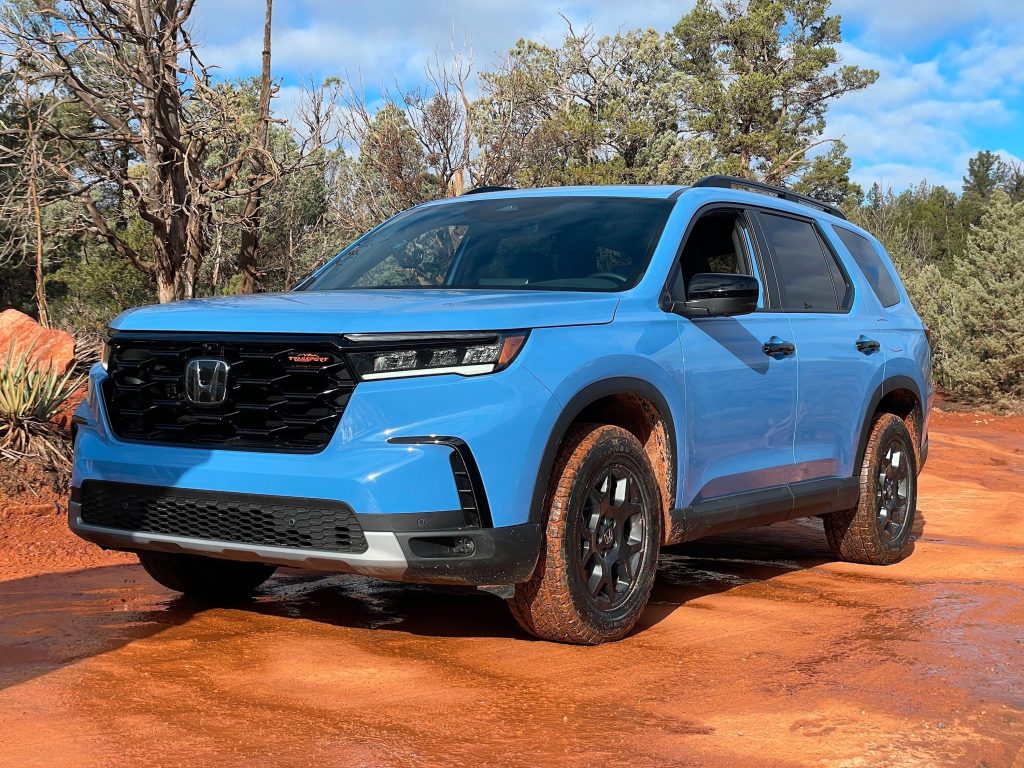
The Pilot earns a spot because it highlights an important distinction among modern SUVs. Having all-wheel drive does not necessarily mean a vehicle is built for serious trail use. The system can improve traction in bad weather and on unpaved surfaces, while the factory tires indicate that Honda primarily designed the Pilot for everyday driving rather than demanding off-road conditions.
For buyers who rarely leave pavement, that is an advantage rather than a weakness. The road-biased tire is quieter, more comfortable, and better aligned with everyday driving. It simply should not be mistaken for specialized off-road equipment.
2. Mazda CX-50
The Mazda CX-50 occupies a more adventurous position than many compact crossovers, yet its standard tire configurations remain strongly influenced by road use. Mazda designed the CX-50 to provide greater confidence on dirt and light trails, but its factory rubber does not turn it into a dedicated rock-crawling SUV.
The distinction can be seen in the type of tread used on many CX-50 configurations. Road-oriented all-season tires provide predictable handling and efficient operation on asphalt while still offering enough traction for gravel roads, wet grass, and moderate dirt tracks.
That compromise is exactly what many owners need. The CX-50 is likely to spend much more time commuting than climbing rock ledges. A deeply lugged mud tire would sacrifice refinement and efficiency for capability that many drivers would never use.
Once the terrain becomes more demanding, however, the tire becomes the limiting factor. Closely packed tread blocks can collect mud more readily than aggressive off-road patterns, while the sidewalls are not intended for repeated contact with sharp rocks. Drivers may also need to maintain more conservative speeds and choose their lines carefully.
Mazda’s all-wheel-drive system still provides a useful advantage. It can manage torque distribution and improve traction when individual wheels encounter reduced grip. But the system cannot replace tread depth, sidewall protection, or the self-cleaning ability of a purpose-built all-terrain tire.
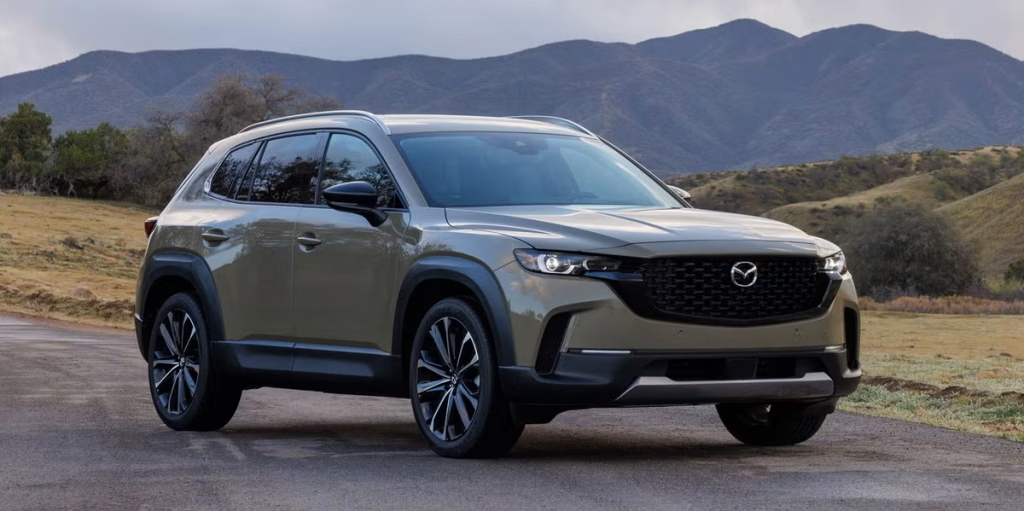
The CX-50 therefore represents a different kind of capability from the Bronco or Wrangler. It is an adventure-oriented crossover that can comfortably reach campsites, gravel roads, and maintained trails, but its standard road-biased rubber signals that Mazda’s priorities remain balanced between outdoor use and daily driving.
That is why it belongs in this group. The vehicle itself may look adventurous, but the tire specification provides a realistic boundary for how far that capability should be pushed.
3. Subaru Outback
The Subaru Outback is one of those SUVs where the distinction between all-weather capability and genuine off-road equipment can be easy to misunderstand.
Its standard tire setup is intended primarily for road use, even though the vehicle itself has a long-standing reputation for handling gravel, snow, and rough access roads. Subaru’s symmetrical all-wheel-drive system gives the Outback useful traction, but the factory tires remain an important part of the equation.
Road-oriented tires are built around surfaces that provide relatively consistent grip. Their tread patterns emphasize predictable steering, wet-weather water evacuation, and comfortable highway operation.
Those characteristics suit the Outback’s role as a family-oriented adventure vehicle that may travel hundreds of miles on pavement before reaching an unpaved destination.
The problem emerges when the trail becomes substantially rougher. Loose mud can fill narrower tread channels, reducing the tire’s ability to maintain effective contact with firmer material.
Sharp rocks present another concern because conventional road-biased construction is not designed around repeated impacts at reduced tire pressures.
The Outback’s ground clearance and X-MODE traction management can still make it surprisingly capable on mild trails. It can handle surfaces that would leave many ordinary crossovers struggling, particularly when the driver maintains appropriate momentum and chooses a sensible line.
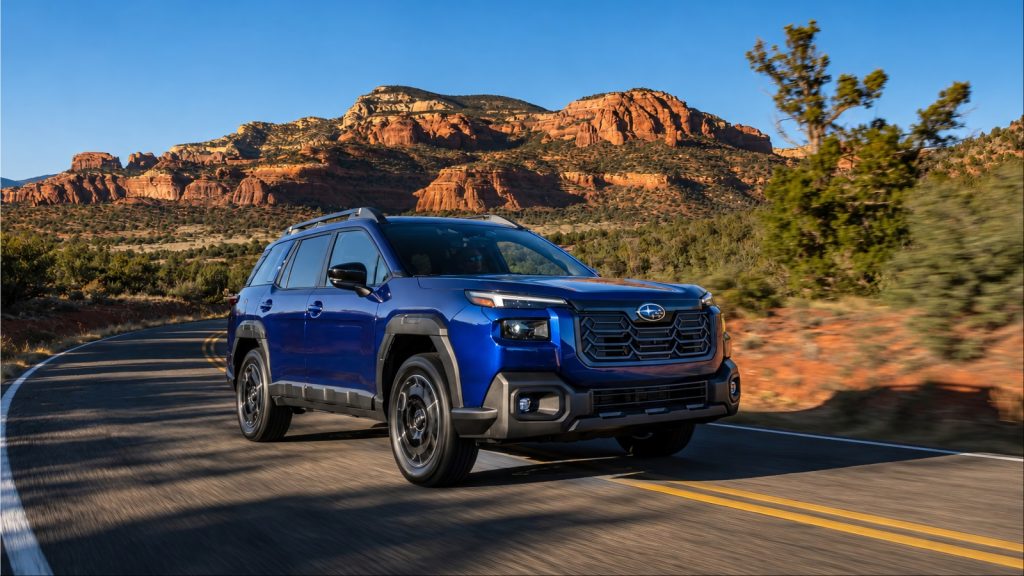
However, those capabilities should not be confused with the characteristics of a dedicated trail vehicle. The tire remains optimized for the compromises of daily transportation.
That makes the Outback a useful example in this comparison. Its road-focused rubber is exactly what makes it pleasant for commuting, touring, and wet-weather driving, but it also establishes a ceiling for more aggressive off-road use.
Changing to a properly selected all-terrain tire can alter that balance significantly, but the stock configuration is fundamentally designed around the road.
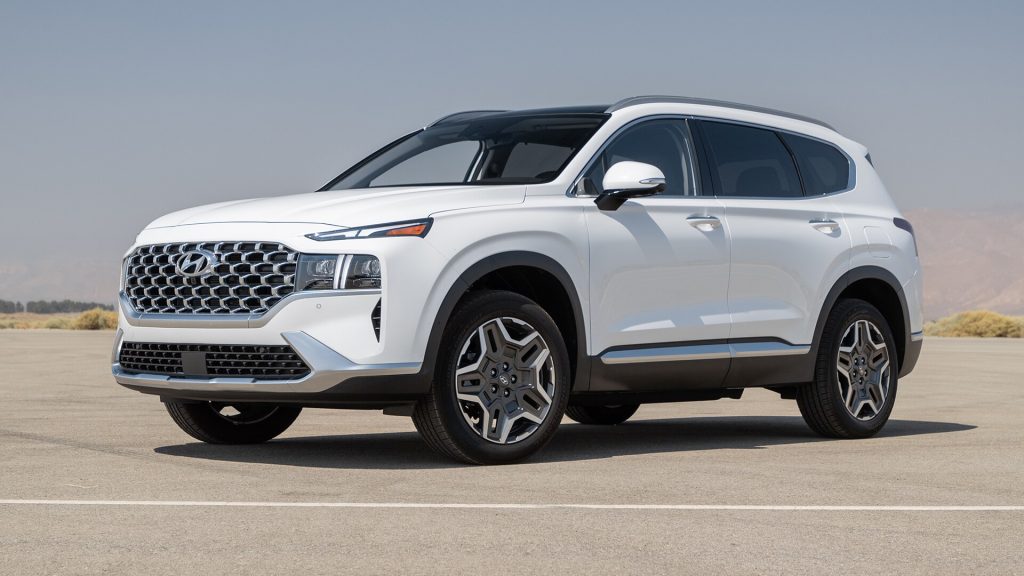
4. Hyundai Santa Fe
The Hyundai Santa Fe has the equipment needed to provide confident traction on poor roads, but its factory tire configuration is fundamentally aimed at everyday pavement use.
Depending on the trim and market, the Santa Fe uses all-season tires designed to provide balanced performance across dry roads, rain, and moderate winter conditions rather than deep mud or technical trails.
That choice makes sense considering the vehicle’s mission. The Santa Fe is a family crossover first. Its buyers generally need quiet highway operation, predictable cornering, and comfortable ride quality rather than maximum traction on rock gardens.
A heavily lugged tire would introduce compromises that would be noticeable every day while providing benefits only occasionally.
The limitation becomes clear once an unpaved route deteriorates. A smooth gravel road presents little difficulty, but deep mud, loose stones, and steep, uneven surfaces demand more from the tread. A road-focused tire has fewer large voids through which mud can escape and generally provides less mechanical bite in loose terrain.
The Santa Fe’s electronically controlled all-wheel-drive system can compensate for differences in wheel traction by directing power where it can be used more effectively. That technology is valuable when a wet road or slippery surface catches one axle off guard. It does not, however, turn an all-season tire into an all-terrain tire.
There is also a practical consideration involving sidewalls. Road tires are designed to deliver a comfortable ride and stable handling on paved surfaces. Repeated impacts against sharp rocks are outside the environment for which they are optimized.
The Santa Fe therefore earns its place here not because it lacks useful traction technology, but because its tire choice establishes a different priority. Hyundai has optimized the SUV for the roads most owners actually use.
It can venture onto dirt and gravel, but drivers heading into genuinely difficult terrain should recognize that the tires, rather than the drivetrain, may become the first major limitation.
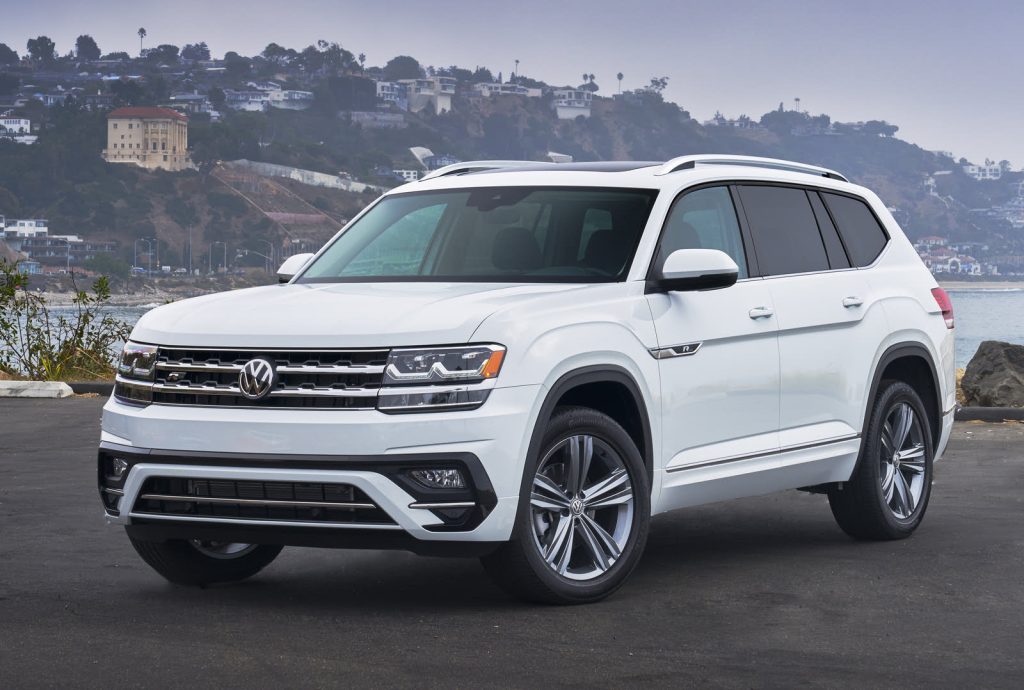
5. Volkswagen Atlas
The Volkswagen Atlas provides plenty of space, substantial proportions, and, in applicable configurations, all-wheel-drive capability, yet its standard tire philosophy remains focused on everyday road driving. Its factory rubber is selected primarily around highway stability, comfort, and all-season usability rather than the demands of serious off-road travel.
That distinction becomes important because the Atlas can visually suggest greater capability than its tires actually provide. Its size and SUV proportions can make a dirt trail seem like a natural environment for the vehicle, but appearance does not determine traction. The tread has to generate usable grip on whatever surface lies beneath it.
On pavement, the Atlas’s road-focused tires make sense. Their tread design is suited to wet and dry roads, while the relatively road-friendly construction helps maintain predictable steering and comfortable ride quality. Those characteristics are especially valuable in a large family SUV that may spend much of its life carrying passengers on highways.
An unmaintained trail introduces different demands. Mud requires tread voids capable of clearing material rather than allowing it to remain packed between blocks.
Rocks require sidewall durability and a tire capable of operating at appropriate off-road pressures. Sand requires a broad, compliant contact patch. A conventional road tire is not optimized for all of those conditions.
The Atlas can still manage many unpaved surfaces. A maintained forest road or firm gravel track is very different from a muddy trail filled with deep ruts, and the vehicle’s available traction management can help when the surface becomes slippery.
Its inclusion in this category therefore illustrates the difference between an SUV capable of traveling off pavement and one equipped specifically for off-road traction. The Atlas is designed to take families farther than a conventional sedan, but its stock tires keep the emphasis firmly on road manners. For serious trail use, the tire is likely to become the first component demanding extra caution.
