
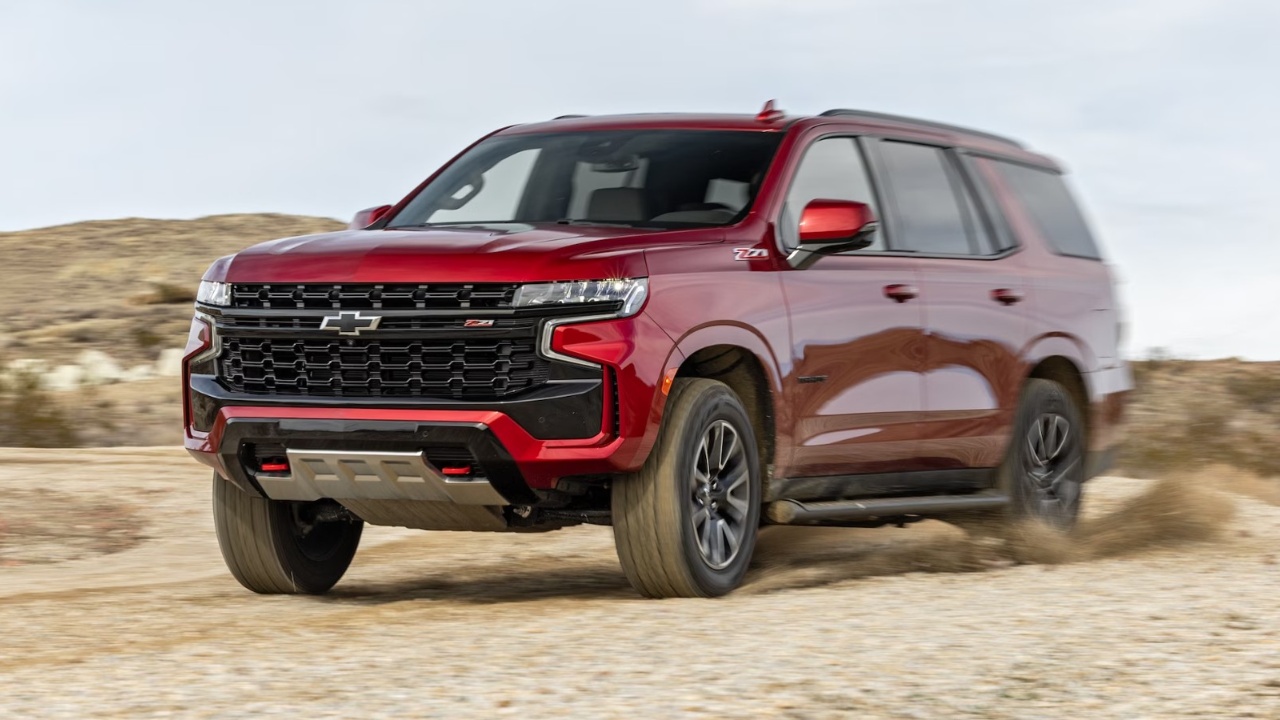
For families, a third row is useful only when it can quickly make room for people or cargo. Power-folding seats take that convenience a step further by allowing drivers to transform the rear of an SUV with the push of a button rather than manually lifting heavy seatbacks.
The feature is becoming increasingly common in large three-row SUVs, but availability still varies by trim and configuration. Some models offer a 60/40 split, while others provide more sophisticated 40/20/40 arrangements.
The following new U.S.-market SUVs combine three-row seating with powered third-row folding, making interior reconfiguration considerably easier.
1. 2026 Ford Expedition
The Ford Expedition has turned its third row into something much easier to manage than the heavy manual seats found in older SUVs.
Ford’s 2026 specifications list a 40/20/40 PowerFold third row, allowing the rear seats to fold electronically rather than requiring passengers to pull straps and physically push the seatbacks forward. The system is designed to make the transition from passenger duty to cargo duty considerably less demanding.
The split arrangement is especially useful when the owner needs only part of the rear area. Instead of sacrificing all three rear seating positions, the available configuration lets users create different combinations of passengers and cargo.
That can matter during a family trip when someone needs to remain in the third row while luggage occupies the remaining space.
Ford also redesigned the Expedition’s interior for the current generation, giving it a large 24-inch panoramic display that incorporates the digital instrument panel and center information area. Yet the powered seating remains a physical convenience feature rather than another screen-based gimmick.
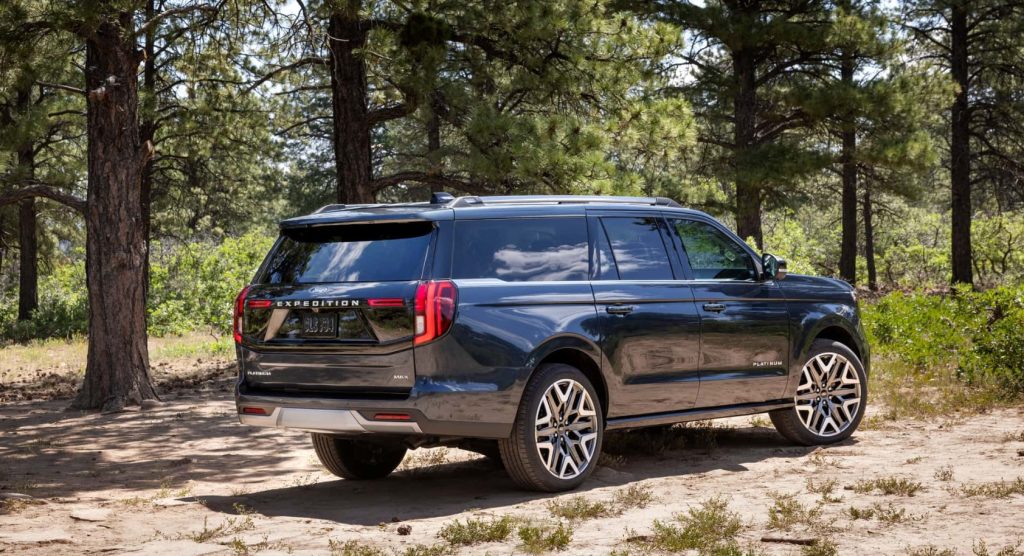
There are two versions of the 3.5-liter EcoBoost V6. The standard engine produces 400 horsepower and 480 lb-ft of torque, while the high-output version produces 440 horsepower and 510 lb-ft. Ford rates properly equipped versions for as much as 9,600 pounds of conventional towing.
The combination makes the Expedition useful for more than school runs. It can carry a full passenger load, tow a substantial trailer, and then quickly convert its rear cabin into additional cargo space. For a large SUV, that flexibility is one of the most useful reasons to have power-operated third-row seating.
2. 2026 Toyota Sequoia
The Toyota Sequoia enters 2026 with an important change that directly addresses third-row convenience. Toyota made power-folding third-row seating standard across the lineup for the 2026 model year, meaning buyers no longer have to restrict their search to an expensive upper trim simply to get electrically operated rear seats.
The system uses a 60/40 split, so the third row can be configured for a mixture of passengers and cargo. That becomes particularly useful with the Sequoia’s sliding third-row design and adjustable cargo shelf system. Toyota lists a maximum cargo capacity of 86.9 cubic feet with the rear seats folded, while the SUV can seat up to eight with its second-row bench.
There is an interesting mechanical story underneath the convenience feature. Every 2026 Sequoia uses Toyota’s i-FORCE MAX hybrid powertrain, combining a twin-turbocharged V6 with an electric motor and a 10-speed automatic transmission. The system produces 437 horsepower and 583 lb-ft of torque.
That gives the Sequoia a character quite different from many family-focused three-row SUVs. It is built on a truck-based platform and can tow up to 9,500 pounds when properly equipped. The power-folding third row therefore complements a vehicle capable of handling substantial trailers while still serving as a family hauler.
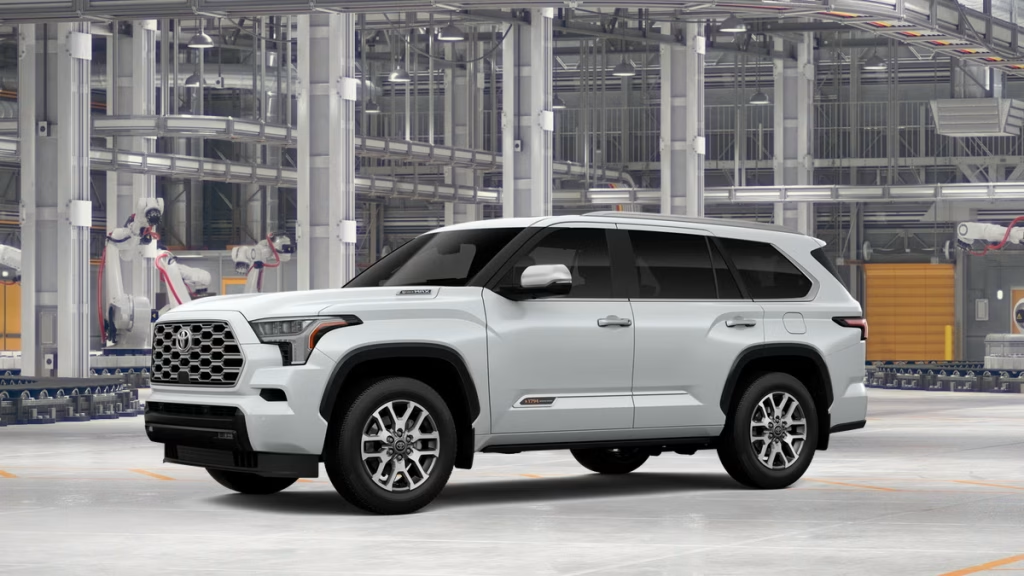
Toyota’s decision to make the feature standard for 2026 is significant because powered seating is no longer merely a luxury convenience here. A buyer choosing the entry-level SR5 can get the same basic third-row folding technology without moving into the upper reaches of the lineup.
3. 2026 Chevrolet Tahoe
The Chevrolet Tahoe is one of the clearest examples of a large family SUV, making the third row easier to manage with the push of a button. For 2026, the Tahoe can be equipped with power-folding third-row seatbacks, with switches positioned in the cargo area.
Chevrolet’s owner’s manual explains that the left and right portions of the third row can be folded independently, allowing the driver to create different combinations of passenger and cargo space.
That split is more useful than it might initially sound. If a family needs to carry a long item while keeping passengers in the third row, only one side can be lowered. When the entire rear area is needed for cargo, both sections can be folded flat.
The ability to control the seats from the cargo area also means there is no need to climb into the back just to rearrange them.
The Tahoe’s large dimensions make this feature especially valuable. Chevrolet offers seating for up to eight, depending on configuration, while the SUV can be ordered with a 5.3-liter V8, 6.2-liter V8, or 3.0-liter Duramax turbo-diesel. The diesel produces 305 horsepower and 495 lb-ft of torque, while the 6.2-liter V8 develops 420 horsepower and 460 lb-ft.
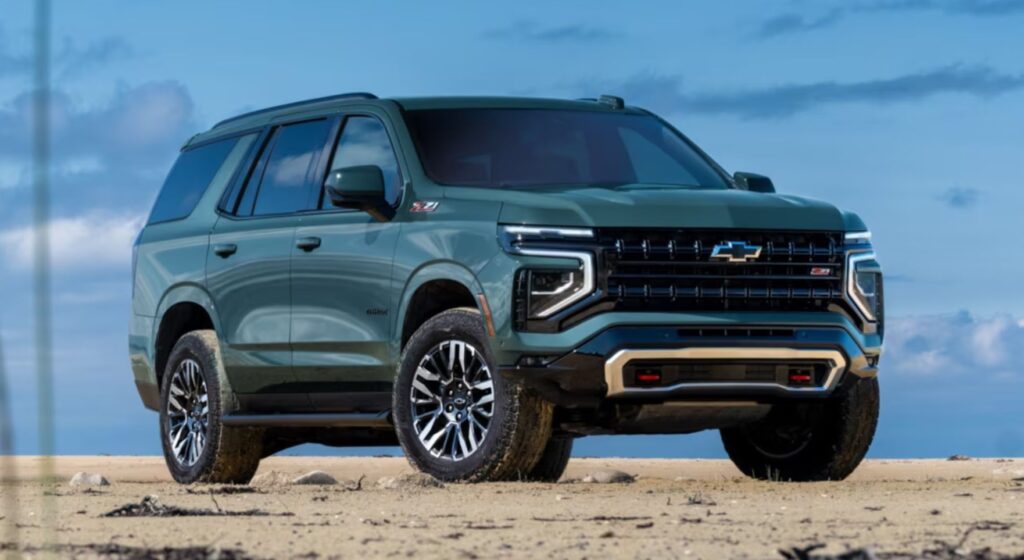
The Tahoe can also tow up to 8,400 pounds when properly equipped, giving the power-folding third row a role beyond everyday family transportation.
A useful detail is that power folding is configuration-dependent, so buyers should verify the exact trim and equipment rather than assuming every Tahoe has electrically operated third-row seats.
4. 2026 GMC Yukon
The GMC Yukon takes the same basic concept and gives it a more upscale setting. GMC states that the Yukon has standard power-folding third-row seats, making the feature considerably easier to find than in many SUVs where it is restricted to expensive packages.
The controls are positioned in the cargo area, and GMC’s 2026 owner’s manual describes separate switches for the left and right sides of the third row. Holding the appropriate switch folds the seatback, while another operation raises it back into position.
That means the driver can configure the rear of the SUV while standing behind it, which is particularly convenient when loading groceries, luggage, or large objects.
The Yukon also offers a useful choice between standard and extended body styles. The regular Yukon provides substantial cargo capacity behind the third row, while the Yukon XL stretches the body to provide considerably more room for luggage without requiring the third row to be sacrificed.
GMC lists the Yukon as seating up to eight, depending on configuration. Powertrain choices include a 5.3-liter V8, a 6.2-liter V8, and an available 3.0-liter Duramax turbo-diesel. Properly equipped, the Yukon can tow up to 8,400 pounds.
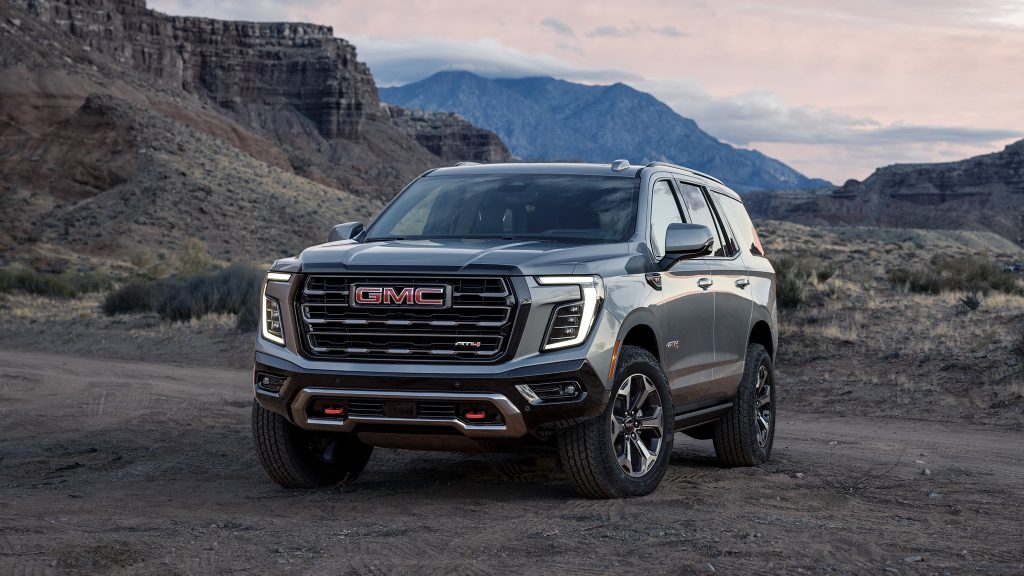
What makes the Yukon particularly interesting is how the powered third row fits into its broader interior philosophy.
GMC has loaded the SUV with large screens, available Super Cruise, and a power-sliding center console. However, for families, one of its most practical features is also one of the simplest. With the push of a button, the third row folds away neatly into the cargo area.
For households that frequently switch between passengers and bulky cargo, that can save considerable effort.
5. 2026 Hyundai Palisade
The 2026 Hyundai Palisade makes powered third-row operation particularly interesting because Hyundai has integrated the function into a much broader interior-control system.
On appropriately equipped versions, the third row can be folded and unfolded using controls in the cargo area, giving the driver a way to change the rear seating arrangement without reaching into the seatbacks manually. Hyundai lists the 60/40 split third row across the lineup, while power-folding and unfolding are available on higher trims.
That distinction matters when shopping. The feature is not standard on every Palisade, so buyers looking specifically for powered third-row operation need to target the appropriate Limited or Calligraphy configurations.
Hyundai also provides electric cargo-area releases for the second row, making it easier to access the third row or create additional cargo room.
Once folded, the Palisade provides 46.3 cubic feet of cargo space behind the second row and 86.7 cubic feet with both rear rows folded. With all three rows in use, there are 19.1 cubic feet behind the third row.
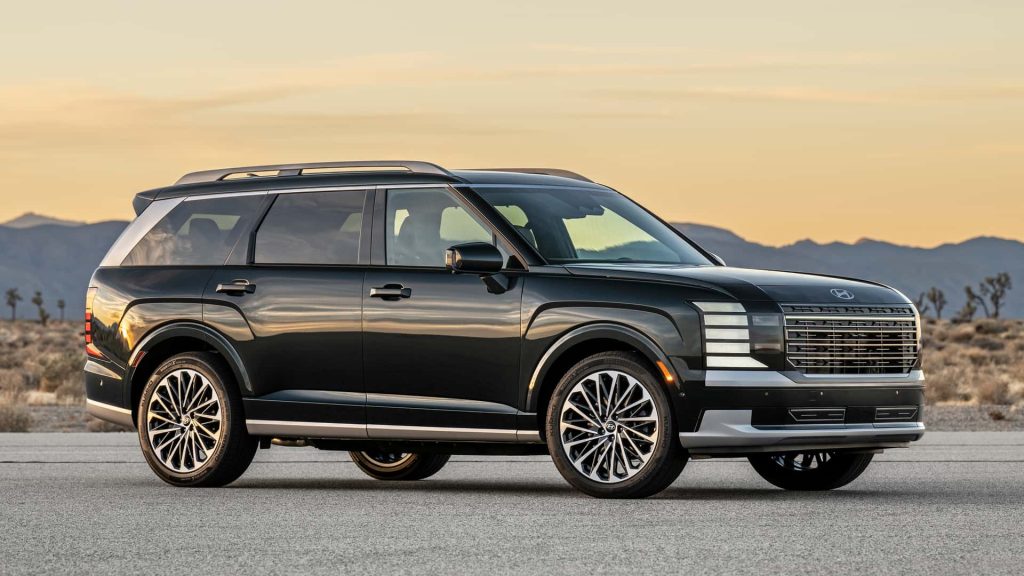
The 2026 gasoline Palisade uses a 3.5-liter V6 producing 287 horsepower and 260 lb-ft of torque. A new hybrid version is also available, with Hyundai listing 329 combined horsepower and 339 lb-ft of combined torque.
For families, the powered seats are more than a luxury flourish. They make it much easier to switch between carrying six or seven passengers and loading bulky items, particularly when the rear seats need to be rearranged frequently.
6. 2026 Hyundai Palisade Hybrid
The 2026 Hyundai Palisade Hybrid deserves its own place because the electrified version combines the same useful power-folding third-row concept with a completely different powertrain.
Hyundai’s U.S. specifications show 60/40 split third-row seating, with power folding and unfolding available on the appropriate higher trims. The controls can be accessed from the cargo area, making it possible to transform the rear cabin without manually lifting the seatbacks.
This becomes especially useful when the SUV is being used as a family vehicle during the week and a cargo carrier on weekends. With the third row folded, Hyundai lists 46.3 cubic feet of cargo capacity behind the second row. Folding both rear rows increases the available space to 86.7 cubic feet.
The hybrid system is the major difference from the regular Palisade. Hyundai combines a 2.5-liter turbocharged four-cylinder with an electric motor and a 1.65-kWh lithium-ion battery. The company rates the system at 329 combined horsepower and 339 lb-ft of combined torque.
The hybrid also illustrates how manufacturers are adding convenience features without abandoning physical controls altogether. The Palisade’s infotainment system can be used for various vehicle functions, but the powered seating gives occupants dedicated controls for changing the cabin configuration.
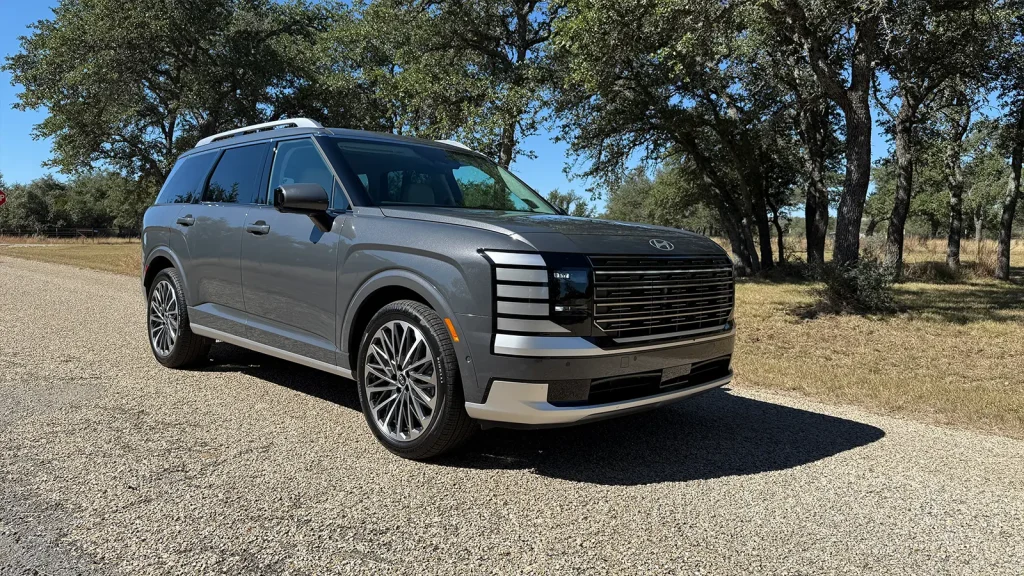
Hyundai specifically identifies the power-folding third-row function on the higher Calligraphy and Limited Hybrid trims. Lower versions retain split-folding third-row seats but do not provide the same powered operation.
For buyers who want three rows, electrification and an easy way to convert passenger space into cargo space, the Palisade Hybrid offers an unusual combination in the current U.S. SUV market.
7. 2026 Jeep Grand Cherokee L
The Jeep Grand Cherokee L proves that power-folding third-row seating is not limited to the biggest full-size SUVs. Jeep lists an available power-folding third-row bench for the 2026 Grand Cherokee L, giving this three-row version of the Grand Cherokee a useful advantage when the cabin needs to switch from passenger duty to cargo hauling.
The system is particularly useful because the Grand Cherokee L is smaller than many traditional full-size three-row SUVs. The Jeep lists 17.2 cubic feet of cargo space behind the third row. Fold that row down, and the figure rises to 46.9 cubic feet with the second row in place. With both rear rows folded, the available volume reaches 84.6 cubic feet.
That means the powered seat is not merely a luxury feature. It changes how the SUV can be used during the day. A family can carry seven people in the morning, fold the third row when shopping, and create a substantially larger cargo area without manually wrestling with the rear seatbacks.
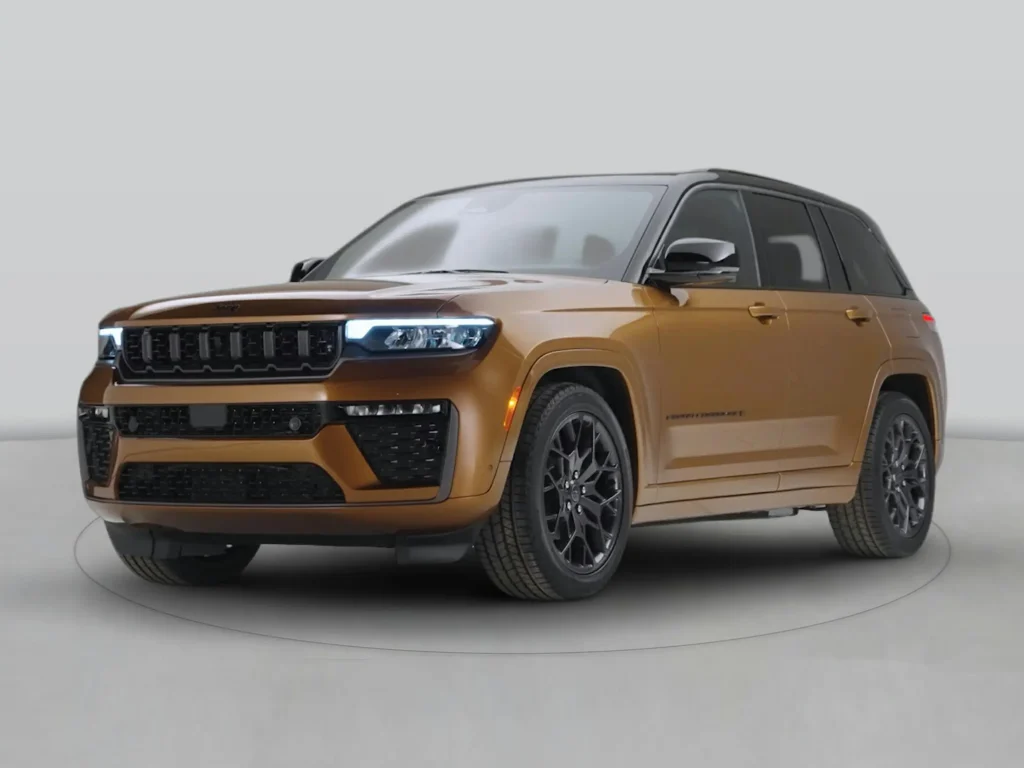
Jeep also offers the Grand Cherokee L with a choice of second-row seating arrangements. Buyers can select captain’s chairs or a bench, allowing seating for up to seven people. The third row itself is designed to fold when additional cargo room is required.
For 2026, the Grand Cherokee L continues to use a 3.6-liter Pentastar V6, giving the SUV enough output for everyday family use and towing duties. The available power-folding third row makes the package particularly practical for buyers who want three-row versatility without moving into a full-size SUV.
8. 2026 Lincoln Navigator
The Lincoln Navigator takes power-folding seating into the luxury SUV category, and its third-row arrangement is more sophisticated than a simple 50/50 split. Lincoln offers a 40/20/40 PowerFold third-row bench that can fold flat at the touch of a button.
That middle section can therefore be lowered independently, giving owners several ways to balance passengers and cargo.
That flexibility matters in a vehicle designed to carry large families. The Navigator can seat up to eight people when equipped with the available second-row bench, while captain’s chairs reduce capacity to seven. With the third row folded, the SUV becomes substantially more useful for luggage, sports equipment, and bulky purchases.
Lincoln lists 21.6 cubic feet of cargo space behind the third row in the standard Navigator. Folding the rear seats expands maximum cargo capacity to 107 cubic feet. The longer Navigator L stretches the body by almost 12 inches and raises maximum cargo capacity to 121.6 cubic feet.
The power-folding third row is only one part of the Navigator’s electrically operated interior. Lincoln also offers PowerFold second-row seating, allowing the cabin to be reconfigured with considerably less physical effort. The result is a vehicle where several seating positions can be changed without manually lifting large seatbacks.
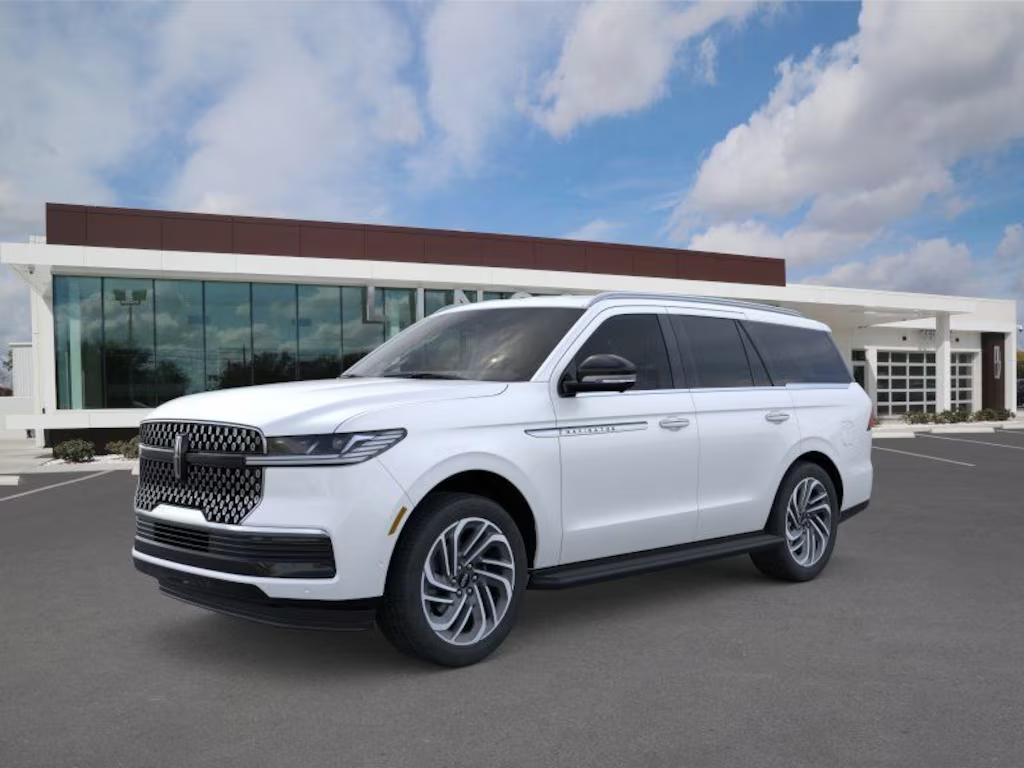
The 2026 Navigator is powered by a twin-turbocharged 3.5-liter V6 that delivers 440 horsepower and 510 lb-ft of torque. Its strong engine gives the large luxury SUV plenty of power, while the powered seats serve a more practical purpose by making the spacious cabin easier to configure for passengers and cargo.
9. 2026 Acura MDX
The Acura MDX approaches power-operated seating from a more compact luxury-SUV perspective. Acura’s 2026 specifications list a 50/50-split third row, and the MDX provides a variety of electrically operated seating functions throughout the cabin.
Its emphasis is less about turning the SUV into a giant cargo carrier and more about making a premium three-row interior easier to configure.
The MDX has 16.3 cubic feet of cargo capacity behind the third row. Folding the third row increases the available area behind the second row to 39.1 cubic feet, while folding both rear rows provides as much as 71.4 cubic feet.
Acura also provides a removable second-row center seat, allowing owners to change the cabin between a seven-passenger arrangement and a configuration with second-row captain’s chairs.
That flexibility gives the MDX a slightly different purpose from enormous body-on-frame SUVs. It is easier to maneuver in everyday surroundings while still providing a third row when needed. The power-related convenience features help make that compromise easier to live with.
Acura offers two engines for 2026. Standard MDX versions use a naturally aspirated 3.5-liter V6 producing 290 horsepower and 267 lb-ft of torque. The Type S Advance receives a 3.0-liter turbocharged V6 producing 355 horsepower and 354 lb-ft of torque.
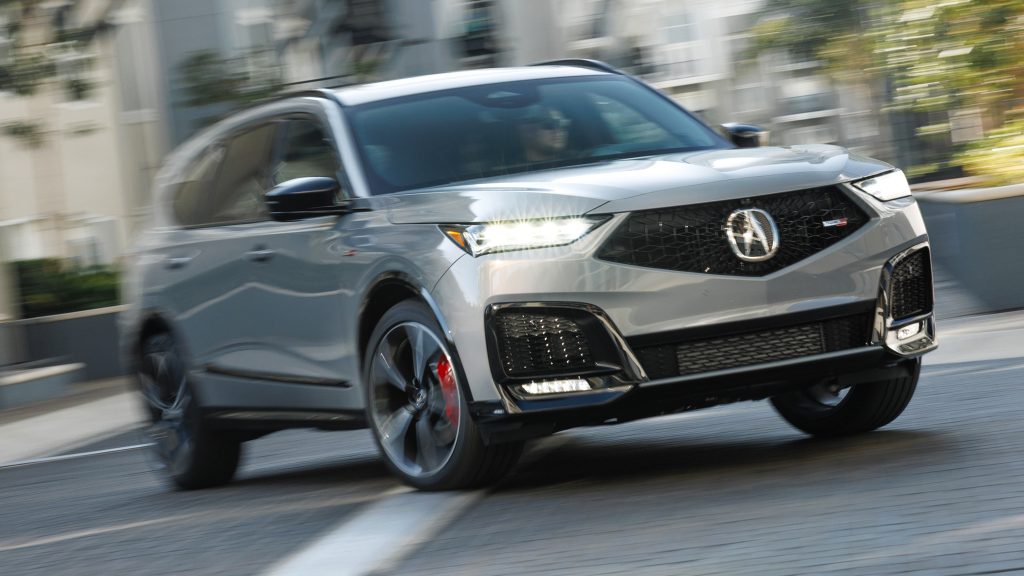
The third row is also genuinely usable for the class, with 29.1 inches of third-row legroom and 36.2 inches of headroom.
For buyers who want a luxury SUV that can carry seven people but does not feel as enormous as a full-size model, the MDX combines flexible seating with a relatively manageable footprint.
10. 2026 Cadillac Escalade IQ
The Cadillac Escalade IQ proves that power-folding third-row seating is not disappearing as SUVs move toward electric powertrains.
Cadillac lists a power-folding third row as standard equipment on the 2026 Escalade IQ, giving the electric luxury SUV the ability to switch between passenger and cargo configurations without manually lowering the rear seatbacks.
The numbers are substantial. Cadillac’s specifications show seating for seven and 24.2 cubic feet of cargo space behind the third row. Fold the second and third rows, and the available area rises to as much as 125.2 cubic feet.
There is also a 12.2-cubic-foot eTrunk beneath the hood, giving the Escalade IQ another storage area separate from the passenger compartment.
The third row itself offers 36.7 inches of legroom, while the second row provides 41.4 inches. That gives the Escalade IQ an unusually spacious interior for an electric SUV.
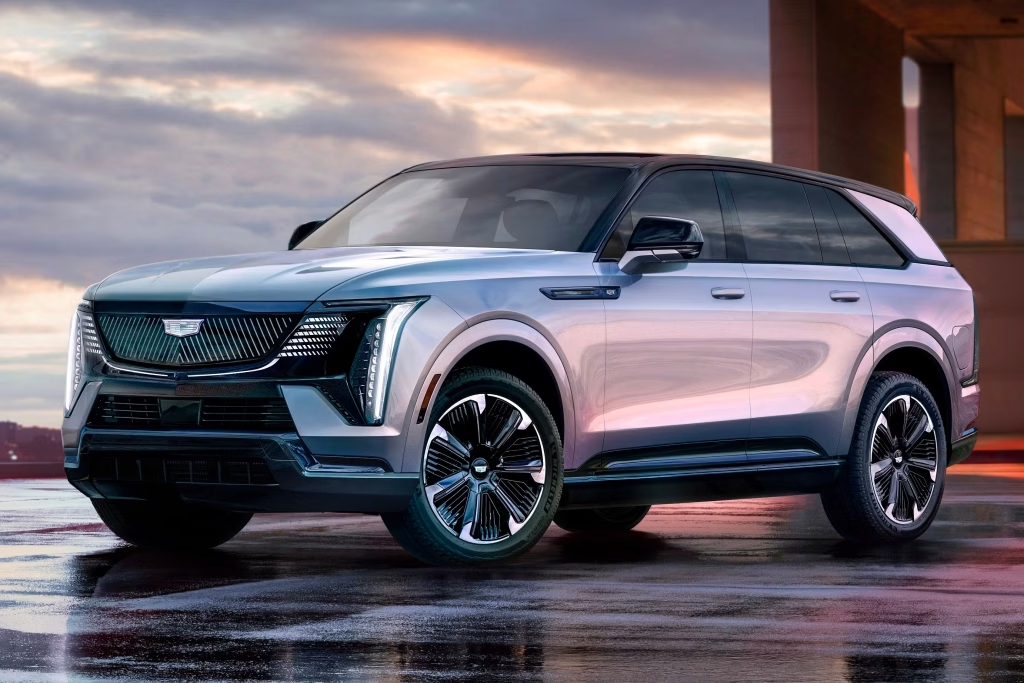
Its powertrain is just as dramatic. The Escalade IQ uses a large battery-electric system producing up to 750 horsepower and 785 lb-ft of torque in its available Velocity Max configuration. Cadillac also lists up to 450 miles of estimated range for the model, depending on configuration and testing conditions.
The powered third row therefore fits naturally into the vehicle’s high-tech character. A 55-inch Horizon Display spans the dashboard, the SUV can charge at up to 350 kW, and the rear seats can fold electrically to create a huge cargo area.
Rather than treating powered seating as an isolated luxury feature, Cadillac has made it part of a broader approach to convenience. The Escalade IQ combines electric performance, extensive passenger space, and push-button cargo flexibility in one of the most technologically advanced three-row SUVs in the current U.S. market.
