
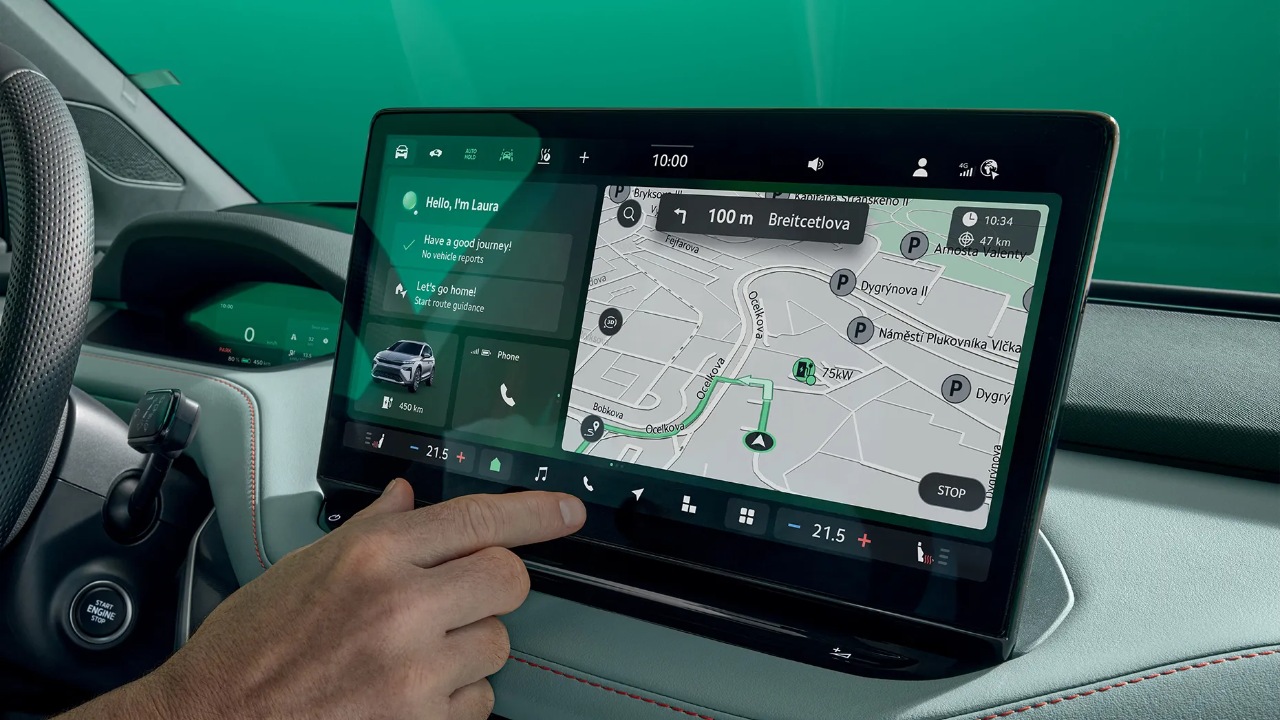
Infotainment has become one of the biggest differences between modern cars. A good system should do more than put a giant screen in the dashboard.
It needs to respond quickly, present information clearly, integrate smartphones smoothly, and make navigation, music, and vehicle controls easy to access while driving.
In 2026, several U.S.-market vehicles are pushing this technology much further, with OLED displays, Google-based software, sophisticated voice assistants, over-the-air updates, and screens stretching almost across the cabin.
The cars below stand out for combining impressive hardware with useful software, rather than relying on screen size alone to create a high-tech impression.
1. Mercedes-Benz EQS
The Mercedes-Benz EQS remains one of the clearest examples of what happens when a luxury automaker treats infotainment as a central part of the cabin rather than simply adding a large touchscreen.
Its MBUX Hyperscreen combines three displays beneath a single curved glass surface, creating a dashboard that stretches almost from one A-pillar to the other.
In the U.S.-market 2026 EQS 450 4MATIC Sedan, Mercedes-Benz lists a 12.3-inch digital instrument cluster, a 17.7-inch OLED central display, and a 12.3-inch OLED passenger display as part of the system.
What makes the setup interesting is that the passenger receives a dedicated screen rather than simply sharing the driver’s display. The front passenger can interact with entertainment and other functions without taking over the central screen.
Mercedes also uses its Zero Layer interface to place frequently needed functions and applications closer to the surface instead of forcing the driver through multiple menus.
Voice control is another major part of the experience. The MBUX system responds to the “Hey Mercedes” activation phrase and uses natural-language understanding for commands.
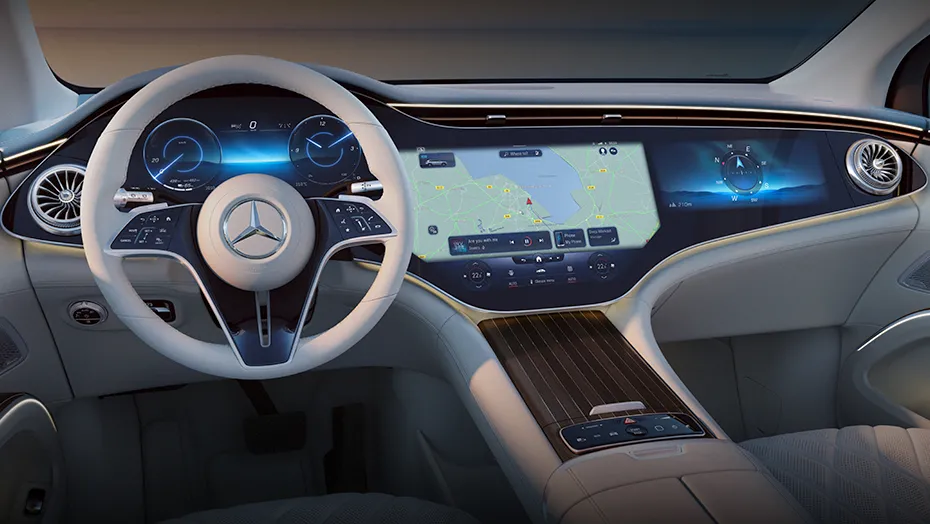
Mercedes-Benz says the system can control functions such as navigation and climate settings through voice interaction, while over-the-air updates allow the software to evolve after the vehicle leaves the dealership.
The EQS therefore stands out not simply because it has three screens. It combines OLED display technology, dedicated passenger interaction, voice control, navigation, and software updates into one integrated digital environment. That makes the infotainment experience feel like an important part of the vehicle’s architecture rather than an accessory added to it.
2. Cadillac Escalade IQ
The Cadillac Escalade IQ takes the giant-screen approach to an entirely different level. Its dashboard features a 55-inch Horizon Display, a continuous screen that combines the driver’s information area with the central infotainment interface.
Cadillac describes the display as spanning the dashboard, giving the electric luxury SUV one of the largest integrated screens available in a production vehicle.
The impressive part is that the display is not there simply for visual drama. Cadillac integrates navigation, media controls, vehicle information, and other functions into the ultra-wide interface.
The 2026 Escalade IQ also offers Google built-in compatibility and a 5G Wi-Fi hotspot, giving the system access to connected services beyond traditional radio and smartphone mirroring.
Audio is another major part of the cabin’s technology package. The luxury version includes a 19-speaker AKG Studio Audio System, while the sport version raises that to 21 speakers. Buyers choosing the available Executive Second-Row package can get a 42-speaker AKG Studio Reference Audio System with Dolby Atmos.
Rear passengers have their own technology options as well. Cadillac offers two 12.6-inch rear touchscreen displays as part of the rear-seat entertainment system. That turns the Escalade IQ into something closer to a mobile entertainment lounge for passengers on long trips.
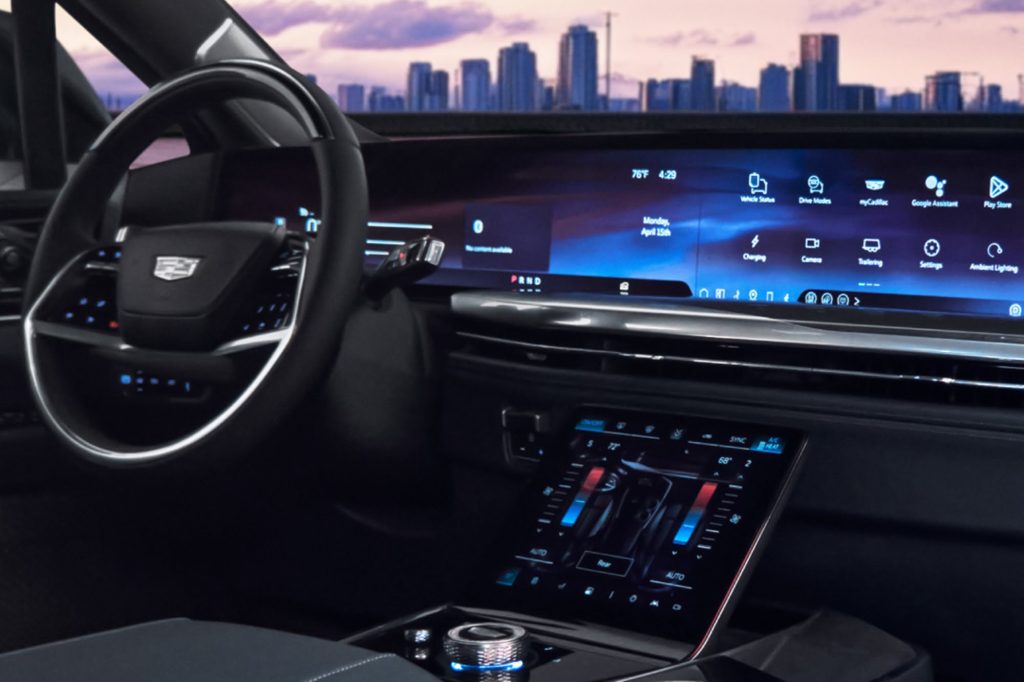
The sheer size of the main display is obviously part of the attraction, but the Escalade IQ’s appeal comes from how much of the cabin’s digital experience is connected through it.
The combination of the 55-inch Horizon Display, Google built-in compatibility, 5G connectivity, and sophisticated audio gives the electric Escalade a distinctly digital character. It demonstrates how infotainment is increasingly becoming one of the defining features of a luxury vehicle rather than simply a place to control the stereo.
3. 2026 Audi A6
Audi’s latest MMI system takes a different approach from the giant-screen trend. Instead of making the display the story by itself, Audi has focused on how quickly and naturally the system responds to the driver.
The 2026 Audi A6 uses the automaker’s newest MMI infotainment architecture, based on Android Automotive OS and developed with Volkswagen Group’s CARIAD software division. MotorTrend named Audi MMI its 2026 Best Tech Award winner for infotainment, specifically citing its responsive operation and intuitive user experience.
The A6 also gives occupants a modern digital layout without making every function dependent on a single enormous touchscreen. Its infotainment interface is integrated with the digital cockpit, while the system supports smartphone connectivity and Audi’s connected services.
The underlying Android Automotive platform is particularly important because it allows the vehicle’s software to operate independently rather than simply mirroring a phone for its core functions.
What separates the A6 from some screen-heavy rivals is the emphasis on usability. In a recent comparison involving the 2026 A6, Car and Driver found Audi’s latest Android-based system easier to use than the more complicated interfaces in several competing luxury sedans. That is an important distinction because infotainment quality is not determined by display size alone.
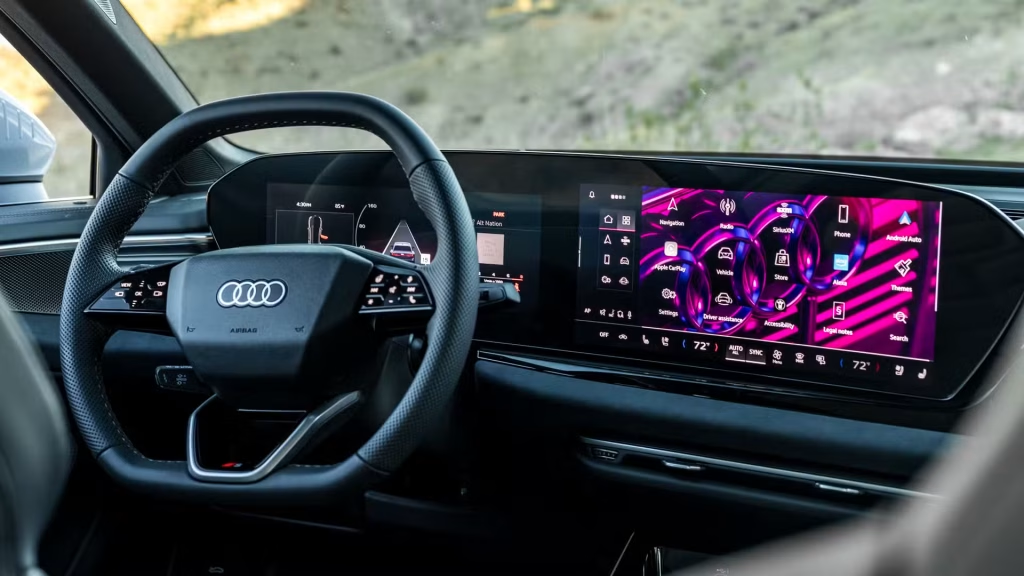
The A6 also benefits from being a completely redesigned model for 2026, giving Audi an opportunity to integrate its latest software architecture from the beginning rather than adapting an older dashboard.
For drivers who want technology that feels sophisticated without turning every interaction into a hunt through menus, the A6’s MMI system is one of the most significant infotainment upgrades of the 2026 model year.
MotorTrend’s recognition provides independent support for Audi’s approach, which places greater emphasis on software alongside the hardware that surrounds it.
4. 2026 Genesis GV70
The 2026 Genesis GV70 completely changes the visual character of its cabin with a 27.0-inch OLED display that combines the digital instrument cluster and infotainment system into one continuous screen.
Rather than placing two separate displays next to one another, Genesis integrates both areas into a single widescreen panel stretching across the dashboard. The result is one of the most distinctive digital cockpits in the compact luxury SUV segment.
The display is not merely large. The OLED panel provides sharp graphics and strong contrast, while the infotainment section remains touchscreen-controlled.
Genesis also retains a physical rotary controller on the center console, giving drivers an alternative to reaching toward the screen. That combination is useful because a huge touchscreen can look impressive but become frustrating if every function requires a fingertip.
Genesis made another important change for 2026. Wireless Apple CarPlay and Android Auto are now standard, allowing drivers to connect compatible smartphones without plugging them into the vehicle. The system also features improved voice recognition and expanded support for over-the-air updates.
The GV70’s interface has another advantage that is easy to overlook. Genesis retained physical controls for important functions, including temperature adjustment and volume, rather than placing every cabin function inside the touchscreen.
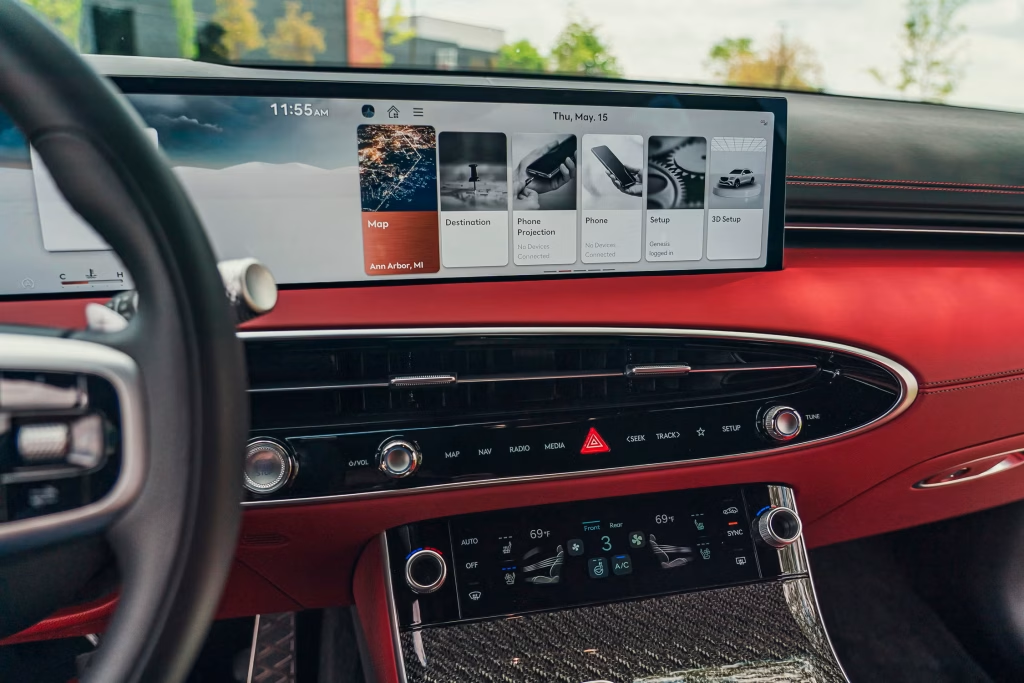
Car and Driver found the revised system intuitive and highlighted the combination of the large OLED display, straightforward controls, and improved technology.
The result is a cabin that feels thoroughly modern without becoming dependent on screen size alone. The 27-inch panel gets attention when you first sit inside, but the physical controller, wireless smartphone integration, improved voice recognition, and familiar Genesis interface are what make the technology useful during everyday driving.
5. 2026 BMW 7 Series
The BMW 7 Series treats infotainment as part of a much larger digital environment. Its centerpiece is the BMW Curved Display, which combines a 12.3-inch information display with a 14.9-inch central touchscreen.
For 2026, BMW continues to pair this hardware with BMW Operating System 8.5, while newer software and connected functions give the luxury sedan a technology package that goes well beyond navigation and music.
One of the system’s strengths is the range of ways occupants can interact with it. The central screen is touch-operated, but the 7 Series also retains BMW’s iDrive rotary controller, allowing the driver to operate many functions without reaching toward the dashboard.
Voice commands are available through BMW’s Intelligent Personal Assistant, which can recognize natural-language requests for various vehicle functions.
The rear cabin takes the technology considerably further. The available 31.3-inch BMW Theatre Screen drops from the roof and provides rear passengers with a massive 8K-resolution display.
It supports Amazon Fire TV built-in, allowing passengers to access streaming entertainment when appropriate. The screen’s 32:9 aspect ratio makes it particularly unusual compared with conventional rear-seat entertainment displays.
Audio is another major component. The available Bowers & Wilkins Diamond Surround Sound System uses 36 speakers and a 1,965-watt amplifier, turning the 7 Series into a sophisticated mobile listening environment.
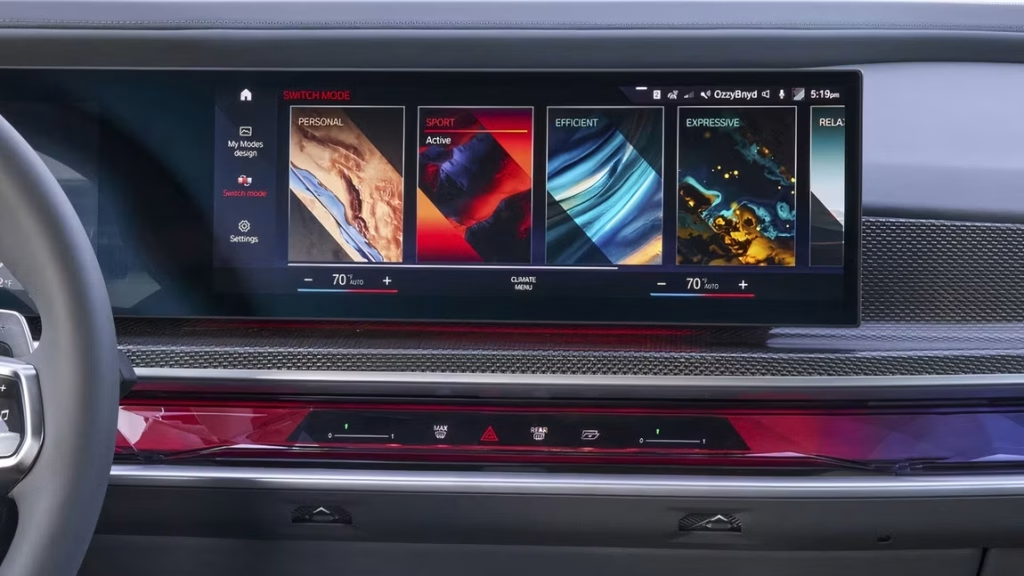
What makes the 7 Series especially interesting is that BMW has not treated infotainment as a single screen. The technology is distributed throughout the cabin, from the driver’s curved display to the rear theater screen and integrated audio system. That creates different experiences for the person driving and the passengers sitting behind them.
For buyers who want a luxury sedan where the digital experience extends well beyond the dashboard, the 7 Series remains one of the most technologically ambitious choices available in the U.S. market.
6. 2026 Lincoln Nautilus
The Lincoln Nautilus has one of the most visually dramatic infotainment layouts in the American luxury SUV market. Its defining feature is the 48-inch panoramic display that stretches across the dashboard.
Lincoln calls it the panoramic display, and rather than functioning as one giant touchscreen, it primarily places information and content across the driver’s field of view while a separate central touchscreen handles many vehicle functions.
That distinction is important. The panoramic display gives the cabin its high-tech appearance, but Lincoln designed it so the driver can see navigation and other information without constantly looking down toward a conventional center-mounted screen.
The system works with Lincoln’s digital experience, which uses Google Maps for navigation and integrates connected features into the vehicle.
The center touchscreen sits below the panoramic display and provides access to climate controls, media, settings, and other functions. Lincoln also provides physical controls for important functions, including a conventional volume control, which makes basic adjustments easier while driving.
Wireless Apple CarPlay and Android Auto are available, giving owners a familiar smartphone interface when they want to use their own applications. Lincoln also provides Amazon Alexa integration and connected services, adding voice-based interaction beyond traditional vehicle commands.
The Nautilus is particularly interesting because the large screen is not simply a giant version of a normal infotainment display. Its placement changes how information is presented to the driver. Lincoln can put navigation directions, vehicle information, and other content across the driver’s forward view while leaving the center display available for other occupants.
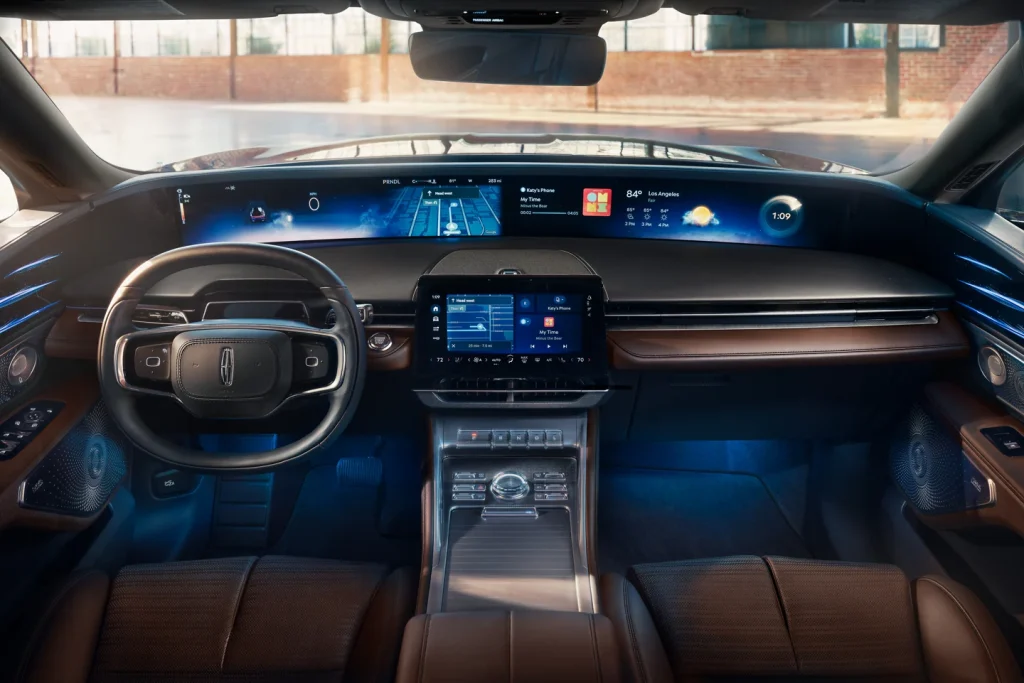
That approach gives the Nautilus a different personality from vehicles that put nearly every function onto one vertical touchscreen. The hardware is certainly eye-catching, but the more important achievement is the way Lincoln divides information between the panoramic display and central control screen.
For a buyer interested in a futuristic cabin without moving to a full-size luxury SUV, the Nautilus makes a strong technology statement.
7. 2026 Volvo EX90
The Volvo EX90 approaches infotainment with a philosophy that is noticeably different from the screen-heavy systems found in many luxury vehicles. Its centerpiece is a 14.5-inch vertically oriented touchscreen powered by Google’s Android Automotive operating system.
Instead of requiring a phone to provide the basic navigation and app environment, the EX90 has Google Maps, Google Assistant, and Google Play integrated directly into the vehicle.
That setup gives the EX90 a major advantage for drivers already comfortable with Google’s ecosystem. Navigation can be handled through Google Maps, while voice commands can be issued through Google Assistant.
The system also supports over-the-air software updates, allowing Volvo to add or improve functions without requiring owners to visit a dealership for every software change.
The vertical screen is positioned within easy reach of the driver and controls a large portion of the vehicle’s functions. Volvo also uses a digital instrument display in front of the driver, keeping essential driving information separate from the main touchscreen.
What makes the EX90 particularly interesting is how closely its infotainment is tied to the vehicle’s broader software architecture.
Volvo designed the electric SUV around a centralized computing system capable of supporting its infotainment, connectivity, and advanced driver-assistance technology. That means software is not simply an entertainment layer sitting on top of traditional vehicle electronics.
The EX90 also offers Apple CarPlay, while Android users can take advantage of the native Google environment without depending entirely on smartphone projection.
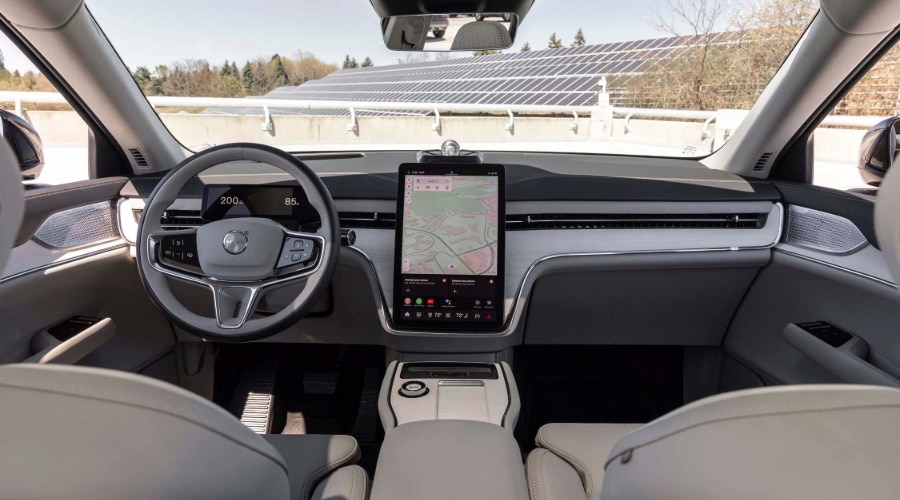
There is a trade-off to this approach. The system places many vehicle controls inside the touchscreen, so drivers who prefer physical buttons may need some adjustment.
Yet the combination of native Google services, frequent software updates, a high-resolution portrait display, and connected vehicle functions makes the EX90 one of the more sophisticated infotainment systems available in the 2026 U.S. luxury SUV market.
Its appeal comes less from having the largest screen and more from treating the car as an updatable digital platform.
8. 2026 Rivian R1S
Rivian’s infotainment system is one of the more distinctive setups in the U.S. EV market because the company designed its software environment largely in-house instead of simply adopting an off-the-shelf system from a traditional automotive supplier.
The 2026 R1S continues to use a 15.6-inch central touchscreen, complemented by a 12.3-inch digital instrument display.
The central screen is the command center for navigation, media, climate functions, and many vehicle settings. Rivian’s interface is designed around the vehicle’s software rather than treating smartphone mirroring as the primary experience. The company provides its own navigation system and integrates connected features throughout the cabin.
One of the most useful aspects is the software’s ability to evolve through over-the-air updates. Rivian has repeatedly used software updates to introduce new functions and improve existing ones, meaning the system can change significantly during the ownership period.
That is particularly valuable for an electric vehicle, where software controls a growing number of vehicle functions.
Rivian also redesigned aspects of its infotainment experience for newer software releases, including improvements to navigation, charging information, and vehicle controls. The company has increasingly connected the infotainment interface with its EV-specific functions, making the screen more than a conventional media hub.
Another interesting feature is the R1S’s gear selection and drive-mode integration. Information about the vehicle’s various drive settings and off-road functions can be presented through the digital interface, which is particularly relevant for a vehicle designed for both road and trail use.
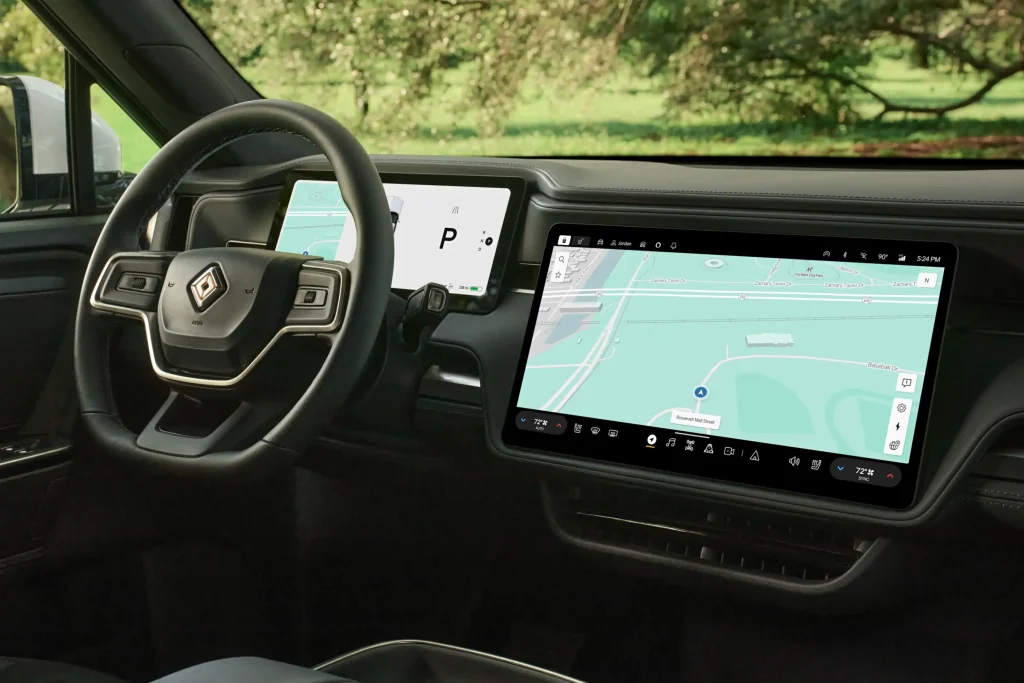
The R1S does not try to win the infotainment battle simply by having the largest screen. Instead, its strength is the integration between software, electric powertrain information, navigation, and vehicle controls.
For drivers who appreciate technology that changes through software updates, the Rivian is compelling because the system is not necessarily finished on the day the vehicle is delivered. Its digital architecture allows Rivian to continue modifying the experience as the vehicle receives new software.
9. 2026 Porsche Panamera
The Porsche Panamera takes a more driver-focused approach to infotainment than many luxury cars that rely almost entirely on one enormous central screen.
Its Porsche Communication Management system centers on a 12.3-inch touchscreen, while an optional 10.9-inch passenger display gives the front passenger a separate interface. Porsche introduced the passenger screen specifically to let the passenger interact with infotainment without distracting the driver.
That second display is more than a decorative panel. Porsche says passengers can use it for functions such as navigation and radio, while compatible streaming services can also be displayed on the passenger screen.
A special privacy film prevents the driver from seeing the passenger’s entertainment content while the vehicle is moving. Video streaming through the central display is restricted to when the car is stationary.
The Panamera also avoids making every cabin function touchscreen-dependent. Porsche retains physical climate controls and a mechanical rotary volume control, giving the driver tactile options for frequently used functions.
That matters because a sophisticated infotainment system can become frustrating when basic operations require navigating several digital menus.
Smartphone integration is another part of the system, with wireless connectivity and USB-C ports available throughout the cabin. Porsche also provides a wireless phone charger with cooling and 15-watt charging capability.
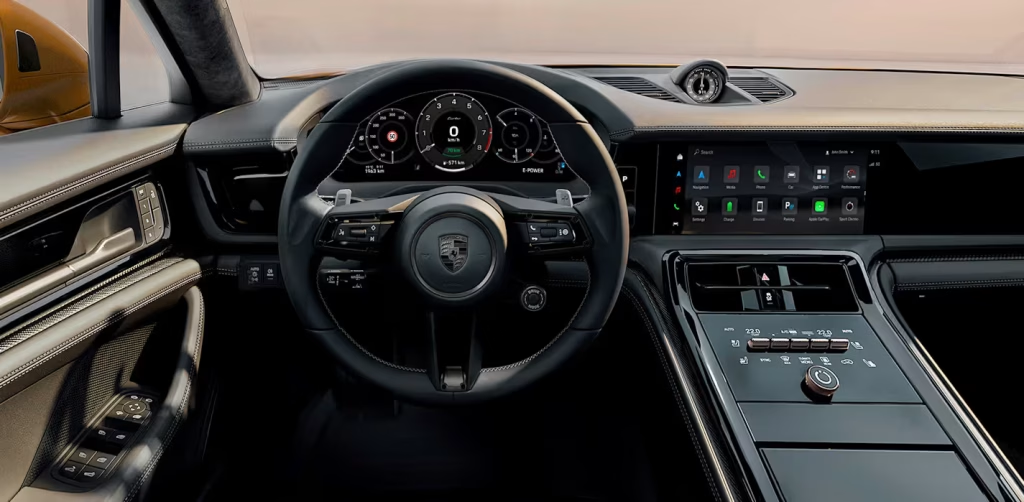
The Panamera’s infotainment appeal therefore comes from balance rather than screen size alone. The driver gets a large central display, the passenger receives a dedicated interface, and physical controls remain available for important everyday functions.
For a luxury performance sedan, that combination makes sense. The technology is extensive, but Porsche has not abandoned conventional controls entirely. The result is a system designed to give passengers more digital freedom while keeping the driver’s interaction with the car relatively focused.
10. 2026 Kia EV9
The Kia EV9 proves that sophisticated infotainment does not have to be restricted to six-figure luxury vehicles. The three-row electric SUV uses a 12.3-inch infotainment touchscreen, a 12.3-inch digital instrument display, and a separate 5-inch climate-control display, creating what Kia calls its connected panoramic display setup.
The 2026 U.S.-market EV9 also includes wireless Apple CarPlay and Android Auto, allowing owners to bring familiar smartphone navigation, music, and communication applications directly into the vehicle.
Kia’s system includes voice recognition, Bluetooth connectivity, SiriusXM, and connected services, while higher trims can be equipped with a 14-speaker Meridian premium audio system.
The EV9’s infotainment is particularly useful because the screen arrangement does not attempt to put every function into one enormous panel. The separate climate display leaves the main screen available for navigation and media, while the driver’s 12.3-inch display handles information needed behind the wheel.
Kia also supports over-the-air updates, allowing software and certain vehicle functions to be updated without a traditional dealership visit. The EV9’s digital key and fingerprint recognition features add another layer to the technology package, although those systems serve vehicle access and personalization rather than infotainment directly.
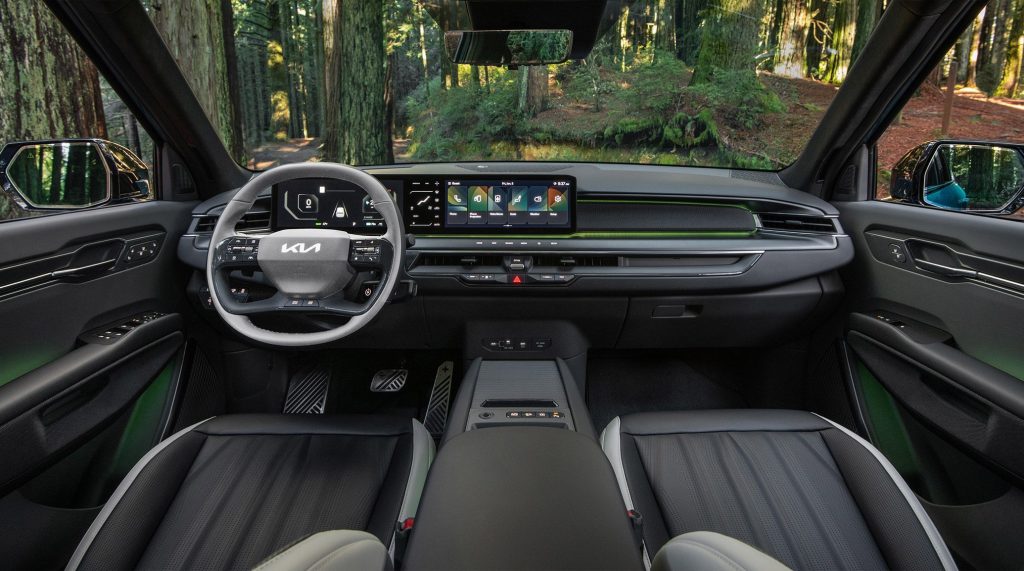
What makes the EV9 stand out is the combination of useful technology and broad availability. The core infotainment package is not reserved exclusively for the most expensive version of the SUV. Kia lists the 12.3-inch navigation display, Apple CarPlay, Android Auto, voice recognition, and connected telematics across the U.S. 2026 EV9 lineup.
That makes the EV9 a compelling choice for buyers who want a modern digital cabin without moving into the pricing territory of the largest European luxury SUVs. Its screens may not be the biggest in this group, but the system delivers the functions most drivers actually use while retaining a clear separation between navigation, vehicle information, and climate controls.
