
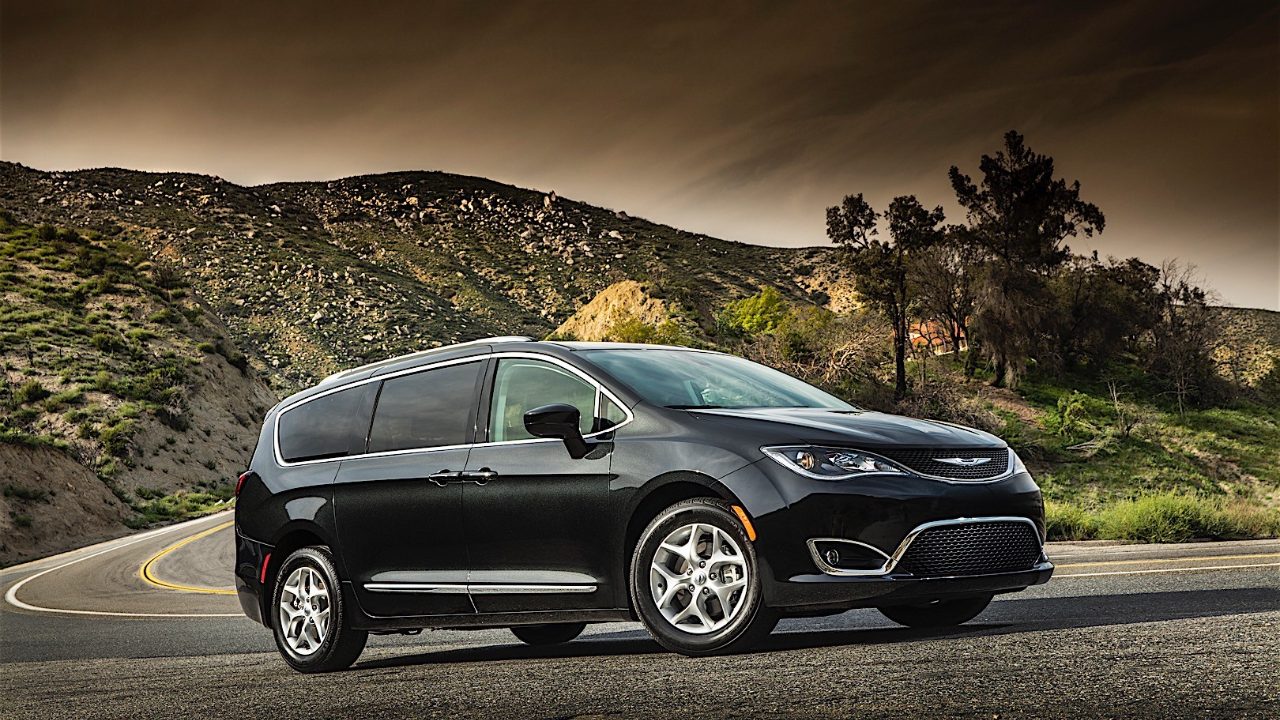
Minivans remain some of America’s most practical family vehicles, but the 2026 IIHS safety awards reveal a major weakness in the segment. No minivan earned either Top Safety Pick or Top Safety Pick+ for 2026.
IIHS says rear-seat protection remains a key reason, with current minivan models still struggling in the updated moderate-overlap front crash test. The 2026 lineup includes the Toyota Sienna, Honda Odyssey, Chrysler Pacifica, Chrysler Voyager, and Kia Carnival.
The Sienna and Carnival receive marginal ratings in the updated moderate-overlap test, while the Odyssey and Pacifica receive poor ratings. The absence of minivans from the awards is therefore not accidental.
1. Toyota Sienna
The Toyota Sienna comes closest to meeting the demanding 2026 IIHS safety requirements, but its rear-seat crash performance still keeps it out of the award winners.
The 2026 Sienna receives a marginal rating in the updated moderate-overlap front test, even though its small-overlap front and updated side tests both receive good ratings. Its headlights are also rated Good, and Toyota provides a standard front crash prevention system that earns an Acceptable pedestrian rating.
The moderate-overlap result is especially important because this is the test IIHS has redesigned to place greater emphasis on rear occupants. The Sienna’s structure and safety cage perform well, but its rear passenger protection does not reach the Good threshold required for a 2026 Top Safety Pick or Top Safety Pick+.
Under the current 2026 criteria, a vehicle must have good ratings in the small-overlap front, moderate-overlap front, and side tests to qualify for either award.
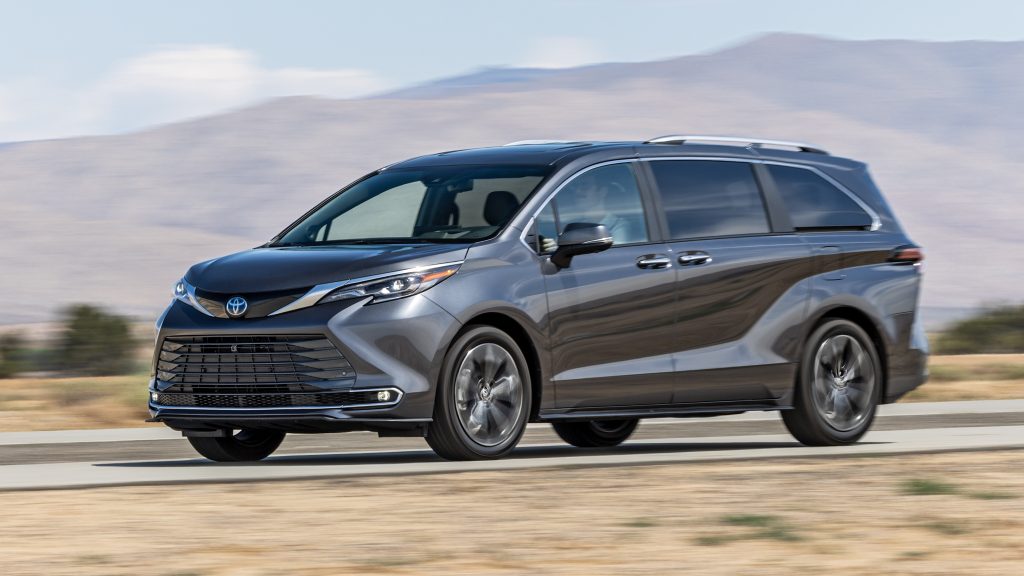
The Sienna does have an important advantage in another family-safety area. IIHS previously found that it was the only one of four tested minivans whose second-row seat-belt reminder system met all the requirements for a Good rating. Its LATCH system also earns a Good+ rating in the current IIHS evaluation.
The current U.S. Sienna uses a hybrid-only powertrain, giving buyers a very different mechanical setup from traditional V6-powered minivans.
2. Honda Odyssey
The Honda Odyssey is one of America’s most recognizable family vehicles, yet it faces a serious obstacle under the 2026 IIHS award criteria.
The current IIHS minivan table lists the Odyssey with a Poor rating in the moderate-overlap front test, while its small-overlap front rating is Good and its updated side rating is Good. That combination automatically prevents it from qualifying for the 2026 Top Safety Pick award.
The rear-seat issue is not new. When IIHS introduced its updated moderate-overlap test for rear occupants, the 2023 Odyssey received a poor rating. Its driver-side protection was strong, with good ratings for the structure and safety cage and the major driver injury categories.
The second-row dummy produced the more concerning result. Rear head and neck protection was poor, while chest protection was marginal. IIHS also found that the rear dummy’s head came too close to the front seatback during the crash.
That history explains why the Odyssey remains an important example when discussing the gap between traditional front-seat crash testing and newer rear-passenger evaluations. The minivan was designed specifically to carry families, yet its second-row restraint performance has not reached the level IIHS now demands for its annual awards.
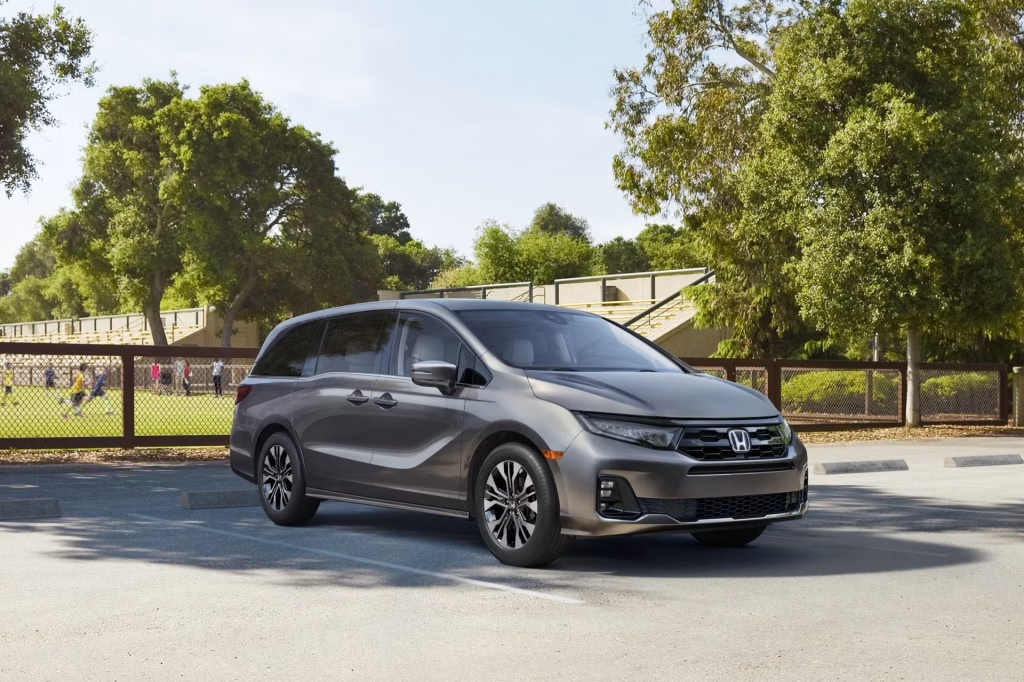
The Odyssey does offer a strong family-oriented cabin and a standard three-row layout. Its U.S. powertrain is a 3.5-liter V6 producing 280 horsepower and 262 lb-ft of torque.
3. Chrysler Pacifica
The Chrysler Pacifica remains one of America’s best-known family minivans, but its latest IIHS results show why the segment is still struggling to satisfy the toughest 2026 safety requirements.
The current IIHS rating for the Pacifica lists a marginal result in the updated moderate-overlap front crash test. Its structure and safety cage received a Good rating, while the driver’s head and neck, chest, thigh and hip, leg and foot, and restraint performance were all Good.
The rear passenger tells a different story. Head and neck protection was acceptable, chest protection was marginal, and rear restraints and dummy kinematics were acceptable. IIHS’s earlier testing identified excessive belt forces on the rear dummy’s chest as one of the major concerns.
The Pacifica’s side-curtain airbag also failed to deploy during that earlier test, adding another issue to the test record.
The important point is that the Pacifica does not have a structurally weak cabin. Its driver protection remains strong. The problem is how effectively the restraint system manages the second-row occupant during the 40-mph moderate-overlap crash.
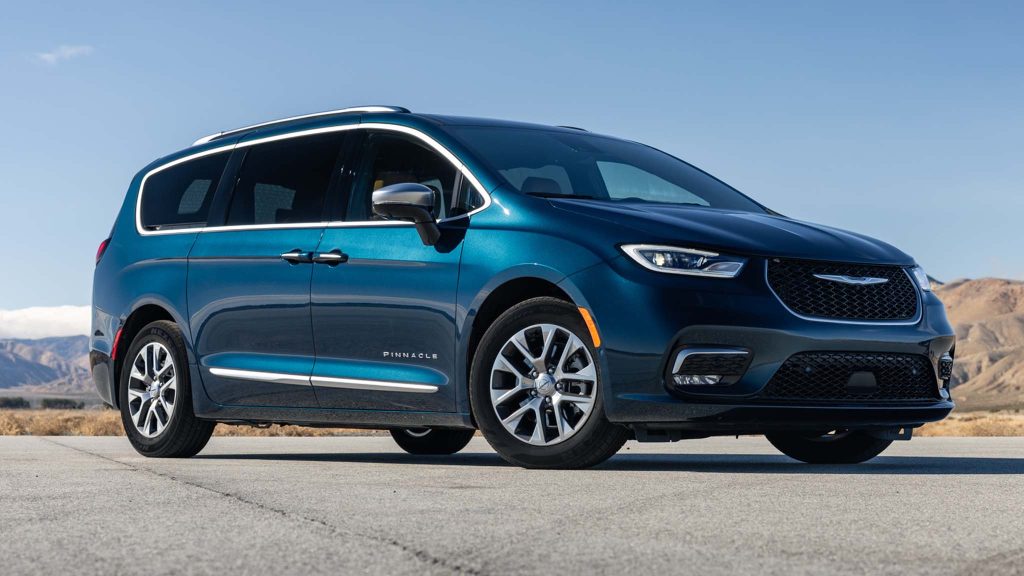
That weakness is particularly relevant in a minivan because the vehicle’s primary purpose is transporting families.
A vehicle can have extensive space, multiple seating positions, and modern driver-assistance technology, yet still miss an IIHS award when its rear crash performance falls below the required threshold. For the U.S. market, the Pacifica’s gasoline version uses Chrysler’s familiar Pentastar V6.
4. Kia Carnival
The Kia Carnival has the appearance and practicality of a modern family hauler, but its rear-seat crash performance remains one of the reasons minivans have struggled to qualify for IIHS’s 2026 awards.
The current 2026 IIHS table gives the Carnival a marginal rating in the updated moderate-overlap front test. Its small-overlap front result is good, while the updated side test is acceptable.
The rear-seat concern goes back to IIHS’s original evaluation of the 2023 Carnival. Its structure and safety cage earned good ratings, as did the driver’s major injury measurements. However, rear head and neck protection was marginal, and chest protection was marginal.
The rear restraint and dummy-kinematics category was acceptable. IIHS also reported unusually high forces on the rear dummy’s neck and excessive belt forces on the chest.
Kia has made structural changes to the Carnival for newer model years. For 2025 models, IIHS notes reinforcements to the B-pillar, front and rear doors, and rear seat railings. Those changes helped the vehicle earn an Acceptable updated side rating, but they did not move its moderate-overlap result into the Good category.
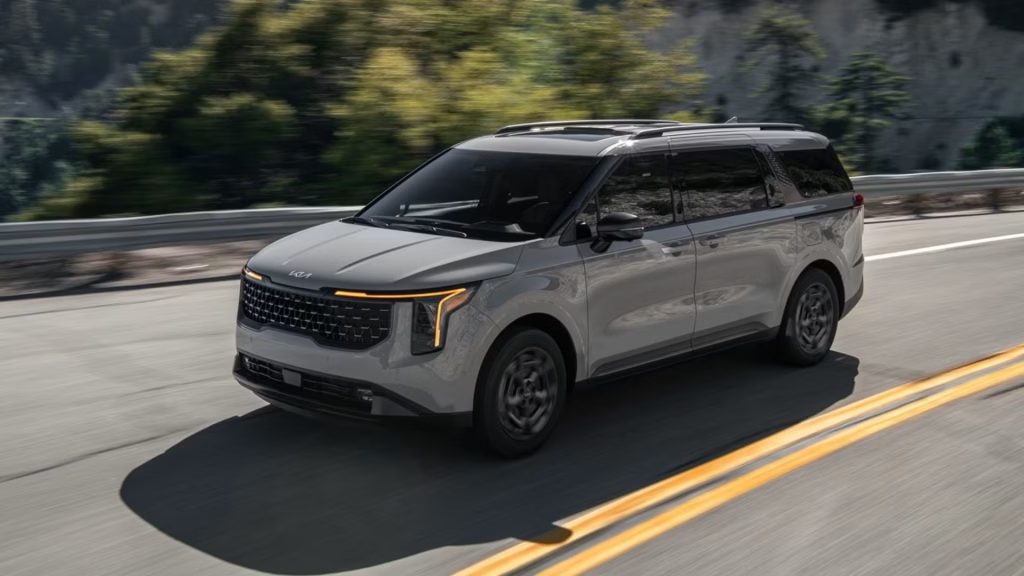
That distinction explains why the Carnival remains absent from the 2026 Top Safety Pick list. The issue is not that the vehicle performs poorly in every crash test. Rather, one of the specific tests required for the award continues to expose limitations in rear occupant protection.
5. Chrysler Voyager
The Chrysler Voyager occupies an unusual position in the 2026 U.S. minivan market because it is included in IIHS’s current minivan category, but it does not have a complete set of crashworthiness evaluations.
The 2026 Voyager has a Good small-overlap front rating and an Acceptable updated side rating, but IIHS has not published a moderate-overlap front rating for the vehicle. That means there is no verified 2026 rear-passenger result that can be used to call the Voyager a poor performer in the updated test.
That distinction matters for an article specifically focused on rear-seat safety. The Voyager shares its basic platform with the Chrysler Pacifica, and IIHS notes that the Voyager was introduced as a fleet-focused model while sharing the Pacifica’s platform.
However, shared architecture does not automatically establish identical crash performance for every test or model year.
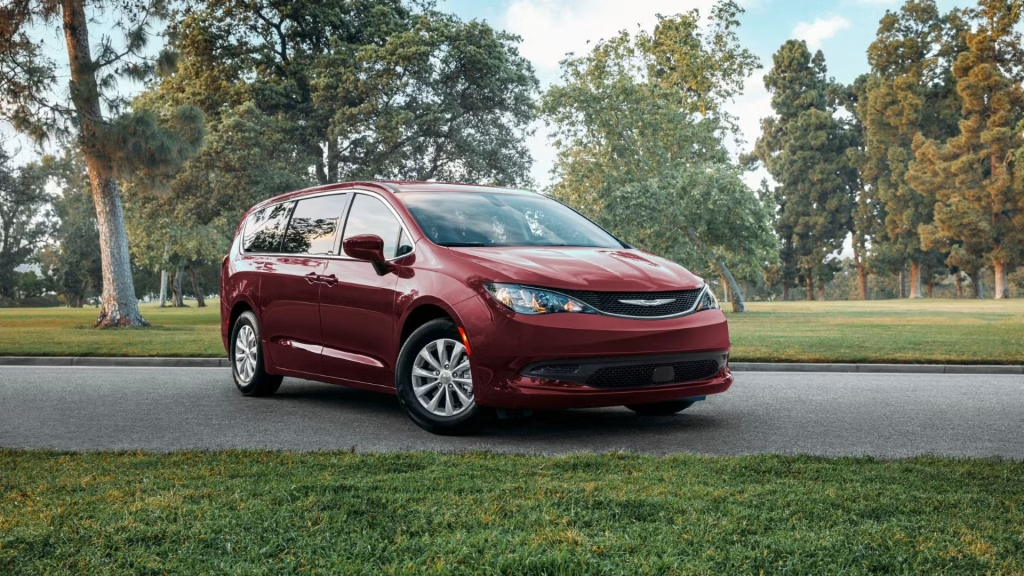
The Voyager also misses the 2026 Top Safety Pick requirements for reasons beyond its untested moderate-overlap performance. Its headlights receive a poor rating, while its standard pedestrian front crash prevention system receives an acceptable rating.
IIHS requires good results in the small-overlap, moderate-overlap, and side tests for a vehicle to qualify for the 2026 Top Safety Pick award.
So, rather than labeling the Voyager’s second row a failure, the accurate conclusion is that its current rear-seat crash performance remains unverified by the specific IIHS test needed for this comparison.
6. Chrysler Pacifica Hybrid
The Chrysler Pacifica Hybrid adds another layer to the minivan safety discussion because its powertrain differs from the standard gasoline Pacifica, while its crash-safety history comes from the same broader Pacifica family.
IIHS’s current 2026 database lists a separate Pacifica Hybrid entry, but the available page does not provide a new moderate-overlap crash rating for a 2026 hybrid model. Its published 2026 information instead includes an acceptable headlight rating and other safety-system information.
The more useful evidence comes from IIHS’s testing of the Pacifica family. In the updated moderate-overlap test, the Pacifica received a marginal rating, with the rear passenger’s chest protection rated marginal and rear restraints and dummy kinematics rated acceptable.
IIHS also documented excessive rear seat-belt forces and noted that the side-curtain airbag did not deploy during that test.
Those findings explain why the Pacifica family has struggled to meet the latest award requirements, but they should not be presented as a brand-new 2026 hybrid crash result. The distinction between a tested vehicle and a mechanically related variant is essential when reporting safety data.
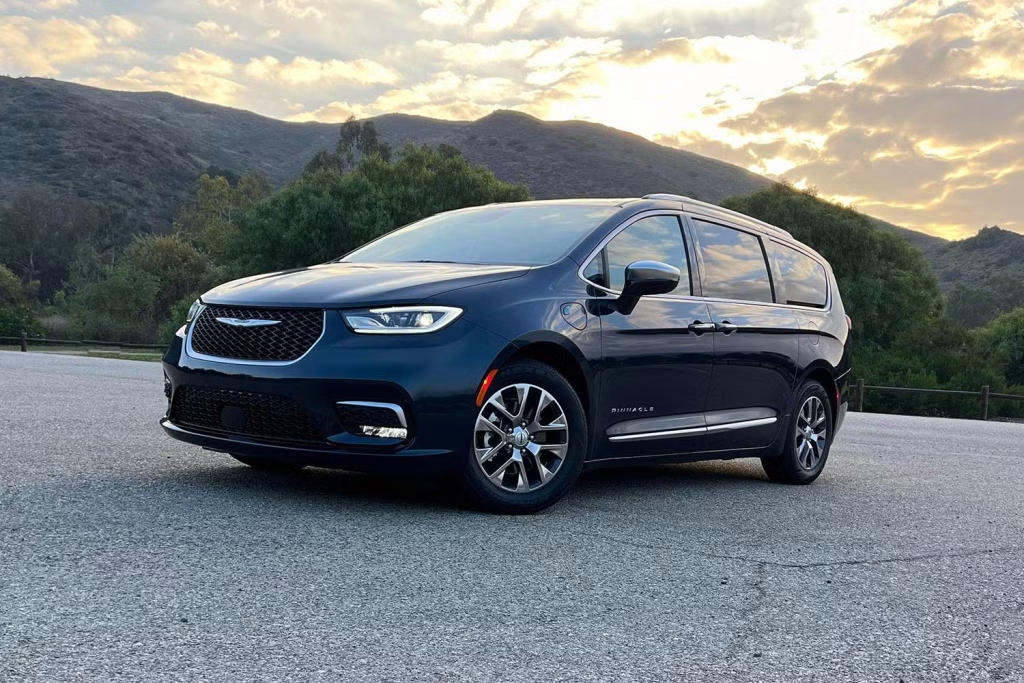
The Pacifica Hybrid also deserves attention because its plug-in hybrid powertrain was discontinued after the 2023 model year for retail sales, despite the 2026 IIHS database retaining a Pacifica Hybrid entry. Therefore, it should not be presented as a newly introduced 2026 retail minivan without qualification.
7. Chrysler Town & Country
The Chrysler Town & Country is useful as a historical comparison because it shows that the rear-seat safety problem did not suddenly appear with the latest generation of minivans. The Town & Country was replaced by the Pacifica beginning with the 2017 model year, and IIHS records its earlier crash evaluations separately.
Its older crash tests were conducted before IIHS introduced the updated moderate-overlap test that specifically places a second-row dummy behind the driver.
That means it would be misleading to assign the Town & Country a modern rear-passenger rating that it never actually received. The vehicle’s historical results can still provide context, but they should not be presented as equivalent to the 2023 minivan evaluations.
The distinction is important because IIHS changed its testing strategy after research showed that front-seat safety had advanced faster than rear-seat restraint technology. The newer test specifically examines rear head and neck, chest, and thigh injury measures along with rear restraint performance.
The Town & Country was nevertheless a major U.S. family vehicle during its production run. It offered three rows, sliding rear doors, and substantial passenger capacity, making its intended use very similar to today’s Pacifica.
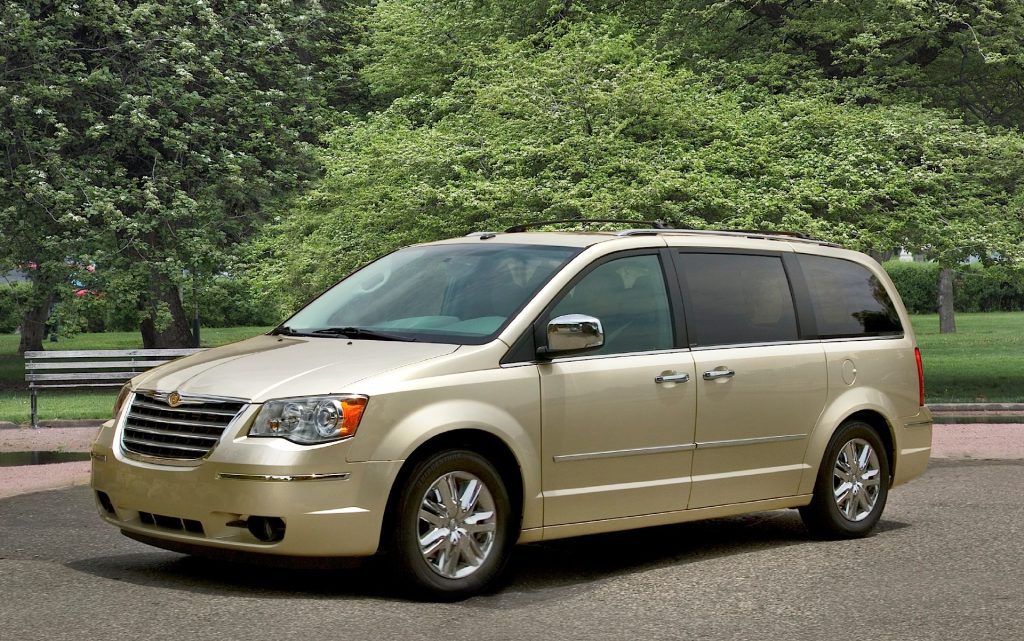
For the final model years, the minivan used Chrysler’s familiar Pentastar V6. The figures below represent the 2016 U.S. model.
8. Dodge Grand Caravan
The Dodge Grand Caravan provides another historical example, but the same testing limitation applies. It was discontinued after the 2020 model year and therefore does not have a modern IIHS rear-passenger rating from the updated moderate-overlap test.
That matters because the purpose of this article is to explain why today’s minivans are struggling to earn 2026 IIHS awards. The updated test is fundamentally different from the older evaluations.
IIHS now places one dummy in the driver’s seat and another directly behind the driver in the moderate-overlap test, allowing the organization to measure protection for both seating positions during the same crash.
The Grand Caravan’s inclusion here should therefore be understood as historical context, not as a claim that IIHS tested its second-row occupant using today’s protocol. It was one of the longest-running minivan nameplates in the American market and shared its basic architecture with the Chrysler Town & Country during its later years.
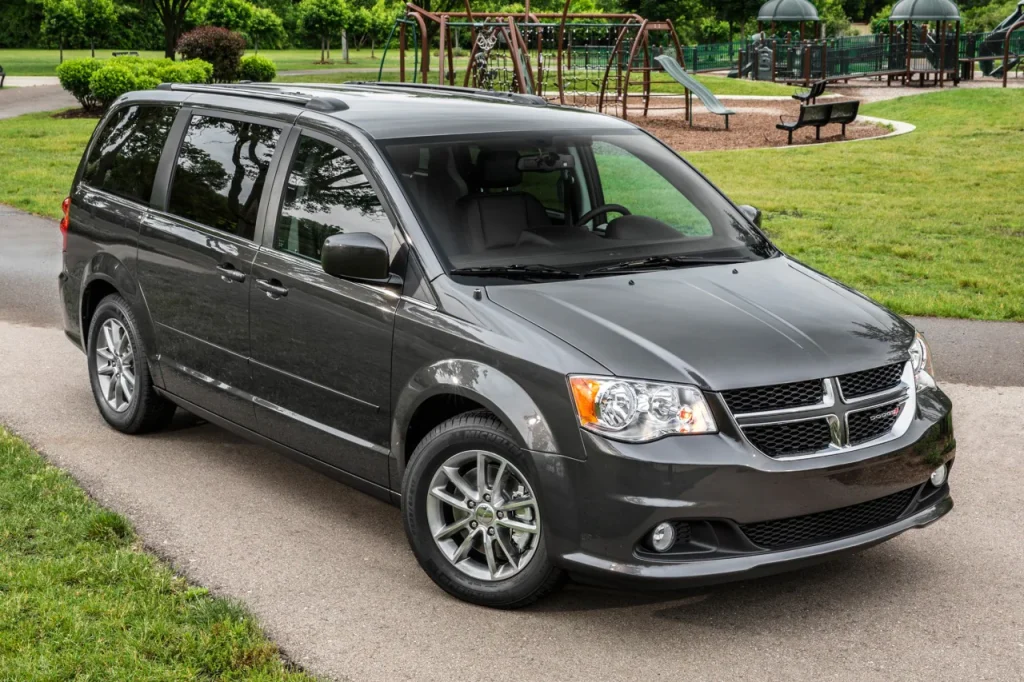
Its continued presence in family-car discussions also illustrates how dramatically safety testing has changed. A vehicle could perform well under an older driver-focused test while leaving questions unanswered about the second row. The updated testing framework was created specifically to close that information gap.
The 2020 Grand Caravan used Chrysler’s 3.6-liter Pentastar V6, producing 283 horsepower and 260 lb-ft of torque.
9. Volkswagen Routan
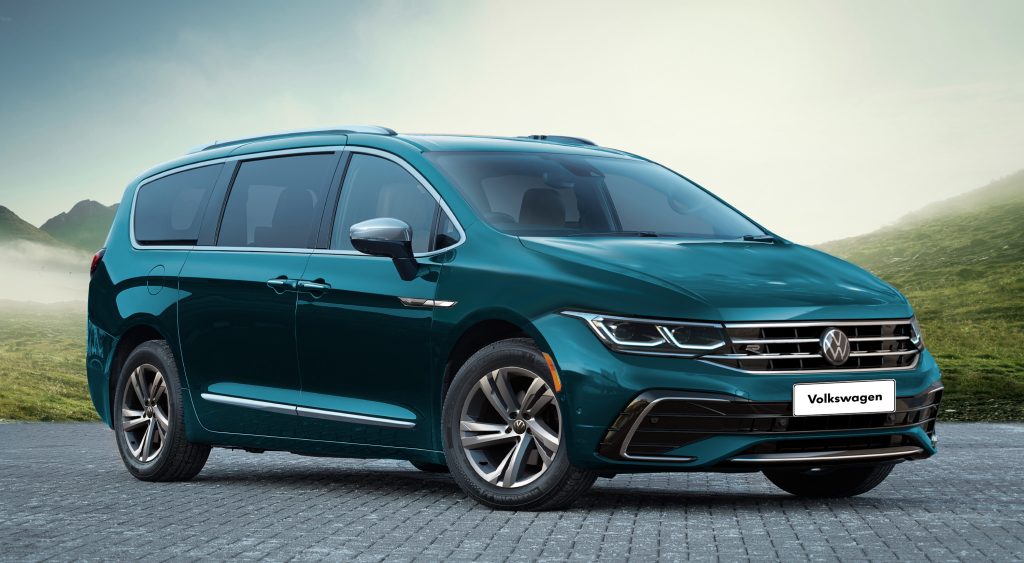
The Volkswagen Routan is another historical example that needs to be treated differently from the current 2026 minivans. It was sold in the United States from 2009 through 2012 and was closely related to the Chrysler Town & Country and Dodge Grand Caravan.
IIHS tested the Routan using the older moderate-overlap and side-crash procedures, not the updated rear-passenger moderate-overlap test introduced decades later.
That means there is no legitimate modern IIHS rating for the Routan’s second-row occupant under the methodology now used to evaluate the Sienna, Odyssey, Pacifica, and Carnival. The older IIHS evaluation nevertheless found that the vehicle’s side protection was strong when equipped with the standard head-curtain airbags covering all three rows.
This historical distinction is important. It would be incorrect to use the Routan as evidence that a particular rear-seat restraint weakness exists under today’s testing standards. Instead, its inclusion demonstrates how much IIHS testing has changed.
The modern evaluation specifically measures rear head and neck, chest and thigh injury risk, belt positioning, and occupant movement.
The Routan was powered by several engines during its short U.S. production run. The later models used Chrysler’s 3.6-liter Pentastar V6.
10. Nissan Quest
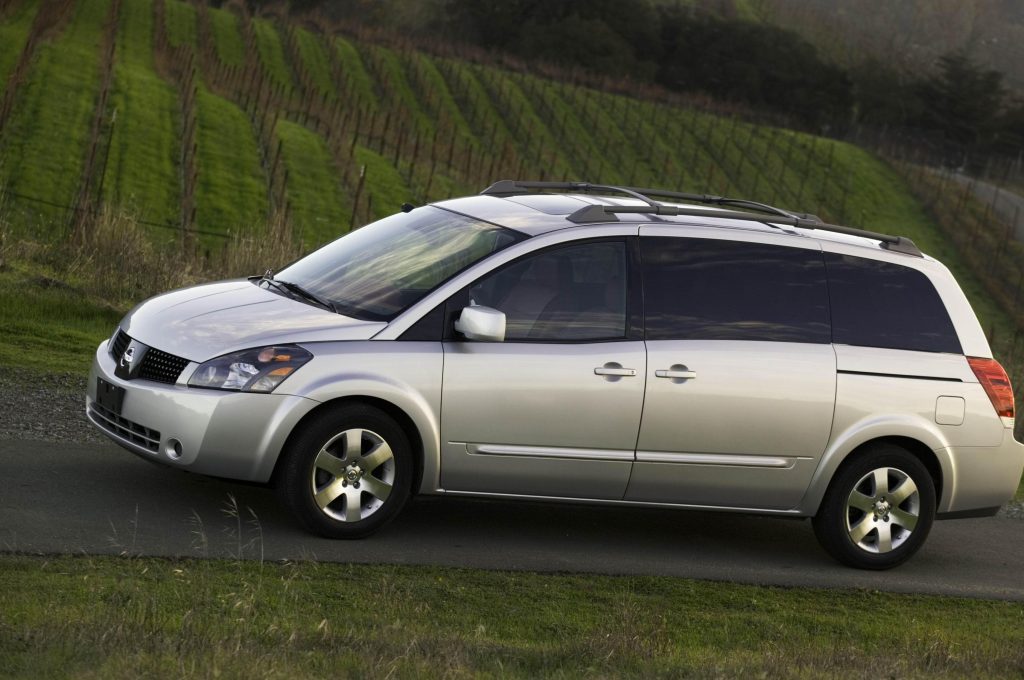
The Nissan Quest provides another historical reference point rather than a current 2026 IIHS rear-seat test result. Nissan discontinued the Quest after the 2017 model year, meaning it is no longer part of the current U.S. minivan market represented in IIHS’s 2026 class.
Its historical crash-testing also predates the updated moderate-overlap procedure that specifically evaluates a second-row dummy. Consequently, it would be inaccurate to assign the Quest a modern rear-seat grade such as Marginal or Poor simply because today’s minivans are being scrutinized more heavily.
That limitation actually reinforces the central point of this article. IIHS’s modern rear-seat testing was created because older evaluations did not provide enough information about the people sitting behind the driver.
The new procedure uses a second dummy representing a small adult or 12-year-old child and examines whether the occupant remains properly positioned during the crash.
The Quest was nevertheless a genuine three-row family minivan, with sliding rear doors and substantial passenger capacity. Its final U.S. generation used Nissan’s 3.5-liter V6, giving it a useful combination of space and performance for family transportation.
It should therefore be regarded as historical context, not evidence of a current IIHS rear-seat weakness.
