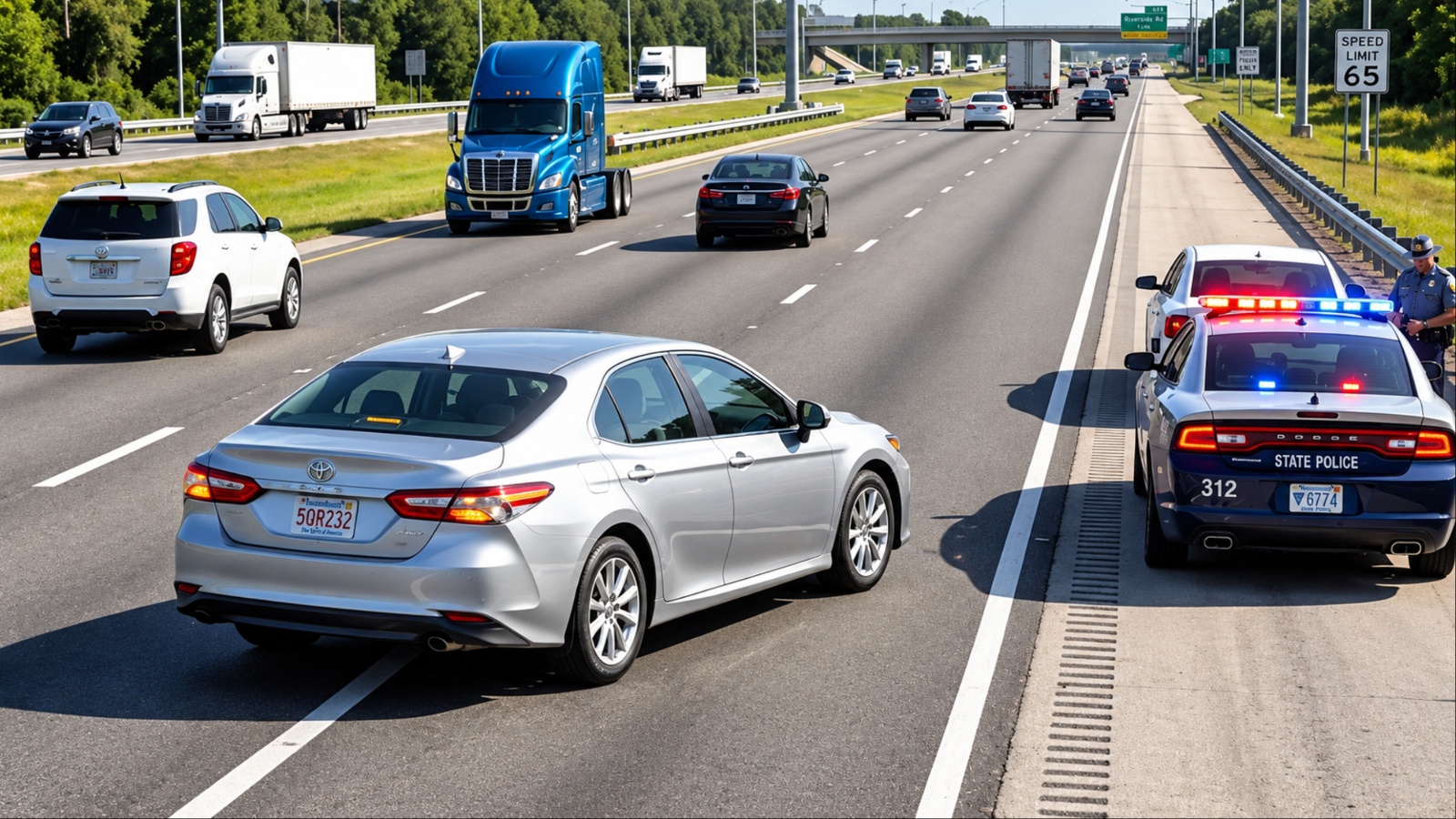
A move-over ticket looks like a minor traffic citation until you read the number printed on it. Every state requires drivers to change lanes or slow down for stopped emergency vehicles, and most now extend that duty to tow trucks, utility crews, and, in a growing number of states, ordinary drivers stranded with their hazard lights on. The rule is simple. The price of ignoring it is not, and it swings wildly from one state line to the next.
This ranking looks at the ten states where a violation can cost the most, weighing the fine for an ordinary violation first and the worst-case penalty second. Some of these states hit first-time offenders with four-figure fines. Others keep the routine ticket modest but attach felony charges, six-figure fines, license suspensions, or jail time when someone gets hurt. Here is how they stack up, ranked from the costliest state down.
1. Illinois
Illinois earns the top spot because its headline penalty applies to an ordinary violation, not just the worst crashes. Under Scott’s Law, the state’s move-over statute, the Illinois State Police says a first violation carries a fine between $250 and $10,000. A second or later violation is fined between $750 and $10,000. A judge decides where in that range a driver lands, which makes the law unusually unpredictable and unusually expensive.
The consequences climb quickly when a crash is involved. A violation that damages another vehicle is a Class A misdemeanor, and one that injures or kills someone can be charged as a felony.

Driving privileges can be suspended for six months after a crash causing injury and for 24 months after a fatality, according to the Secretary of State’s office, which has also added reminders to license and registration renewal notices and put a question about the law on the written driving exam.
Scott’s Law is named for Chicago Fire Lieutenant Scott Gillen, who was struck and killed on December 23, 2000, while responding to a crash. The law covers police cars, fire trucks, ambulances, tow trucks, and other authorized vehicles with flashing lights. Drivers are expected to change lanes when they safely can and slow down when they cannot.
Illinois is also where the law is best publicized. The State Police offers an educational video, a crash map showing where violations occur, and a task force report, and the Secretary of State distributes a brochure.
2. Colorado
Colorado ranks second because of its extraordinary ceiling. The routine ticket is comparatively modest, but a violation that kills someone is a class 6 felony, punishable by one to two years in prison and a fine of up to $100,000. That is the highest maximum fine we found for a move-over offense anywhere.
Reports differ on the everyday cost. One recent summary describes a $150 ticket with three license points, while a Colorado law firm’s overview puts the standard fine between $15 and $100 plus a surcharge. Either way, the careless driving classification and the points are what hurt. If a violation causes bodily injury, it becomes a class 1 misdemeanor, with a minimum of six months in jail, a $500 fine, or both, and a maximum of 18 months and $5,000.
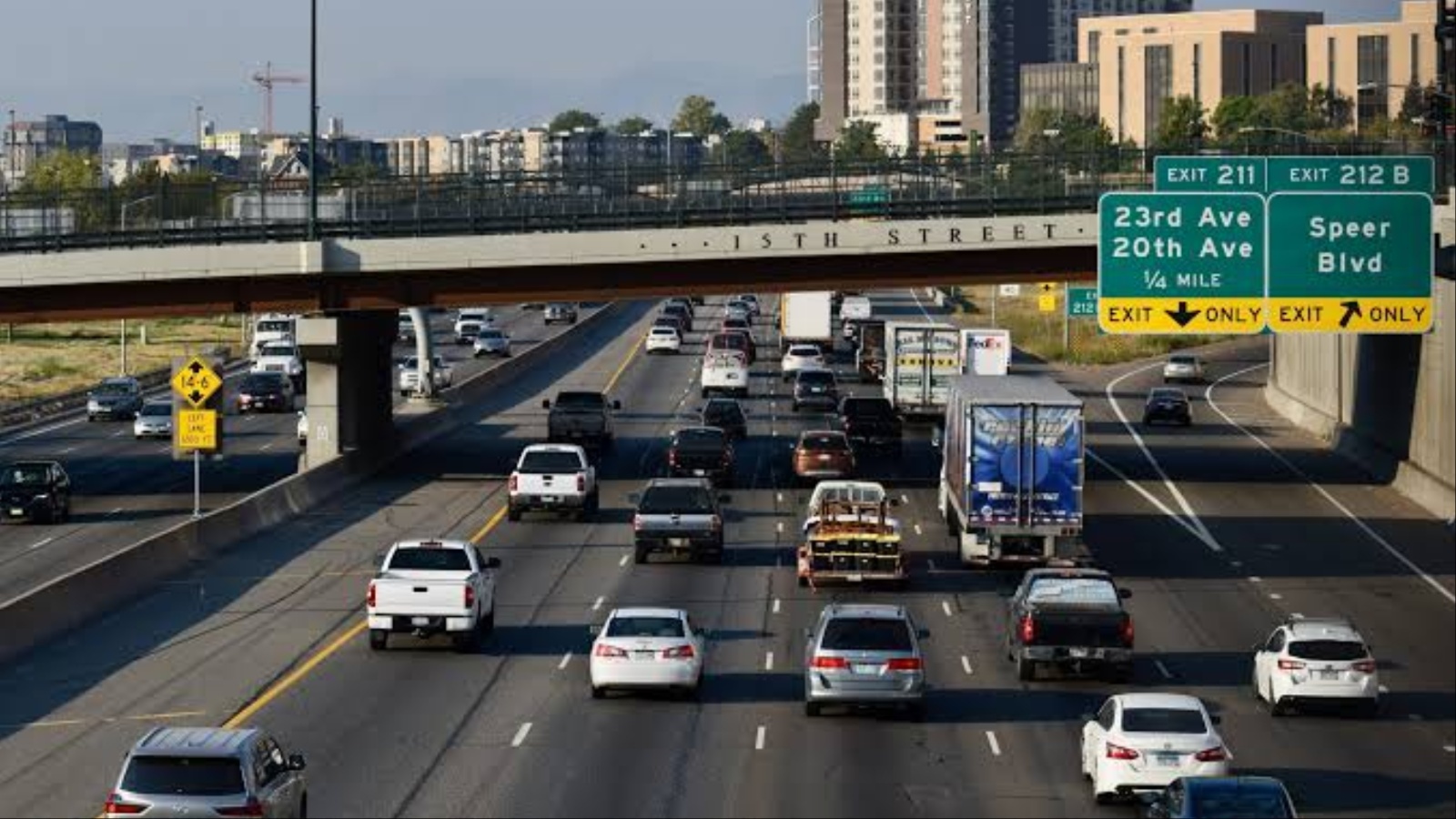
Colorado’s law is also broad. Drivers must move over one lane for stationary emergency vehicles, tow trucks, and public utility vehicles, and the rule was expanded to include vehicles being fitted with tire chains. If moving over is not possible, drivers must cut their speed to 20 mph under the limit on faster roads, or under 25 mph where the limit is 40 or less. A fiscal note found 230 people were sentenced under the law over a three-year span.
Enforcement is real, and points follow the fine. The required slowdown also depends on the road. On a highway posted at 65 mph, for example, a driver who cannot change lanes must drop to 45 mph.
3. Oklahoma
Oklahoma has one of the steepest fine schedules for ordinary drivers. After a revision, the penalty is $1,000 for a first offense and $2,500 for each subsequent offense, according to coverage of the change that quoted the Oklahoma Highway Patrol. Those numbers rise to $5,000 if an emergency worker is injured, and to $10,000 with possible criminal charges if the offense results in a worker’s death.
The state has had a move-over law since 2002, and it has been widened more than once. A 2015 update required caution around emergency vehicles, and a 2019 change brought in any vehicle with flashing lights, including a civilian’s hazard lights. That makes Oklahoma one of the places where passing a stranded motorist too closely can cost more than many states charge for hitting a police cruiser.

The reporting on the new fines dates to late 2023, so confirm current amounts before relying on them. Even so, a four-figure penalty before anyone is hurt places Oklahoma firmly near the top of this list. Drivers should treat every roadside vehicle showing flashing lights as protected, whether it belongs to a trooper, a wrecker operator, or a neighbor changing a flat tire.
The ladder of penalties is the point of the law. A first violation costs $1,000, a repeat costs $2,500, an injury to a worker costs $5,000, and a death costs $10,000 with possible criminal charges. Highway Patrol Captain Scott Hampton said the rules exist to protect the lives of people working or stranded beside the road.
4. Pennsylvania
Pennsylvania’s Steer Clear law has been through a major toughening. State police explained when the revised penalties took effect that a first offense is $500, a second is $1,000, and a third or later is $2,000. A third offense can also bring a 90-day license suspension. Before that change, the maximum for a first offense had been $250, with smaller increases for repeat offenders.
Violations that injure or kill an emergency service responder, or a person in or near a disabled vehicle, carry additional fines of up to $10,000. That makes Pennsylvania one of the few states that pairs a meaningful first-offense price with a clear, escalating ladder for repeat violators.

The law also requires drivers who cannot change lanes to slow down to at least 20 mph below the posted speed limit. Since it applies to disabled vehicles as well as emergency crews, it covers a wider range of everyday situations than the previous rule.
Some summaries list the first-offense fine as up to $500, along with two points on the driver’s license.
Repeat offenders face the most, since a third violation brings both the highest fine and a possible suspension. Police observation at emergency scenes is expected to be the key to enforcement, so drivers should not assume a violation will go unnoticed.
5. Connecticut
Connecticut’s routine ticket is lower than the states above it, but its exposure when a responder dies is serious. Reporting from state police has long placed the starting fine at $181, with fines doubling in construction zones to $362 or more. That is a real cost for a first offense, though not extreme by this list’s standards.
The risk lies in the aggravated penalties. A legislative analysis from 2025 says the existing penalty for a violation that kills an emergency vehicle’s operator or occupant is a fine of up to $10,000.

A bill discussed that year would have turned such a violation into first-degree manslaughter, a class B felony carrying up to $15,000, up to 20 years in prison, and a one-year mandatory minimum. We could not confirm that the bill became law, so treat the felony version as proposed unless you verify otherwise.
Connecticut’s move-over law took effect in 2009 and covers police, fire, and emergency medical vehicles, maintenance vehicles, and wreckers with activated flashing lights. Drivers must reduce speed to a reasonable level below the limit and, when in the adjacent lane, move over one lane unless that would be unsafe. State troopers have run enforcement campaigns that produced hundreds of tickets in a matter of days.
New Haven police noted that enforcing the law on city streets is difficult because there is rarely anywhere for drivers to move. Emergency crews say they would still like drivers to give them more room on city streets, not only on highways.
6. Indiana
Indiana’s everyday penalty is a Class B infraction, which carries a fine of up to $1,000. State police have said that first-time violators sometimes receive a warning, particularly after the law was widened to cover any disabled vehicle with hazard lights, but drivers should not count on leniency.
What pushes Indiana up the list is the severity when someone is hurt. A violation that results in serious injury or death can be charged as a Level 6 felony. A driver can also lose their license for up to two years if the violation injures or kills an emergency worker, or damages emergency equipment.

A trade publication covering a highway worker’s death reported that motorists can be fined as much as $10,000 under the law, a figure that appears to reflect the felony range rather than the standard infraction.
Indiana drivers who cannot change lanes must slow to at least 10 mph below the posted limit. Indiana also made a notable policy choice by extending protection to utility service vehicles and then to ordinary stranded vehicles, showing how quickly these laws have grown beyond their original focus on police and fire crews. Anyone passing a car with its hazards flashing should assume the law applies.
The possible two-year suspension is what turns a roadside lapse into a long-term problem. Indiana has also joined coordinated enforcement campaigns with troopers from Ohio, West Virginia, Kentucky, Michigan, and Pennsylvania, so a push can reach drivers regardless of where they live.
7. Virginia
Virginia pairs a mid-sized fine with real jail exposure. Reporting on the state’s law has described penalties of up to $2,500 and up to 12 months in jail, and a February 2026 Georgia news report comparing the two states put Virginia’s maximum at $2,500, five times Georgia’s. That puts it among the highest ceilings for a violation that does not involve a death.
The routine ticket looks smaller. Coverage of a later expansion of the law described a $250 penalty for disobeying it, and an older police campaign announcement mentioned a fine of up to $250 for a first offense. The gap between $250 and $2,500 reflects how Virginia treats a basic infraction versus a more serious charge in court.
The state’s rule requires drivers to move over a lane when possible for emergency vehicles, tow trucks, and Virginia Department of Transportation workers. It has also been expanded to cover any vehicle pulled off the main lanes with flashers, flares, or other warning signs. A Hanover firefighter’s death in October 2018, when a semi struck his crew’s truck on the roadside, helped drive the push for that expansion, led by his widow.
Virginia’s law illustrates how states strengthen roadside safety protections following a tragedy. State Police Sergeant Cesare Tiano explained the rule simply. Drivers should move over one lane when possible, and if they cannot, they should slow down. He emphasized that everyone approaching these situations should reduce speed to help keep both drivers and roadside workers safe.
8. Texas
Texas does not have the highest sticker price, but it climbs fast when someone is hurt. A standard violation brings a fine of $200 to $500. If the failure to move over causes bodily injury to a roadside worker or anyone else, the fine can reach $2,000, and the offense becomes a Class B misdemeanor.
The Texas law gives drivers two options. They can move over a lane when it is safe, or, if they cannot, slow to 20 mph below the posted speed limit. On roads where the limit is 25 mph or less, they must slow to 5 mph. The law applies to emergency vehicles, tow trucks, and other vehicles showing authorized warning lights, and it was strengthened after data showed dozens of tow truck drivers were being struck and killed each year.
One feature worth knowing is that Texas drivers may be able to dismiss a basic violation by completing a defensive driving course, according to one summary of the law. That option does not erase the risk of a larger penalty in an injury case, but it softens the cost of a minor lapse. Drivers on busy highways such as the Houston and Dallas corridors should remember that slowing down counts only when changing lanes is truly unsafe.
The standard fine range of $200 to $500 can vary by court, and the injury-related penalty is the one that changes lives. A Class B misdemeanor adds a criminal record on top of the fine.
9. Tennessee
Tennessee’s Department of Transportation says the penalty for violating its Move Over Law is a fine of up to $500 and possibly up to 30 days in jail. That combination of a meaningful fine and the possibility of a short jail term is what earns Tennessee a place on the list.
The law, found in Tennessee Code Annotated section 55-8-132, requires drivers to move into an adjacent lane when safe or slow down when approaching emergency vehicles, recovery vehicles such as tow trucks, highway maintenance vehicles, solid waste vehicles, and utility service vehicles. In practice, it applies to any responder vehicle displaying audible or visual signals.

Tennessee was the 30th state to pass a move over law, which it did in 2006 as part of a broader failure-to-yield statute. Its broad list of covered vehicles, including garbage trucks, means drivers face the requirement more often than they might expect, and the jail provision means a judge can treat a careless pass as more than a paperwork matter. Drivers who assume the rule applies only to police cruisers can end up facing a court date instead of a simple payment.
Tennessee’s rule is not limited to police and fire crews. Highway maintenance, solid waste, and utility vehicles all qualify, so the number of situations that trigger the duty is large. Drivers should slow down and move over whenever any responder vehicle shows flashing lights or sounds a siren, and they should remember that a judge, not a clerk, may decide the outcome when jail is possible.
10. Georgia
Georgia rounds out the list with a fine of up to $500 and three license points. The statute, Georgia Code section 40-6-16, requires drivers approaching stationary emergency vehicles with flashing lights to change lanes if possible, or to slow below the posted limit and be ready to stop. It also covers tow and recovery vehicles, highway maintenance vehicles, and utility linemen.
The three points are what make the $500 ceiling worth watching. Points can raise insurance premiums and, if enough accumulate, threaten a license. Georgia’s penalty is also the subject of an active debate. After a police officer in Hahira was killed on Interstate 75, local law enforcement officials called for tougher penalties, and lawmakers have pointed to states with higher fines as models.

Georgia is a useful reminder that a state can rank in the top ten without extreme numbers. A $500 maximum is higher than many states charge, and a driver who causes a crash can also face criminal charges and civil liability for the damage. Drivers who cannot safely move over should slow below the posted limit and be prepared to stop.
Some Georgia lawmakers have pointed out that the fine is far lower than in some other states. Virginia’s maximum, for example, is five times higher. Supporters of tougher penalties argue that a $500 limit does not reflect the danger roadside workers face, while others note that the three points already carry real costs through higher insurance. Drivers should assume the current rules will be enforced.