
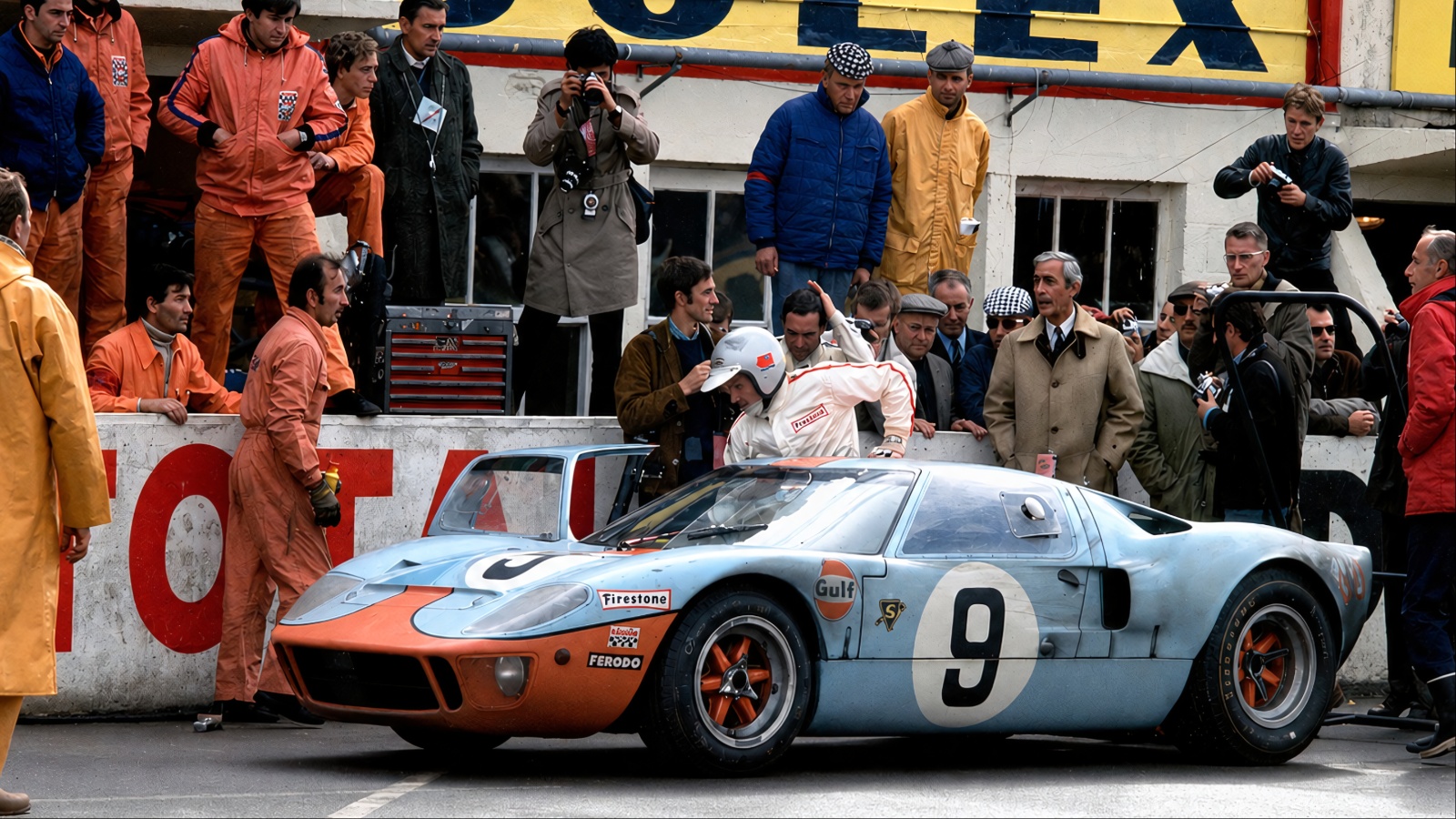
The Ford GT40 was born from a failed deal with Ferrari and became one of the greatest racing stories in automotive history. In 1963, Ford and Ferrari were negotiating a possible acquisition, but the discussions collapsed.
Ford did not abandon its ambitions in international motorsport. Instead, it decided to build a racing car capable of challenging Ferrari at the 24 Hours of Le Mans.
Ford formed its High Performance and Special Models Operation Unit shortly after negotiations with Ferrari were suspended. Its goal was to develop a racing GT capable of competing at major endurance events such as Sebring and Le Mans.
The first GT40 arrived quickly, but Ford soon discovered that building a fast car was easier than building one capable of surviving 24 hours at racing speeds.
The GT40 failed at Le Mans in 1964 and 1965. Ford then reorganized the program, brought in Carroll Shelby and Holman & Moody, developed the 427-cubic-inch V8-powered Mark II, and focused heavily on reliability.
In 1966, the strategy finally worked. Three Ford GT40 Mark IIs finished first, second, and third at Le Mans, ending Ferrari’s six-year winning streak. Ford then won again in 1967, 1968, and 1969.
Ford’s Failed Ferrari Deal Created a Racing War
Ford’s interest in Ferrari was not simply about buying an exotic-car brand. Ferrari’s success at Le Mans had given the company enormous international credibility, and Ford wanted a stronger presence in European performance racing.
The negotiations reached an advanced stage in 1963, but on May 22, Ford and Ferrari announced that discussions had been suspended. Only a month later, Ford established a dedicated high-performance operation to develop a racing GT for events including Le Mans.
Ford turned to Britain for much of the initial engineering work. Roy Lunn developed the basic Ford GT concept, while Eric Broadley and his Lola organization helped construct the car. John Wyer, who had managed Aston Martin’s successful Le Mans program, organized the racing effort, while Carroll Shelby became involved as Ford’s performance representative in Europe.
The resulting car was radically different from Ford’s conventional performance vehicles. It used a mid-engine layout and an exceptionally low body. Roy Lunn reduced its height to just 40 inches, inspiring the GT40 name.
The original GT40 used Ford’s 289-cubic-inch V8. Its low weight, aerodynamic efficiency, and mid-engine balance gave Ford the basic ingredients for a competitive endurance racer.
The first tests quickly exposed the difference between being fast and being ready for Le Mans.
During testing, the GT40 proved difficult to control at high speed. Aerodynamic changes improved the car, and its straight-line performance was impressive. At Le Mans in 1964, Phil Hill set a lap record, proving Ford could match Ferrari’s speed. But reliability remained a major weakness.
Ford’s cars suffered failures, including problems with their Colotti gearboxes. All three GT40s were out of the 1964 Le Mans race after only 12 hours.
The 1965 season brought further development. Ford improved the GT40’s aerodynamics and mechanical components, while Ken Miles became an important development driver. Engineers made extensive changes to airflow, ducting, bodywork, and other components.
Ford also developed a 427-cubic-inch V8. The seven-liter engine was considerably more powerful than the original 289 and was fitted into the mid-engine chassis while maintaining the car’s aerodynamic shape.
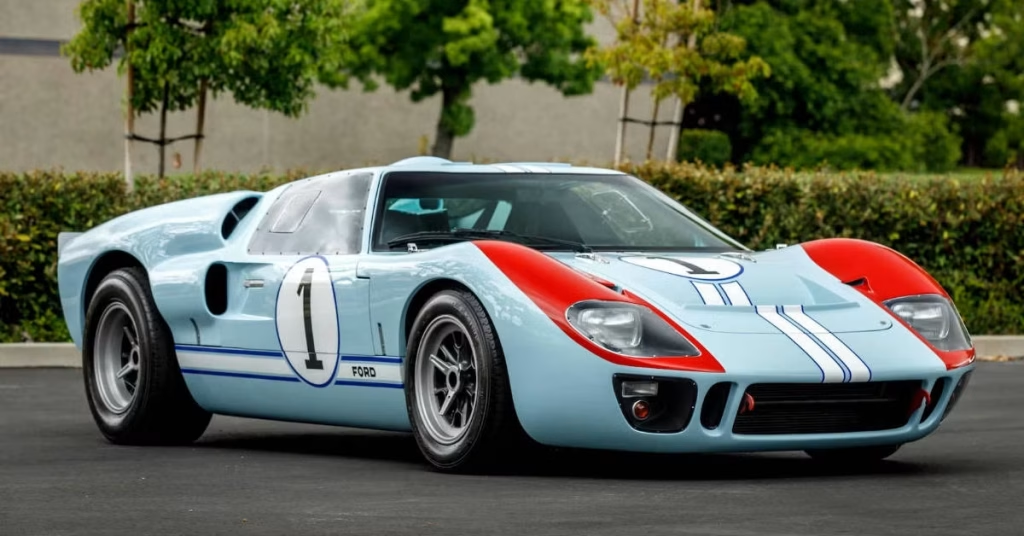
The new GT40X was astonishingly quick. During Le Mans testing in 1965, it recorded a 3:33 lap, almost five seconds faster than the Ferraris. Ken Miles reportedly reached approximately 210 mph.
But Ford still failed to win. The 1965 Le Mans effort ended with gearbox and other mechanical failures. Ford’s speed was no longer the question. Reliability was.
Ford now had to choose between continuing the GT40 as an engineering project or reorganizing the entire program around winning. It chose the second option.
The GT40 Finally Beat Ferrari at Le Mans
For 1966, Ford created a dedicated Le Mans Committee to reduce bureaucracy and coordinate its racing efforts. Holman & Moody joined Shelby American, creating a larger and more organized operation.
The resulting Mark II was a substantially improved GT40. The 427 V8 remained the centerpiece, but Ford revised the body, suspension, fuel system, and brakes. The car used a four-speed manual transmission because the 427 produced so much torque that Ford considered a fifth gear unnecessary.
The brakes received particular attention. The Mark II could exceed 200 mph, placing enormous demands on its braking system.
Ford engineers worked with Kelsey-Hayes, while Shelby engineer Phil Remington developed a quick-change caliper system and Holman & Moody created a quick-change rotor system. If something failed during the race, mechanics could replace it rapidly.
Ford also subjected the engine to extreme durability testing. After a 1966 Sebring failure, engineers developed dynamometer testing designed to reproduce Le Mans conditions. Ford eventually produced a 427 making about 485 horsepower at 6,400 rpm that could survive 48 hours of testing, twice the length of the actual race.
The preparation transformed the program. Ford entered 1966 with a car already tested in endurance competition. At Daytona, the GT40 Mark II won the 24-hour race and swept the top three positions. At Sebring, Ford again demonstrated the pace and durability required for long-distance racing.
Then came Le Mans. Ford entered eight GT40 Mark IIs, supported by more than 100 technicians, mechanics, engineers, and administrators. Shelby American, Holman-Moody, and Alan Mann Racing all contributed to the operation.
The GT40s had the speed to fight Ferrari, but Ford’s teams now understood that survival was equally important. As the race progressed, Ferrari’s factory cars began suffering mechanical failures. Ford also lost entries, but several GT40s remained near the front.
Eventually, Ferrari’s factory challenge disappeared. Bruce McLaren and Chris Amon won in the No. 2 GT40 Mark II. Ken Miles and Denny Hulme finished second, while Ronnie Bucknum and Dick Hutcherson completed the Ford podium sweep in third.
The victory ended Ferrari’s six-year winning streak at Le Mans and secured Ford its first victory at the legendary race. However, the finish was surrounded by controversy.
Ken Miles had been one of the GT40 program’s most important development drivers and had already won Daytona and Sebring earlier that year. Ford arranged for its leading cars to cross the finish together as a symbolic demonstration of dominance.
The official result nevertheless went to McLaren and Amon because their car had started farther back on the grid and had covered a greater distance. The Automobile Club de l’Ouest therefore classified it first, while Miles and Hulme were officially second.
Miles never got another chance to win Le Mans. He died later in 1966 while testing Ford’s J-Car at Riverside International Raceway.
Ford continued its Le Mans assault in 1967 with the Mark IV. Dan Gurney and A.J. Foyt drove it to victory, producing another milestone for the company. Ford then won again in 1968 and 1969, completing four consecutive Le Mans victories.
That record transformed the GT40 from an expensive response to a failed Ferrari deal into one of the most important racing cars ever built.
The GT40’s significance also explains why Ford later revived the GT name for a modern supercar. But the original remains unique because its entire existence was shaped by competition.
Ford did not build it simply because it wanted another sports car. It built it because Ferrari was the benchmark it wanted to defeat.
The first GT40 was fast but unreliable. Ford then changed the engine, improved aerodynamics, strengthened the transmission and brakes, reorganized its racing operation and brought together talented engineers and drivers. The result was not an overnight success.
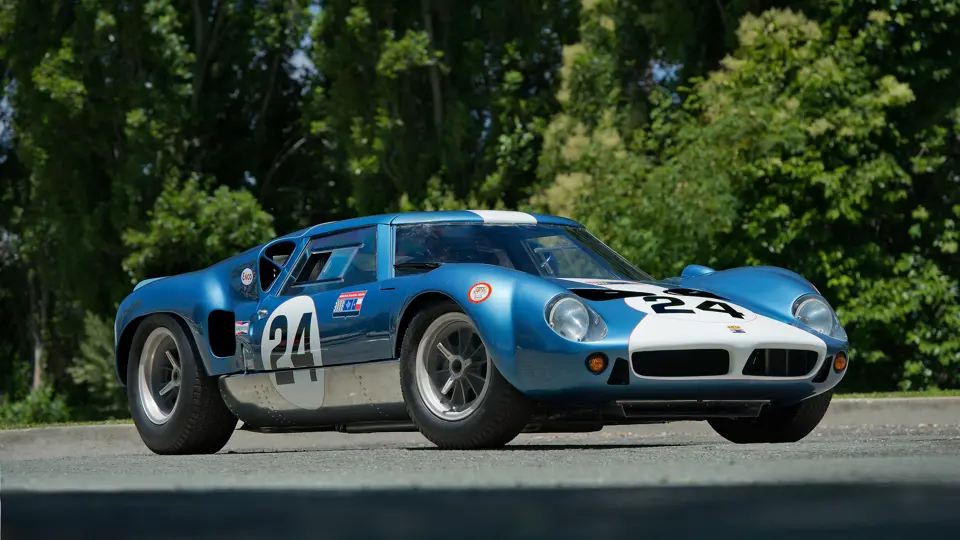
It was the product of repeated failure. That makes the GT40’s 1966 victory so significant. Ford entered Le Mans in 1964 with confidence and watched all three cars fail. Two years later, it controlled the podium. By 1969, Ferrari had been beaten four consecutive times.
The Ford GT40 represents much more than an old racing car. It is the result of Ford turning rejection into competition, competition into engineering development, and engineering development into one of motorsport’s most famous victories.
Ford could not acquire Ferrari. So it built a car that could beat Ferrari at Le Mans. And when the GT40 crossed the finish line first in 1966, it proved that Ford could challenge the most prestigious European racing manufacturer of the era and defeat it on the world’s most demanding endurance-racing stage.
