
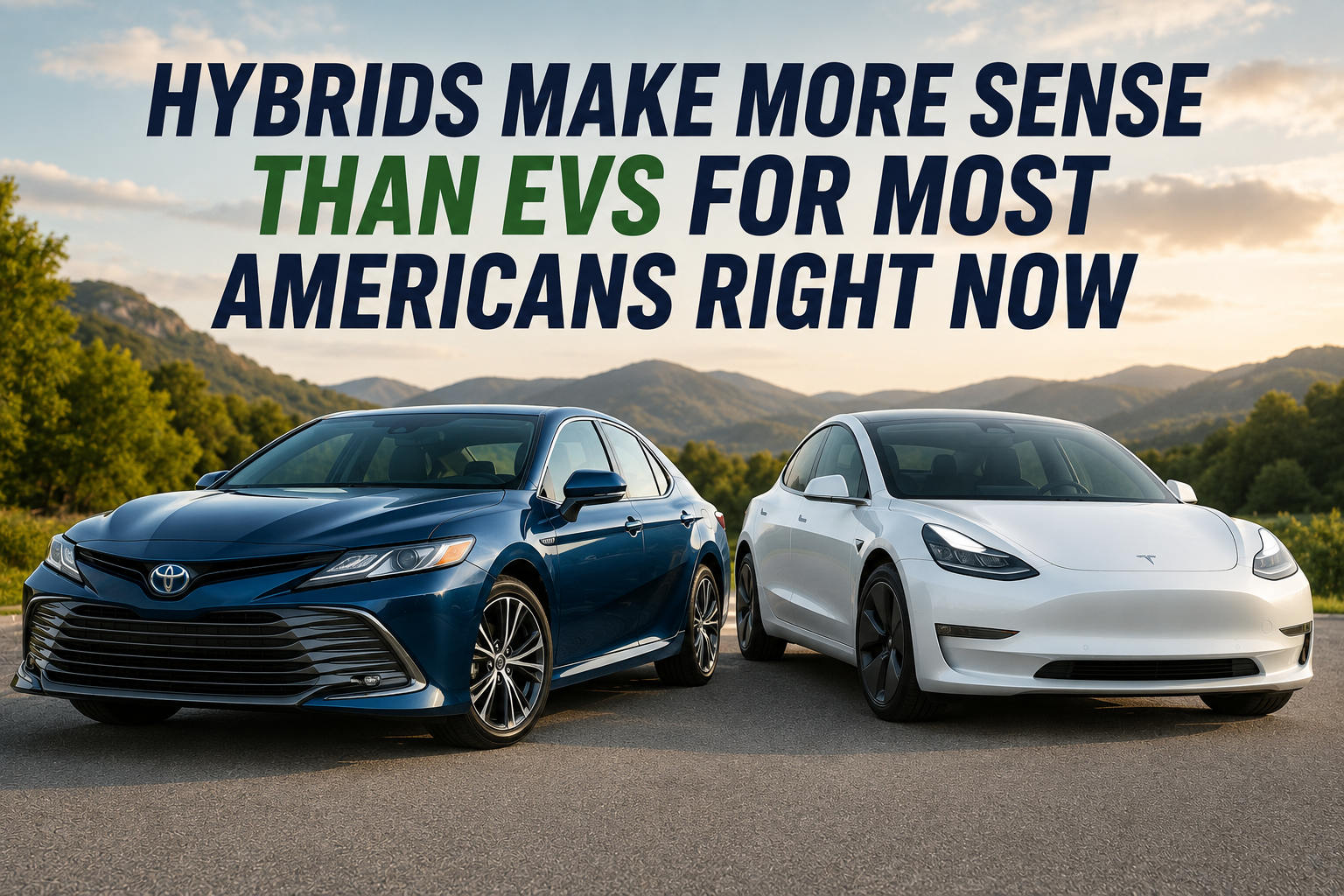
For years, the automotive industry has promoted electric vehicles as the inevitable future of personal transportation.
Major manufacturers have committed billions of dollars to battery development, governments have introduced incentives to accelerate adoption, and policymakers have set ambitious targets designed to reduce dependence on internal combustion engines.
As a result, consumers have been presented with a narrative suggesting that fully electric vehicles are the obvious next step for nearly everyone. The reality in 2026 is more complicated.
Electric vehicles have made remarkable progress. Modern EVs offer impressive acceleration, lower maintenance requirements, and increasingly competitive driving ranges.
Charging infrastructure has expanded significantly compared with just a few years ago, and battery technology continues to improve. Yet despite those advances, many American consumers remain hesitant to make the transition.
Interestingly, the market itself appears to be revealing what buyers truly want. While EV sales continue to grow, hybrid vehicles have become one of the hottest segments in the automotive industry. Manufacturers that once planned to rapidly phase out hybrids are now increasing production to meet rising demand.
This shift is not happening because consumers oppose electrification. Instead, many buyers are discovering that hybrids offer a practical compromise that delivers meaningful fuel savings without requiring major lifestyle changes. For millions of Americans, that balance currently makes far more sense than a fully electric vehicle.
Also Read: 8 Questions to Ask a Dealer Before You Buy
The Sales Numbers Tell an Interesting Story
Consumer demand often provides the clearest picture of market realities. Recent data from Cox Automotive shows that hybrid sales have grown dramatically over the past two years, outpacing many industry forecasts.
Several manufacturers, including Toyota, have reported record hybrid demand, with some models facing waiting lists because production has struggled to keep pace with customer interest.
The popularity of hybrids is especially notable because it comes during a period when consumers have more EV choices than ever before. Buyers are not selecting hybrids because electric vehicles are unavailable. They are choosing them because they better fit their current needs.
Market analysts at S&P Global Mobility have observed that many consumers view hybrids as a lower-risk transition toward electrification. Drivers can reduce fuel consumption significantly while avoiding concerns related to charging access, range limitations, and battery degradation.
The result is a market where hybrid demand continues climbing even as manufacturers aggressively promote fully electric alternatives.
Charging Infrastructure Still Creates Challenges
One of the biggest obstacles facing EV adoption remains charging infrastructure. The United States has made substantial progress in expanding public charging networks.
According to the U.S. Department of Energy, the number of public charging stations has increased dramatically over the past decade. Nevertheless, availability remains uneven across the country.
Urban areas generally enjoy better charging coverage, but millions of Americans live in suburban or rural communities where charging options remain limited. Apartment residents face additional challenges because they often lack access to dedicated home charging equipment.
A study conducted by AAA found that concerns about charging availability remain one of the primary reasons many consumers hesitate to purchase an electric vehicle.
Hybrids eliminate that issue. Owners continue using the existing network of gasoline stations while benefiting from electric motors that improve efficiency.
There is no need to install charging equipment, plan routes around charging stops, or worry about charger availability during busy travel periods. For many households, that convenience remains extremely valuable.
Road Trips Favor Hybrid Technology
Americans travel long distances more frequently than drivers in many other parts of the world.
Family vacations, interstate business trips, holiday travel, and recreational journeys often involve hundreds of miles in a single day. While modern EVs have made impressive gains in range, long-distance travel still requires more planning than a traditional gasoline-powered vehicle.
A driver operating a hybrid typically refuels in five minutes and continues the journey. An EV owner may need to locate available charging stations, wait for charging sessions to complete, and occasionally adjust travel plans based on infrastructure availability.
Although fast-charging technology continues to improve, the process remains more time-consuming than a conventional fuel stop.
Research from Edmunds has repeatedly shown that long-distance travel remains one of the areas where many consumers perceive hybrids as more practical than fully electric vehicles.
That perception is especially common among buyers who regularly tow trailers, boats, or recreational equipment. Towing significantly reduces EV range, often requiring additional charging stops during trips. Hybrids largely avoid those complications.
Affordability Matters More Than Ever
Vehicle affordability has become a major issue across the automotive industry. New vehicle prices remain significantly higher than they were just a few years ago, while interest rates have increased, resulting in financing costs for many consumers. As a result, buyers are paying closer attention to purchase prices than ever before.
Although electric vehicle prices have fallen in some segments, many EVs still cost more than comparable hybrid models. Incentives can reduce that gap, but eligibility requirements vary, and not every consumer qualifies for available tax credits. A hybrid often delivers a more attractive financial equation.
For example, a buyer can purchase a hybrid sedan or crossover, achieve substantial fuel savings, and avoid paying the premium associated with larger battery packs and advanced charging hardware.
According to vehicle cost analyses conducted by Kelley Blue Book, hybrids frequently offer shorter payback periods than EVs because their initial purchase prices remain more accessible. For households balancing budgets carefully, that difference can be decisive.
Reliability Remains a Major Advantage
One reason hybrids have become increasingly attractive is their impressive reliability record. Many hybrid systems have now been on the road for decades. Manufacturers such as Toyota and Honda have refined their technology through multiple generations, creating systems with proven durability.
Annual reliability studies from Consumer Reports consistently rank numerous hybrid models among the most dependable vehicles available. In several recent studies, hybrids actually outperformed both traditional gasoline vehicles and fully electric models in predicted reliability.
That finding surprises many consumers. While EVs contain fewer moving parts, they also rely heavily on sophisticated software systems, advanced battery management technology, and complex electronic architectures. Some manufacturers have experienced growing pains as they rapidly expanded their EV lineups.
Hybrids benefit from decades of development while avoiding many of the technological challenges associated with newer EV platforms. For buyers who prioritize long-term dependability, that track record provides valuable peace of mind.
Cold Weather Still Favors Hybrids
Climate plays a major role in vehicle performance. Electric vehicles generally perform very well in moderate temperatures, but cold weather continues to affect battery efficiency. Numerous studies have documented range reductions during winter conditions, particularly when cabin heating systems are operating.
Research conducted by AAA found that freezing temperatures can significantly reduce EV driving range under certain conditions. Although modern thermal management systems have improved performance, cold-weather effects remain noticeable.
Hybrids are less vulnerable to these challenges. Because they combine gasoline engines with electric motors, they retain the flexibility to operate efficiently regardless of weather conditions. Drivers do not need to worry about substantial range reductions during winter road trips or unexpected cold snaps.
For Americans living in northern states, that advantage remains highly relevant. A hybrid provides many of the benefits of electrification without introducing additional concerns during harsh winter months.
Consumer Preferences Are Evolving
Interestingly, many consumers who initially considered purchasing EVs are ultimately selecting hybrids instead.
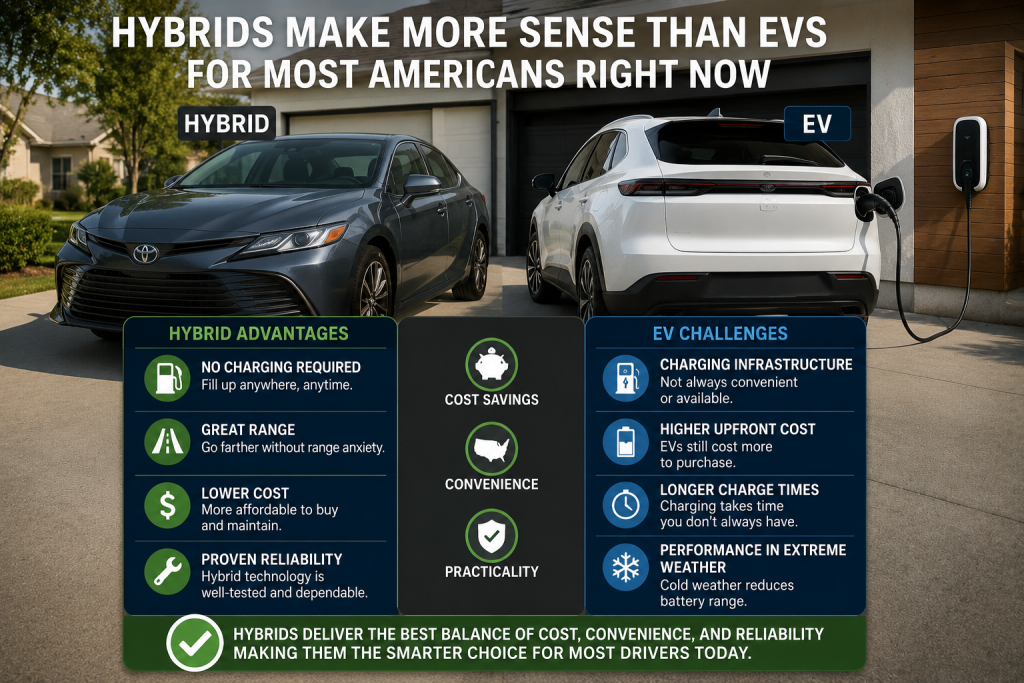
Surveys conducted by J.D. Power suggest that a significant percentage of buyers appreciate electrification but remain uncertain about fully abandoning gasoline-powered transportation.
This group often includes households with only one vehicle. When a family depends on a single vehicle for commuting, errands, vacations, emergencies, and long-distance travel, flexibility becomes extremely important. A hybrid offers that flexibility while still reducing fuel consumption and emissions.
The decision is not necessarily ideological. Most consumers simply want a vehicle that fits their lifestyle with minimal inconvenience. For many households, hybrids currently achieve that goal more effectively than EVs.
EVs Still Make Sense for Some Drivers
None of this means electric vehicles are a poor choice. For drivers with reliable home charging, predictable commuting patterns, and access to robust charging infrastructure, EVs can be excellent vehicles. They offer smooth performance, lower maintenance requirements, and potentially lower operating costs.
Many EV owners report extremely high satisfaction levels once they adapt to the charging routine. In certain situations, an electric vehicle absolutely represents the best option.
The key point is that those situations do not yet describe the majority of American households.
The automotive industry often presents EV adoption as a simple transition, but consumer needs vary significantly based on geography, housing arrangements, driving habits, and financial considerations.
Why Hybrids Are the Smartest Choice Today
The success of hybrids demonstrates that consumers are looking for practical solutions rather than ideological ones.
Drivers want lower fuel costs, reduced emissions, strong reliability, and convenient ownership experiences. Hybrids provide all of those benefits while eliminating many of the concerns that continue to slow EV adoption.
They require no charging infrastructure, support long-distance travel, perform consistently in cold weather, and often cost less than comparable electric vehicles. At the same time, they deliver impressive fuel economy and meaningful reductions in gasoline consumption.
That combination explains why hybrid sales continue to rise even as manufacturers expand their electric vehicle offerings.
Eventually, charging infrastructure will become more widespread, battery technology will improve further, and EV prices may fall enough to make fully electric vehicles the obvious choice for most consumers.
That future may arrive sooner than many expect. Right now, however, the evidence from sales trends, consumer surveys, reliability studies, and real-world ownership experiences points in a different direction. For a large percentage of American drivers, hybrids represent the most practical, affordable, and convenient path toward electrification.
They deliver many of the advantages consumers want today while avoiding many of the compromises they are not yet ready to accept. That is why hybrids currently make more sense than EVs for most Americans.
Also Read: 10 Hidden Features In The Toyota RAV4
