
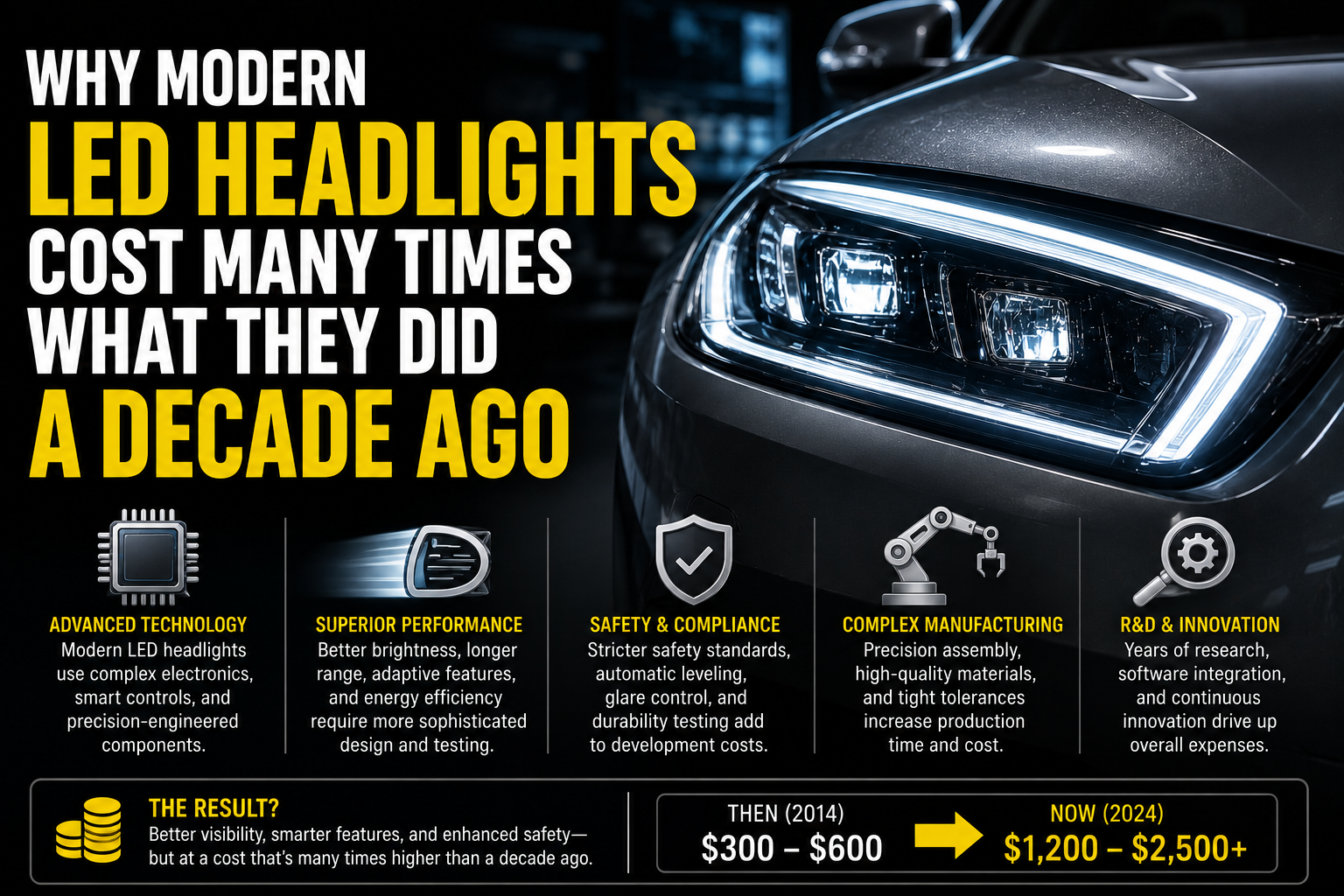
Walk into a dealership’s parts department after damaging a headlight on a modern vehicle, and the repair estimate can be shocking. A decade ago, replacing a halogen headlight assembly often cost a few hundred dollars.
Today, replacing a single LED headlight on a premium SUV or luxury sedan can easily cost $1,500 to $4,000, while some advanced matrix LED or laser-assisted units can exceed $5,000 before labor.
The dramatic increase has left many owners wondering how a part whose primary job is simply to illuminate the road became as expensive as an engine rebuild used to be. The answer lies in the evolution of the headlight from a simple bulb inside a plastic housing into one of the most sophisticated electronic systems on a vehicle.
Modern headlights are no longer just lights. They are computers, cameras, sensors, communication devices, precision optical instruments, and safety systems packed into a single sealed module.
Every technological improvement has made nighttime driving safer and more comfortable, but each advancement has also increased manufacturing costs, repair complexity, and replacement prices.
Also Read: 10 Tools To Fix Scratches On Cars
Ten Years Ago, headlights were relatively simple.
Around 2015, many mainstream vehicles still relied on halogen headlights. Their design was straightforward.
A replaceable bulb sat inside a reflector housing or projector lens. If the bulb burned out, the owner usually spent between $20 and $60 on a new bulb, installed it in minutes, and continued driving. Even replacing an entire headlight housing rarely exceeded a few hundred dollars unless the vehicle had suffered collision damage.
HID (High-Intensity Discharge) headlights were becoming more common on premium vehicles, but they remained comparatively simple.
They required a ballast to ignite the xenon bulb and a projector lens to focus the beam, yet most components could still be replaced individually. Today’s LED systems have fundamentally changed that approach.
LEDs Changed Everything
When automakers began introducing LED headlights across their lineups, the primary goal was not styling. LEDs offer several genuine engineering advantages.
They consume less electrical power than halogen bulbs, produce brighter and whiter light, respond instantly, and can last tens of thousands of hours under ideal conditions. Their compact size also gave designers far greater freedom to create distinctive lighting signatures that became an important part of brand identity.
Manufacturers quickly realized headlights could become a styling feature as recognizable as a grille or badge.
Audi popularized LED daytime running lights. BMW developed Corona Rings and later Icon Lights. Mercedes-Benz created Digital Light. Volvo introduced the “Thor’s Hammer” signature, while Cadillac, Genesis, Hyundai, Lexus, and many others built unique front-end designs around LED technology.
The result was a rapid industry-wide shift away from replaceable bulbs toward fully integrated lighting modules.
The Bulb Is No Longer Replaceable
One of the biggest reasons repair costs have increased is that many modern LED headlights are not designed around replaceable light sources.
Instead of changing a burned-out bulb, technicians often replace the entire headlight assembly.
Inside a modern LED unit are multiple printed circuit boards carrying dozens of LEDs, electronic drivers, voltage regulators, heat-management systems, optical lenses, and communication hardware. These components are designed to operate together as a sealed system.
If one critical electronic component fails, replacing the complete assembly is often faster, more reliable, and more practical than attempting board-level repairs.
While this improves durability under normal use, it dramatically increases repair costs when damage does occur.
Adaptive Headlights Added Motors and Electronics
The next major leap came with adaptive lighting systems. Traditional headlights always pointed straight ahead regardless of steering input.
Modern adaptive systems turn with the steering wheel, illuminating curves before the vehicle reaches them. Some also adjust vertically during acceleration and braking to maintain proper beam alignment.
To accomplish this, manufacturers added the following:
- Electric stepper motors
- Position sensors
- Electronic control units
- Steering-angle communication
- Suspension-level sensors
- Calibration software
Each additional component increases manufacturing cost while introducing more parts that can fail or require recalibration after repairs.
Even a relatively minor collision can disturb these systems enough to require replacement or electronic recalibration.
Matrix LED Technology Is Remarkably Complex
Perhaps the biggest technological jump has been the introduction of matrix LED headlights. Instead of one high beam and one low beam, a matrix system contains dozens or even hundreds of individually controlled LEDs.
The vehicle’s front camera continuously scans the road for:
- Oncoming traffic
- Vehicles ahead
- Street lighting
- Pedestrians
- Road signs
- Lane markings
Software then determines which LEDs should remain illuminated and which should dim. Rather than switching between high beams and low beams, the system creates dark zones around other vehicles while leaving the remainder of the road brightly illuminated.
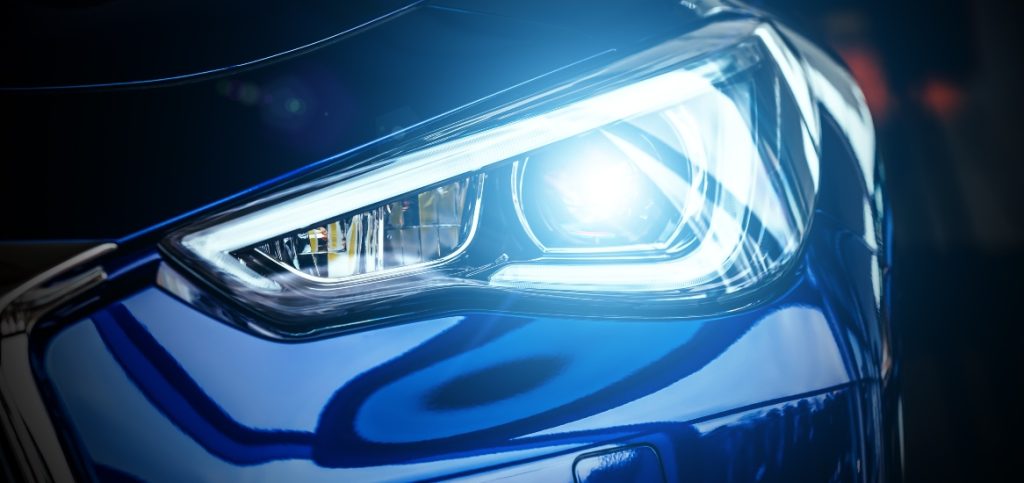
Drivers receive nearly continuous high-beam visibility without dazzling oncoming traffic. This technology requires enormous computing power compared with older headlights.
Every LED segment must react almost instantly while communicating with cameras, steering sensors, navigation systems, and vehicle-speed data. The headlight has effectively become another computer on the vehicle.
Heat Management Is Surprisingly Expensive
LEDs produce less wasted energy than halogen bulbs, but they still generate considerable heat. Heat is the biggest enemy of LED lifespan.
To prevent overheating, manufacturers incorporate sophisticated cooling systems into each assembly. These may include:
- Aluminum heat sinks
- Copper thermal plates
- Cooling fins
- Electronic temperature sensors
- Active cooling fans
- Thermal interface materials
Luxury vehicles with matrix lighting often contain miniature cooling systems comparable to those found inside high-performance computers. Without them, LEDs would quickly lose brightness or fail prematurely.
Precision Optics Cost More Than Most People Realize
A halogen reflector spreads light in a relatively simple pattern. Modern LED headlights require extremely precise optics.
Each LED must project light onto specific areas of the road while meeting strict government regulations governing glare, beam shape, brightness, and illumination distance.
Manufacturers use:
- Precision projector lenses
- Multi-layer optical coatings
- Reflective chambers
- Fresnel lenses
- Light guides
- Diffusers
These optical components are manufactured to extremely tight tolerances. Small imperfections can significantly affect beam quality.
Producing these lenses requires sophisticated molding techniques and extensive quality control, adding further cost to every assembly.
Headlights Now Communicate With the Vehicle
Modern headlights rarely operate independently. Instead, they exchange information continuously with multiple vehicle systems through the Controller Area Network (CAN) or Ethernet architecture.
They may communicate with:
- Forward-facing cameras
- Radar sensors
- Steering system
- Suspension
- Navigation
- Rain sensors
- Ambient-light sensors
- Driver-assistance modules
For example, navigation data may tell the headlights that a sharp curve is approaching before the driver begins turning.
Some systems automatically widen the beam inside intersections or narrow it during high-speed highway driving. This level of integration transforms headlights into active participants in vehicle safety.
Styling Has Become a Major Cost Driver
Lighting has become one of the most recognizable aspects of automotive design. Manufacturers now invest heavily in creating signature lighting that distinguishes one brand from another.
Audi’s Digital Matrix LEDs, Mercedes-Benz Digital Light, BMW Crystal Headlights, Genesis Two-Line lighting, Cadillac vertical LEDs, and Volvo’s Thor’s Hammer all require custom engineering.
Unlike generic halogen housings used across multiple models years ago, today’s headlights are often unique to a specific vehicle generation or even a single trim level.
That limited production volume increases manufacturing costs because tooling expenses are spread across fewer units.
Crash Safety Standards Increased Complexity
Modern headlights must survive far more demanding safety requirements. They must withstand:
- Temperature extremes
- Moisture intrusion
- UV exposure
- Vibration
- Minor impacts
- Car-wash chemicals
- Road salt
- High-pressure water
At the same time, pedestrian-safety regulations influence bumper and front-end design, requiring tighter packaging around the lighting system. The assemblies themselves must also meet strict waterproofing standards.
As a result, manufacturers use stronger plastics, advanced sealing materials, laser welding, and higher-quality adhesives. All of this improves durability but raises production costs.
Calibration Adds Repair Costs
Replacing the headlight itself is often only part of the bill. After installation, many modern systems require electronic calibration.
Dealership technicians connect factory diagnostic equipment to:
- Reset adaptive-lighting modules
- Recalibrate beam alignment
- Verify steering-angle operation
- Confirm communication with cameras
- Update software if necessary
Some vehicles also require static aiming equipment or calibration targets positioned several meters in front of the vehicle.
This process can add hundreds of dollars in labor even when the replacement itself is straightforward.
Independent repair shops increasingly invest in specialized calibration equipment because more insurance repairs require these procedures.
Insurance Companies Feel the Impact
Expensive headlights have become a growing concern for insurers. Many low-speed collisions that once required only bumper repairs now involve replacing sophisticated LED lighting modules.
Even minor parking-lot accidents can crack a lens or damage internal electronics. A repair that might have cost $700 ten years ago can now exceed several thousand dollars once the headlight, bumper, calibration, paintwork, and driver-assistance sensors are included.
Insurance industry studies have repeatedly shown that rising parts costs are one of the primary reasons collision-repair expenses continue increasing despite improvements in vehicle safety. Higher repair bills ultimately contribute to higher insurance premiums for many drivers.
Will Headlights Become Even More Expensive?
Probably. Manufacturers continue introducing increasingly advanced lighting technologies.
Mercedes-Benz Digital Light uses more than one million micro-mirrors to project extremely precise light patterns.
Some experimental systems can project symbols onto the road to warn pedestrians or guide drivers through construction zones.
Future headlights may integrate the following:
- Augmented-reality projections
- High-definition micro-LED arrays
- AI-controlled beam optimization
- Vehicle-to-vehicle communication
- Enhanced pedestrian recognition
Each advancement improves capability while adding additional hardware, software, and manufacturing complexity.
At the same time, repairability has become a growing topic within the automotive industry. Some manufacturers are beginning to show more modular lighting designs that allow certain components to be replaced individually instead of replacing the entire assembly.
Whether that trend expands will largely depend on balancing repair costs against reliability and manufacturing efficiency.
Are They Worth the Extra Cost?
From a safety perspective, the answer is often yes. Numerous studies have shown that better nighttime visibility reduces driver fatigue and improves reaction times.
Adaptive high beams, curve-following headlights, and matrix LED systems help drivers detect pedestrians, cyclists, wildlife, and road hazards earlier than conventional halogen systems.
That added visibility can prevent crashes that would cost far more than the headlight itself. The challenge comes after an accident.
Owners who never damage a headlight may enjoy years of improved nighttime safety without thinking about replacement costs.
Those who experience even a relatively minor collision, however, may discover that one damaged lighting assembly has become one of the most expensive components on the front of the vehicle.
Also Read: 10 Hidden Features In The Honda Pilot
