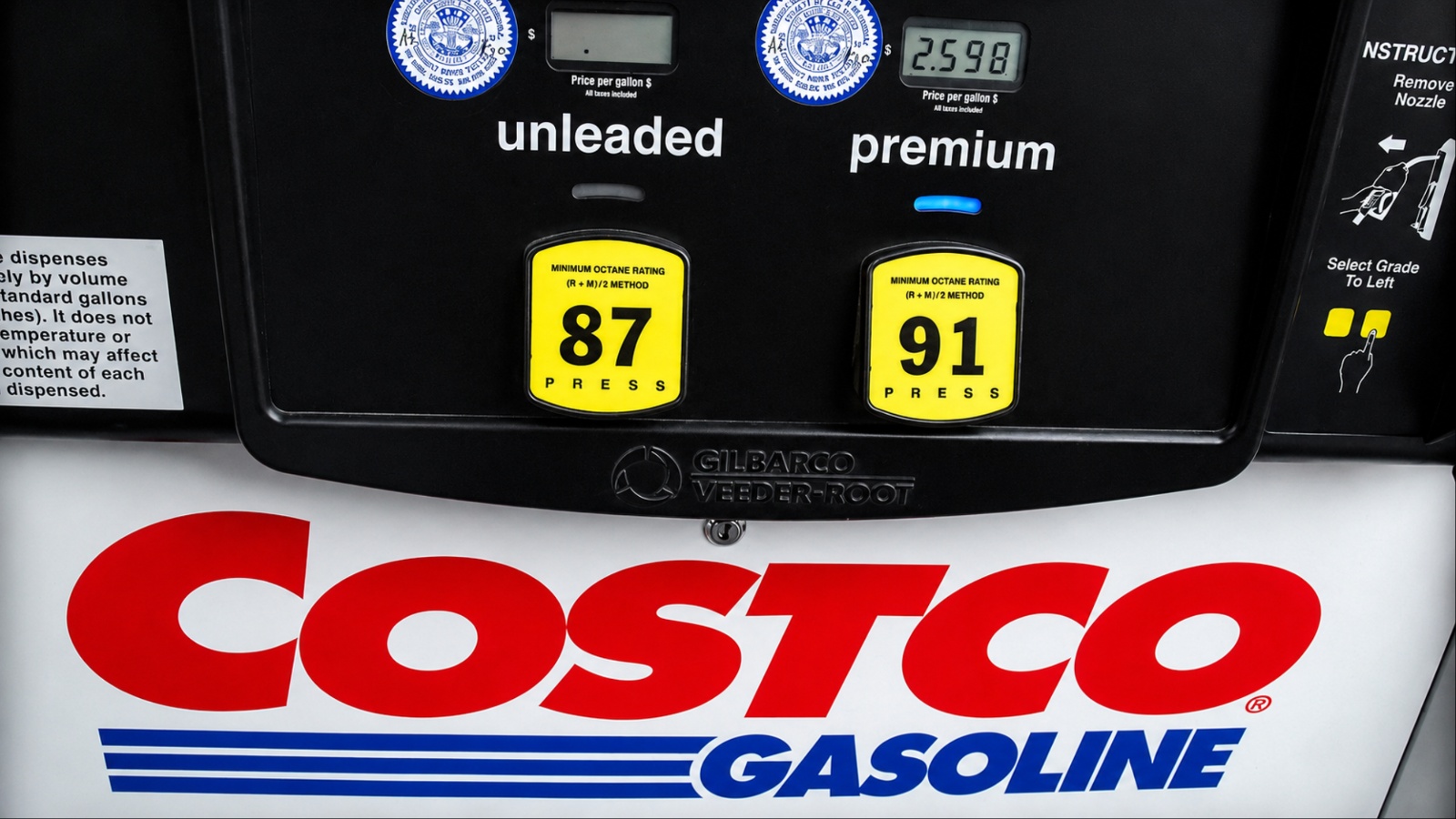
Fuel at warehouse clubs may appear similar from one station to another, but the gasoline can differ in its detergent requirements. This becomes important when comparing two of the largest warehouse retailers in the United States, Costco and Sam’s Club.
Costco’s Kirkland Signature gasoline is officially licensed as TOP TIER™ fuel, while Sam’s Club gasoline is not currently listed as a TOP TIER™-approved gasoline brand. The distinction is based on the official TOP TIER program’s current licensed-brand list, not on a claim that Sam’s Club fuel fails federal gasoline requirements.
That last point is important. All gasoline sold in the United States must meet federal and state fuel regulations. TOP TIER is a voluntary performance standard developed with automakers that requires substantially stronger detergent performance than the minimum regulatory requirements.
Costco says its Kirkland Signature gasoline has been certified to meet TOP TIER performance standards since 2014. The company’s current fuel information also says the certification applies to every gasoline product it sells, meaning the distinction is not limited to one particular octane grade.
The official TOP TIER program makes the same point from the other direction. It states that the performance standard applies to all octane grades sold at a licensed retail outlet, even if the TOP TIER decal is not displayed on a particular pump. Costco/Kirkland Signature is currently included on the organization’s U.S. licensed gasoline list.
Sam’s Club, meanwhile, does not appear on that current licensed-brand list. That means its gasoline should not be described as TOP TIER unless a specific fuel brand sold at a particular location is separately licensed.
The difference does not necessarily mean a Costco vehicle will run dramatically better than a Sam’s Club vehicle after one tank. The significance is that Costco voluntarily commits its gasoline to a higher detergent-performance specification, while Sam’s Club gasoline is not currently certified under that program.
What TOP TIER Actually Means for Your Gasoline
The term “TOP TIER” is often misunderstood as a premium fuel grade or a higher-octane gasoline. It is neither. Octane and detergent quality address different things.
Octane measures a gasoline’s resistance to engine knock. Detergent additives help control deposits that can accumulate in components such as fuel injectors and intake valves.
The TOP TIER program was created by automakers to establish a higher gasoline detergent-performance standard. According to TOP TIER, licensed gasoline contains an additive package that has been tested at independent engine laboratories and shown to meet the program’s performance requirements.
That means 87-octane TOP TIER gasoline is still 87 octane, while 91-octane TOP TIER gasoline remains 91 octane. The certification concerns the fuel’s additive package and deposit-control performance, not its octane number.
The distinction matters because federal regulations already require gasoline sold in the United States to contain an EPA-approved deposit-control additive. Costco notes that the EPA has required deposit-control additives in gasoline since 1995. TOP TIER goes beyond that minimum requirement.
Costco says Kirkland Signature gasoline contains five times the EPA detergent requirement in both regular unleaded and premium grades. The company says the formulation is intended to help clean existing deposits and prevent additional buildup on fuel injectors and intake valves.
Costco’s current fuel information similarly says its formula is designed to reduce deposit buildup that can affect engine performance, fuel economy, and emissions.
This does not mean using Costco gasoline will automatically increase a vehicle’s fuel economy by a specific percentage. Costco’s claims concern the potential effects of deposit control, while real-world fuel economy depends on many factors, including driving style, traffic, temperature, vehicle condition, tire pressure, and fuel requirements.
The more reasonable conclusion is that TOP TIER certification provides an additional quality benchmark for the detergent package. That distinction is especially relevant as modern engines become more sophisticated.
Fuel-injection systems operate under demanding conditions, and deposits can affect how an engine performs over time. TOP TIER’s purpose is to establish a consistent detergent standard designed to help control those deposits.
It also explains why the certification applies across grades. TOP TIER’s official guidance says licensed retailers must meet its detergent-performance requirements for all octane grades sold at the outlet.
Therefore, Costco’s regular gasoline does not lose its TOP TIER status simply because it is 87 octane instead of premium. That makes the Costco claim more significant than simply saying its premium fuel is TOP TIER.
Costco and Sam’s Club Take Different Positions
Costco has made fuel quality a central part of its Kirkland Signature brand. The company says its gasoline is tested in laboratories, contains additional deposit-control additives, and is filtered to help prevent contaminants such as sediment and water from reaching customers’ vehicles.
Costco also says its gasoline has been certified to TOP TIER performance standards across the products it sells.
The current TOP TIER licensed-brand list independently confirms Costco/Kirkland Signature as a licensed gasoline brand in the United States.
Sam’s Club takes a different approach. Its official fuel center information focuses on station availability, membership requirements, pricing, and fuel center services. Sam’s Club does not appear on the current TOP TIER licensed gasoline-brand list.
That does not establish that Sam’s Club gasoline is poor quality. This is where comparisons between the two retailers can easily become misleading.
Not being TOP TIER-certified does not mean gasoline is contaminated, unsafe, or below federal specifications. It means the fuel is not currently being marketed under the voluntary TOP TIER performance standard.
A Sam’s Club customer is therefore still buying gasoline that must comply with applicable fuel regulations. The difference is that there is no current TOP TIER certification attached to the Sam’s Club gasoline brand itself.
Another important point is that gasoline sold at different retailers can come from overlapping refinery and distribution networks. The retail brand does not necessarily mean the fuel originated at a refinery owned by that retailer.
What can differ is the additive package blended into the gasoline before it reaches the consumer. This is why the TOP TIER designation focuses on detergent performance rather than simply the source of the fuel.
For Costco customers, the certification makes the distinction clear. Kirkland Signature gasoline meets the TOP TIER standard across its gasoline grades.
The official TOP TIER organization also introduced TOP TIER+ in 2026, an evolution of the existing standard designed to extend detergent benefits to today’s gasoline direct-injection engines. TOP TIER announced that Costco was among the national brands that had announced TOP TIER+ status as the new standard rolled out.
That development is particularly relevant because direct-injection engines can present different deposit-related challenges from older engine designs.
Costco has therefore positioned its fuel program around more than simply selling inexpensive gasoline. The company emphasizes detergent concentration, deposit control, filtration, and certification as parts of its fuel offering.
Sam’s Club’s competitive advantage has traditionally been its warehouse-club pricing model, and fuel prices can be highly competitive at both retailers depending on location and market conditions. For consumers, that creates a practical decision.
If Costco and Sam’s Club are selling gasoline at similar prices in a particular market, Costco has the clear advantage in terms of documented TOP TIER certification.
If Sam’s Club is substantially cheaper or considerably more convenient, the decision becomes less straightforward. The absence of TOP TIER certification does not mean the gasoline will damage an engine or immediately cause inferior performance.
Drivers should also follow the vehicle manufacturer’s fuel recommendation. If an owner’s manual calls for regular 87-octane gasoline, paying extra for premium does not automatically provide a benefit simply because the premium fuel has a higher octane number.
Conversely, if an engine requires premium fuel, the correct octane rating remains more important than the retailer’s brand.
The most useful takeaway is therefore not that Costco gasoline is “good” and Sam’s Club gasoline is “bad.”
It is that Costco has verifiable third-party certification for its gasoline under a voluntary detergent-performance standard, while Sam’s Club does not currently hold that TOP TIER gasoline-brand listing.
For drivers who specifically want TOP-TIER gasoline, the choice is straightforward. The official program lists Costco/Kirkland Signature among its licensed U.S. gasoline brands, and its rules state that the certification applies across the octane grades offered by licensed retailers.
Costco’s own documentation reinforces that point, stating that Kirkland Signature fuel is certified to meet TOP TIER performance standards and that the certification is available across the gasoline products it sells.
Sam’s Club remains a legitimate fuel option, but its gasoline should not be advertised as TOP TIER based on the current official listings.
For consumers, that distinction provides a useful way to compare the two warehouse clubs without overstating what fuel certification can accomplish.
Costco has a documented advantage when it comes to fuel standards. Kirkland Signature gasoline is certified as TOP TIER across its gasoline grades. Sam’s Club can still be competitive on price and convenience, but its gasoline does not currently have the same TOP TIER certification.