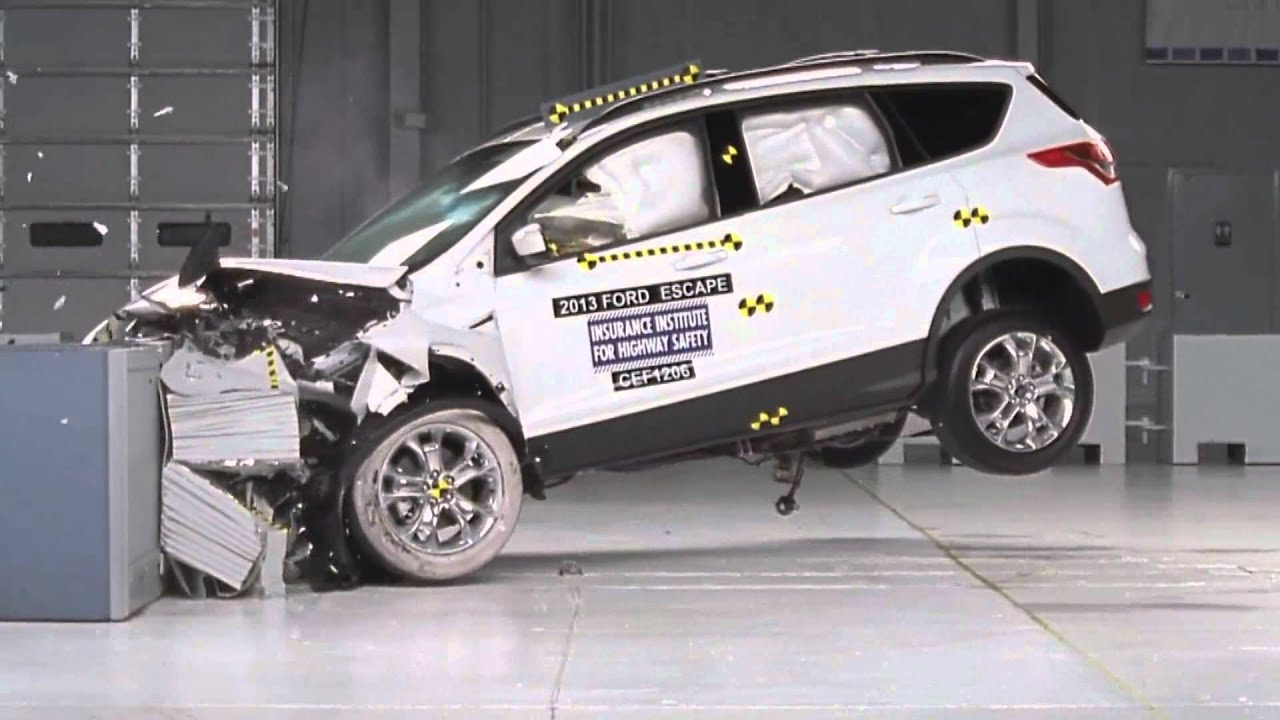
Crash testing has transformed vehicle safety by revealing how bodies deform, how restraints protect occupants, and where serious injuries can occur. Older vehicles were built before many modern crash-test procedures and occupant-protection technologies became standard.
Today’s assessments examine more collision types and measure how well vehicles preserve survival space. These seven comparisons focus on documented old-versus-new crash tests, highlighting the results and the safety lessons behind them.
Historical ratings are not always directly comparable because testing procedures have changed, but these examples show how crash protection has developed through measurable engineering improvements.
1. 1959 vs. 2009: The Frontal Offset Crash Test
In 2009, the Insurance Institute for Highway Safety (IIHS) conducted a widely reported frontal offset crash demonstration involving a 1959 Chevrolet Bel Air and a 2009 Chevrolet Malibu.
Both vehicles collided at approximately 40 mph, with only part of each car’s front end engaging the other. The test showed a dramatic difference in how their structures responded to impact.
The older vehicle’s passenger compartment experienced extensive deformation. IIHS measurements showed that the footrest moved rearward by approximately 24.4 inches, compared with about 2.8 inches in the newer vehicle.
At a dashboard measurement point, rearward intrusion was approximately 12.6 inches in the 1959 car and roughly 1.2 inches in the 2009 car. These measurements help explain why cabin deformation is such an important factor in evaluating crash protection.
The modern vehicle benefited from a structure engineered to absorb impact energy in designated areas while keeping the passenger compartment more intact. Its restraints and airbags were also designed to work together to reduce occupant contact with hard interior surfaces.
The demonstration did not test every vehicle from either era, so its findings should not be treated as a universal safety rating. However, the difference in structural damage highlights an important point. A heavy metal body does not guarantee occupant protection if the passenger cabin collapses during a crash.
Modern crashworthiness places greater emphasis on maintaining survival space and managing forces before they reach the people inside.
2. 1990s Crash Protection vs. Modern Small-Overlap Frontal Testing
During the 1990s, frontal crash testing was already an established part of vehicle safety evaluation. However, many earlier assessments focused on impact patterns that engaged a relatively large portion of the vehicle’s front end.
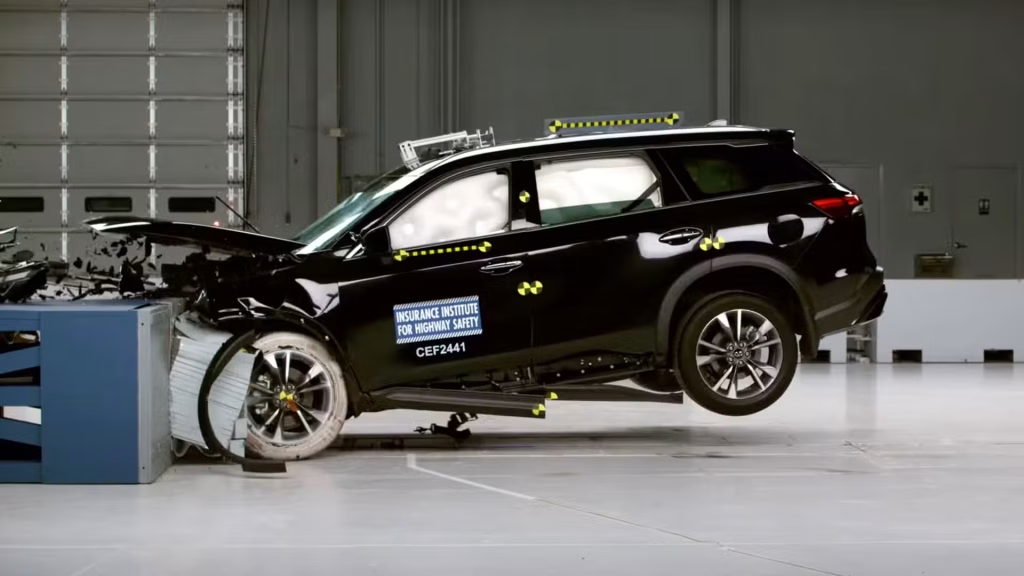
In 2012, IIHS introduced a small-overlap frontal test to address another dangerous scenario: a collision in which only 25 percent of the front width strikes a rigid barrier at 40 mph.
The newer test places unusual stress on the front corner of the vehicle. Because the impact can miss major components designed to absorb crash energy, the wheel and suspension may be forced toward the passenger compartment. The vehicle may also rotate abruptly, increasing the demands placed on the restraint system.
This test revealed weaknesses that conventional frontal assessments could miss. Some vehicles that had performed well in other crash tests initially struggled to maintain cabin integrity or control dummy movement in small-overlap collisions.
Manufacturers responded by strengthening front-corner structures, modifying suspension components, and improving the way crash forces travel through the body.
A direct numerical comparison with a typical 1990s crash test is only possible if the same vehicle is evaluated under both testing procedures. The key distinction lies in the testing methods, as modern safety assessments examine impact scenarios that were not routinely tested under the same standardized conditions decades ago.
The development of small-overlap testing demonstrates how crash research changes safety priorities. Rather than relying on a single frontal result, modern evaluation examines a wider range of collision scenarios, helping engineers identify weaknesses that might otherwise remain hidden until a real-world crash occurs.
3. Original vs. Updated Side-Impact Crash Test
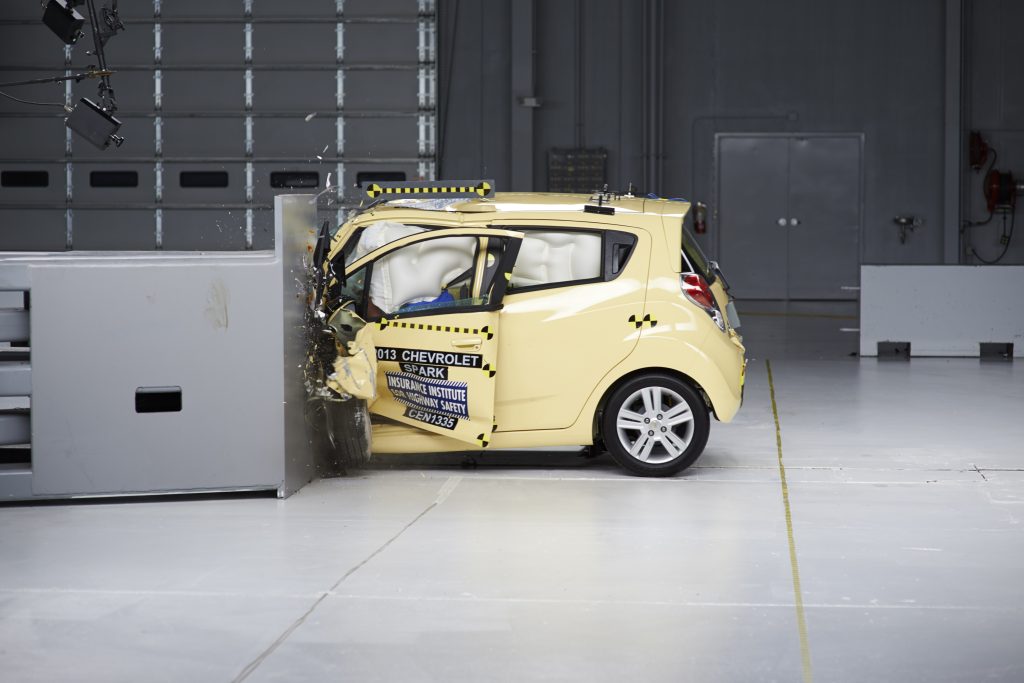
Side-impact crashes can be especially dangerous because a vehicle’s doors provide less space for absorbing impact energy than its front end.
IIHS began its side-impact testing program in 2003, using a moving barrier designed to represent the front of a typical SUV or pickup. The test helped encourage manufacturers to strengthen side structures and adopt side-curtain airbags.
In 2021, IIHS introduced a more demanding version of the test. The updated procedure uses a 4,200-pound moving barrier traveling at 37 mph, with a front profile designed to represent a modern SUV.
The earlier test used a lighter barrier and lower impact speed, reflecting the vehicles common when the original procedure was developed. The heavier striking rig delivers approximately 82 percent more crash energy, making it harder for a vehicle to earn a strong rating through structural reinforcement alone.
The updated test also examines injury risks for both the driver and a rear-seat occupant. Instrumented dummies record forces affecting the head, neck, torso, and pelvis, while engineers measure how far the barrier intrudes into the passenger compartment.
This broader assessment matters because a side collision can injure people in either seating row, particularly when the striking vehicle is tall and heavy.
The change illustrates how crash testing adapts as the vehicles on American roads change. SUVs and pickups have become a larger share of the fleet, so the striking vehicle in a side collision may be heavier and taller than the cars that shaped earlier test procedures.
A rating from the original test cannot simply be substituted for a result under the updated procedure. The newer assessment deliberately creates a more severe impact, pushing manufacturers to improve protection beyond the level that earlier testing had already encouraged.
4. Original vs. Updated Rear-Impact Whiplash Test
Rear-end collisions may happen at relatively low speeds, but they can still cause painful neck injuries. The original IIHS head-restraint evaluation examined how well a vehicle’s seat and head restraint supported an occupant during a simulated rear impact.
Its dynamic test represented a stationary vehicle being struck from behind at approximately 20 mph by a vehicle of the same weight. Engineers assessed how quickly the dummy’s head contacted the restraint and measured forces acting on the neck.
As manufacturers improved their seat designs, nearly all tested vehicles began earning good ratings under the original procedure. IIHS discontinued that test in 2022 because it no longer provided enough challenge to encourage further improvements.
The institute subsequently developed a more demanding whiplash-prevention evaluation, announced in January 2026.
The new evaluation simulates two rear-impact scenarios, representing a stationary vehicle struck by another vehicle of the same weight traveling at 20 mph and 30 mph.
Instead of crashing the entire vehicle, engineers secure the driver’s seat to a test sled and use an instrumented dummy to examine how the seat and head restraint manage the occupant’s movement.
The updated assessment measures more than the time it takes for the head restraint to contact the dummy’s head. It also examines head and spine alignment, forces acting on the neck, and how the seat absorbs energy transferred to the body.
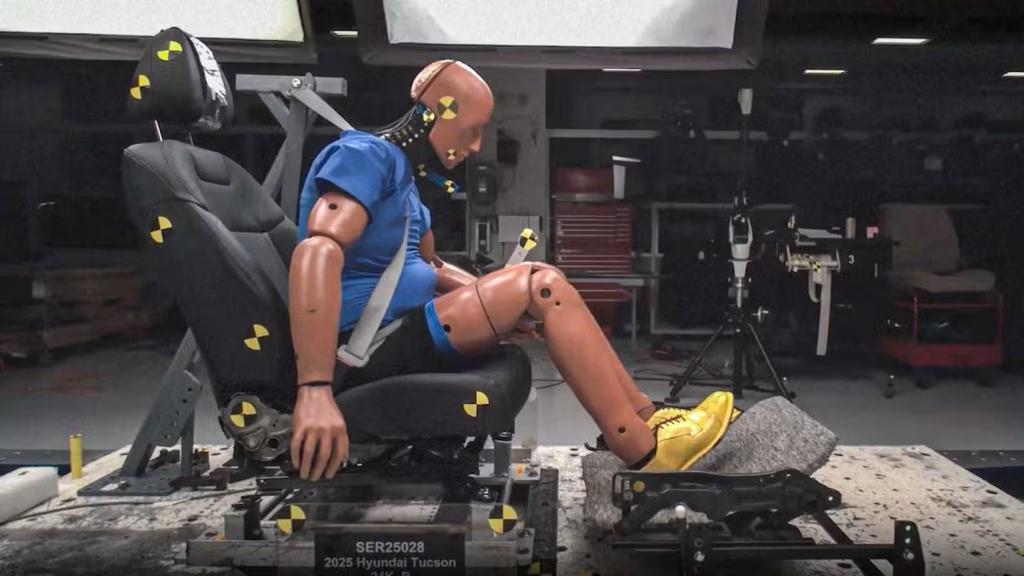
Pelvis movement and acceleration near the upper spine help engineers understand how the seat controls occupant motion.
The key advance is the more comprehensive evaluation of how a person’s body moves during a rear impact. A restraint that is tall enough may still provide inadequate protection if it contacts the head too late or allows excessive movement of the neck and spine.
The revised test encourages manufacturers to improve the entire seat and restraint system rather than relying on head-restraint geometry alone.
5. Original vs. Updated Moderate-Overlap Frontal Crash Test
The moderate-overlap frontal test has been part of IIHS safety evaluations since 1995. In the original procedure, a vehicle travels at 40 mph into a deformable barrier, with 40 percent of its front end overlapping the barrier.
The test simulates an offset frontal collision and examines whether the vehicle’s structure and restraint systems protect the driver. Over time, manufacturers improved their designs, and strong ratings became common.
In 2022, IIHS revised the test to address growing concerns that rear-seat occupants were not receiving the same safety improvements as those in the front seats.
The revised test places a second crash-test dummy in the rear seat, representing a small adult woman or a child around 12 years old. The driver dummy remains in place, allowing engineers to assess protection in both seating rows during the same crash.
The updated procedure measures more than cabin deformation. Sensors assess injury risks to the head, neck, chest, legs, and feet, while additional equipment examines rear-seat belt tension and chest compression. High-speed video helps investigators determine whether the seat belt and airbags control the dummy’s movement effectively.
The reason for the change is important. As front-seat airbags and advanced seat belts improved, the rear seat did not always receive equivalent restraint technology.
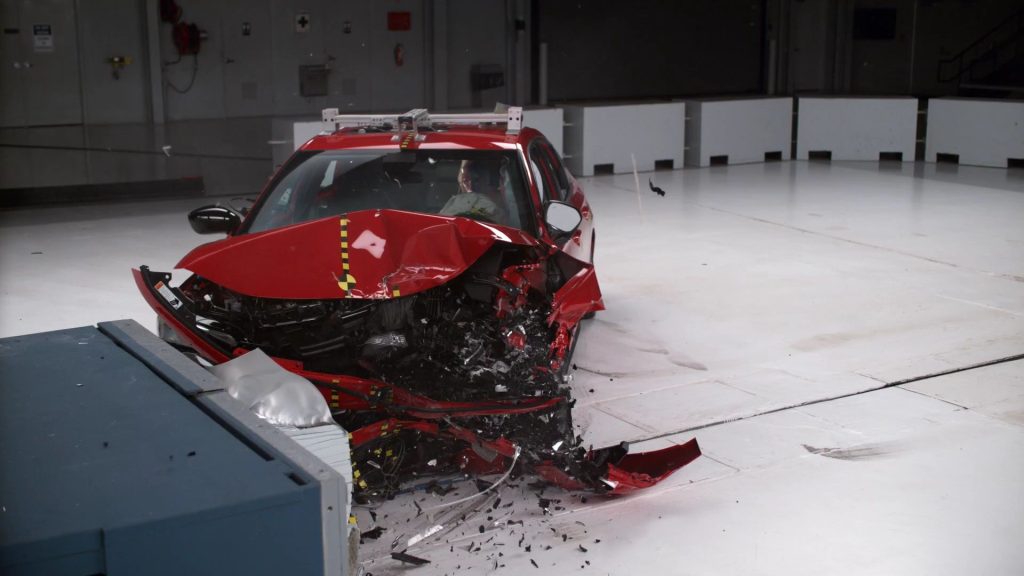
IIHS reported that, in vehicles from model year 2007 onward, belted rear-seat occupants had a 46 percent higher risk of fatal injury than belted front-seat occupants in the real-world data it analyzed. This does not mean the rear seat is inherently more dangerous in every crash, but it highlighted a gap that needed attention.
The updated test pushes manufacturers to consider protection for the whole cabin, not just the driver.
6. Original vs. Modern Side-Pole Crash Test
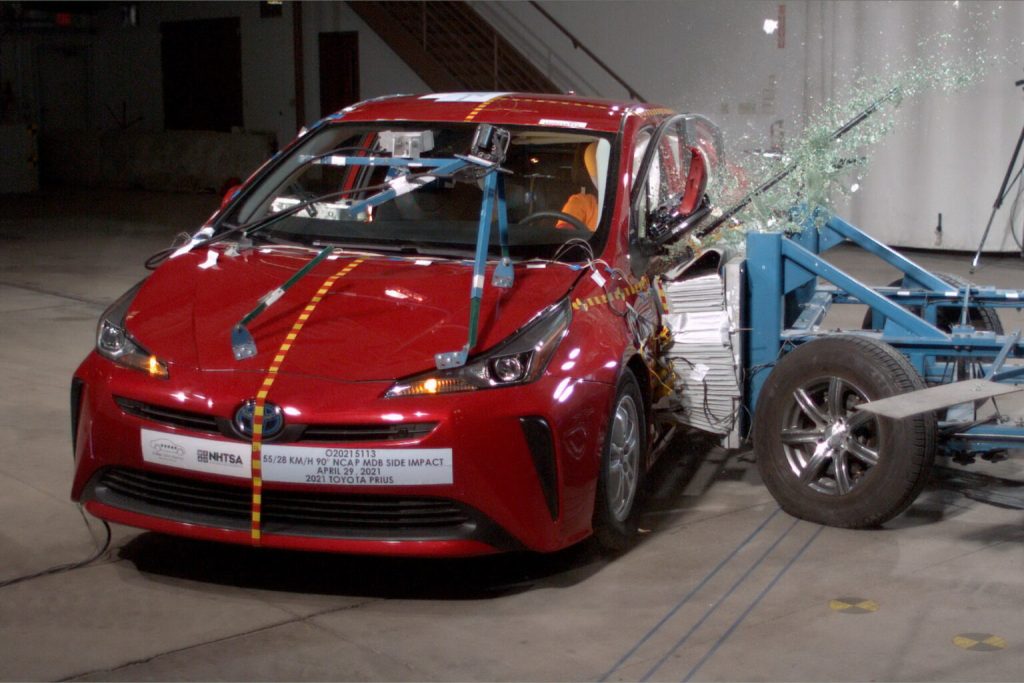
A collision with a tree, utility pole, or similarly narrow object can concentrate impact forces into a small section of a vehicle’s side. This is why the National Highway Traffic Safety Administration (NHTSA) added a side-pole assessment to its enhanced New Car Assessment Program.
The agency announced major changes in 2008, including the new pole test, improved crash-test dummies, and stricter rating criteria. The enhanced program began with vehicles from the 2011 model year.
In the current NHTSA side-pole test, a vehicle strikes a rigid pole approximately 10 inches in diameter at 20 mph, approaching at a 75-degree angle. A dummy representing a small adult woman sits in the driver’s seat with the seat belt fastened.
Sensors measure forces affecting the head, neck, chest, abdomen, lower spine, and pelvis. These readings help estimate the risk of serious injury.
The narrow pole creates a different challenge from a conventional side-impact barrier. Rather than spreading force across a broad section of the doors, the impact concentrates it in a limited area. Engineers must ensure that the side structure, airbags, and restraint systems work together to reduce intrusion and protect the occupant’s head and torso.
Earlier U.S. government crash ratings did not include this same standardized side-pole assessment, so a direct comparison between an older vehicle’s original star rating and a modern pole-test rating would be misleading. The change reflects a wider understanding of the types of collisions that cause serious injuries.
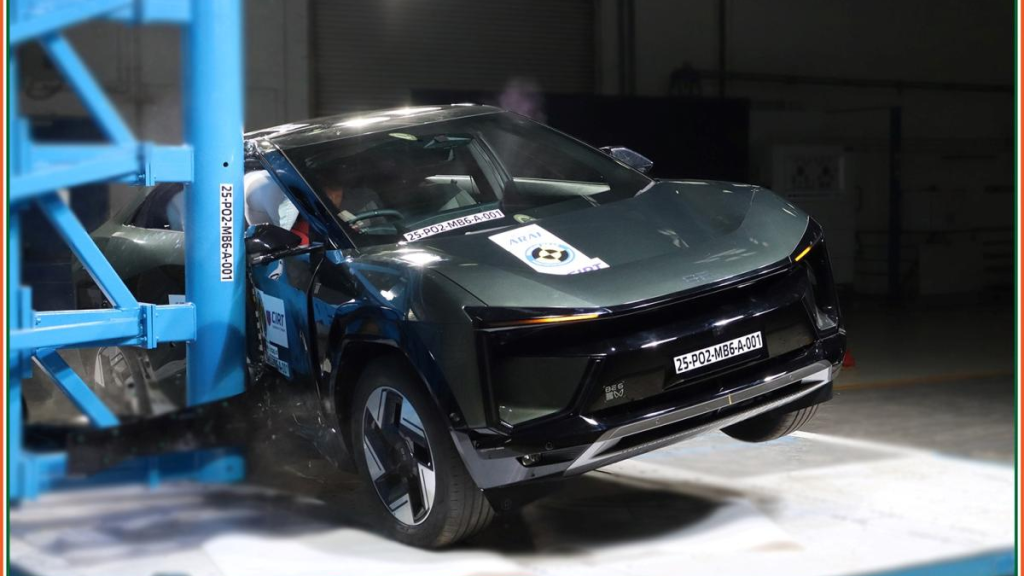
Modern testing also examines more than whether the doors remain closed. Injury measurements and occupant movement matter because a vehicle can sustain considerable exterior damage while still protecting its occupants, or look relatively intact while exposing them to dangerous forces.
The pole test gives safety engineers a more targeted way to identify and address risks in narrow-object side collisions.
7. Early vs. Modern Rollover-Resistance Testing
Rollover safety testing has also evolved beyond simply examining a vehicle’s shape and dimensions. In 2000, NHTSA began evaluating rollover resistance using a static measurement based on a vehicle’s track width and center-of-gravity height.
These characteristics help indicate how top-heavy a vehicle is and how readily it might tip under certain conditions.
In 2003, NHTSA expanded the program to include a dynamic test designed to simulate a maneuver that can lead to a rollover.
This added an assessment of how a vehicle responds when its direction changes rapidly, rather than relying only on measurements taken while it is stationary. The agency’s enhanced safety-rating program later combined rollover-resistance information with frontal and side-impact results.
The distinction matters because a vehicle’s rollover risk depends on more than its height. Track width, center-of-gravity location, tire grip, suspension behavior, and driver inputs can all influence how it responds to a sudden maneuver.
Electronic stability control can help a driver maintain directional control and reduce the likelihood of certain loss-of-control crashes, although it cannot eliminate every rollover risk.
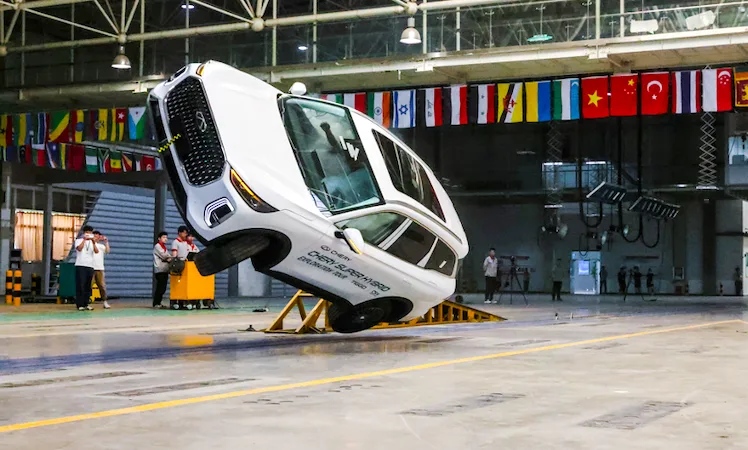
Modern rollover-resistance assessments therefore provide information that a simple static measurement cannot deliver by itself. However, neither method recreates every real-world rollover, and ratings should be understood as indicators of relative risk under defined test conditions.
The broader lesson is that safety testing has progressed from assessing individual physical characteristics toward evaluating how a vehicle behaves under more realistic driving challenges.
By combining static measurements, dynamic maneuvers, crash tests, and newer crash-prevention assessments, safety programs give consumers a more complete picture than early rating systems could provide.