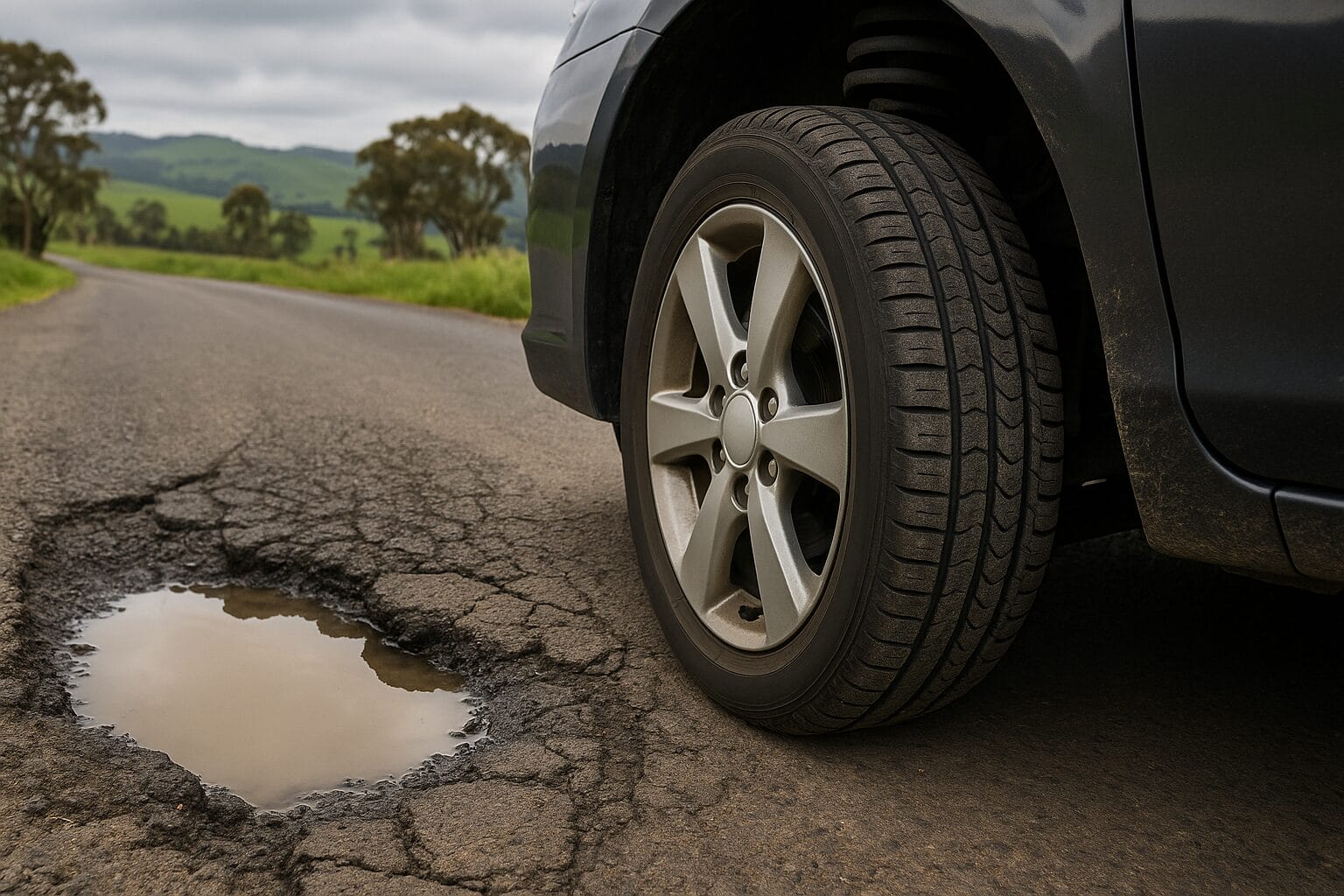
A deep pothole can do more than ruin a smooth drive. One impact can damage a tire, bend a wheel, affect suspension components, or leave a driver facing an unexpected repair bill. In some parts of the United States, motorists can file claims with state transportation agencies or other government offices to seek compensation.
However, payment is never automatic. Eligibility depends on who maintains the road, the evidence available, filing deadlines, and state liability laws. These eight states have established claim procedures or legal routes worth knowing before you pay for pothole-related vehicle repairs yourself.
1. Rhode Island
Rhode Island has one of the clearest state-level pothole damage claim procedures in the country, but it also imposes a strict reimbursement limit. The Rhode Island Department of Transportation (RIDOT) accepts claims when a vehicle is damaged by a pothole on a state-maintained road.
If the incident occurs on a town or city road, RIDOT cannot process the claim, so identifying the road’s owner is an essential first step.
One key detail to remember is the seven-day filing deadline for pothole damage claims with RIDOT. Waiting until repairs are scheduled or insurance discussions are settled could result in missing the deadline.
The department also states that a special Rhode Island law caps pothole claim reimbursement at $300. That means a driver facing a $700 tire and wheel repair should not assume the state will cover the entire bill.
Drivers should record the exact location, date, and time of the impact, photograph the pothole if it is safe to do so, and retain repair estimates, receipts, and other relevant documentation.
The claim should be submitted through RIDOT’s dedicated pothole claim process. The department provides a separate process for other types of roadway damage, so motorists should not confuse those rules with the seven-day pothole deadline.

The $300 cap makes Rhode Island’s procedure relatively straightforward, but it does not guarantee payment for every incident. The damage must have occurred on a state road, and the claim must satisfy the department’s requirements.
Drivers should document the incident as soon as possible and file their claims promptly instead of assuming the state will automatically cover the repair costs.
2. Indiana
Indiana gives motorists a formal route to seek compensation when a pothole on a state-maintained road damages their vehicle.
The process runs through the Indiana Department of Transportation (INDOT) and the Indiana Attorney General’s Office. Rather than promising automatic payment, the state uses a tort claim procedure to investigate whether a state agency was responsible for the damage.
Drivers who believe an INDOT-maintained road caused vehicle damage can submit State Form 54668, Notice of Tort Claim for Property Damage, or provide a written claim that follows the applicable requirements under Indiana law.
INDOT says supporting documents may include an incident or police report, vehicle registration, photographs, medical reports when relevant, and repair documentation. For vehicle repairs, the agency requests paid receipts or two estimates.
The claim is evaluated using the available evidence. Investigators consider whether the damage was caused by an issue for which the state agency may be legally responsible. Filing the paperwork does not mean compensation is guaranteed, and the state can reject a claim if the evidence does not establish liability.
Road ownership matters here, too. INDOT handles claims involving roads under its responsibility, while potholes on city streets or county roads should be reported to the relevant local government. Drivers can contact INDOT at 1-855-463-6848 for guidance about state-road damage and reporting.

Before submitting a claim, preserve photographs, repair estimates, receipts, and the precise location of the pothole.
Indiana’s process gives motorists a formal opportunity to seek reimbursement, but successful claims depend on evidence and the state’s liability determination, not simply on proving that a tire or wheel was damaged.
3. Connecticut
Connecticut is one of the states where motorists can submit claims for vehicle damage caused by the condition of a state-maintained highway.
The Connecticut Department of Transportation (CTDOT) accepts written claims, and unlike Rhode Island, the state does not publish a fixed reimbursement cap specifically for pothole-related vehicle damage. That does not mean every claim will be approved or that drivers are automatically entitled to the full repair bill.
The state requires claims to be submitted by mail within 90 days of the damage occurring, according to information reported about CTDOT’s claims procedure.
Drivers should provide a clear account of the incident, including the date, time, precise road location, direction of travel, and description of the damage. Photographs of the pothole and damaged vehicle, repair estimates, invoices, and any available witness information can help support the submission.
The most important issue is proving that the damage is legally attributable to the state’s responsibility. A pothole on a city street is not automatically CTDOT’s responsibility. Drivers should first establish whether the road is maintained by the state or by a municipality. If the road belongs to a city or town, the claim should be directed to that local government instead.

Connecticut’s lack of a stated pothole reimbursement ceiling may sound generous, but it should not be mistaken for guaranteed compensation. The department must assess the circumstances and determine whether the state is legally responsible. A claim can be denied even when a driver has genuine vehicle damage.
For motorists, the best approach is to report the hazard promptly, preserve evidence, obtain itemized repair documentation, and send the written claim before the 90-day deadline. Acting quickly also makes it easier to document the road condition before maintenance crews repair it.
4. New Hampshire
New Hampshire provides a formal process for motorists seeking compensation for vehicle damage caused by a pothole on a state-maintained road. The New Hampshire Department of Transportation (NHDOT) can consider claims submitted by drivers, but reimbursement is subject to the state’s requirements and investigation.
The reported maximum payment for vehicle damage is $2,000, making it important for drivers to understand that a costly repair may not be fully covered.
The reported filing deadline is 60 days from the incident. Claims must be completed and mailed to the state’s assistant transportation commissioner. Drivers should not wait until the end of that period to gather paperwork.
Photographs, a precise location, the date and time of the impact, vehicle registration, and repair estimates or paid invoices can all help explain what happened and establish the amount being claimed.
Road ownership is a key part of the process. NHDOT is not responsible for every road in New Hampshire. A pothole on a municipal street or locally maintained road may need to be reported to the town or city instead. Before submitting paperwork, motorists should confirm which agency maintains the stretch of road where the damage occurred.
Even when a claim is submitted within the deadline, payment is not automatic. The state must review the facts and determine whether the circumstances support compensation. Drivers should also check their insurance coverage, especially if the repair cost exceeds the reported state payment limit.

New Hampshire’s process can provide some financial relief, but the $2,000 ceiling means motorists should keep realistic expectations. Prompt reporting and complete documentation give a claim a stronger foundation.
5. Vermont
Vermont motorists may be able to recover money for vehicle damage caused by a pothole on a state-maintained road, but the state does not operate like an insurance company that automatically pays every repair bill.
The Vermont Agency of Transportation (VTrans) considers whether it had prior knowledge of the dangerous road condition and whether it had a reasonable opportunity to address it before the incident.
There is no published fixed reimbursement cap for these claims. However, a Vermont Agency of Transportation spokesperson has said that payments for pothole-related vehicle damage typically range from $300 to $500.
That is a reported typical payment range, not a guaranteed award or a maximum legal limit. A driver with a damaged wheel, tire, and suspension component could face a much larger bill.
The prior-notice requirement is especially important. Simply showing that a pothole existed and damaged a vehicle may not be enough.
The agency’s knowledge of the defect, the time available to repair it, and the circumstances surrounding the incident can all affect the decision. A pothole that appeared shortly before a vehicle struck it may be treated differently from one that had been reported repeatedly.
Drivers should document the exact location, date, time, and direction of travel. Photographs of the road defect and damaged vehicle can be useful, as can repair estimates, paid invoices, and information from witnesses.
Report the pothole to the relevant transportation authority as soon as possible and ask about the current procedure for submitting a property damage claim.

It is also essential to confirm that the road is maintained by the state. Local streets may fall under municipal responsibility, meaning the town or city rather than VTrans may need to receive the claim.
Vermont offers a possible route to compensation, but the agency’s prior knowledge and response to the hazard are central to whether a claim succeeds.
6. North Carolina
North Carolina allows motorists to submit property damage claims to the North Carolina Department of Transportation (NCDOT), including claims involving vehicles damaged by potholes.
The department’s process involves more than simply requesting reimbursement. NCDOT typically sends the driver’s claim and its own incident report to the North Carolina State Attorney General’s Office for a review of liability.
The central question is whether NCDOT knew about the pothole and made an effort to repair it within a reasonable period of time. A driver therefore needs more than proof of a damaged tire or bent wheel. Evidence about the road defect, its location, and the circumstances of the incident can help investigators assess whether the state may be responsible.
Motorists can submit a claim online or download a Citizen Incident Statement and mail it to the NCDOT office in the county where the damage occurred.
The department asks for details about the incident and the resulting loss. Supporting material such as photographs, repair estimates, paid invoices, and a police or incident report can help explain the claim.
If the Attorney General’s Office denies the request, drivers may appeal to the North Carolina Industrial Commission. This gives motorists another formal avenue to challenge a denial, although it does not guarantee that compensation will ultimately be awarded.

There is an important distinction for incidents inside construction zones. If a vehicle is damaged in a work zone involving a contracted project, NCDOT says it will forward the claim to the contractor, who is responsible for reviewing the road-condition claim.
Before filing, confirm that the road falls under state maintenance rather than city or county control. North Carolina’s system gives drivers a clear way to seek review, but the outcome depends on the evidence and the legal responsibility established during the investigation.
7. South Carolina
South Carolina has an online damage claim process through the South Carolina Department of Transportation (SCDOT). Drivers can use it to seek compensation for vehicle damage caused by a pothole or another road defect on a state-maintained roadway.
However, the department does not promise payment simply because a vehicle was damaged. Its rules require evidence that SCDOT had prior knowledge of the road condition and failed to correct it within a reasonable period.
The filing deadline is one year from the date of the incident. That is considerably longer than Rhode Island’s seven-day window, but waiting is still unwise.
Road repairs can remove the evidence needed to identify the original pothole, and photographs taken immediately after the incident may be more useful than images captured weeks later.
SCDOT requires a completed damage claim form. For vehicle damage, the claimant must provide a copy of the vehicle registration, and the person filing must be the registered owner.
The department also requires either two repair estimates or one paid repair invoice. Its claim form must be properly notarized. Photographs of the damaged vehicle and, when safe, the pothole and surrounding roadway are strongly recommended.

The road’s maintenance status matters. SCDOT’s process applies to state-maintained roads, not every street in South Carolina. If the incident happened on a municipal road, drivers should contact the relevant city or town to learn whether it has a separate claims procedure.
For motorists, the practical advantage is a clearly defined online process and a full year to file. The challenge is proving prior notice and allowing the department to investigate the defect. Keep copies of every submission and repair document, and do not assume that meeting the deadline alone guarantees reimbursement.
8. Virginia
Virginia gives drivers a formal way to submit claims when a pothole damages their vehicle on a road maintained by the Virginia Department of Transportation (VDOT). The department investigates these claims individually rather than paying a standard amount for every damaged tire, wheel, or suspension component.
Its review considers the location and condition of the pothole, whether VDOT had previously been notified, and whether maintenance crews had a reasonable opportunity to repair it.
VDOT directs motorists to submit vehicle damage claims through its online customer service system, myVDOT. The department explains that claims are assessed case by case, so drivers should not interpret the ability to file as a promise of compensation. Evidence that the agency knew about the hazard before the incident can be particularly important.
A strong submission should describe exactly where the incident happened, including the route, direction of travel, and nearby landmarks.

Drivers should also record the date and time, photograph the pothole when it is safe, and take pictures of the damaged vehicle. Repair estimates, paid invoices, and any available witness details can further support the account.
One common mistake is sending a claim to VDOT when the damaged road is actually maintained by a city, county, or another authority. Virginia has many roads under different maintenance responsibilities, so confirming ownership before filing can prevent unnecessary delays.
VDOT’s guidance does not specify a universal pothole reimbursement amount. The result depends on the evidence and the agency’s legal responsibility for the road condition. Drivers should report the pothole promptly, preserve their repair paperwork, and use myVDOT to begin the claim process.