

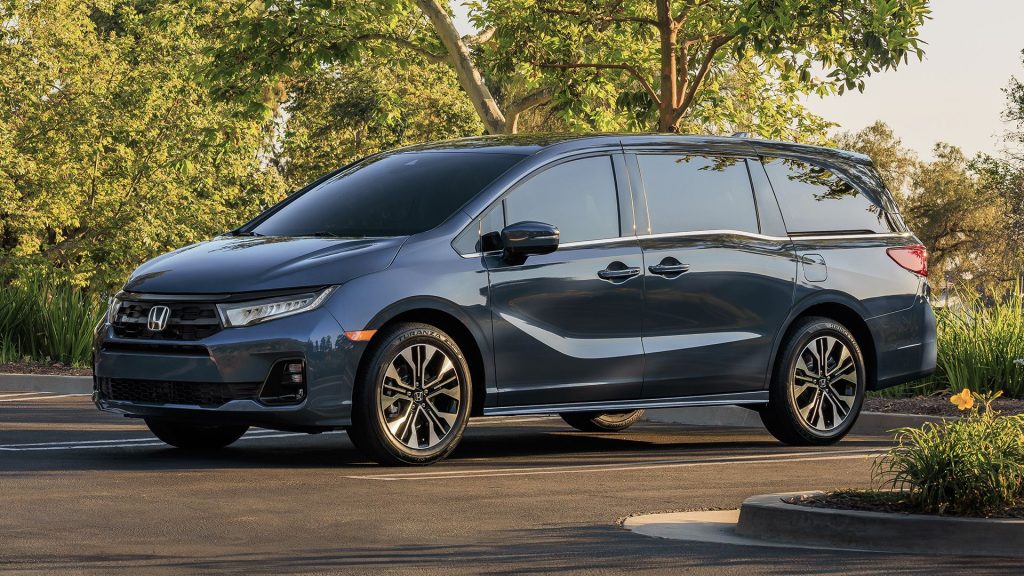
Honda Motor Co. has issued a large-scale recall affecting more than 440,000 Odyssey minivans in the United States, primarily covering model years 2018 through 2022.
The recall addresses a defect that could cause side airbags to deploy unintentionally, raising broader concerns about the reliability of software-controlled safety systems in modern vehicles.
The issue centers on the Supplemental Restraint System (SRS) control unit. According to recall findings, the system may incorrectly interpret certain road impacts, such as potholes or debris strikes, as collision events. As a result, the side and curtain airbags could deploy even when no crash has occurred.
This malfunction presents a tangible safety risk. Airbags are engineered to deploy with considerable force during collisions, and unintended activation can lead to injuries or sudden driver distraction.
Reports linked to the defect include multiple injury claims, underscoring that even false deployments can have real-world consequences.
Unlike traditional recalls tied to mechanical failures, this issue appears to stem from calibration sensitivity within the SRS software.
The system’s thresholds may be set too low, allowing normal driving conditions to trigger a response intended only for significant impacts. This reflects a broader industry challenge, where safety systems increasingly rely on software logic rather than purely mechanical triggers.
Honda’s corrective action involves inspecting affected vehicles and either reprogramming or replacing the SRS control unit.
The repair process is expected to be straightforward and will be carried out at no cost to owners. Notification to customers is scheduled in phases, with service availability aligned through authorized dealerships.
While the immediate fix is relatively simple, the implications are more complex. Modern vehicles integrate software into nearly every aspect of safety, from airbag deployment to advanced driver assistance features.
This enables more precise control but also introduces new failure modes that may not emerge until vehicles encounter diverse real-world conditions.
The timeline of the issue also illustrates the difficulty of identifying such defects. Reports of irregular airbag behavior surfaced years before the recall was formally issued, reflecting the challenges of validating systems that must account for a wide range of driving environments and impact scenarios.
For vehicle owners, the priority remains straightforward: respond to recall notices promptly and complete the recommended repairs. Although the likelihood of unintended deployment across the full vehicle population remains relatively low, the potential consequences justify immediate attention.
More broadly, this recall serves as a reminder that automotive safety is undergoing a structural shift. As vehicles become increasingly software-defined, ensuring reliability requires not only robust engineering but also continuous calibration, testing, and validation of complex digital systems.
Odyssey recall is not an isolated incident. It is an example of how evolving technology is reshaping both the benefits and the risks associated with modern vehicle safety.
