
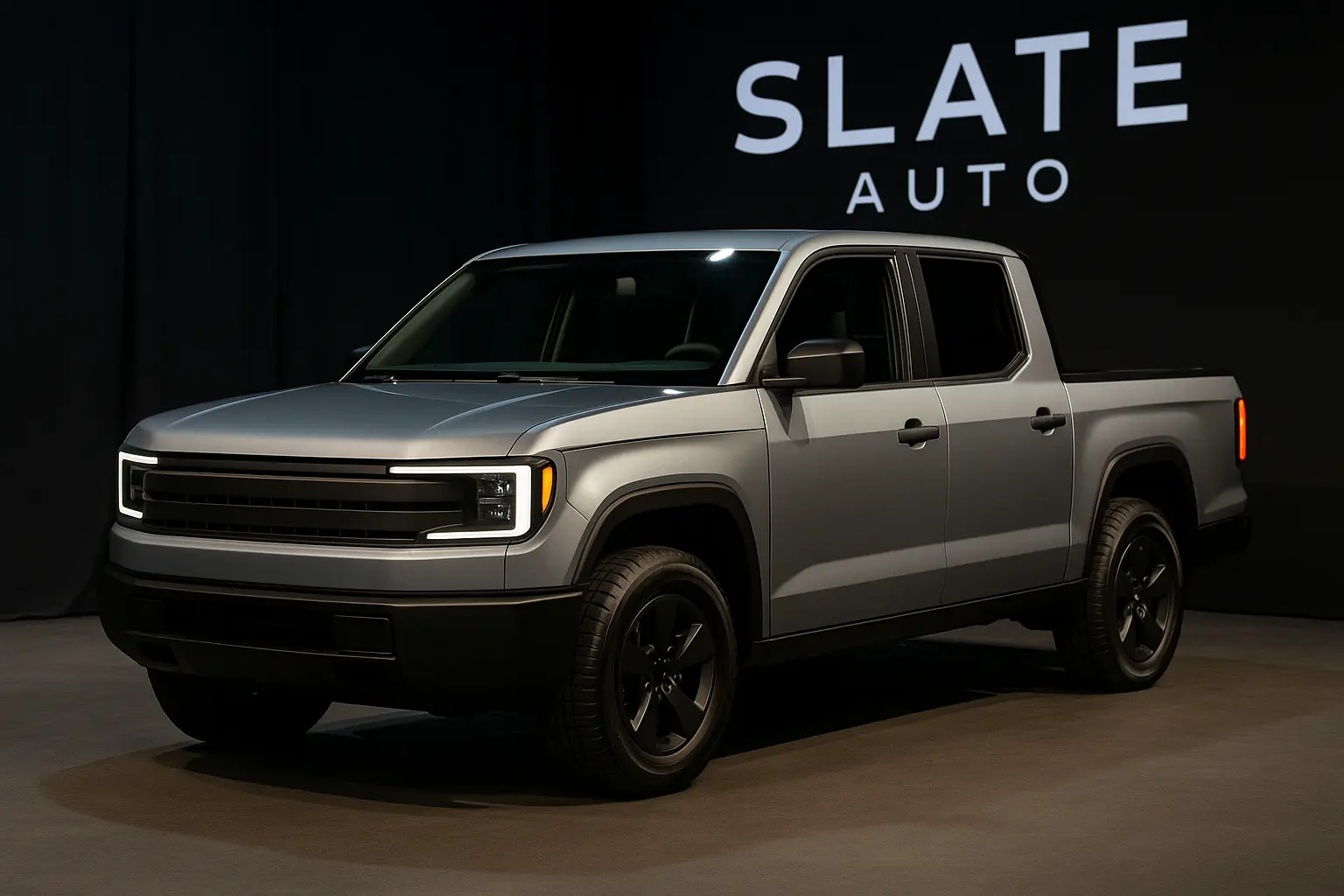
The push to make electric vehicles more affordable could take a significant step forward later this month as Slate Auto prepares to reveal pricing and open preorders for its highly anticipated electric pickup.
The startup, backed by investors that include Amazon founder Jeff Bezos, has confirmed that reservations for the truck will begin on June 24, giving consumers their first opportunity to secure one of the most talked-about budget-focused EVs in development.
The announcement comes at a time when many electric vehicles remain out of reach for average buyers. While automakers continue expanding their EV lineups, affordability remains one of the industry’s biggest challenges.
Slate believes it can address that issue with a compact electric truck expected to start in the “mid-$20,000s,” placing it among the least expensive new EVs available in the United States.
Consumer Reports highlighted the upcoming preorder launch this week, noting that the company expects to begin customer deliveries before the end of the year. If Slate successfully meets those targets, it could become one of the first startups to deliver a genuinely low-cost electric pickup to the American market.
For consumers frustrated by rising vehicle prices, the June 24 event may provide an important view into a different vision of electric transportation.
Aiming for a Market Most Automakers Ignore
The modern electric truck segment has largely focused on premium buyers. Vehicles such as the Tesla Cybertruck, Rivian R1T, Chevrolet Silverado EV, and Ford F-150 Lightning have demonstrated that consumers are interested in electric pickups.
However, many of those models begin well above $50,000 and can climb substantially higher depending on trim level and options. Slate is targeting a completely different audience.
Consumer Reports noted that the startup continues to position its pickup in the mid-$20,000 range, a price point rarely discussed in today’s EV market. The strategy centers on attracting buyers who want an electric vehicle but are unwilling or unable to spend luxury-car money.
That approach could help the company stand out in an increasingly crowded marketplace. While established manufacturers continue competing for premium customers, Slate is attempting to address demand at the lower end of the market, where affordable options remain limited.
The company’s leadership believes there is a significant opportunity in serving consumers who simply want practical transportation rather than cutting-edge luxury features.
A Minimalist Approach to Electric Vehicles
Part of Slate’s appeal stems from its willingness to challenge assumptions about what an electric vehicle should be.
Many modern EVs emphasize technology, featuring massive touchscreen displays, sophisticated software systems, and extensive feature lists. Those additions can improve the ownership experience, but they also contribute to higher production costs.
Slate has taken a different route. Early information released by the company suggests the truck was designed with simplicity in mind. Reports covering the vehicle have described a compact, utility-focused pickup that prioritizes affordability and functionality over premium appointments.
The company has also discussed a modular ownership concept that would allow customers to customize their trucks through accessories and add-ons.
Rather than paying for numerous features upfront, buyers could start with a basic configuration and expand capabilities over time.
That philosophy mirrors approaches seen in other industries and could help keep the initial purchase price lower.
Why the Price Matters
The significance of Slate’s upcoming announcement extends beyond the truck itself. Affordability remains one of the biggest obstacles to widespread electric vehicle adoption. Although battery costs have fallen considerably during the past decade, many EVs still carry price tags that exceed those of comparable gasoline-powered vehicles.
Industry analysts have repeatedly pointed to affordable models as a critical requirement for increasing EV market penetration.
Consumer Reports has frequently emphasized that lower-cost electric vehicles are necessary if manufacturers hope to move beyond early adopters and attract mainstream consumers.
The challenge has become even more important as economic uncertainty and higher interest rates influence vehicle purchasing decisions. Buyers are paying closer attention to monthly payments and total ownership costs than they did just a few years ago.
If Slate can deliver a competitively priced truck while maintaining acceptable performance and usability, it could attract customers who have been waiting for a more accessible entry point into electric vehicle ownership.
Competition Will Be Intense
Despite the excitement surrounding the truck, Slate faces significant challenges. Launching a vehicle company is notoriously difficult, particularly in the electric vehicle sector. Numerous startups have struggled with manufacturing delays, supply-chain disruptions, funding requirements, and production scaling challenges.
Even companies with strong investor backing have encountered obstacles when transitioning from prototype development to mass production.
Slate must also compete against established manufacturers that possess decades of manufacturing experience and extensive dealer networks. The company believes affordability can help offset those disadvantages.
By entering a segment that larger automakers have largely ignored, Slate hopes to carve out a niche rather than compete directly with premium electric trucks. Whether that strategy succeeds will depend on execution as much as pricing.
Consumers have become increasingly cautious following years of ambitious startup promises across the EV industry. Many buyers will likely wait for additional production details before committing to a purchase.
Preorders Offer an Early Test
The June 24 preorder launch will provide the clearest indication yet of consumer interest. Unlike earlier announcements and prototype presentations, reservation numbers represent real customer engagement. Strong demand could validate Slate’s belief that the market is ready for an affordable electric pickup.
The company has indicated that preorders will be non-refundable, a detail that may influence reservation activity. While refundable deposits have become common throughout the EV industry, non-refundable reservations require a greater level of commitment from prospective buyers.

That could make preorder figures a more meaningful measure of consumer confidence. Industry observers will be watching closely not only for pricing information but also for updates regarding production capacity, delivery schedules, and future expansion plans. Those details may ultimately prove just as important as the vehicle’s sticker price.
A Potential Turning Point for Budget EVs
The electric vehicle industry has spent years focusing on premium products designed to showcase new technology and maximize profit margins. Slate is betting that the next phase of EV growth will come from affordability rather than exclusivity.
Consumer Reports’ coverage of the upcoming preorder launch underscores the importance of that strategy. A truck priced in the mid-$20,000 range would occupy a position largely vacant in today’s electric vehicle market.
The company still faces considerable hurdles, from manufacturing execution to long-term financial sustainability. Yet the concept itself addresses one of the most persistent criticisms of the EV industry: the lack of truly affordable choices.
As June 24 approaches, consumers, investors, and competitors alike will be paying close attention. If Slate can deliver on its pricing promises and begin customer deliveries before the end of the year, the startup could become one of the most important new players in the budget EV segment.
For buyers waiting for an electric truck that prioritizes value over luxury, the coming weeks may reveal whether that vision is finally becoming reality.
Also Read: Why Did One Million Americans Stop Shopping for New Cars?
