
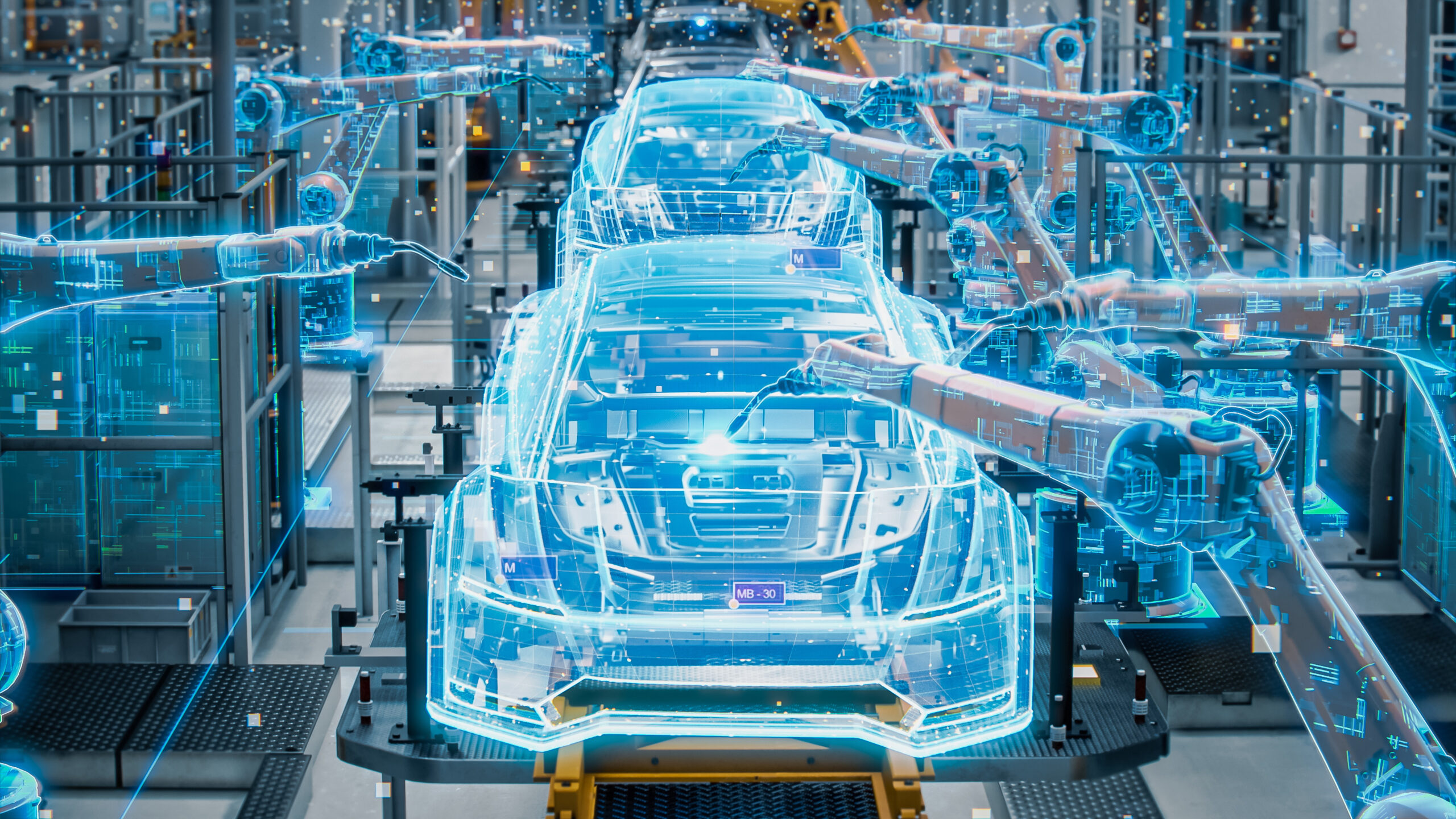
Artificial intelligence is no longer confined to powering voice assistants, autonomous driving features, or software inside modern vehicles. It is now transforming an equally important part of the automotive business: the factory floor.
Across North America, Europe, and Asia, automakers are investing billions of dollars in AI-driven manufacturing systems that promise to build vehicles faster, improve quality, reduce costs, and make production lines far more flexible than ever before.
The shift comes at a crucial time for the industry. Carmakers are simultaneously managing the transition to electric vehicles, increasingly complex software-defined cars, supply chain disruptions, and growing pressure to improve profitability.
Traditional assembly lines, while highly automated, were designed for predictable production cycles. Today’s factories must adapt quickly to changing consumer demand, multiple powertrain options, and rapid technological innovation.
Industry experts believe artificial intelligence will become the technology that ties these challenges together. Instead of relying solely on pre-programmed automation, manufacturers are deploying AI systems capable of analyzing millions of data points, learning from production patterns, and making real-time decisions that improve efficiency.
According to McKinsey, AI has the potential to create some of the largest productivity gains in manufacturing, particularly through predictive maintenance, automated quality inspection, and production optimization.
The consulting firm notes that advances in robotics and AI are shifting factories from fixed automation toward intelligent, adaptive manufacturing systems that continuously improve over time.
Also Read: 10 Best Project Cars For First-Time Modifiers
Automotive Manufacturing Is Entering a New Era
Industrial robots have been part of automotive factories for decades, performing repetitive jobs such as welding, painting, and lifting heavy components. The difference today is that those machines are becoming increasingly intelligent.
The International Federation of Robotics estimates that more than 4 million industrial robots are now operating in factories worldwide, reflecting the rapid expansion of automation across manufacturing industries.
Modern robotic systems combine advanced sensors, computer vision, machine learning, and cloud connectivity, allowing them to recognize defects, adjust to changing production conditions, and work more safely alongside human employees.
Rather than replacing every worker, AI is helping manufacturers automate routine decisions while enabling employees to focus on complex assembly work, engineering, maintenance, and process improvement.
Automakers Are Expanding AI Investments
Several global manufacturers have already begun integrating AI into daily production. Mercedes-Benz is among the most aggressive adopters. Reuters reported that the company has invested in Texas-based robotics developer Apptronik and is testing its Apollo humanoid robots at facilities in Berlin and Hungary.
Initially, the robots are handling repetitive jobs such as transporting components and assisting with quality inspections. Mercedes-Benz production chief Jörg Burzer said the company is targeting applications where labor shortages exist while reducing physically demanding work for employees.
BMW is following a similar strategy. The automaker has expanded testing of humanoid robots after successful pilot programs at its Spartanburg, South Carolina, facility. These machines are designed to perform repetitive manufacturing tasks while allowing employees to concentrate on higher-value operations.
Hyundai has taken a different approach by designing an entirely new factory around AI technology. Its $7.6 billion Hyundai Motor Group Metaplant America in Georgia was built with AI, robotics, autonomous logistics systems, and digital twin technology integrated from the beginning rather than added later.
According to company officials, every vehicle assembled at the plant passes through more than 20 AI-assisted or robotic manufacturing processes before leaving the production line.
Industry analysts told Business Insider that this approach could improve quality control while helping Hyundai respond more quickly to supply chain disruptions and changing market conditions.
Digital Twins Are Revolutionizing Production
One of the fastest-growing technologies inside modern automotive plants is the digital twin. A digital twin is a virtual replica of an entire factory or production line that receives live data from sensors installed throughout the facility.
Engineers can simulate production changes, equipment upgrades, or workflow adjustments inside the virtual environment before making physical modifications.
If a quality issue develops during production, AI can analyze historical manufacturing data, compare it with current operating conditions, and identify likely causes within minutes. Engineers can then test possible solutions digitally before implementing them on the assembly line.
General Motors has embraced this concept as part of its broader AI strategy. Speaking to Automotive Manufacturing Solutions, GM automation leader Dr. Miguel Saez explained that digital twins allow robotic systems to learn manufacturing tasks through virtual experimentation, dramatically reducing programming time while improving flexibility.
Instead of manually teaching robots every movement, engineers can use AI-powered simulations to develop new manufacturing skills before deployment.
AI Is Making Factories More Efficient
Beyond robotics, AI is changing how factories operate every day. Predictive maintenance has become one of the most valuable applications.
Sensors installed on production equipment continuously monitor vibration, temperature, pressure, and energy consumption. AI software analyzes this information to detect patterns that may indicate a machine is beginning to fail.
Instead of waiting for equipment to break unexpectedly, maintenance teams receive early warnings and can replace components during scheduled downtime.
McKinsey says predictive maintenance can significantly reduce unexpected production interruptions while lowering maintenance costs, allowing factories to operate more efficiently.
AI is also improving quality control. High-resolution cameras paired with machine-learning algorithms inspect welds, paint finishes, panel alignment, and electrical components far more consistently than traditional manual inspections.
Defects can be identified almost instantly, reducing waste and helping manufacturers improve vehicle quality before cars leave the factory.
AI Is Strengthening Supply Chains and Factory Logistics
Artificial intelligence is also transforming how automakers manage supply chains, an area that gained renewed attention after the pandemic exposed weaknesses in global production networks.
Modern AI platforms can analyze supplier performance, inventory levels, shipping schedules, weather conditions, and production demand in real time. When delays occur, the software can recommend alternative suppliers, adjust production schedules, or redistribute parts between plants to minimize disruptions.
Manufacturers are increasingly pairing these AI systems with autonomous mobile robots that transport components across factory floors and warehouses without human intervention.
According to the International Federation of Robotics, collaborative robots and autonomous logistics systems are among the fastest-growing segments of industrial automation, helping factories become more flexible and responsive to changing market conditions.
Humanoid Robots Are Moving Closer to the Assembly Line
While traditional robotic arms remain the backbone of vehicle production, several automakers are testing humanoid robots designed to work in spaces originally built for people.
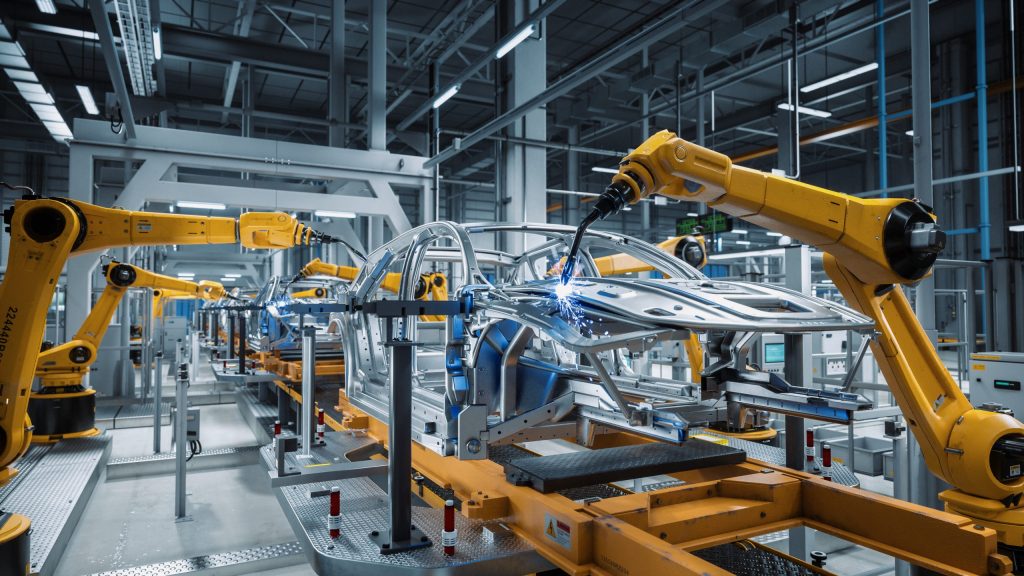
Mercedes-Benz and BMW have already launched pilot programs using human-shaped robots for repetitive tasks such as moving parts, handling materials, and assisting with inspections.
These robots are still in the early stages of deployment, but they offer a key advantage. Instead of redesigning factories around new equipment, manufacturers can introduce humanoid robots into existing production environments with minimal changes.
Reuters reported that Mercedes-Benz views these systems as a way to support employees and address labor shortages rather than replace workers entirely.
AI Will Change Jobs More Than It Eliminates Them
Concerns about automation replacing factory workers continue to surface, but most industry analysts expect AI to reshape manufacturing jobs instead of eliminating them. As repetitive tasks become automated, demand is expected to grow for robotics technicians, software engineers, AI specialists, maintenance experts, and data analysts.
Hyundai has stated that its AI-powered Metaplant America will employ thousands of workers while creating new technology-focused roles to support advanced manufacturing systems.
Similar investments by BMW, Mercedes-Benz, and General Motors reflect an industry-wide shift toward combining human expertise with intelligent automation rather than relying on either alone.
The Future of Car Manufacturing Is Becoming Smarter
Artificial intelligence is rapidly evolving from a productivity tool into a core part of automotive manufacturing strategy.
From predictive maintenance and digital twins to autonomous logistics and AI-driven quality control, these technologies are helping automakers build vehicles more efficiently while adapting to increasingly complex production demands.
Although challenges remain, including high implementation costs, cybersecurity concerns, and the need for workforce training, the direction of the industry is becoming clear.
Companies that successfully integrate AI and robotics into their manufacturing operations will be better positioned to improve quality, reduce costs, and respond quickly to future market changes.
As investments continue across the global automotive sector, the factory of tomorrow is taking shape today.
Rather than replacing human workers, AI is creating smarter production systems where people, robotics, and intelligent software work together to build the next generation of vehicles with greater speed, precision, and flexibility.
Also Read: 10 Charging Mistakes That Shorten An EV Battery’s Life
