
U.S. automakers are facing another major disruption to their North American manufacturing strategies as Washington and Ottawa negotiate changes to automotive trade rules that could reshape how vehicles and components move between the two countries.
The discussions come as the United States considers reducing its 25% tariff on Canadian-built vehicles to 15%, but the proposed relief would come with stricter requirements governing how much of a vehicle’s value must come from the United States or North America.
For automakers that have spent decades building highly integrated supply chains across the United States, Canada, and Mexico, the changes could create billions of dollars in additional costs.
According to Reuters, at least two Detroit automakers estimate that proposed changes to North American content requirements could add approximately $2 billion in annual costs for each company. The potential expense would come on top of billions already being absorbed from existing tariffs on vehicles, parts, steel, and aluminum.
The negotiations are therefore becoming much more than a discussion about tariff rates. They could influence where automakers build vehicles, where suppliers establish factories, and how future North American vehicle programs are engineered.
Why Canada Matters So Much to U.S. Automakers
The automotive industries of the United States and Canada are deeply connected. Vehicles assembled in Canada frequently use components manufactured in the United States, while American factories depend on Canadian suppliers for engines, transmissions, castings, and other parts.
That integration developed over decades because manufacturers could locate production wherever it was most efficient while moving components across the border with relatively few barriers.
The proposed rules could challenge that model. Reuters reported that U.S. negotiators are seeking a system under which the tariff on Canadian vehicles could fall from 25% to 15%, but the reduction would be linked to the amount of U.S. content in those vehicles.
Washington wants only U.S.-specific content to count toward the tariff deduction, while Canada wants the calculation to recognize content from across North America, including parts manufactured in Mexico.
That difference may sound technical, but it has major consequences for automakers. Consider a vehicle assembled in Ontario using a combination of American, Canadian, and Mexican components.
Under Canada’s preferred approach, all three sources would contribute toward the North American content calculation. Under the U.S. position, Mexican and Canadian components would not necessarily provide the same benefit when determining the reduced tariff.
Automakers would consequently have an incentive to source more components from American suppliers. That could mean new U.S. factories, additional investments, and more domestic jobs. It could also mean higher production costs.
The auto industry has already warned that the proposed changes could add billions of dollars to annual expenses. Reuters reported that GM expects gross tariff-related expenses of $2.5 billion to $3.5 billion in 2026, while Ford has estimated its net tariff impact at roughly $1 billion.
Adding another layer of supply-chain costs could make the economics of North American vehicle production considerably more difficult.
Automakers Could Be Forced to Restructure Supply Chains
The biggest challenge is that automakers cannot simply change suppliers overnight. A modern vehicle contains thousands of parts, and many suppliers have long-term contracts with manufacturers.

Moving production from Canada or Mexico into the United States could require new factories, additional tooling, transportation changes, and years of planning. That is particularly important for vehicles already in production.
An automaker might technically be able to source a component from a U.S. supplier, but if that supplier lacks sufficient capacity, the company could need to finance an expansion or find another supplier entirely. In some cases, the change could require redesigning components to accommodate a different manufacturing process.
The pressure is even greater for newer technologies. Electric vehicles rely heavily on batteries, electric motors, power electronics, and other components that are increasingly being produced through international supply chains.
Changing regional-content requirements could therefore influence where automakers build future battery plants and source critical materials. The potential consequences extend to vehicle pricing as well.
If manufacturers cannot absorb higher costs, some expenses could eventually reach consumers through higher transaction prices. That would add pressure to a U.S. auto market where affordability has already become a significant issue.
There is also a competitive concern. Reuters reported that Detroit automakers have argued that Japanese, South Korean, and European manufacturers can face a lower tariff burden when exporting vehicles into the United States.
The American Automotive Policy Council, representing Ford, GM, and Stellantis, has previously argued that this creates an uneven competitive environment.
Detroit manufacturers therefore want stronger domestic production incentives without creating a system that makes their vehicles substantially more expensive than those produced by international competitors.
The administration, meanwhile, has argued that stronger domestic-content requirements are intended to encourage manufacturers to invest more heavily in American factories and create U.S. jobs.
Both sides therefore have an incentive to strengthen North American manufacturing, but they disagree about how quickly and at what cost that transition should occur.
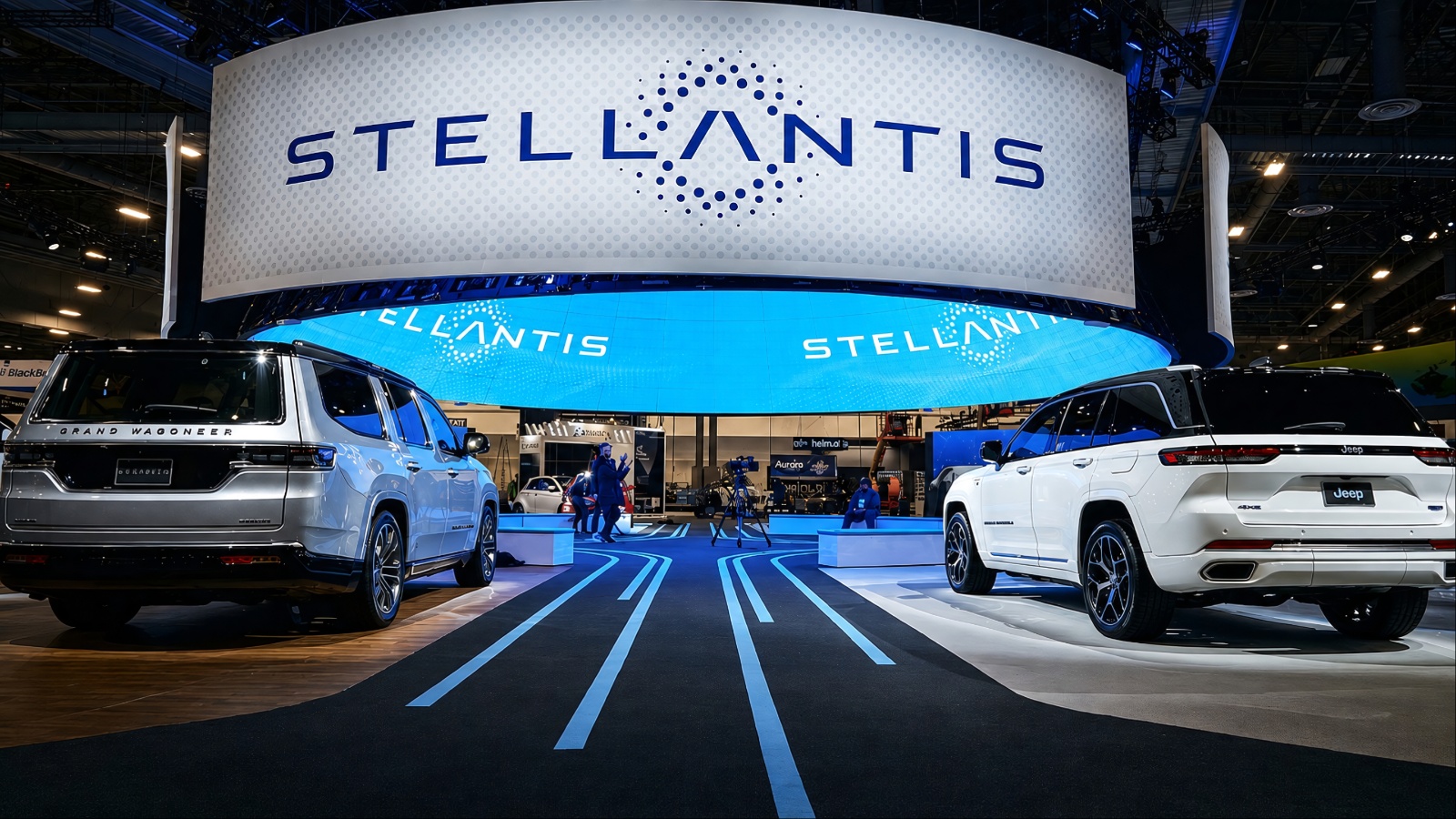
Stellantis’ Brampton Plant Highlights the Stakes
Few examples illustrate the uncertainty better than Stellantis’ Brampton, Ontario, assembly plant.
The factory has been closed for retooling since 2024, but its future became increasingly uncertain after Stellantis moved planned production of the Jeep Compass to Illinois.
Reuters reported that the company is considering a possible sale of the Brampton facility, based on information provided by the Canadian auto workers’ union Unifor. Stellantis has not issued a formal closure announcement and has said it is exploring sustainable options for the site.
The plant’s situation is directly connected to the broader trade environment. Brampton once represented an important part of Stellantis’ Canadian manufacturing footprint. The decision to shift future Compass production to Illinois demonstrated how tariffs and trade uncertainty can influence factory decisions.
According to Reuters, Unifor said Stellantis had informed the union that it intended to discuss a potential sale of the facility with another company. The union has criticized the situation and is preparing to negotiate with Stellantis as its current labor agreement approaches expiration.
The plant’s future is particularly significant because approximately 2,200 jobs are associated with the facility.
The uncertainty does not mean Stellantis has decided to abandon the site. The company has declined to confirm a sale and has described its approach as exploring options that could create a sustainable future for Brampton.
Nevertheless, the situation demonstrates how quickly trade policy can affect industrial planning.
An assembly plant can remain economically viable under one tariff structure and become much more difficult to justify under another. Automakers must also consider whether investing hundreds of millions or billions of dollars in retooling makes sense when trade rules can change during the vehicle’s expected production life.
The Final Rules Could Reshape North American Manufacturing
The current negotiations are taking place alongside broader discussions over the future of the United States-Mexico-Canada Agreement, or USMCA.
Reuters reported that the United States and Canada are separately negotiating potential auto-tariff relief, while broader North American trade discussions are also underway. The immediate negotiations could reduce the Canadian vehicle tariff to 15%, but disagreements remain over how content deductions would be calculated.
That means automakers still do not know exactly what the final system will look like. For manufacturers, uncertainty itself is a problem.
Companies planning factories and vehicle programs need to make decisions years ahead. A manufacturer deciding today where to build a new vehicle expected to launch in 2029 or 2030 needs confidence that the trade rules will remain reasonably stable.
If the final agreement rewards U.S. content heavily, manufacturers could respond by increasing American production. That could benefit domestic suppliers and workers while reducing dependence on foreign components.
But the transition would be expensive. Ford has already shown how companies are responding to the administration’s push for more U.S. production. Reuters reported that the automaker plans to shift production of certain Lincoln vehicles for the American market from China to U.S. factories because of high tariffs on Chinese imports.
CEO Jim Farley said the company recognized that it needed to make changes to its manufacturing strategy. A similar process could occur with Canadian production.
Some vehicles could be shifted into U.S. factories. Some suppliers could move production south of the border. Others could invest in new American plants to preserve access to the U.S. market.
But not every vehicle program can be relocated economically. That is why the outcome of the negotiations will matter so much.
A tariff reduction to 15% could provide immediate relief for Canadian-built vehicles, but stricter content rules could offset some of that benefit if automakers must dramatically increase the percentage of U.S.-made components.
For consumers, the ultimate question is how much of the cost reaches vehicle prices. For workers, it is whether the rules create new American manufacturing opportunities without causing Canadian or Mexican plants to lose production.

For automakers, the challenge is maintaining a supply chain that remains competitive while complying with a rapidly changing trade framework.
The potential sale of Stellantis’ Brampton plant shows that these decisions are already affecting real factories and workers, even before a final agreement has been reached.
The coming negotiations could therefore become a turning point for North America’s auto industry.
If Washington succeeds in pushing significantly higher U.S.-content requirements, manufacturers may accelerate investments in American factories and suppliers. If the rules become too expensive, however, companies could face higher vehicle costs and reduced flexibility.
Either way, the traditional North American auto-production model is being tested. The final agreement will determine whether the region’s tightly integrated supply chain evolves gradually or undergoes a much more dramatic restructuring.
