
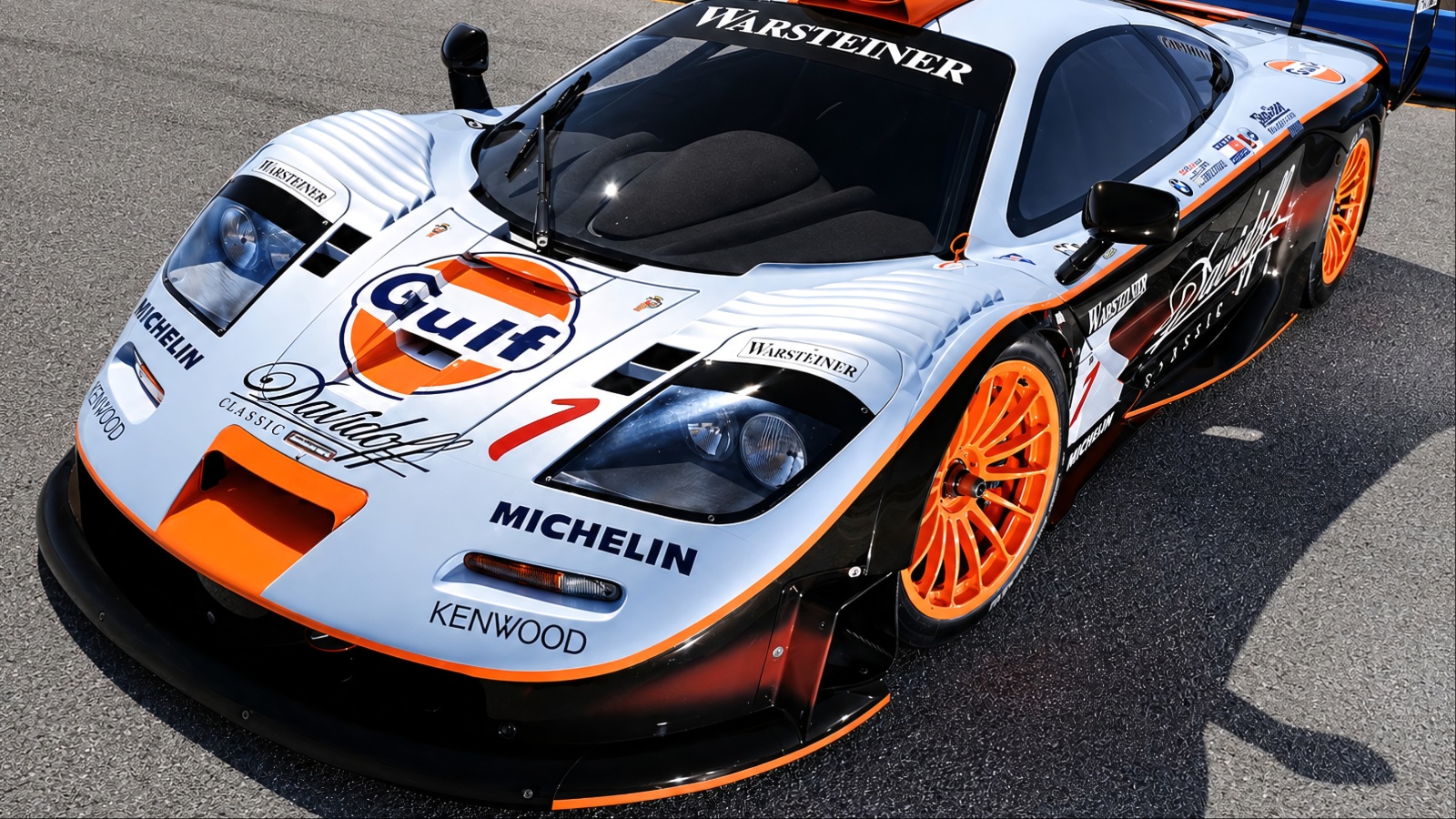
A legendary McLaren F1 GTR has set a new benchmark for British collector cars after selling for $34.655 million at RM Sotheby’s Monterey auction, making it the most expensive British-built car ever sold at public auction.
The car is chassis 10R, a 1996 McLaren F1 GTR known as the “Pop Art F1.” It is one of the rarest and most historically significant examples of McLaren’s famous racing-derived supercar.
According to RM Sotheby’s, 10R is the first F1 GTR built to the highly developed 1996 specification, one of only two short-tail factory XP prototypes and the only F1 GTR to wear its distinctive factory-created scarlet-and-yellow livery.
The result was particularly remarkable because this was not a pristine museum piece that had spent its entire life untouched. The car was involved in incidents during its history, including a crash involving Pink Floyd drummer Nick Mason, who owned it for 25 years. Yet those events did little to diminish its value.
Instead, its extraordinary provenance, rarity, factory history, racing significance, and connection to one of Britain’s most famous musicians helped turn it into one of the most desirable McLaren F1S in existence.
Why Chassis 10R Is So Special
The McLaren F1 GTR already occupies a unique position in automotive history. The original McLaren F1 was conceived as a road-going supercar, but its performance potential eventually led McLaren to develop a racing version for the BPR Global GT Series.
The resulting F1 GTR transformed the already extraordinary road car into a serious competition machine.
Its greatest achievement came at the 1995 24 Hours of Le Mans, where McLaren’s F1 GTR won outright on its competitive debut. The victory became one of the most important moments in the company’s history and helped establish the F1 as one of the greatest performance cars ever produced.
The 1996 version became even more developed. According to RM Sotheby’s, only nine McLaren F1 GTRs were built to 1996 specification, making them exceptionally rare even within the tiny F1 GTR population.
Chassis 10R was the first of those nine cars. It was retained by McLaren as a factory development and promotional vehicle rather than immediately being sold to a racing customer. That factory connection is one of the biggest reasons for its value.
McLaren used the 10R for testing and development, including preparation for the 1996 24 Hours of Le Mans. It was driven during testing by McLaren factory drivers and appeared at motorsport events wearing the distinctive red-and-yellow graphics that eventually became inseparable from its identity.
RM Sotheby’s describes the 1996 GTR as the fastest version of the F1 GTR, benefiting from substantial development compared with the 1995 car.
The bodywork was revised to generate additional downforce, while the gearbox received a lightweight magnesium housing and stronger internal components. The changes also reduced weight by approximately 38 kilograms compared with the earlier version.
Chassis 10R therefore represents a particularly important point in the evolution of the F1 GTR. It was not simply another example of a rare race car. It was the factory’s first 1996-specification prototype and remained closely connected to McLaren during the development of the updated racing machine.
That history would already have made it extraordinarily valuable. Then came its unusual ownership story.
From McLaren Factory to Nick Mason’s Collection
After its factory career, chassis 10R was converted for road use by McLaren. In 1999, the car was acquired directly from McLaren by Nick Mason, the drummer and co-founder of Pink Floyd and one of the world’s best-known car collectors.
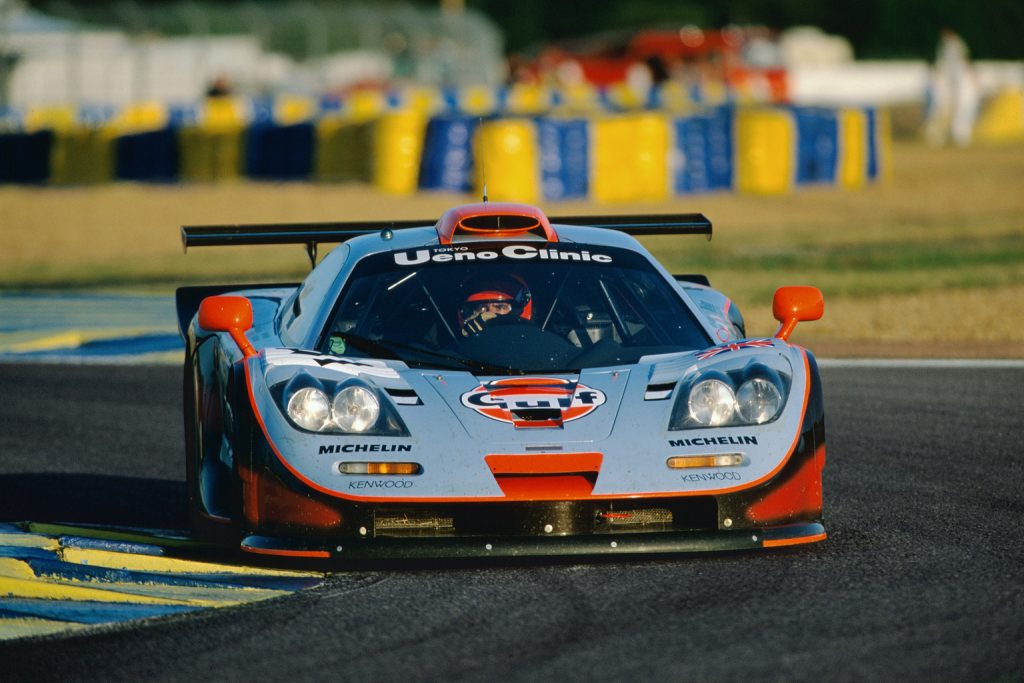
Mason’s ownership added another extraordinary layer to the car’s provenance. Rather than simply placing the F1 GTR in storage, Mason continued to use it at events and driving gatherings. The car remained in his collection for approximately 25 years, while specialist McLaren experts maintained it.
According to RM Sotheby’s, 10R was maintained by Paul and Dean Lanzante during Mason’s ownership. Lanzante’s involvement is particularly significant because the company has extensive experience with McLaren F1S and their racing derivatives.
The car was also involved in incidents during that period. In 2014, Mason took the F1 GTR on the Club’s Tour of Tuscany, a 750-kilometer road rally through Italy. Three years later, he famously crashed 10R during a demonstration at the Goodwood Members’ Meeting, where the car left the track and struck a tire barrier.
The incident could have been devastating for a car of such rarity, but chassis 10R was subsequently restored by Dean Lanzante. RM Sotheby’s says the car underwent another major restoration following the Goodwood incident.
That history is unusual for a collector car worth tens of millions of dollars. Many ultra-expensive vehicles achieve their value partly because they have remained virtually untouched. Chassis 10R followed a different path.
It was used by McLaren, driven by factory personnel, converted for road use, driven by Mason, and eventually damaged and restored. Yet the car’s authenticity and history remained intact.
In fact, those experiences arguably strengthened its story. A McLaren F1 GTR that had spent decades hidden in a private collection would have been valuable. A factory prototype that was actually driven, developed, displayed, and enjoyed by one of the world’s most famous car collectors has a different kind of appeal.
Its scarlet-and-yellow “Pop Art” appearance also makes it instantly recognizable. RM Sotheby’s notes that the livery was created as a factory design rather than a private racing team’s sponsorship scheme. Gordon Murray was involved in the concept, with the bold graphics deliberately intended to make the car visually distinctive.
That combination of engineering, art, motorsport, and celebrity ownership is almost impossible to reproduce.
A Record-Breaking Auction Result
The $34.655 million sale at RM Sotheby’s Monterey auction confirms just how highly collectors value the most significant McLaren F1S.
The result made chassis 10R the most expensive McLaren ever sold at public auction and the most expensive British-built car ever sold at auction, according to RM Sotheby’s.
The car had been estimated at more than $35 million before the sale, meaning the final result came remarkably close to the auction house’s expectation.
It also shows how strongly the collector market continues to respond to genuinely irreplaceable cars.
There are plenty of expensive supercars available to wealthy buyers. But there are only a tiny number of McLaren F1 GTRs, and even fewer with factory prototype status, major racing history, unique factory livery, and long-term ownership by a globally recognized collector.
That distinction matters. The value of a car such as the 10R cannot be calculated simply from its horsepower, weight, or performance. Its worth comes from the story attached to the chassis.
The F1 GTR’s connection to Le Mans is particularly important. McLaren’s 1995 victory was extraordinary because the F1 GTR was derived from a road car rather than being developed from the beginning as a dedicated prototype racer.
RM Sotheby’s describes the F1 GTR as the last outright Le Mans-winning race car developed directly from a GT hypercar, making it a particularly important link between road-car engineering and endurance racing.
Chassis 10R did not win Le Mans itself, but it belongs to the same engineering lineage and was used in the development of the later GTR specification.
It also has a connection to McLaren’s own factory program, making it far more significant than an ordinary privateer race car.
The sale comes during a particularly strong Monterey Car Week for the collector market. RM Sotheby’s described its Monterey auction as one of the world’s most important venues for significant collector automobiles, and the 2026 event produced several extraordinary results.
For McLaren, the $34.655 million result provides another demonstration of the extraordinary position occupied by the F1 within the collector market.
The original road-going McLaren F1 is already considered one of the defining supercars of the 1990s. Its central driving position, naturally aspirated BMW V-12, lightweight construction, and limited production made it a technological landmark.
The GTR pushed that concept into motorsport. Chassis 10R represents one of the most advanced stages of that transformation.
Its sale also demonstrates that a car does not need to be untouched to command an extraordinary price. What matters is whether the vehicle retains its authenticity and whether its history adds something meaningful to its identity.
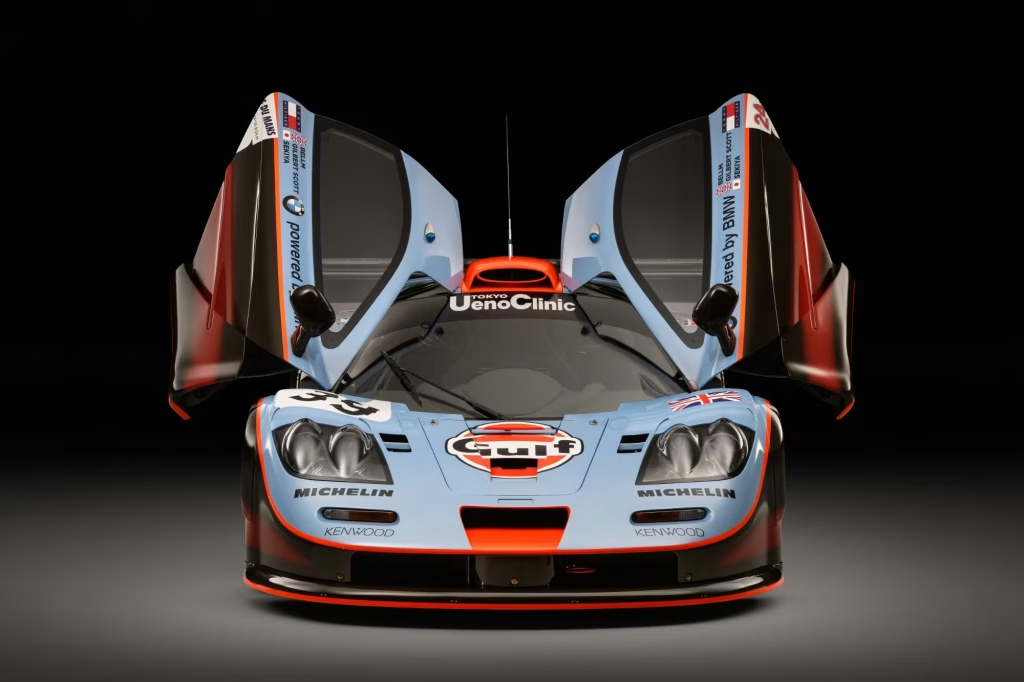
In 10R’s case, the crashes became part of the story rather than destroying the car’s collectability.
The car’s new owner now possesses something that cannot realistically be duplicated: the first 1996-specification McLaren F1 GTR, one of only two short-tail factory XP prototypes; the only F1 GTR with its unique factory pop-art livery; a former McLaren development car; and a vehicle that spent a quarter-century with Nick Mason.
That is why the $34.6 million figure is more than simply an enormous price tag. It reflects the convergence of motorsport history, engineering significance, rarity, celebrity ownership, and cultural identity.
The McLaren F1 GTR was already one of the most important British racing cars ever produced. Chassis 10R now has another distinction to add to its remarkable résumé: it is the most expensive British-built car ever sold at public auction.
And perhaps most fittingly, it achieved that status not by being preserved as a static artifact, but by carrying decades of stories with it.
