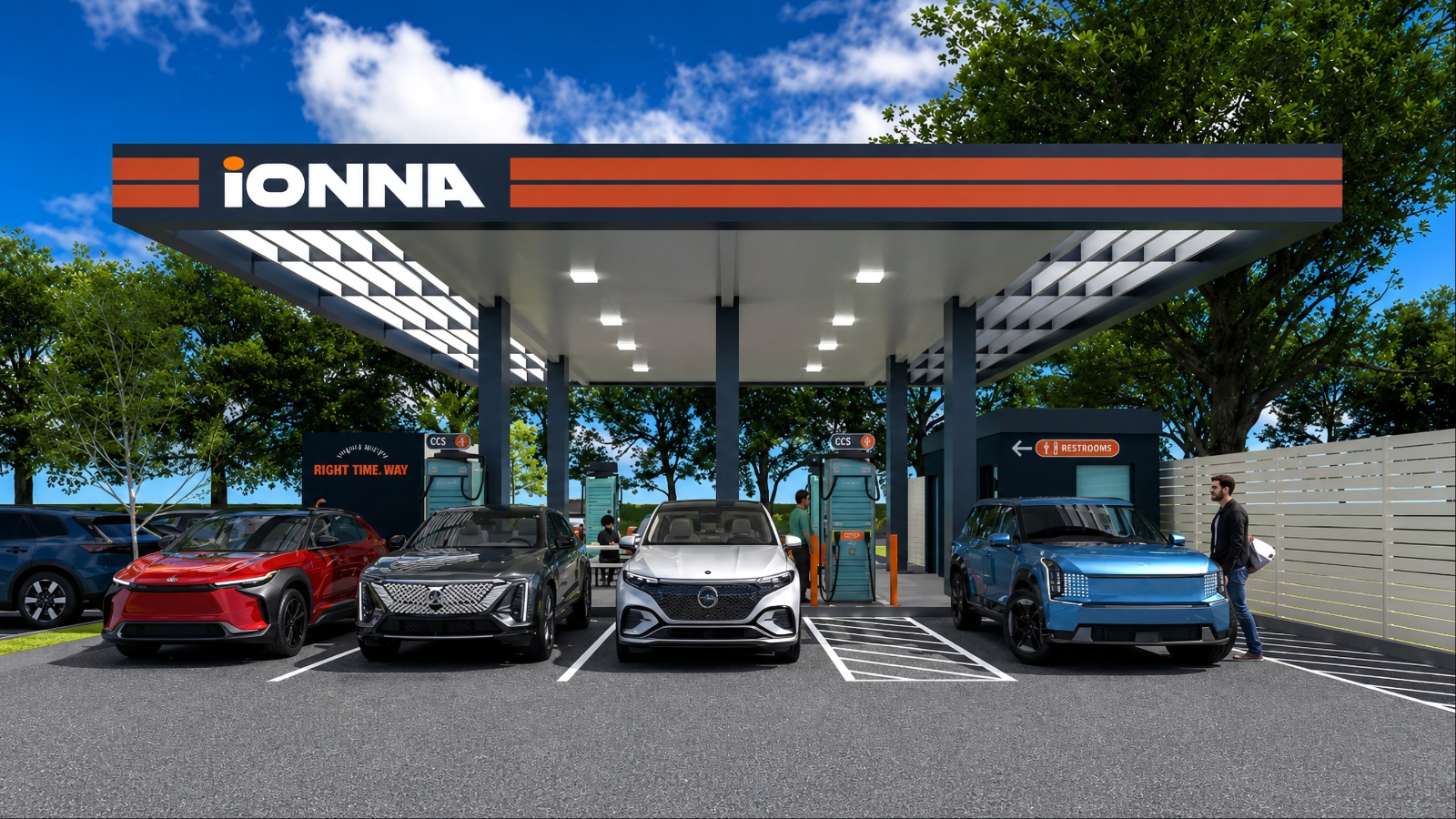
IONNA, the electric-vehicle charging network backed by eight major automakers, has emerged as the highest-ranked DC fast-charging network in the latest U.S. public charging study, surpassing Tesla’s Supercharger network on key measures of customer satisfaction.
The result is significant because Tesla’s Supercharger network has spent years establishing itself as the benchmark for public EV charging in the United States. Tesla’s charging infrastructure was one of the company’s biggest advantages, particularly because of its broad coverage, straightforward payment system, and generally strong reliability.
But the latest data suggests that the competitive landscape is changing. According to WardsAuto, IONNA ranked ahead of Tesla in the latest study, benefiting from newer charging equipment, strategically designed locations, and a focus on making the charging process easier for drivers.
The findings come from the 2026 J.D. Power U.S. Electric Vehicle Experience Public Charging Study, which evaluates public charging experiences across the United States. The study found that the overall reliability of DC fast charging has improved significantly, while newer automaker-backed networks are setting a higher standard for the customer experience.
For IONNA, the result provides an important early validation of its strategy. The network is still relatively new compared with Tesla’s extensive Supercharger operation, yet it has already achieved the highest satisfaction score among the eligible DC fast-charging networks measured in the study.
IONNA Takes the Top Spot
IONNA’s rise is particularly notable because the network is a joint venture created by BMW, General Motors, Honda, Hyundai, Kia, Mercedes-Benz, Stellantis, and Toyota.
Those automakers came together because public charging has remained one of the biggest challenges facing EV adoption. While manufacturers have become increasingly comfortable producing electric vehicles, they have had less control over the public charging experience their customers encounter during road trips.
IONNA was created to address that problem by developing a large network of high-powered charging locations across North America. The latest J.D. Power study gives the network a strong early result.
IONNA ranked first among DC fast-charging networks with a score of 807 points on a 1,000-point scale, according to the study. The Mercedes-Benz Charging Network followed with 797 points, while the Rivian Adventure Network ranked third at 755.
Tesla’s Supercharger network did not take the top position in this year’s ranking, marking an important change in the public charging landscape.
WardsAuto reported that IONNA’s advantage comes from several characteristics that EV owners increasingly prioritize, including charging reliability, convenience, and location quality.
The result should not be interpreted as meaning Tesla’s network has suddenly become unreliable. Tesla still operates one of the largest and most established fast-charging networks in the country, and access to Superchargers has expanded considerably as more automakers have adopted Tesla’s North American Charging Standard connector.
Instead, the study shows that newer networks are beginning to close the gap and, in some areas, exceed the experience provided by older infrastructure.
That could become increasingly important as more EV drivers gain access to multiple charging networks.
Newer Chargers Are Changing the Experience
One of the biggest findings from the J.D. Power research is that the public charging experience itself is improving.
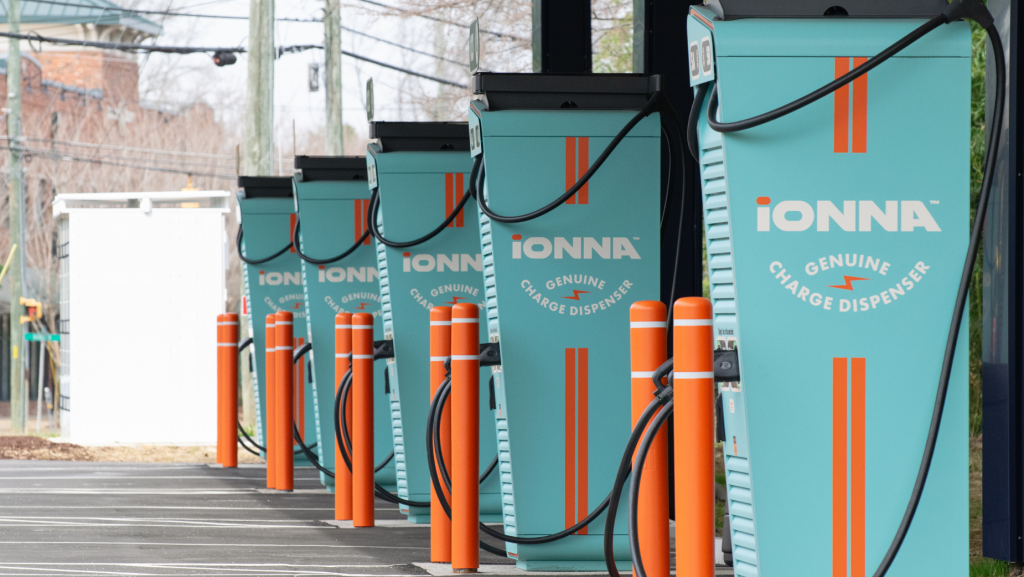
Satisfaction with DC fast chargers increased 12 points to 666 in the latest study, with improvements across all 10 factors measured by J.D. Power. Charger availability improved by 27 points, while satisfaction with safety and charging cost each increased by 18 points.
The study also found that the rate of non-charge visits, when an EV driver arrives at a station but cannot successfully charge, fell to 12%, the lowest level recorded in the history of the study. That compares with 14% during the same period a year earlier.
That is an important development for the EV industry. A driver can tolerate a slightly longer charging session if the charger works reliably. The more frustrating scenario is arriving with a low battery only to discover that the station is offline, the payment system does not work, or the charger cannot establish a connection with the vehicle.
Reliability therefore has a direct impact on consumer confidence. The newer automaker-backed networks appear to be benefiting from starting with modern equipment rather than having to maintain large fleets of aging chargers.
J.D. Power specifically noted that the three newer OEM-backed networks included in the study performed strongly in areas such as ease of charging, charging speed, and charger availability. In some areas, their advantages over the segment average exceeded 100 index points.
IONNA’s approach also emphasizes charging locations that can make the experience more convenient.
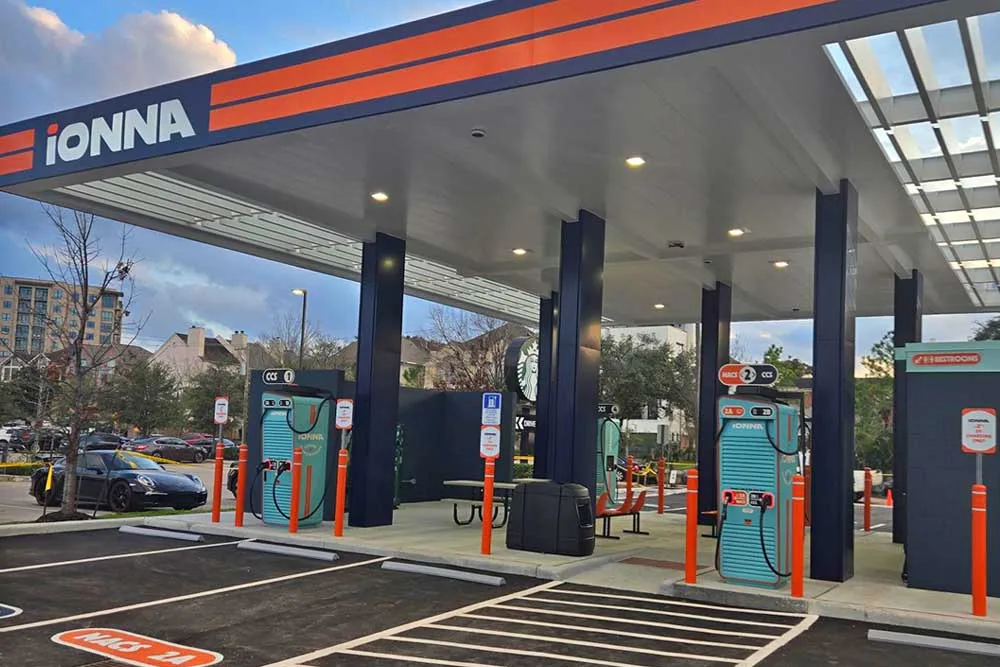
The network has been developing larger charging sites, known as Rechargeries, designed around the idea that drivers should have more than just a row of charging stalls. The first IONNA Rechargery is being developed in Apex, North Carolina, and the company plans to expand its network across the United States.
That location strategy matters because charging is becoming less about simply providing electricity and more about reducing the inconvenience associated with waiting.
J.D. Power found that satisfaction was highest for DC fast chargers located at hotels, gas stations, convenience stores, and restaurants, while dealership and standalone parking-lot locations scored lower.
This suggests that drivers value being able to eat, shop, use restrooms, or take a break while their vehicles charge.
The implication for IONNA and its competitors is straightforward: the best charging network may not simply be the one with the most plugs. It may be the network that combines reliable hardware with locations that make charging easier to fit into a normal trip.
Tesla Still Has a Major Advantage
Despite IONNA’s strong result, Tesla’s position in the U.S. charging market should not be underestimated.
The Supercharger network has been operating at scale for years and has become a major part of Tesla’s ownership experience. The company built its charging infrastructure alongside its vehicles, allowing it to develop a tightly integrated system for navigation, payment, and charging.
Tesla also has a huge geographic footprint. That scale remains one of the network’s biggest advantages, particularly for drivers traveling long distances through less densely populated areas.
Tesla’s other advantage is that its charging connector has effectively become an industry standard in North America.
A growing number of automakers have adopted Tesla’s North American Charging Standard, commonly known as NACS, for their electric vehicles. Many existing EVs that originally used CCS can also access Superchargers through approved adapters.
That means Tesla’s network is no longer primarily a Tesla-only resource. Ford, General Motors, Hyundai, Kia, Mercedes-Benz, and other manufacturers have been expanding access to Tesla’s charging infrastructure, giving millions of additional EV drivers the ability to use Superchargers.
That makes IONNA’s ranking particularly interesting. The network is not competing against a weak or isolated charging system. It is attempting to differentiate itself against an established infrastructure network that has become accessible to a much broader portion of the EV market.
The latest results suggest that IONNA does not necessarily need to match Tesla charger-for-charger to compete effectively. Instead, it can focus on quality.
For automakers, that could be a significant advantage. IONNA was created specifically because manufacturers recognized that charging infrastructure affects the ownership experience of their EVs.
If customers can consistently find functioning, fast, and convenient chargers, concerns about road-trip reliability become less significant.
That could also help automakers sell EVs to customers who remain hesitant about charging away from home.
The timing is important because public charging has become a more visible issue as EV adoption has expanded.
The J.D. Power study found that overall charging satisfaction is improving, but the continued emphasis on charger availability and reliability shows that the industry still has work to do.
IONNA’s early performance could encourage other automakers and charging companies to adopt a similar approach.
The network is also entering a market where charging infrastructure is becoming increasingly competitive. Mercedes-Benz has developed its own charging network, Rivian continues expanding its Adventure Network, and established charging companies such as EVgo and ChargePoint remain important parts of the U.S. ecosystem.
The result is a shift away from the idea that one charging network will dominate every aspect of the market.
Instead, EV owners may increasingly choose between multiple high-quality networks depending on location, pricing, vehicle compatibility, and convenience.
For Tesla, that means the Supercharger network’s historic advantage can no longer be taken for granted.
For IONNA, meanwhile, the first-place ranking provides an important opportunity to establish its reputation while the network is still expanding.
The biggest challenge will be maintaining that performance as the number of chargers and users increases. A network can perform exceptionally well when its infrastructure is new, but reliability must remain high as utilization grows and equipment ages.
That will ultimately determine whether IONNA’s current advantage becomes a lasting competitive strength.
For the broader EV industry, however, the latest study is encouraging. Public charging is becoming more reliable, non-charge visits are declining, and newer networks are raising expectations for what the charging experience should look like.
IONNA’s first-place ranking is therefore more than a victory for one charging network. It shows that Tesla’s Supercharger system is no longer the only benchmark for a dependable public charging experience.
The competition is becoming much more serious, and that could benefit EV drivers most of all. As automakers and charging companies compete to build faster, more reliable, and more convenient networks, the public charging experience could become one of the areas where EV ownership improves most rapidly.
IONNA may still be far smaller and newer than Tesla’s Supercharger network, but its performance in the latest study sends a clear message: the next generation of U.S. charging infrastructure is arriving, and Tesla no longer has the field to itself.